

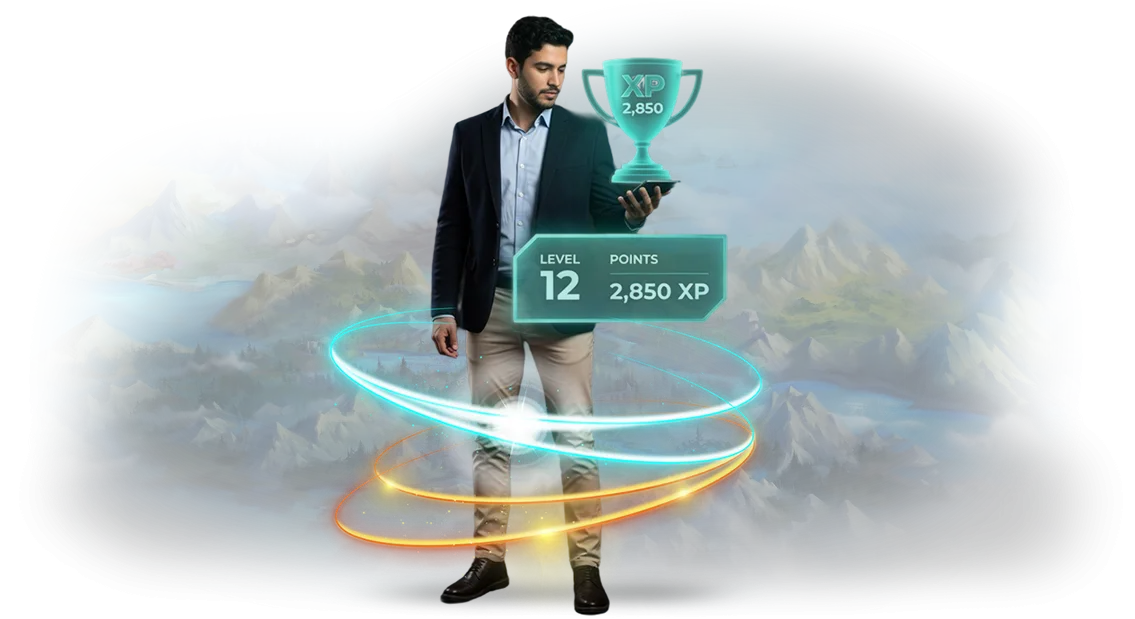
Retaining Travel Agencies and Operators: How Gamification Solves the Problem
Demand for travel services is unstable: seasonal downturns, client outflow to competitors, and a declining average order value are familiar to every owner of travel agencies and operators.
Classic incentive methods — discounts and promotions — yield less and less because they do not create emotional attachment with clients.
The tourist chooses by price and leaves as quickly as they came, and the business keeps spending its budget on attracting new people instead of working with the existing base.
The other side of the problem is the team. Managers without a clear motivation system do not see their own contribution to the overall result: interest in work drops, initiative disappears, and sales of additional services and tours shrink.
As a result, revenue goes down, and client loyalty does not grow — the service remains “like everyone else’s,” and retaining the tourist becomes harder.
Gamification of business processes solves both tasks at once. Inside the company, game mechanics turn routine into competition: manager ratings, ranks, team challenges, and rewards for meeting the plan.
This directly affects employee motivation — everyone understands what they earn points for and how to improve their results.
For tourists, a new-format loyalty program is created: traveler levels, personal tasks, and privileges that encourage them to return to you and recommend the agency to friends.
We help travel agencies and operators close this need turnkey: we analyze your business processes, design game mechanics around your company’s goals, and implement them so they work to increase sales.
As a result, you get a stable flow of inquiries regardless of the season, growth in repeat requests, and a team invested in the outcome.
What Gamification Gives Your Business
Routine sales metrics and reports kill any manager’s motivation. Gamification turns work into an engaging competition where every employee sees their progress and strives for leadership.
This is especially important for the travel business: the client’s emotions depend on the manager’s mood — and therefore on their engagement.
When an employee eagerly meets the plan, service quality and the average order value rise. They offer additional services, book more expensive tours, and create a sense of care for the client.
The company benefits in three areas at once: higher turnover, more repeat sales, and stronger brand loyalty. That is how gamification increases overall business efficiency.
On the technical side, we use proven game modules that integrate with your CRM and do not require restructuring how managers work. And our implementation experience at our team allows us to launch the system in two weeks and quickly get a measurable result. All mechanics are configured around your rules — from a simple rating to team quests.
As a result, your agency gains a competitive advantage: the team works with enthusiasm, clients feel the difference, and profit grows without additional advertising spend.
While others squeeze employees with plans and fines, you create an atmosphere of healthy excitement that brings money in any season.
Gamification Formats for Your Company’s Goals
In travel retail, manager motivation decides everything: seasonal spikes give way to quiet periods, and standard sales plans quickly become routine.
Gamification turns goal achievement into an engaging process — employees see their progress, compete with each other, and receive recognition for results. But it is important to choose a format that fits your company’s specifics: team size, sales channels, and product type.
We develop game systems tailored to travel agencies and operators. Here are the main formats our clients choose.
| Format | For whom | What it gives the business |
|---|---|---|
| Leaderboards and staff ratings | Sales departments, travel managers | Sales growth, transparent competition, clear success criteria |
| Quests for employees | Launching new tours, training newcomers | Fast product immersion, engagement, teamwork |
| Game mechanics with points and levels | Working with regular clients, long deals | Motivation maintenance, loyalty growth, repeat sales |
| Tournaments between teams or branches | Agency networks, distributed offices | Interdepartmental competition, experience sharing, uniform work standards |
| Simulators and role-playing games | Complex products, sales training | Objection handling, manager confidence, higher conversion |
When choosing a format, we consider team size, seasonality, and goals for the year. We often combine several mechanics — for example, launching a general rating and adding quests to the start of a hot destination.
As a result, you get a tool that works toward a measurable outcome: revenue growth, plan fulfillment, and increased employee engagement.
How the Game System Is Implemented
Implementing a game system is a clear process that does not distract the team from their main tasks. We follow a transparent plan: every stage is agreed upon, you see intermediate results, and the launch is not a surprise.
- Brief and immersion. We examine how sales and motivation are structured in your agency and which metrics matter. We record goals: sales growth, manager engagement, or plan fulfillment.
- Plan and prototype. We show what the competition and rating system will look like: roles, rewards, scenarios. You approve the mechanics before development starts — this eliminates unexpected revisions.
- Integration with your accounting system. We connect ratings to your CRM or accounting program without stopping operations. Sales and inquiry data are pulled automatically — managers do not have to fill in anything manually.
- Configuring rules and roles. We set up points, levels, and competition periods. We account for the specifics of travel agencies: seasonality, destinations, and team or individual standings.
- Team training. We run a short workshop: how to see the rating, what participation gives, and how competitions affect results. We explain the benefits so employees see gamification as support, not control.
- Launch and support. We launch the system and accompany the first competitions, collecting feedback. After launch, we stay in touch: we adjust rules, help with new seasons, and develop mechanics further.
In the end, you get a working motivation tool embedded in everyday processes. The result is higher sales and engagement without additional burden on managers.
What Is Included in the Gamification System Package
You receive not just code but a ready-made tool that immediately fits into your managers’ workflow. No extra development required: configuration, instructions, and support are already included in the package.
Game system analytics are your sales mirror. See which employees are leading, where clients are being lost, and which mechanics actually drive bookings.
- Individual settings — game rules, scenarios, and your agency’s branding, a motivation system tailored to your structure.
- Detailed instructions — simple guides for administrators and managers: how to manage the rating, assign tasks, and work with points and prizes.
- Rating management panel — a clear leaderboard, employee distribution by level, and each person’s progress.
- Game system analytics — activity breakdown by team, client conversion, and booking dynamics after launch.
- Manager reports — weekly and monthly summaries without manual exports: each employee’s contribution, seasonality, and growth areas.
- Technical support — advice on setup and scenarios, quick resolution of any issues at startup and during operation.
All of this is included in the project cost — no hidden fees or “we’ll send it later.” You launch gamification and see results in the first week: increased activity, clear statistics, and an engaged team.
Case Study: Sales Growth After Gamification
We faced a common challenge for travel agencies: increase sales without increasing the advertising budget. Managers worked on autopilot — they responded to inquiries and consulted, but showed no initiative in upsells: insurance, hotels, excursions. This alone was costing the agency up to a third of potential revenue from each inquiry.
We developed a competition and rating game system for the travel agency “Gorizont”. Its foundation is profit-driving metrics: plan fulfillment, upsells, and inquiry processing speed.
Each manager sees their rating and the steps to the next reward — this creates transparent motivation.
The growth results showed within two months. Upsell conversion increased 1.8 times, the average order value grew by a quarter, and the number of target actions per manager almost doubled.
Employees stopped waiting for instructions and began proactively offering additional services to clients.
The head of the Gorizont network shared a review: “Usually interest in any new system fades after a couple of weeks. Here we got sustainable growth — the team really got into the game.
Ambition helped us increase sales and simplified control: all metrics are visible in the rating without daily reports.”
This gamification case is a successful project that showed a properly built competition system delivers measurable results.
For travel agencies and operators, it is a way to increase sales without changing the product range or advertising budgets — you just need to engage the team.
Which Gamification Mechanics Suit a Travel Business?
There is no universal mechanic that fits every travel agency — the right choice depends on the goal. If the task is to boost sales during the “hot” season, a competitive manager rating works.
If you want to retain clients between trips, an accumulative system of levels and bonuses works better. We start from your specific business growth point, not from a pretty wrapper.
For travel companies, leaderboards work most often — ratings that compare the performance of employees, partners, or even agencies within a network. They create healthy excitement, make work transparent, and push managers to close deals more actively.
The second most common request is personalized traveler tracks: points for bookings, excursions, and reviews that turn one-time clients into regulars.
To avoid wasting your budget, we begin with a quick audit of your processes. We see where sales are currently being lost or clients are dropping off, identify the metric to improve, and choose a mechanic for it.
For a travel agency, this could be repeat bookings, average order value, or inquiry response time — each task needs its own mechanic.
The optimal format is to launch one simple rating or bonus program as a pilot. It will show real dynamics within 2–4 weeks without major investment, and after that you can scale the mechanic or add new elements.
This approach lets you test the hypothesis on small data without overloading the team with complex systems.
In practice, most clients settle on a combination of “employee rating + traveler levels”: it covers both team motivation and audience loyalty. But the final decision always rests on your business logic — we simply offer the tools that pay off fastest.
Frequently Asked Questions About Gamification
Every second customer from the travel business doubts whether competitions and ratings are too expensive, time-consuming, and complex to implement. We have collected the four most frequent questions — and answer them without technical details, only what affects the result.
How much does gamification development cost?
The budget depends on the number of participants and the number of game mechanics — ratings, levels, rewards. To start, an amount comparable to the cost of one website is enough, and the system works for years. We will lock in the exact estimate in the contract after a short brief.
When will we launch and will there be first results?
A typical project takes 3–4 weeks: we set up an employee or client rating, connect it to your database, and run a test tournament. Sales do not stop — inquiries are still processed while we work, and the first competitions can be held within a month.
Will gamification help in the travel industry?
Yes, when it comes to real manager motivation. Tour operators report a 20–30% increase in inquiries converted to bookings after implementing transparent ratings: employees see their progress and try harder. For agencies, point accumulation programs for tourists increase repeat inquiries.
Will the system work with our accounting database?
You do not need to change anything in your current programs. We will set up data exchange with your CRM, booking systems, and accounting — employees work exactly as before, and ratings update automatically as deals are closed.
Get a Gamification Plan for Your Company
For a travel agency or operator, gamification is not entertainment but a way to increase sales and retain staff. But before implementing a system, you need to understand which format suits you best: manager competitions, partner ratings, or game mechanics for clients.
We handle the first step. Leave a request for a project estimate — and receive a proposal you can evaluate without obligation. Here is what happens after you contact us:
- You leave a request or ask for a consultation — we clarify your goals.
- We review current processes: how tours are sold, how employees and agents are motivated, and what affects repeat bookings.
- We prepare a gamification plan for your company: goals, target audience, game formats, and performance indicators.
- We calculate the project: implementation timeline, stages, and cost — everything is fixed in a transparent proposal.
- We agree on the final version: you make edits, we adjust the plan.
- After approval, we launch the system turnkey: team training, technical support, and ongoing guidance.
The request is not binding. You get concrete numbers and a plan of action, not general words. To calculate a project for your travel agency or operator, fill out the form — and within one business day you will receive the estimate and a list of next steps.