

Clients Are Leaving Coworking Spaces: How to Retain Residents?
A coworking space lives off a steady flow of residents: every empty desk is lost revenue, and every departing client is a loss not only of rent but also of the atmosphere that attracts new people.
A familiar scenario: at first, residents are active and take part in the life of the space, but a couple of months later their visits become less frequent, the contract isn't renewed, and floor space sits idle.
The problem isn't the quality of the renovation or internet speed — it's the absence of a sense of membership value.
People stay where they feel valued and engaged. In a coworking space, this comes down to simple things: recognition, status, and clear rewards for activity. Without this, a coworking space becomes an impersonal service that is easily replaced by a cheaper option.
Retaining residents isn't about off-the-cuff discounts — it's about systematic work on loyalty, where every visit, participation in events, and invited friend bring the person visible benefits.
This is where business gamification comes in.
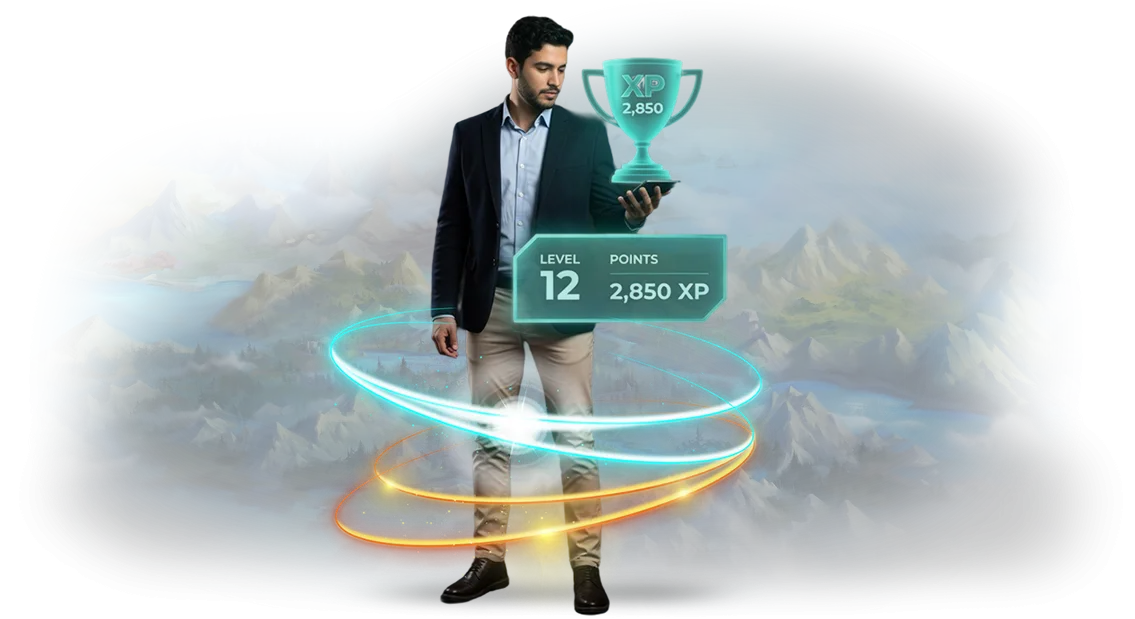
We turn routine into a game: residents earn points for attendance, completing tasks, and participating in the community, while the coworking space gets a manageable mechanic that increases visit frequency and extends the duration of collaboration.
This isn't entertainment for the sake of entertainment — it's a tool that directly affects space occupancy and revenue predictability.
We develop gamified solutions for coworking spaces with the specifics of your space and audience in mind. We understand that every resident is not a row in a CRM but a person who needs to be constantly engaged.
That's why we don't create an abstract "game" but a system that integrates into your business processes and quietly boosts loyalty. As a result, you get less churn, more renewals, and a lively atmosphere that makes people come back.
What Gamification Brings to Business: Engagement, Loyalty, Revenue
Coworking guests come for a one-off meeting and often don't return: there's no reason to stay, sign up for a new format, or bring colleagues. Gamification solves this through simple game mechanics — points, levels, contests, rewards for actions. The visitor begins to see progress, and the coworking space sees regular visits and revenue growth.
For over 10 years, we have been designing game scenarios for businesses. Unlike one-off promotions, gamification is embedded into daily processes: booking a meeting room, attending events, inviting friends, paying for a membership. Every action is converted into points and bonuses that work toward loyalty.
What Game Mechanics Deliver
Below are typical scenarios for coworking spaces:
| Format | Who It's For | What It Gives the Client |
|---|---|---|
| Points for visits | Regular residents | Repeat visits and membership renewals |
| Quests and contests | New guests and event groups | Higher engagement and natural viral reach |
| Rewards for referrals | All visitors | Inflow of new clients without advertising spend |
| Bonus store | Active users | Upselling of coffee, meeting rooms, and additional services |
Each mechanic solves a specific problem: points for visits increase visit frequency, while referral rewards turn a satisfied guest into a promotion agent. The result is growth not only in engagement but also in the average check through upselling.
What This Looks Like in Practice
The coworking space gets a clear motivation system: the guest sees their level, status, and available bonuses in a single interface. The administrator doesn't need to count points manually — all analytics are collected in one dashboard. You see which mechanics pay off and adjust your program accordingly.
Gamification doesn't require changing habits — it integrates into existing booking and payment processes. Visitors keep doing the same actions, but now those actions bring them tangible benefits. That's sustainable growth in loyalty and revenue.
Game Mechanics Formats for Coworking Spaces: Choose What Fits Your Task
For a coworking space, gamification isn't just entertainment — it's a tool for managing demand and loyalty. Each business task requires its own format: some mechanics fill idle hours, others unite residents, and still others turn random guests into regulars. Below is a comparison table so you can quickly find a solution for your current goal.
| Format | Who It's For | What It Gives the Client (the Coworking Owner) |
|---|---|---|
| Quests | New visitors, days with low meeting room occupancy | More inquiries and higher fill rate for "dead" slots, a news hook for social media and local partnerships |
| Leaderboards | Residents and regular clients | Higher activity, competitive drive, incentive to book workspaces more often |
| Marathons | Target audience: freelancers, startups, study groups | Building the habit of working specifically in your space, growth in repeat visits |
The choice of format depends on the specific task: quests work best for one-off attention grabs, leaderboards for retaining residents, and marathons for long-term engagement. Mixed schemes also work well, where one mechanic supports another.
For over ten years now, we have been designing such mechanics for coworking spaces and services.
We'll help you choose a format for your goal without overpaying for unnecessary options — and then implement it in a Telegram Web App, familiar to clients without requiring them to install additional apps.
How We Launch Gamification: 5 Steps to Results
Implementing gamification for a coworking space isn't about random gimmicks — it's work carried out through clear project stages. We don't disappear after launch: we provide support, watch the numbers, and evolve the mechanics. Here's how the work with our clients goes.
-
Brief and immersion into the task. An interview with you and the manager: which areas are underutilized, which visitor actions need strengthening — payments, renewals, event participation. We record business goals and success criteria.
-
Designing the mechanics. We select scenarios that fit your process: resident leaderboards, points for meetings, team challenges. We keep only what affects coworking occupancy and revenue.
-
Prototype and approval. We show screen mockups of how a participant earns and spends points. You make edits before development starts — no rework at the launch stage.
-
Development and testing. We build the TWA on a professional tech stack and test Telegram login, point accruals, and prize redemption. You see the project progress and control timelines at every step.
-
Launch and engagement. We announce the game to residents: text, visuals, and joining instructions. We're on hand in the first few days so players get involved quickly and issues are resolved immediately.
-
Support and evolution. We analyze participation, see which mechanics are stalling, and propose new seasons, tasks, and integration with coworking events. Gamification pays off and keeps driving business growth.
What's Included in the Delivery: A Complete Launch Package
Gamification for a coworking space isn't just "drawing animations" — it's a complete package that needs to work without your involvement.
That's why the delivery includes everything necessary, from game logic to a ready-made guide for staff, rather than an abstract "turnkey development."
Here's what's in the package you receive after launch:
- Game scenario — a thoroughly designed system of points, levels, and rewards for your goals, not template mechanics.
- Configured Telegram Web App — an interface that opens via a "Play" button and requires no app installation.
- Telegram bot setup — features, notifications, and automations are already activated and tested; all you have to do is tell your guests "welcome to the game."
- Launch guide — a clear document: how to onboard participants, what affects activity, and what to do in unusual situations.
- Staff training — a short practical walkthrough of the mechanics so administrators can answer guest questions instantly.
- Basic content pack — starter tasks and rule descriptions so the game works on launch day, not a month later.
- Admin panel access — you see activity, points, and participants, and understand what's paying off and what needs fine-tuning.
We also explicitly specify that all elements come with clear usage rights and require no special technical knowledge to manage.
The package already covers typical coworking scenarios: attracting visitors during "dead hours," bringing back lapsed guests, and increasing loyalty among regular residents.
The key point is that you don't get scattered files but an interconnected system where the bot, interface, and game scenario complement each other.
This eliminates the situation where "the game sort of exists, but nobody plays it": the mechanics are adapted to real visitor behavior, and the interface requires minimal effort to get started.
Case Study: How Game Mechanics Increased Attendance by 40%
The owner of a coworking network approached us: regular clients were starting to leave, new ones came only through one-off discounts, and meeting room occupancy was declining.
We proposed implementing game mechanics in their Telegram bot so that visits became part of a system rather than a coincidence.
How It Works
The idea is simple: for every visit, meeting room booking, or referral, the guest earned points. They could exchange those points for work hours and coffee. This mechanic changed behavior — clients started planning their visits through the bot instead of acting haphazardly.
What Changed
Results over three months: attendance grew by 40%, the average check rose by 18% due to upselling of meeting rooms and additional services, and the share of guests who visit 4+ times a month grew 1.5 times.
Loyalty also showed up in the numbers: the NPS score rose from 32 to 54 points. Most importantly, these clients don't leave after promotions end, because the game has become part of their habit.
This case shows: we don't just hand out points — we design mechanics around the coworking space's business processes. We account for when guests come to work, when they hold meetings, and which services they need. That's why the result is systemic, not one-off.
If you want to boost attendance and loyalty the same way — write to us, and we'll analyze your scenario in a single call.
How to Choose the Right Game Format for Your Goal?
Choosing a game format is really about choosing a business task. One mechanic doesn't fit everyone: what attracts new guests perfectly won't help retain regular clients, and an educational scenario solves a completely different problem.
So first, it's important to define what result you expect from gamification — growth in first-time visits, higher loyalty among current residents, or a quick introduction to the coworking space's services and rules.
If the goal is activation — that is, attracting new visitors — you need short, clear mechanics that trigger excitement from the very first touch: a quiz with a prize, a wheel of fortune, a reward for the first visit.
Such games don't require long explanations, offer instant wins, and give people a reason to stop by the coworking space, take part, and tell others about it.
If the main task is retention, a progression system takes center stage: levels, visit streaks, accumulating points, personal challenges. Here, the visitor sees that their activity brings tangible bonuses and returns again — a habit of working specifically in your space is formed. This mechanic pays off when you need to reduce churn and increase repeat payments.
If you want to educate guests and introduce them to the meeting rooms, offices, rental rules, and coffee area, a guided tour scenario works better: the person completes short tasks, unlocks new locations, and receives a reward for completed steps. This relieves the administrator and helps newcomers get comfortable in the space faster.
We help you find your way through the choice of mechanics as early as the brief stage.
We analyze your audience, attendance, and typical customer pain points, and propose the game format that will work specifically for your goal — whether it's a one-off promotion for acquisition or a long-term motivational system for regular residents.
Frequently Asked Questions About Implementing Game Mechanics
Before implementing game mechanics in coworking spaces, clients tend to have the same doubts: timelines, integration complexity, the need for technical support, and adaptation to the specifics of the format. We answer the main questions — briefly and to the point.
How long does implementation take?
A typical project takes 2–4 weeks from brief to launch. The timeline depends on the number of game scenarios and integration points: meeting room booking, loyalty system, events. First results are visible as early as the first week.
Is the game difficult to integrate?
No. The app works inside Telegram, so guests don't need to install anything. We connect it to your system using standard tools, handle the work ourselves, and don't require replacing your existing software.
Is technical support needed?
Yes, it's included. We provide ongoing support: we monitor stability, update scenarios to match your goals, and resolve issues quickly. This isn't just a "game" — it's a tool we're responsible for.
How is adaptation to a coworking space handled?
We study your format: pricing plans, seat booking, events. We tailor the game mechanics to your specifics — points for visits, challenges for residents, rewards for referrals. The game amplifies what already delivers results.
If you still have questions, ask them in the comments or on a call. We'll suggest a solution that fits your coworking space's format.Launch Gamification in Your Business Within 2 Weeks
You get not just mechanics with points and badges, but a working tool that increases visitor return rates and engages the team. Gamification will fit into your processes — from registration to regular visits — and start delivering measurable results within the first weeks.
To ensure a smooth launch without lengthy approvals, we take on the entire cycle: from idea to Telegram integration. To do this, we use ready-made solutions and professional tools — you don't need to dive into technical details.
What you get immediately after contacting us:
- A consultation on gamifying your coworking space: we analyze your goals, audience, and engagement points.
- A cost and timeline estimate for your project — before work starts and with no hidden conditions.
- A clear launch plan with role assignments — you know who's responsible for what.
- A scenario prototype at the brief stage — you see how the mechanic will work in your space.
- Gamification launch within 2 weeks after key decisions are approved.
- Post-launch support: we train the team and adjust the mechanics based on results.
Leave a request — we'll show how gamification will increase the number of regular guests and reduce manual work for administrators. At the first consultation, we'll propose a solution for your goals and provide an accurate cost estimate. We're available via messengers — we'll respond within an hour.