

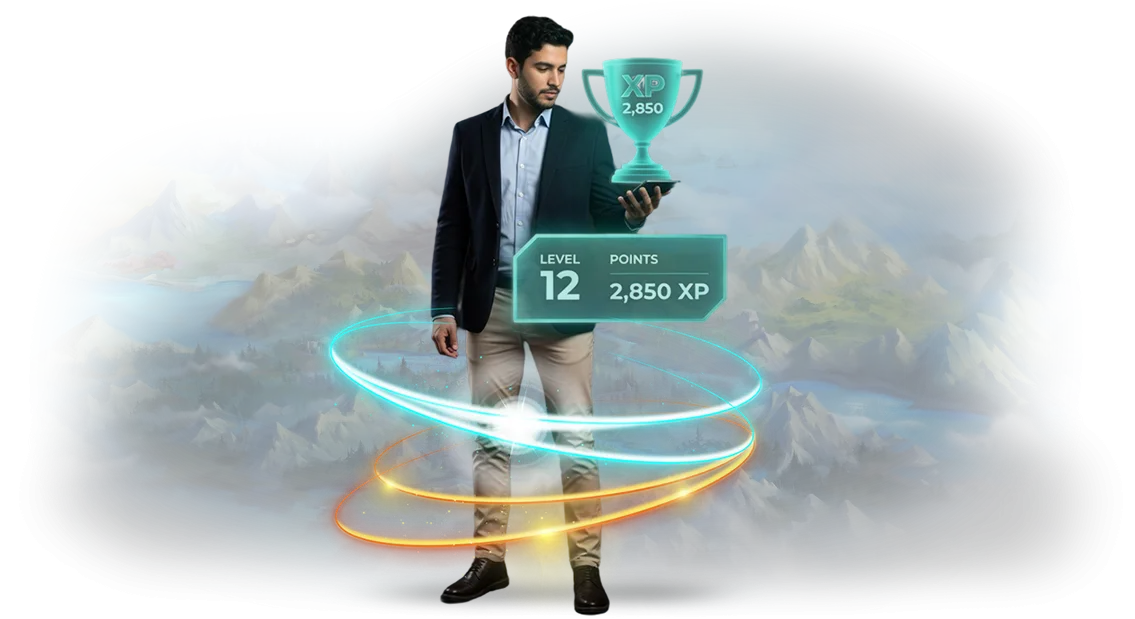
Why Business Needs Gamification in Education and Training
When it comes to education and training, most companies face the same problem: the audience loses interest by the second or third session. Employees go through training just to check a box, clients don’t return to the materials, and new formats don’t deliver the expected results. Time and budget are wasted — engagement drops, and knowledge doesn’t stick.
Meanwhile, competitors aren’t standing still. They actively use game mechanics in business: they turn learning into a competition, add rewards, levels, and feedback.
As a result, their audiences master materials faster, complete training more willingly, and stay more loyal to the brand. Without such tools, you risk falling behind — attention goes to those who know how to hold it in an engaging way.
The client doesn’t just need “knowledge delivery” — they need measurable value: faster employee ramp-up, higher sales, fewer mistakes, and client trust. Gamification of education solves exactly this problem.
It turns routine into a clear system of goals, where every step is supported by a result, and progress is visible to both the participant and the manager.
We help businesses close the gap between boring training and real engagement. We design game mechanics for your tasks — from onboarding new hires to regular team training. We implement processes so they drive business metrics, not just entertain.
What Business Results Game Mechanics Deliver
Game mechanics aren’t just entertainment — they are a tool for achieving business results. They turn education and training from a dull mandatory procedure into a process people want to continue. Concrete results are visible from the first implementation stages.
Increased engagement and course completion
Employees and clients finish their training when they see progress and rewards. Well-designed mechanics — points, levels, challenges — keep attention and reduce dropout rates. This directly affects the speed of workforce readiness and the quality of material retention.
Brand recognition through emotions
Game elements create reasons to share results: ratings, badges, virtual rewards. Each such action is natural advertising that spreads among colleagues and acquaintances.
This builds brand engagement: people remember the brand not because of intrusive messages, but thanks to vivid shared experiences and achievements.
Increased loyalty and new leads
Regular game mechanics create a habit of returning to the portal. Competitive elements motivate users to invite friends or partners, which generates a stream of new users without additional advertising costs. As a result, both repeat activity and the number of inquiries grow.
Gamification Formats: Portal, App, Quiz
Choosing a gamification format starts with the question: “What does your audience do more often — work at a computer, use a phone, or meet you at events?” For employee education and training, three schemes are most common: a full-featured corporate portal, a game app, and a short quiz.
Each format has its own role: the portal builds a system, the app holds attention, and the quiz launches quick activity.
What to choose for your audience
| Format | For whom | What it gives the client |
|---|---|---|
| Corporate portal | Employees undergoing regular training, certification, or onboarding | Increased engagement in training, result control, unified knowledge base |
| Game app | Young audiences and employees who learn on the go | Constant access to materials, frequent returns, success statistics |
| Client quiz | Clients, partners, and event visitors | Quick engagement in 3–5 minutes, viral reach, contact collection |
A portal is suitable when training lasts months and progress needs to be tracked. An app — when the goal is to make training habitual and mobile. A quiz — when you need to spark interest and capture contacts in a short time. We combine formats to solve several tasks at once — and stay within budget.
How the Project Goes: From First Meeting to Launch
A clear process is half the success of a project. We structure the work so that you see at every step what is happening, what results are ready, and what comes next. No “black boxes”: you always understand what you are paying for and what you get.
-
First meeting and brief. We discuss your goals: what should gamification deliver — higher engagement, faster learning, increased loyalty. We record the objectives, target audience, timeline, and expected KPIs. You get a clear understanding of the scope of work and a preliminary estimate.
-
Analysis and concept. We study your audience and usage scenarios. We determine which mechanics — points, levels, competition, rewards — will work in your case. The output is a concept that is easy to approve and adjust before development begins.
-
Plan and estimate. We set the milestones, timeline, and budget in the contract. You know what results to expect at each stage and how we control quality. No hidden surcharges: all changes are discussed in advance.
-
Prototype and design. We show what the portal will look like and how the user will interact with the mechanics. You see the future product before programming begins — this saves time and money on revisions.
-
Development and testing. We build the portal on a professional platform and test it with real scenarios. You get a working product that doesn’t “crash” at the most critical moment — whether it’s launching a course or mass employee training.
-
Launch and training. We help integrate the portal into your system, set up access rights, and train administrators. You and your team quickly master the tools and can manage content on your own.
-
Support and growth. We stay in touch after launch: we analyze metrics, make adjustments, and add new modules when needed. You get not a one-off product, but a tool that evolves along with your business.
Full Deliverables of the Gamified Solution
As a result, you receive not just a portal, but a complete working system that genuinely engages employees, students, and trainees in the learning process.
We hand over the solution with all settings, mechanics, and supporting materials — your team can use the system immediately, without constant involvement from developers.
- A ready web portal with game mechanics — levels, points, ratings, rewards. The mechanics are already configured for your training programs and business processes.
- Gamification scenarios for education and training: interactive lectures, quizzes, practical assignments, and team competitions. Any scenario can be easily adapted to a new topic or audience.
- A participant’s personal account with visualized progress — everyone sees their achievements, receives feedback, and understands what to do next to climb the rating.
- An admin panel that doesn’t require complex setup: you create groups, assign courses, manage difficulty levels, and control access to materials yourself.
- Learning and engagement analytics: reports on each participant and team show who is doing well and who needs extra support.
- Full documentation: methodological guides for working with the portal, scenario configuration instructions, and operational regulations for administrators.
- Training for your administrators: we conduct a practical session, walk through typical situations, and provide templates for independent work.
- Warranty support for the entire cooperation period: we consult, update scenarios, and help you grow the portal to meet new challenges.
Case Study: How Gamification Increased Learning Engagement
A classic problem for a corporate university — employees enroll in a course, but only a few make it to the end.
A large manufacturing holding (let’s call it Leader) approached us: after the first modules, 60% of participants dropped out, and interest in the platform declined every week — management was already preparing to shut down the project.
The task
The holding had already tried deadlines and fines — that increased resistance. They needed to restore interest without strict control and turn learning into a habit.
What we did
We conducted an audit: employees didn’t see progress, didn’t understand the course’s value, and received no feedback. Linear lectures were replaced with levels, achievements, and team competitions.
Each lesson became a step in the story, assignments gave points and instant reactions. The mechanics were integrated into the learning process, not turned into a separate game.
The result
After two months, activity tripled, time spent in courses increased 2.5 times, and course completion rose from 40% to 86%. Voluntary repeat completions grew by a third: learning changed from an obligation into a habit. Employees started suggesting new course topics themselves.
The project didn’t remain a pilot — the client expanded gamification to all divisions and continues cooperation in the form of ongoing support.
How to Choose a Gamification Format for Your Task?
The right gamification format is determined not by trends, but by a specific business task.
For an educational portal, this could be speeding up the onboarding course for newcomers, increasing the number of completed modules, or practicing complex skills until they become automatic.
Before choosing mechanics, it’s worth answering three questions: which metric do we want to improve, who exactly will go through the training, and where does the process currently “fail” — attention is lost, motivation drops, or practice is lacking.
The answers immediately narrow down the choice. If employees drop learning in the middle — short game scenarios with rewards for each step work well. If you need to implement new sales or service standards — role-playing simulations with feedback help.
For regular practice and knowledge control, competitive mechanics with ratings and team scoring are suitable. None of the formats are universal, but each solves its own task if it is based on a real business process.
This is where our role begins: we don’t offer “a game for the sake of a game” — we conduct a gamification audit. We look at your learning process, find the points of motivation loss and bottlenecks, and then select a format that measurably improves the result.
Together with you, we define metrics — course completion rate, the speed at which an employee reaches the required level, repeat visits to materials. Already at the prototype stage, it becomes clear what dynamics work and what should be changed.
In the end, you get not abstract “gamification” but a tool embedded in the training process that makes a measurable contribution to business.
If you want to check before launch — tell us what task you are solving, and we will suggest a suitable format and show how it will work with your data. It takes one short call.
Frequently Asked Questions About Gamification in Education and Training
Frequently Asked Questions About Gamification in Education and Training
Any new system raises questions: how long will development take, how to integrate it into current processes, and what happens if something goes wrong. Below, we address the most common client concerns — honestly and without technical details.
How long does it take to develop a gamified portal?
It depends on the scope of the task. A standard project — from a branded page to a full-fledged training course with assignments — takes 3 to 8 weeks. At the start, we fix the deadlines in the contract and show a stage plan so you can see progress every week.
Is it difficult to integrate the system into the current learning process?
Integration doesn’t require stopping classes. We configure the portal in parallel with your current work: we bring in instructors, upload materials, and train the team.
Usually, adaptation takes 3–5 working days, and after the first launch you receive instructions for employees and students.
How secure is participant data?
We work on a secure server architecture: role-based access, backup, and permission separation for administrators, instructors, and students. Personal data and test results are stored in accordance with legislation and are not shared with third parties.
What if errors or questions arise after launch?
After project delivery, we stay in touch: the first 30 days of support are included in the cost, after that — on a convenient plan. Average response time is 2 working hours, and critical issues are resolved the same day. You always know who to contact and when you’ll receive an answer.
Will I be able to update content and add new assignments myself?
Yes, there is a user-friendly admin panel for that. You can change texts, add levels, rewards, and assignments without involving developers. We provide training on the panel at the launch stage — and give you video instructions that are always at hand.
Let’s Discuss Your Task and Estimate Your Project
Training and education often become a formality: employees take courses just to check a box, knowledge doesn’t stick, and time and money are wasted. A gamified web portal changes that — it turns the process into a clear game with goals, rewards, and visible progress. Participants see their path, compete, and get results that truly affect their skills.
Leave a request for gamification — it’s a consultation with an engineer and a methodologist. We’ll discuss your task, audience, and expected results, then prepare a project estimate and an implementation plan.
You’ll understand what the portal will look like, what your team needs to provide, and how long the preparation will take.
In response, you will receive:
- An analysis of your current training system and growth points
- A gamification concept for your audience: scenarios, mechanics, rewards
- A preliminary project estimate and timeline
- A step-by-step portal implementation plan
- Recommendations for motivating and retaining participant attention
- A checklist: what to prepare for launch
For 10 years, we have been creating learning systems that deliver measurable results: higher course completion, repeat visits, and time saved on training.
Leave a request — we’ll get back to you within one business day, ask clarifying questions, and show how our clients have solved similar tasks.
Fill out the form below or write to us in a messenger — let’s start with a short conversation and find a solution for your task.