

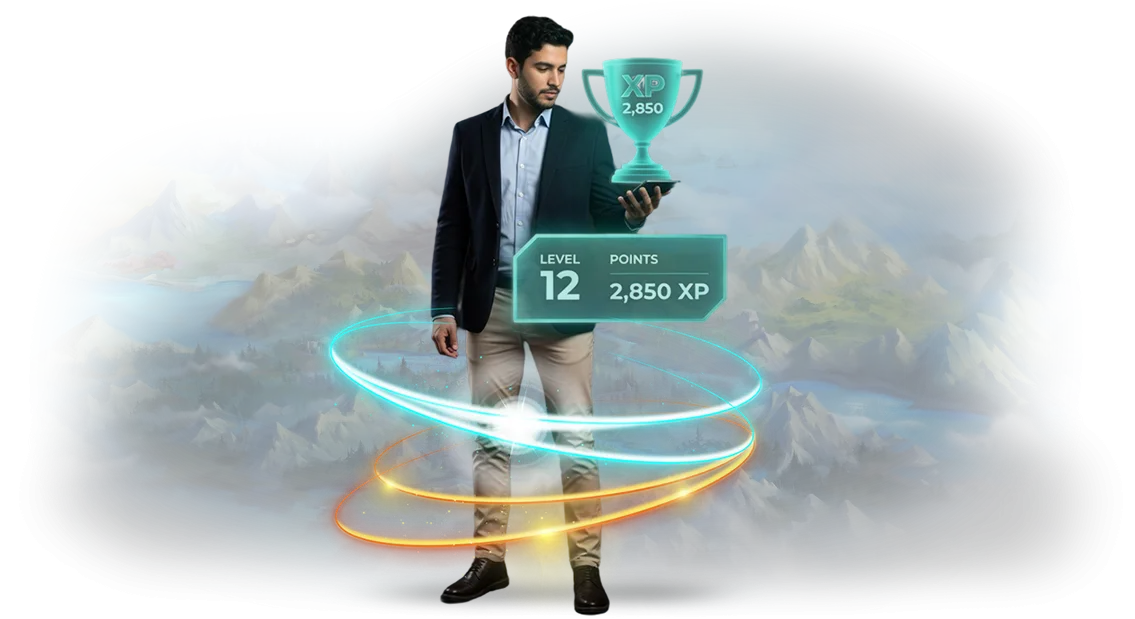
Why manufacturing and machine-building companies lose employees and orders
Imagine a workshop or design bureau where experienced specialists work "on autopilot," with no interest in the outcome. Every day is the same: operations, reports, approvals.
Staff engagement drops, and with it accuracy, speed, and the willingness to take responsibility. This is how manufacturing and machine-building companies quietly lose efficiency: first deadlines slip, then quality suffers, and then key employees start leaving.
When experienced people quit, orders fall through, and clients move to competitors. Managers try to solve the problem with bonuses and fines, but this only produces a short-term effect.
What is needed is a system that activates employees' intrinsic motivation and makes routine processes clear and engaging — then people stay, and metrics improve.
Gamification of business processes is exactly about this: it turns production tasks into a game with goals, levels, and clear feedback. Employees see their contribution to the overall result, compete on reaching targets, and receive recognition for their achievements.
This is not entertainment but a management tool that reduces efficiency losses and retains valuable talent.
We develop gamified solutions for industrial companies: from motivation systems on production lines to training portals and corporate competitions.
We help you stop losing employees and orders by turning routine into an engaging, transparent process that delivers measurable business results.
What gamification of business processes brings to manufacturing and machine building
Gamification converts routine production tasks into a format that is clear and interesting for employees. Instead of abstract instructions — visual goals, skill levels, and clear feedback.
This is especially important for machine-building enterprises, where product quality depends directly on the attentiveness and qualifications of the staff.
The first and most tangible result is higher productivity. When an employee sees their contribution to the overall result in real time, they get distracted less and complete the plan more willingly.
The competitive element between shifts or sections kicks in naturally, without additional administrative pressure.
The second effect is a reduction in defects. Gamification helps reinforce correct actions: the system rewards error-free task execution and immediately flags deviations.
Workers learn from their mistakes in a safe environment, not at the moment a defective part has already moved to the next processing stage.
The third is staff training. Game mechanics turn tedious regulations and technical documentation into interactive scenarios. New employees come up to speed faster, and experienced ones refresh their knowledge without leaving the production floor.
Ultimately, all these improvements add up to growth in key enterprise metrics: higher output, lower costs, stable quality. Management gets a transparent picture of team engagement and competence — which means decisions can be based on data, not guesswork.
Gamification formats for manufacturing and machine-building tasks
Gamification formats for manufacturing and machine-building tasks
Manufacturing and machine building employ different categories of workers: engineers, line operators, supervisors, logistics staff, and office personnel. Each has their own tasks and their own rhythm — a one-size-fits-all game will not deliver results.
So we match the gamification format to a specific goal: train staff, reduce the number of errors, speed up internal processes, or simply increase engagement.
Formats can vary: from a mobile app for employees "in the field" to a full-fledged gamified portal that unites all internal activities. Below are typical scenarios that most often solve the challenges of production companies.
Format comparison table
| Format | Who it is for | What the client gets |
|---|---|---|
| Mobile app | Employees on site, field crews, maintenance services | Quick access to tasks, instructions, and competitions without a workstation. Conveniently mark completed steps and view the leaderboard in real time. |
| Gamified portal | Office staff, engineering personnel, managers | A single point for training, submitting suggestions, and internal contests. Employees complete courses at their own pace, and managers see each department's progress. |
| Employee quests | Mixed teams, cross-shop groups | Team tasks that develop collaboration between departments. Plant quests help onboard newcomers faster and surface non-obvious problems in processes. |
| Simulators and trainers | Equipment operators, process engineers | Safe practice of rare or dangerous situations. Mistakes on a simulator do not cause downtime, and skills are reinforced faster than in a regular lecture. |
Whichever format you choose, the result is the same: employees do not just complete tasks — they engage with the process with genuine interest.
Gamification turns training and routine into a game, and you get clear metrics: higher engagement, fewer errors, faster process completion.
Tell us about your challenge — we will recommend the best format for your production and how to implement it quickly.
Stages of implementing gamification at an enterprise: from brief to launch
At machine-building enterprises, gamification delivers results when tied to production metrics — safety, quality, speed of mastering operations.
To make sure it does not turn into a "toy," we structure the implementation around a proven workflow: from brief to launch and support, with clear timelines and owners for each stage.
-
Gamification brief. We dive into the enterprise's objectives: reducing defects, following regulations, training newcomers, increasing output. We record current loss points and target metrics — these are later used to measure effectiveness.
-
Plan and scenarios. We define which employee actions are "built into" the game: completing safety briefings, working through checklists, submitting suggestions. We calculate task frequency and the points system so interest does not fade after a month.
-
Portal design. We build an interface that makes sense to workers, supervisors, and engineers: personal accounts, achievement boards, team competitions between shops. Every element is tied to a real process, not to abstract "points."
-
Implementation. We assemble a working prototype so you can already see the future result at this stage. We make adjustments based on feedback from managers and employees before the system is scaled across all sections.
-
Gamification launch. We run a pilot — at one site or across the entire production at once. We train in-house administrators, provide guides for employees, and support the first game cycles to address objections and questions.
-
Project support. We analyze activity and the dynamics of production metrics, adjust task difficulty, add new achievement categories and seasonal activities. You get a working tool that does not require constant oversight from the IT department.
What is included in the gamified portal delivery package
When you order a gamified portal, it is important to understand exactly what you receive.
We put together the delivery package so that the system does not merely go live — it is understandable to employees, manageable by your administrators, and provides transparent data for management.
The final package includes everything needed to launch and develop the mechanics right on your site.
- Gamification documentation — description of rules, point-awarding scenarios, levels, and statuses. Your managers can always check the system logic and adjust it for new tasks.
- Reports for management — visual dashboards on engagement, departmental activity, and metric dynamics. You will not have to collect data manually — key metrics are displayed in a convenient format.
- Administrator training — a hands-on session for your employees who will manage the portal. They will learn to create contests, configure rewards, and handle feedback without constantly contacting us.
- User guides and instructions — short materials that explain to employees how to participate, where to check their status, and what bonuses are available. This speeds up launch and reduces the number of questions.
- Technical support at launch — in the first weeks after go-live we stay in touch: we help administrators, respond quickly to unusual situations, and adjust settings if needed.
- Maintenance and update schedule — you understand how the system evolves: what enhancements are possible, how often new features appear, and what is needed to activate them.
This package covers the key needs of a production enterprise: you receive not just software, but a working system with documentation, training, and support. This makes it possible to implement gamification without downtime in the shops and without overloading your IT department.
In the end, you invest in a clear tool that is easy to roll out to new sections and teams — and every stage of its operation remains under the manager's control.
Case study: 23% output growth at a machine-building plant
The head of a machine-building plant faced a typical problem: planned targets were met on paper, while time in the shops was lost to waiting, changeovers, and shift handovers.
Dispatchers could see the downtime but could not influence it in the moment, and operators did not understand what they were being bonused for. Motivation was weak.
We audited the production portal and moved control of key metrics into a game mechanic. Instead of a task list — personal progress; instead of reprimands — competition between shifts. The system did not require equipment replacement and ran on the plant's existing infrastructure.
Implementation results
In the first three months, output grew by 23% without increasing the payroll: people began working more effectively for status, ranking, and recognition from the team.
Defects fell by 17%, and overtime dropped by a quarter — shifts managed to deliver the volume without overrunning.
The key effect is the durability of the result. Six months later, output had not dropped, even though the competitive season had ended.
The habit of performing tasks in the correct order became ingrained at the level of operational discipline, and no changes to the process flow were needed.
Why the client came back
Precision Products Plant from Novosibirsk returned after the first launch to expand the system for shop-floor analytics.
The production director called gamification "a management system, not a game for employees": now a problem team is visible before the end of the shift, along with the reason for the drop in performance. A repeat order is the best indicator of real implementation results.
For the manufacturing and machine-building sector, game mechanics solve the controllability challenge. Management gets transparent control, and employees get a clear link between actions and results. The case went beyond one-off motivation and became part of the plant's operating system.
How to choose a gamification format for your production specifics?
Choosing a gamification format starts not with a nice idea but with a question: which production process do you want to change — speed up training of new employees, improve product quality, or reduce equipment downtime.
There is no universal solution for all enterprises: what engages an engineering shop may not work at all for a warehouse complex or a quality control section.
The specifics of the production determine the format. If employees work at the machines and rarely come to a computer, we design scenarios through tablet terminals or QR-code navigation.
If the goal is to reduce the number of errors during acceptance, gamification is built on short checklists and instant feedback.
For plants with shift work, asynchronicity is important: each employee joins the game at a convenient time, and results accumulate in the team's shared table.
We tailor the mechanics to your actual metrics: operation speed, number of complaints, share of the plan completed.
For some clients, a tournament between shifts with a public leaderboard on a shop-floor screen works well; for others, individual training tracks with point accumulation and unlocking of practical tasks.
Still others need emergency simulation to train personnel for abnormal situations without risk to production.
Before proposing a format, we visit the site, talk to supervisors and line staff, and look at how work processes are organized. This allows us to eliminate barriers: poor internet in the shop, reluctance of older employees to learn interfaces, or bans on phone use. As a result, gamification becomes part of the work rhythm rather than an extra burden.
The right format is one that is clear to the employee, does not require stepping away from work, and gives the manager transparent numbers on engagement and results. This is the approach we apply in projects for manufacturing and machine-building enterprises.
Tell us about your challenge — we will help you choose a format that will actually change your metrics.
Frequently asked questions about implementing gamification in production
Clients in production often view gamification with caution: it seems like entertainment rather than a business tool. In reality, a properly designed system solves concrete problems — reduces downtime, speeds up training, and increases employee engagement. Here are answers to the questions we hear most often before a project starts.
What if the system does not work or employees do not accept it?
We do not hand over a "raw product." We first run a pilot with one team or section, check how people actually use the mechanics, and only then scale up. The contract includes clear acceptance criteria — if they are not met, we refine it free of charge.
In 10 years, there has not been a project we had to discard: there is always a format that works on your site.
How long does implementation take?
A typical portal for a production section is launched in 3–4 weeks: brief, design, development, pilot, and training.
Complex scenarios with integration into accounting systems take longer, but we always break the project into stages — the first visible result appears within a month.
How much does it cost?
The cost consists of the scope of mechanics and the number of participants, not "development hours for the sake of hours." We prepare an accurate estimate after the brief and show you what effect you will get: shorter onboarding time, higher output, fewer defects. We fix the budget at the start and do not inflate it during the project.
Gamification is a game, and our employees are serious people. Will the team be skeptical about it?
Good gamification does not turn work into a toy. It introduces transparent goals, clear rules, and fair evaluation of results — people see that their efforts are noticed, and this reduces turnover.
We adapt the style to the production culture: restrained mechanics, no "cartoons." After the pilot, employees usually ask to add new tasks themselves.
Ready to discuss gamification for your enterprise?
Manufacturing and machine-building enterprises need more than just points and ratings — they need a tool that reduces downtime and increases engagement among workers and engineering staff.
Submit a request for gamification — and we will advise how the portal will fit into your business processes and what it will deliver in numbers. After your inquiry, you will receive a clear action plan and a precise understanding of the budget and stages. Here is what the first contact includes:
- Expert consultation: we analyze the pain point — newcomer onboarding, team motivation, quality control.
- Cost calculation for gamification tailored to your processes and production scale — no template pricing or hidden surcharges.
- Portal concept proposal: which scenarios, rewards, and metrics will work in the specific context of a machine-building plant.
- Effect assessment: how gamification will impact defect reduction, deadline compliance, and employee initiative.
- Implementation plan highlighting quick wins and areas where results will appear in the first month.
- Integration review with accounting systems: we determine which data will feed the leaderboards and how managers will see the dynamics.
- Demonstration of the approach using examples of solutions for similar production companies.
To get a cost calculation and a consultation, simply submit a request on this page. We respond within one business day and continue the conversation in the language of your business — without unnecessary technical jargon and bureaucratic language. This approach rules out template solutions and prepares a portal that employees will use every day.