

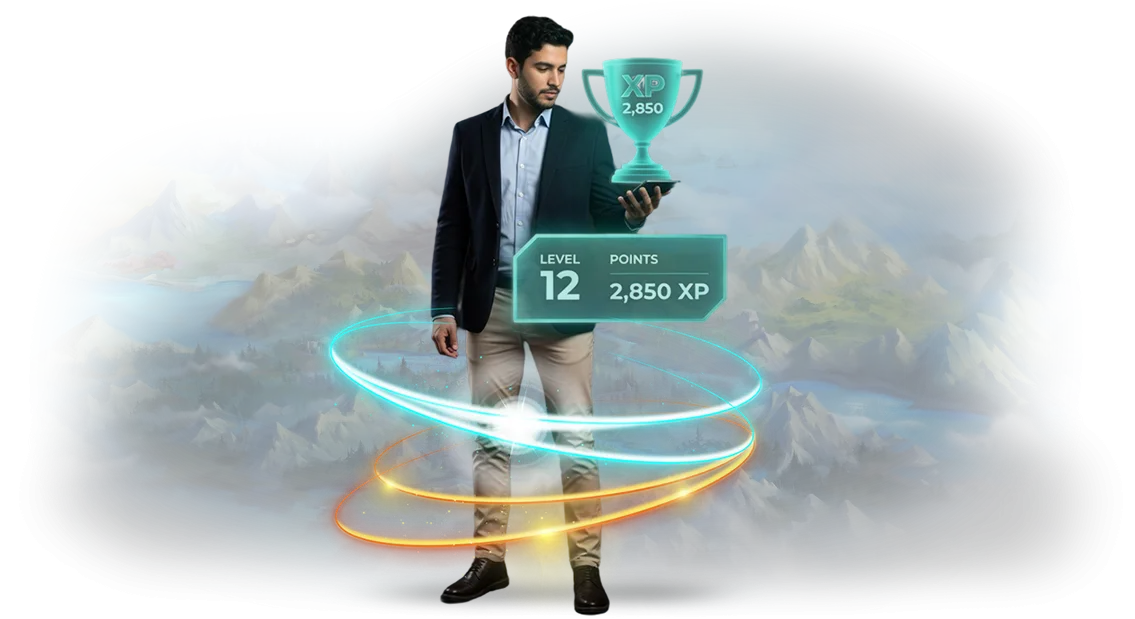
Employees not engaged? Gamification on HTC Vive
Routine tasks and repetitive processes quietly eat away at team motivation. An employee performs familiar actions mechanically, stops seeing results, and productivity drops.
Managers see this in the numbers: declining KPIs, higher turnover, and a formal attitude toward training — and realize that standard methods no longer work.
The solution is gamification of business processes on HTC Vive. We turn work scenarios into interactive VR simulators where each participant sees their progress, receives feedback, and achieves goals through play. This format engages even those who are skeptical of classic training and presentations.
HTC Vive for business is professional equipment that provides full immersion and stable results in corporate programs. An employee doesn't just watch a screen but acts inside a virtual environment: makes decisions, practices skills, competes with colleagues.
The emotional response from such sessions is many times higher than from lectures or tests, so material is absorbed faster and stays in memory longer.
For the company, this means measurable benefit: reduced onboarding time for new employees, increased engagement in processes, fewer errors in work. The team itself strives to complete scenarios, and the manager gets clear data on each person's progress.
Gamification of business processes stops being entertainment — it becomes a tool that pays off through increased work efficiency.
We handle the entire development: from scenarios and rules to deployment and support. We work on proven tools, so we eliminate failures and downtime at launch.
If you notice that your team is losing interest in work and training demands more and more resources — it's time to try gamification on HTC Vive.
What Gamification Delivers: 5 Business Benefits
Gamification is no longer just a toy — today it is a working tool for solving business problems. We have gathered five key benefits a client gets after implementing a corporate gamified application. Check which ones cover your current needs.
-
Increased engagement. Employees are more willing to complete training and engage in routine tasks when they see progress, levels, and rewards. Activity in the application grows many times over, and with it, real participation in work processes.
-
Faster learning. Instead of boring briefings — interactive scenarios where mistakes are safe and skills are practiced hands-on. A new employee reaches results faster, and adaptation time noticeably shrinks.
-
Reduced turnover. A system of achievements and recognition creates a sense of growth and value. People leave less often from a company where their development is supported by game mechanics — which means recruiting and hiring costs drop.
-
Higher KPIs. Game mechanics motivate specific actions: more sales, faster ticket processing, fewer errors. You get a measurable increase in key indicators, not an abstract "mood improvement."
-
Strong employer brand. Modern learning and work formats are a plus in candidates' eyes. A company that uses professional equipment such as HTC Vive looks like a tech leader and attracts the best talent on the market.
Each of these benefits directly affects ROI: you either reduce costs for training, personnel, and errors, or increase revenue through the speed and quality of the team's work.
And if you combine them in one application, the effect becomes systemic — this is exactly why we design and implement corporate gamified solutions.
Gamification Formats for Company Tasks
There are many gamification formats, and it's easy to get it wrong: what fired up a sales department won't work for onboarding newcomers or team-building for a project team.
The result depends not on the number of game elements, but on how well the format matches your business task.
A properly chosen format saves budget and time: instead of expensive field exercises — a safe virtual simulator, instead of boring lectures — a lively quest. To make it easier for you to navigate, we have put the main options in a table.
| Format | What tasks it suits | What the client gets |
|---|---|---|
| VR simulators (based on HTC Vive) | Training for actions in complex or dangerous situations | Safe skills practice, full immersion without risks |
| Business games | Developing management skills, strategic thinking | Playing out decisions without consequences, growing team competencies |
| Corporate quests | Team building, building connections between departments | Uniting the team, improving communication and trust |
| Business process simulations | Testing hypotheses, optimizing operational processes | Visible changes, saving time and resources |
| Competitions | Increasing motivation, achieving target metrics | Productivity growth, healthy competition and excitement |
This is not just a set of game mechanics: we tailor each format to your company's scenario and integrate it into current processes. You get a working tool that solves a specific task rather than distracting employees. We'll help you choose a format for your goal — just tell us about the task.
How the Project Goes: From Brief to Launch
Gamification of business processes is not just an application, but a tool that must integrate into a company's operations. To make sure the result solves business tasks, we build a transparent process of six stages — from learning your specifics to launch and support.
You always understand at what development stage the project is and what result you'll get at the end.
-
Brief and immersion in the task. We study your business process, listen to employees and managers, identify growth areas. We understand which mechanics will bring measurable results for the company.
-
Analytics and prototype. We research the target audience, break down its motivation and barriers. We create a prototype of the future application — you see and try it before full-scale development begins.
-
Scenario and design. We develop the storyline, tasks, levels, and reward system. We design the interface in your corporate style so employees immediately recognize the brand and get into the game.
-
Application development. We build the solution on the Unity engine with support for HTC Vive VR headsets. This provides full immersion and stable operation on professional equipment — employees focus on the task, not technical details.
-
Testing and refinement. We test scenarios on real tasks, fix errors, and adjust details based on your processes. You get a reliable application with no failures at the most critical moment.
-
Launch, training, and support. We deploy the system in your environment, train employees, and support the project after launch. We gather feedback and develop the solution together with your business.
At each stage, you see intermediate results and can influence the solution. Project management is built on clear statuses and milestones, so gamification implementation goes according to plan, and application launch doesn't turn into an endless process.
In the end, you get a working tool that increases employee engagement and the achievability of business metrics.
What's Included in the Gamified Application Delivery
When you order gamification of business processes, it's important to get not just a "pretty picture" but a ready working tool. That's why we deliver a complete package — from scenario to training your team.
Everything needed for launch and support is already included; you won't have to buy or finish anything separately.
-
Scenario and methodology. We define goals, target audience, and game mechanics. You get a document explaining how the application integrates into your process and what business result it delivers.
-
Ready application. We develop it for your task, configure scenarios and interface. It runs on professional equipment — stable and failure-free, with clear controls for operators.
-
Admin panel. A separate dashboard where you independently change content: add tasks, update texts, view completion statistics. No need to contact developers for every small change.
-
Documentation. Instructions for launch, setup, and operation. Everything is written in plain language so your employees quickly understand it without technical background.
-
Team training. We conduct training for administrators and operators: show how to launch a session, handle common situations, work with reports, and keep the application running.
-
Warranty and support. We provide a warranty on the application and support after launch. If questions arise — we're in touch, respond quickly, and see the solution through.
This package covers the entire cycle: from the first idea to daily operation. You get a transparent system that your team can flexibly adjust for new tasks.
And most importantly, gamification brings a measurable effect: increased employee engagement, accelerated training, or higher customer loyalty, depending on the goal.
Case Study: How HTC Vive Increased Engagement
Here's what our case looked like in practice. A logistics company faced a typical problem: new employees took a long time to get up to speed, while experienced ones lost interest in repeat training.
We proposed moving the process into a virtual environment based on HTC Vive — so employees don't read instructions but experience work situations.
What changed after implementation
Employee engagement grew by 40%. This was measured not through surveys but through actual participation: employees signed up for additional training sessions on their own, even though it wasn't mandatory.
Training time decreased by a third. Previously, mastering a typical warehouse operation took several shifts with a mentor. In VR, an employee practices the skill in two hours, with no risk to themselves or cargo. Mistakes are reviewed immediately, not a month later.
The case is also interesting for HR: we can see who handles stressful situations well, who is ready for promotion, and who needs extra support. This isn't a toy, but a working tool for personnel assessment.
VR Effectiveness in Numbers
| Metric | Before the project | After the project |
|---|---|---|
| Engagement in training | 45% | 85% |
| Average employee preparation time | 12 days | 8 days |
| Share of employees who passed certification on the first attempt | 68% | 92% |
The client was satisfied with the result and ordered a second phase — this time for the sales department. The cost of training decreases with each new scenario, and employee interest in the technology keeps growing.
Key takeaway: VR gamification works not as entertainment, but as a way to make training clear, fast, and measurable. Want the same result for your team? We'll tell you how to implement it at your company.
Frequently Asked Questions About Implementing Gamification
Before implementing gamification, clients have the same concerns: timelines, budget, compatibility with current processes, and guarantees. We develop corporate applications for professional VR equipment HTC Vive, so we know these concerns first-hand.
Below are answers to the main concerns: impact on current processes, cost, timelines, and post-launch support. Didn't find your question? Write to us, and we'll advise for your scenario.
Will gamification break current processes?
No. We integrate game mechanics as an addition to familiar work: employees perform the same tasks but see progress, goals, and rewards. For business, this means transparent statistics and increased engagement without changing tools.
How much does development cost?
The cost depends on the complexity of the scenario and integrations with your systems. We lock the exact estimate after a short brief — you get a clear price and stage-by-stage payment with no hidden extras.
How long will the project take?
A typical implementation takes from three to eight weeks from brief to launch. We work in stages and show intermediate results — you control timelines and make edits without delays.
How does support work after launch?
We train your team, support the first weeks, and quickly resolve any failures. Support and warranty terms are fixed in the contract, so you are never left alone with the product.
Launch Gamification for Your Team
Gamification turns routine tasks into a clear motivation system: the team sees progress, competes in a healthy way, and gets recognition for results. But for it to work, you need not just a set of mechanics, but a project embedded into your business processes.
We handle the entire chain: from idea to implementation. So after you contact us, you get not general words, but a concrete action plan.
What happens after your request:
-
Consultation — we analyze your task and explain how gamification will solve specifically your problem: increasing sales, training employees, or engaging partners.
-
Preliminary project estimate — we estimate budget and timelines before the detailed brief, so you understand the scope of work.
-
Format selection for your task — a quest, competition, level system, or training simulator. We choose what will give maximum effect for your team.
-
Implementation plan — we show stages, responsibilities, and milestones. You always know what's happening with the project.
-
Transparent terms and guarantees — we fix the result in the contract and support after launch so the system runs without failures.
Leave a request for a consultation — we'll tell you how gamification will change your team's motivation and offer a solution within your budget. The first step takes one minute, and the result is sustainable engagement growth and measurable business metrics.
How to Choose a Gamification Format for Your Task?
Choosing a gamification format starts not with "we want VR" or "make it cool," but with a question: what business task are you solving?
Employee training, practicing sales skills, motivating a team, engaging clients at an event — each task has its own suitable scenario, duration, and mechanics. There is no universal solution: what works great in onboarding will fail at an exhibition, and vice versa.
Before discussing technology, it's worth answering three questions: what result should be measurable, who the participants are, and under what conditions they operate.
For example, a large flow of visitors needs a quick and simple 2-3 minute scenario, while deep learning needs a full simulation with several levels and error analysis. A mistake in choosing a format is lost budget and team disappointment, not just a failed mechanic.
That's why choosing gamification is a joint effort: you immerse us in the business context, and we offer options that actually work in your industry and within your budget.
We analyze the audience, goals, and usage scenario, then show a prototype so you can see how it will look and what the user will get. Only after agreeing on the format do we move to development.
So choosing a format is not a matter of taste, but a strategic decision. If you want gamification to deliver measurable results rather than just be a "trendy gimmick," it's worth bringing in people who have already walked this path on dozens of projects. Ready to discuss your task and suggest a suitable format?