

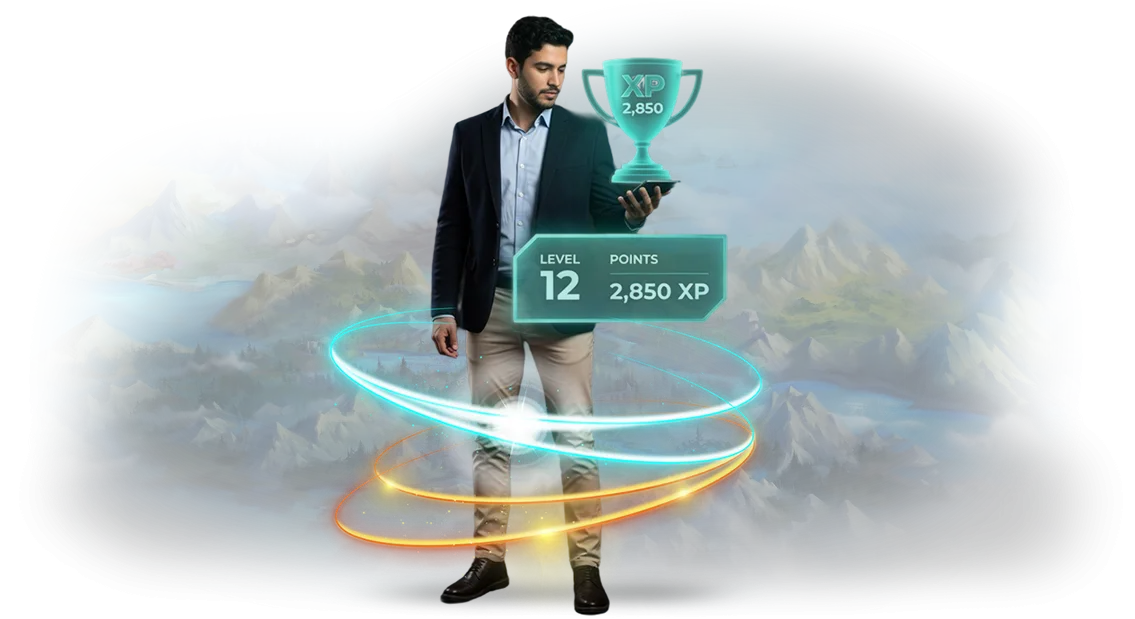
Gamification of Business Processes on macOS: How to Restore Engagement
Employees rarely use corporate programs—and it's not because they're lazy. It's just that accounting, reporting, and internal training systems are often set up as a mandatory chore: no feedback, no clear result, no excitement.
As a result, even good tools sit idle, and employee engagement declines—along with work quality and task completion speed.
Gamification of business processes solves this through natural mechanics: rewards for achievements, levels, competition between teams. When routine turns into a game, employees develop a personal interest.
And for companies that work on Apple devices, it's important that this mechanic is embedded directly into the macOS application—then it launches instantly, looks natural, and requires no training for Mac users.
But simply adding points and achievements isn't enough. You need a well-thought-out system tied to real business goals: meeting plans, completing training courses, participating in projects.
Then gamification strengthens staff motivation and reinforces corporate culture, rather than turning into another soulless ranking.
This is exactly the approach we use at our team: we develop corporate macOS applications that integrate seamlessly into daily work and give employees clear reasons to be more active.
As a result, the company gets not just a "toy" application but a working tool for increasing engagement. Employees return to tasks on their own, share results more willingly, and gain satisfaction from their achievements.
If you notice that internal programs are being ignored and interest in work is declining—gamification of business processes on macOS will be a clear and measurable way to bring energy back to your team.
What Business Gamification Delivers: Engagement, Motivation, Results
Gamification turns routine business processes into a game: employees get clear goals, visible progress, and rewards.
Instead of "I have to do this," there's "I want to complete this." This directly affects key company metrics—below, we break down the specific business benefits you gain.
Employee Engagement
Boring tasks stop being boring when they earn points, levels, and badges. Employees start competing, hitting KPIs with enthusiasm, and offering their own ideas. The company gains a productivity boost without growing the payroll—motivation is already built into the process.
Reducing Turnover
Game mechanics create a sense of progress and recognition. Employees see their achievements, receive feedback, and understand that their contribution is valued.
Such employees are less likely to quit—which means you retain knowledge and experience and don't spend budget on constant recruiting.
Employee Training
Training in a game format is absorbed several times faster: quests, scenarios, instant reactions to mistakes. New employees get up to speed faster, and experienced ones master new processes without lengthy training sessions. This shortens the adaptation period and improves work quality from day one.
Brand Loyalty
Gamification works not only inside the company but also with customers: interactive loyalty programs, quests, cumulative levels. Customers engage with the brand, return more often, and recommend you to friends. As a result, repeat sales and brand awareness grow without aggressive advertising.
Business Results
In the end, gamification pays off: engagement rises, turnover falls, training accelerates, and loyalty strengthens. All game mechanics are tuned to your business metrics, and results are visible in clear analytics. You get not just a game but a working tool for achieving your goals.
We develop corporate gamified applications on the professional Unity engine—this ensures stable performance on macOS, smooth graphics, and reliable integration with your systems. The product you receive genuinely influences business metrics rather than just pleasing the eye.
Gamification Formats: Quest, Competition, Motivation Portal
Gamification isn't "one size fits all": what engages newcomers won't work for the ongoing motivation of experienced employees. That's why we've divided it into three core formats—quest, competition, and a motivation portal. Each addresses its own objective, and together they form a comprehensive reward system.
At the start, we conduct a brief: we find out what results the business expects, how many people will participate, and how often activities will take place. Already at this stage, it's clear which format will work.
Our game solutions run on macOS—on the hardware employees already know—so implementation doesn't require replacing equipment or additional training.
| Format | Target audience | What it gives the client |
|---|---|---|
| Employee quest | For events and training: onboarding, product launch, corporate events | Fast engagement without lengthy preparation, vivid emotions, memorable photos and testimonials for internal channels |
| Team competition | For sales departments, client service, production teams | Metric growth through healthy competition, transparent statistics for managers, rewards for top performers |
| Motivation portal | For companies that need a long-term reward system | Ongoing engagement, accumulation of points and prizes, reduced turnover, employee loyalty |
This isn't a rigid classification: a quest can become a series of challenges, and a competition can be complemented with a personal ranking. We adapt the mechanics to your corporate culture and ensure the result is measurable: conversion, plan fulfillment, participation levels. If you're unsure about the choice—we'll help you determine the format based on a short brief.
Gamification Launch Stages on macOS: From Brief to Support
To ensure gamification delivers a measurable result rather than remaining a pretty toy, we structure the work as a clear project with checkpoints. You always know which stage the project is at and what comes next—this removes risks and unnecessary questions. We work turnkey: from the first brief to post-launch support.
-
Brief and immersion into business objectives. We conduct interviews with you and key employees, analyzing current processes and growth points. We pin down the goals: sales growth, training, motivation, or engagement. The outcome—an approved brief and clear success metrics.
-
Scenario and mechanics design. We work out how employees will interact with the application and which tasks and rewards actually work in your environment.
We present a prototype and the logic before writing code—you see the future solution on screen and can make changes before development starts.
-
macOS application development. We build the gamified application on the professional Unity engine, incorporating your corporate style. Every 1–2 weeks, we show working versions—you control the process instead of waiting for the result at the end.
-
Pilot launch. We launch the application with a limited group of employees and collect their reactions and usage data. We make adjustments quickly: changing difficulty, rewards, or the interface if we see something isn't working.
-
Full launch and integration. We deploy the application to the entire team's Macs, configure access, and connect it to the company's existing tools. We train administrators and provide clear instructions—employees immediately understand what to do.
-
Post-launch support. We monitor analytics, answer questions, and update content: adding new tasks, seasons, and levels. This turns a one-off campaign into a long-term motivation system that keeps working without your constant involvement.
Each stage ends with a checkpoint—a demonstration of results to the client. You make the decision and move forward, so the project remains manageable and predictable.
What's Included in a Gamification Project: Launch Kit
You receive a ready-made project that can be launched and used right away. We don't just write code—we hand over a complete package so your team can manage the gamification independently while you see its impact on business metrics.
Here's what's included in the project:
- Game scenario. A well-developed mechanic, narrative, and levels that engage employees in target actions: sales, training, KPI fulfillment. The scenario ties game elements to real tasks.
- Tailored setup. Adaptation of rules, roles, points, and rewards to your specific business processes. We account for your industry's specifics and team motivation—every element works toward results.
- Admin panel. A convenient interface for managing players, tasks, and results. You change conditions, add contests, and view statuses in real time—without developer assistance.
- Administrator training. We conduct a short session and provide clear instructions. Your employees quickly master the system and continue working with it independently.
- Project analytics. We set up reports on engagement, activity trends, and target metric achievement. You see which mechanics work and adjust the program in a timely manner.
- Documentation and technical support. All necessary documentation for handing the project over to your team. After launch, we stay in touch: help with updates and respond promptly to questions.
By launching gamification turnkey, you save time on internal coordination and don't depend on external contractors. Scenario, management, and analytics—all in one package, and the effect is clear from the early stages: increased employee activity and achievement of set goals.
Case Study: How Gamification Increased Team Engagement by 37%
In retail, staff turnover is one of the biggest sources of losses. Every departing employee means costs for hiring, training, and the time it takes a newcomer to reach the required level.
It was this exact problem that the retail chain "Sever" brought to us: turnover was reaching 40% per year, while engagement in training and plan fulfillment remained low.
Standard onboarding and performance metrics didn't work—employees lost interest, and the business spent money on constant recruiting.
We proposed turning routine tasks into a game. The system awarded points for meeting plans, completing training courses, and helping colleagues.
The application ran on the computers already installed in stores, including macOS devices—so there was no need to purchase additional equipment. Employees saw rankings, earned badges, and could exchange points for real prizes.
Results After Six Months
Team engagement grew by 37% compared to the control group. Turnover dropped by a quarter—especially among those who actively participated in the game.
Nearly 80% of employees opened the application every shift, and training time decreased by 30% because materials were mastered in a game format. Recruiting costs fell—participating stores no longer needed to constantly look for replacements.
Why It Worked
We didn't just add a competition—we accounted for the specifics of retail: shift schedules, varying skill levels, and the need for fast onboarding of newcomers. Gamification became part of the daily routine rather than a one-off campaign.
After six months, the chain's management extended the project to all stores—for us, that's the clearest indicator that the solution works.
How to Choose a Gamification Format for Your Company?
A gamification format shouldn't be chosen by trends but by business objective: first, we determine what result you need.
Different goals require different mechanics—keeping a visitor's attention at an exhibition for three minutes is one thing; engaging employees in corporate processes daily is another. The starting point should be the audience and its journey.
For short events—forums, presentations, conferences—a quest or instant game works: a guest quickly gets involved, has a vivid experience, and takes away an impression of the brand.
For long-running programs—newcomer onboarding, training, regular operations—an accumulative format is needed: points, levels, competition between teams that hold attention for weeks.
We also consider specific company requirements: audience characteristics, corporate culture, technical environment. If employees work on macOS, the application must launch instantly and run without failures—no setup, no extra steps. That's why we select the format for your situation rather than using a template.
Often a client can't immediately articulate the task—that's normal. We ask guiding questions, clarify goals and constraints, and turn "we want something interesting" into a scenario with a measurable outcome.
You get an individual solution that works for engagement and revenue, not a game for the sake of a game.
Contact us for a consultation—in a single conversation, we'll review your situation and propose two or three formats with a result forecast. After that, we'll prepare an implementation plan, and you'll make a decision based on numbers rather than guesswork.
Frequently Asked Questions About Gamification: Addressing Concerns
Any innovation raises questions—and that's normal. Especially when it comes to introducing a game into work processes: it seems complicated, employees won't want to participate, and the launch will drag on. We answer the four main concerns managers have.
How difficult is it to implement gamification into current processes?
Implementing a game doesn't require restructuring the company. We analyze your tasks, integrate game mechanics into existing workflows, and run a pilot on one team.
our team has more than 10 years of experience creating corporate Unity applications for macOS—you get a ready-made solution, not an "experiment" with unpredictable results.
What if employees don't want to participate?
Participation isn't achieved through coercion. We design scenarios so the game provides clear value: feedback, recognition, healthy competition between teams.
Easy entry and an adaptive macOS interface lower the barrier—within a week, most colleagues join the process without reminders.
Who handles technical support after launch?
We provide support across the application's entire lifecycle: we monitor stability, release updates, and resolve incidents promptly. You're never left alone with a problem—a dedicated specialist who knows your project is always in touch.
How long does the project take?
From brief to launch typically takes 4–6 weeks. We set timelines in advance and approve results stage by stage. If you need it faster—we speed things up using ready-made modules and proven solutions without sacrificing quality.
Shall We Discuss Your Task? Tell Us About Your Gamification Project
Every gamification task is unique: one solution drives engagement growth, while another doesn't work. To get results, you need to set the right goal and understand the company's format. That's why we start not with a commercial proposal but with a conversation.
Tell us about your project—which processes you want to digitize, who your audience is, and what devices your team works on. If employees use macOS computers, we'll design an application for your ecosystem.
During the meeting, we'll clarify metrics, discuss mechanics, and propose options that will deliver a measurable impact.
After the first discussion, you'll receive a clear plan:
- an analysis of your task and a proposal for gamification mechanics tailored to your business;
- a transparent cost calculation by stage and realistic timelines;
- implementation options: from a quick prototype to a full-scale corporate application;
- clear next steps—what we do and what we need from you;
- a meeting with the team that will manage the project, with no intermediaries;
- consideration of your platform: macOS and other systems your employees use.
This doesn't obligate you in any way. You'll get an expert assessment and understand how gamification will change your business. Send us an inquiry—write a few lines about your task and a convenient time for a call.