

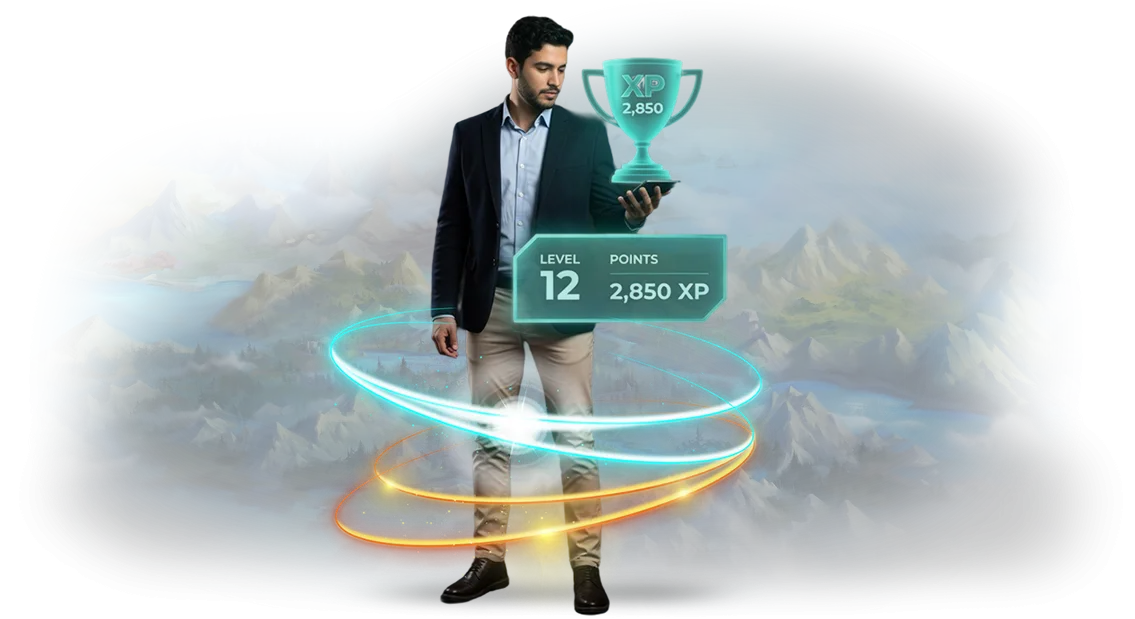
Gamification of Business Processes: Why Microsoft HoloLens?
Corporate events, training sessions, and routine business processes often become a formality: employees show up but don't engage, and information is quickly forgotten. Managers invest budget in trainings and team buildings, but the effect is measured in weeks, not years.
The reason isn't a weak scenario — it's that standard formats don't create emotions and don't give the participant the role of an active player.
Gamification of business processes flips this model: game mechanics — tasks, levels, rewards, competition — make the brain work to hold attention. When an employee isn't listening to a lecture but making decisions, acting, and winning, engagement grows many times over.
But even the most well-designed board game hits a ceiling — a screen or paper. This is where Microsoft HoloLens steps onto the stage.
HoloLens for business adds a third dimension: holograms are placed directly in physical space, and the participant interacts with them through hand and eye movements.
Instead of abstract slides — volumetric objects that can be walked around, examined, assembled, or "brought to life." A corporate event becomes an immersive quest, and training turns into an adventure where each employee remembers not slides but their own experience. This is innovation that every participant sees and feels, from manager to director.
Implementing such solutions doesn't require a revolution in processes — you just need to choose the points where engagement is critical: onboarding, sales, product presentations, team anniversaries.
Gamification on HoloLens pays off through faster learning, better material retention, and increased team loyalty. This isn't technology for technology's sake, but a working tool that turns boring duties into a source of energy and ideas.
When employees say "wow" — that means you've achieved exactly the result you implemented gamification for.
What Gamification with Microsoft HoloLens Gives Business
### Live Guest Reactions and a Memorable Brand Ordinary booths and presentations get lost in the flow of information — a visitor walks past and forgets about the company within a minute.Immersive technologies with <cite>Microsoft</cite> HoloLens turn getting to know a product into an event people talk about: a person puts on the headset, sees a volumetric image of your solution right in the venue, and reacts emotionally.This emotion works stronger than any brochure. Surprise and interest make the guest stay longer, explore the product in action, and discuss what they saw with colleagues. This way an ordinary presentation becomes a source of lively discussion and a reason to approach your team.### Audience Reach and Lead Generation Without Extra Ad Spend Everyone who goes through the scenario takes a photo or video — and shares it on social media. This is a free PR effect: your audience shows the brand to their followers, expanding reach after the event.One visitor brings 2–3 new contacts who learn about you without any additional investment in paid distribution. In parallel, the interactive experience drives lead generation.After the session, the participant leaves contact details to get the results or materials — and you get a database of interested people. All your team needs to do then is properly follow up with warm leads.### Employee Training Without Interrupting Work The same mechanism applies inside the company. An employee goes through a scenario in a safe environment: from production operations to client communication.Mistakes are visible immediately, instructions appear in the field of view at the right moment, and the result is seen right away — this accelerates learning and reduces the load on mentors.Audience engagement in this format is higher than in lectures or tests: the person participates rather than observes. A completed scenario is remembered better, which means it's adopted into work habits faster.Gamification Formats for Business and Events At events and in corporate processes, the main goal is to hold attention and get action from participants: sign up, ask a question, save a contact, take the initiative.Ordinary presentations and handouts often get lost, while a game creates light competition that gets people involved on their own.We design gamification for a specific format: a short activity at an event booth, a working mechanic for employee onboarding, or a series of team quests for team building.
Each scenario is developed from the standpoint of narrative and visual support, not just "a set of mini-games."
We Match the Format to Your Task
| Format | For whom | What it gives the client |
|---|---|---|
| Interactive booth with AR quests | Exhibitions, conferences, forums | Attracts visitors, collects contacts, and engages them in dialogue about the product |
| Team competition game | Team building, corporate events | Brings the team together, breaks down barriers, and creates a positive atmosphere |
| Product training quest | Onboarding, sales department training | Accelerates information retention, increases engagement, and reduces turnover |
| Virtual reward promotion | Marketing, loyalty | Increases repeat visits and builds a client base through interest in the game |
| Role-play negotiation scenario | Management training | Safe skills practice, which boosts the team's confidence |
These are the basic formats we use as a foundation. Before starting, we select the mechanics based on the participant profile and the venue's technical setup, and afterward we help run the activity and collect feedback. You get a ready-made solution, not an abstract idea.
Stages of Turnkey Gamification Development
You get not an abstract document, but a working process that has already been proven across dozens of projects. We handle the entire journey: from the first brief to launch and technical support. Each stage is clear, transparent, and ends with a concrete result that you see and approve.
We use professional equipment, including Microsoft HoloLens augmented reality headsets — this ensures stable operation and full employee immersion in the scenario.
- Brief and task analysis. We study your business goal: what needs improvement — training, engagement, speed of operations. We gather requirements and get familiar with your processes and audience.
- Concept and scenario. We propose game mechanics that solve your specific task. We describe the storyline, roles, rules, and how employees will interact with the application.
- Concept approval. Together with you, we approve the scenario and visual style. You see what the application will look like and make revisions before development begins — this saves time and budget.
- Development and integration. We build the application and connect it to your systems and data. We configure it so that participant results are saved and available to you in a convenient format.
- Testing and launch. We test the scenario on real tasks, fix errors, and launch the project. At this stage, you get a ready-made tool that works without failures.
- Technical support and evolution. We support the project after launch: update content, help with process changes, monitor stability, and track engagement metrics.
In the end, you get not "an app for the sake of an app," but a working tool that employees use with interest, and the business sees measurable results. You stay informed at every stage — from the first discussion to the moment the solution starts delivering value.
What's Included in the Gamified Application Delivery
Many clients worry: "Will we get an application and be left alone with an incomprehensible program?" In reality, the delivery is structured differently — you get not just a file, but a ready-to-use solution complete with documentation, training, and support. We hand over the project so your team can launch gamification and develop it independently.
Here is the complete delivery package:
- A ready-made application built for your business scenario and tested on target HoloLens devices.
- Source code and technical documentation — you remain the full owner of the solution and can bring in any developers.
- User instructions: short guides for launching the scenario, managing holograms, and typical employee actions.
- Administrative regulations: how to update the application, make backups, and deploy it across multiple headsets.
- Employee training: a hands-on session after which your team works confidently without our daily support.
- Warranty obligations: within the agreed period, we fix errors, answer questions, and monitor stability.
- Development roadmap: recommendations for new scenarios and game mechanics prioritized by business impact.
Such a package turns gamification from a one-off experiment into a working tool. You're not dependent on the contractor: employees are trained, documentation is at hand, the warranty backs the launch, and the roadmap shows how to amplify the effect in future iterations. Receiving the project is a clear process, not a "black box."
Case Study: Corporate Game for 500 Participants
When Alfa-Engineering came to us with the task of holding an annual corporate event for 500 employees, standard trainings no longer worked. Turnover within teams, low attendance at the supplementary program — people were used to just sitting things out.
We needed a format that engages everyone and turns the routine of a corporate event into a memorable adventure.
We developed a corporate game with augmented reality elements on Microsoft HoloLens devices. Employees split into teams and completed tasks in mixed reality: searching for virtual artifacts around the office, solving puzzles, competing in speed and logic.
The technology made it possible to use the physical space — a new mechanic for most participants that immediately broke down the "this is boring" barrier.
The result exceeded expectations. 490 out of 500 invited employees took part in the game, and not one person left before the finale.
After the event, a survey showed: 96% of employees rated the experience as useful and interesting, and 82% called it the best corporate event of the year.
Within two weeks, over 300 posts and photos from participants appeared in the company's social media — free reach that can't be bought with advertising.
The key indicator for the business was the growth in engagement over the following quarters: traffic to the internal portal increased by 40%, and turnover dropped by 15% compared to the previous six months.
The client ordered a repeat run of the game for a branch in another city just three months later and recommends us to partners.
This case shows: gamification is not just entertainment, but a tool that solves business problems — from team cohesion to increased loyalty. We take responsibility for results and deliver measurable metrics.
How to Choose the Right Gamification Format for Your Task?
There is no universal gamification format: what works with a sales department won't suit a large exhibition floor or employee training. So the selection starts with a task audit: what goal are you addressing — growing sales, accelerating onboarding, brand awareness?
The answer determines whether you need a short session of a few minutes or a long narrative mechanic with levels and point accumulation.
The second criterion is who will use the application and how. A high-volume visitor flow needs a simple scenario with no briefing required; a permanent team needs a deep storyline with team assignments and visible progress.
The specific requirements of the venue (lobby, meeting room, workshop, client demo) determine session length and interface.
We also define success criteria before development starts: number of completed tasks, share of repeat engagements, time of involvement, or sales growth after training.
We build these metrics into the project so that after the pilot you see business impact, not an abstract "liked it or not."
You don't have to choose a format right away — we help you decide. During the audit, we analyze goals, audience, venue, and expected results, then offer two or three suitable options.
Among them may be augmented reality on Microsoft HoloLens, if the task requires attaching digital prompts to real objects. You get a tool that fits your budget and timeline and delivers a measurable contribution to your KPIs.
Frequently Asked Questions About Gamification Development
Before ordering gamification of business processes on Microsoft HoloLens, clients ask similar questions. We answer the main ones — about timelines, security, warranties, and equipment — to remove doubts before work begins.
How long does it take to develop a gamified application?
A standard project takes 3–4 weeks: scenario design, mechanic approval, development, and testing. The exact timeline is calculated after the brief — it depends on the number of game zones and scenario complexity. You see each stage and don't pay for work that hasn't been done: you personally approve each stage.
How is corporate data security ensured?
We deploy the solution in a protected environment: employee data and internal scenarios never leave your infrastructure. We also sign a non-disclosure agreement, and only authorized participants get system access. This makes gamification usable even in companies with strict confidentiality requirements.
What warranties do you provide?
Warranties are recorded in the contract along with clear acceptance stages. If an error occurs after launch, we fix it at our expense within the agreed period.
For events, we provide on-site technical support to ensure the scenario runs without failures at the most critical moment.
Do we need to buy HoloLens equipment?
No. We provide devices for rent — with setup, charging, and a technician at your venue. If you plan to use gamification regularly, we'll calculate a supply and ongoing support option. We tailor the solution to the number of participants, event format, and your goals.
Get a Consultation on Gamifying Your Business
Start with a consultation — we'll discuss which business processes are worth gamifying first and what results you can get within just a couple of weeks.
We work with companies across various industries and know how to turn employee routine into a game that boosts engagement and task completion speed.
Leave a request for a consultation — and we'll prepare a commercial proposal for your task, as well as suggest a pilot project format. This way you'll see the effect on a limited scope before scaling the solution.
What you get from your inquiry:
- A preliminary consultation: we analyze your processes and identify where gamification will deliver the maximum ROI.
- A commercial proposal with clear timelines, stages, and implementation cost — no hidden work.
- A recommendation for a pilot project — we'll launch a mini version in one department or process so you can evaluate the result live.
- An implementation plan tailored to your infrastructure and equipment, including HoloLens — we handle the technical side.
- Post-launch support: we analyze metrics, refine the mechanics, and help train employees.
The consultation is non-binding — you get expert insight, and you make the decision after you see the numbers. Leave a request on the website or write to us in a messenger — we'll respond within one business day and find a convenient time for a call.