

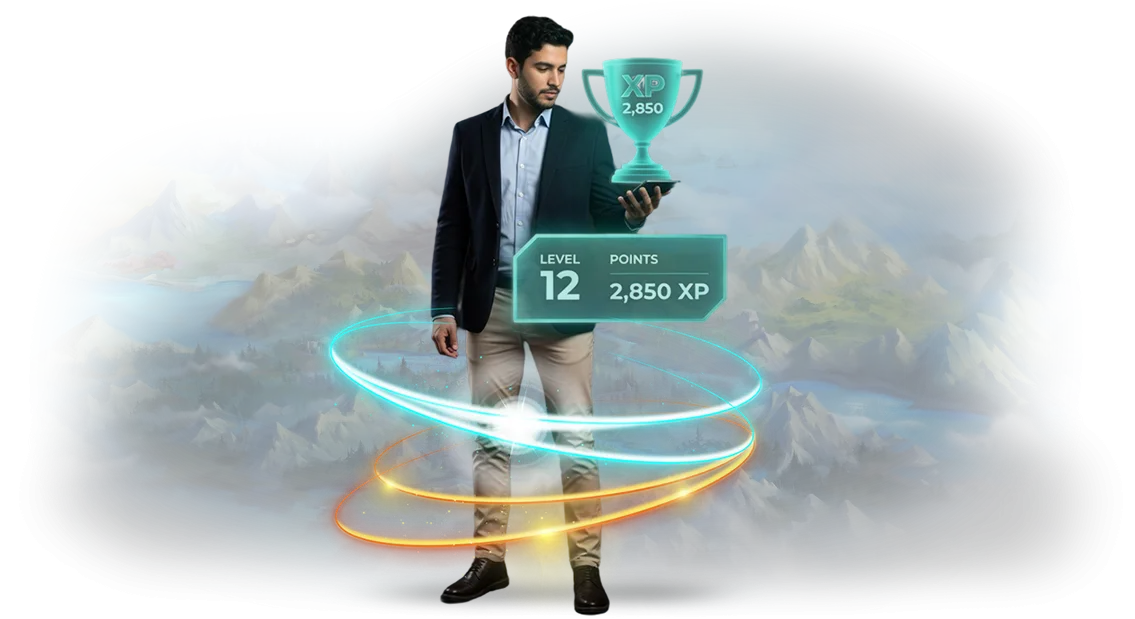
Employees losing interest? Gamification on Realwear will solve the problem
Employees lose interest when every day looks like the one before. A formal attitude to responsibilities leads to mistakes, slow service, and quiet job searching.
Experienced specialists leave, newcomers do not stay — each such case hits revenue, disrupts deadlines, and undermines reputation. Managers are forced to constantly look for people instead of developing the business.
Familiar trainings and paper instructions do not help: employees go through them just to check a box and forget everything within a week.
Gamification on Realwear smart glasses changes the approach — work prompts appear right before your eyes, hands remain free, and your gaze stays on the object. Training becomes part of a real task rather than a separate boring stage.
Points, levels, and competition with colleagues trigger excitement and a genuine desire to do the work better.
Engagement grows when a person sees the results of their efforts. With gamification, employees master operations faster, make fewer mistakes, and are more willing to take on complex tasks.
This is not entertainment but a work tool: it reduces turnover, cuts the cost of training newcomers, and increases overall team efficiency.
We design and implement this kind of mechanics for business: we adapt the game to your processes, connect it to metrics, and support it from idea to daily use.
We take on all the complexity of implementation so that you get the main thing — employees who are alive and engaged in their work, along with stable results and company growth.
What gamification of business processes delivers: 5 key benefits
Imagine employees performing routine operations with the enthusiasm of players: every task is a new level, every win brings points and recognition. Gamification of business processes does exactly that — it turns work into an exciting quest.
And when the process runs on Realwear augmented reality glasses, prompts and feedback appear right before your eyes — no need to look away at screens or instructions.
Growth in productivity and efficiency
According to research, companies that have introduced game mechanics report a 30–50% increase in productivity. Employees see the goal and their progress, so they complete operations faster. Process throughput grows, order completion times shrink — metrics visible within the first month.
Faster learning and onboarding
Newcomers settle into their roles faster when training happens in a game format. Interactive augmented reality scenarios make it possible to practice skills without the risk of mistakes on real equipment.
Onboarding shrinks from weeks to a few days, and mentors spend less time repeating the same instructions.
Team motivation without financial investment
Points, levels, rankings — this is healthy competition and a sense of achievement. The team itself strives to improve results instead of working under pressure. Staff turnover drops, loyalty grows — business stability strengthens without salary increases.
Measurable business results
Gamification produces numbers the owner can see: higher conversion, fewer errors, more repeat engagements. For example, game scenarios in a sales department generate up to 20% revenue growth.
Managers get transparent analytics for each employee and process, which means they can manage results rather than rely on luck.
Corporate gamification formats for different tasks
Every business process needs its own gamification format: what engages newcomers during training will not work for keeping an experienced team interested.
To help you choose the right tool for your specific task, we have gathered the main formats and shown the value each one brings.
We implement all the scenarios listed below in corporate applications adapted for the customer’s hardware — for example, on Realwear headsets.
This ensures stable operation on the shop floor, in the warehouse, or in the field: employees see interactive prompts right before their eyes and stay focused on the process.
| Format | Who it is for | What it gives the client |
|---|---|---|
| Employee training | New employees, workers in hazardous areas | Cuts time-to-competence by up to 2 times, eliminates mistakes during the first shifts |
| Competitions | Sales departments, production teams | KPI growth of 15–25% through healthy competition and a public achievement board |
| Quests | Corporate university, HR brand | Engages the team with company values, creates live stories for social media |
| Simulations | Technical staff, rare emergency situations | Practicing actions without risk to people or equipment, readiness for abnormal situations |
Choose the format that solves your task — and we will adapt the mechanics to your business specifics and embed them into your workflows.
If you are not sure what suits you best, start with a brief: we will analyze your situation and propose the optimal solution within 3 working days.
Development stages of a game application for your team
We structure our work so that you always understand what is happening with the project and when the first result will appear.
All gamification development stages are handled by a single contractor with a dedicated project manager — you do not need to coordinate designers, developers, and testers separately.
-
Brief and analysis of company tasks. We figure out which processes you want to improve: training, sales, internal communications. We define success criteria — for example, increased participation or reduced onboarding time. You get a clear picture of where gamification will deliver quick results.
-
Project management and implementation plan. We assign a responsible manager who prepares a plan with stages and deadlines. You know who is responsible for what and when interim demos will happen.
-
Scenario and game mechanics. We design the storyline, tasks, levels, and rewards. We adapt the interface to your team’s devices, including Realwear, so that everyone can participate at any moment — from a computer, tablet, or wearable device.
-
Technical implementation and integration. Developers build the application, connect it to your accounting systems and HR data, and configure access rights. You receive a reliable working tool, not a demo version.
-
Testing with real employees. We run a pilot with a group of users, collect feedback, and refine the user experience. This helps us avoid rejection of the tool after full rollout.
-
Launch, training, and support. We help embed the application into the daily routine, run short training sessions, and stay in touch after release. You get stable operations and measurable metrics: growth in activity, completed tasks, and internal ratings.
Dozens of our clients have already been through this path: it eliminates long approval cycles and “dead” prototypes. You move from idea to working gamification with clear results at every step.
What is included in the delivery of a gamified application
In the end, you receive not just an application but a complete corporate solution that integrates into your workflows and delivers measurable results.
We handle the entire implementation: from adapting mechanics to your company’s tasks to handing over a full set of materials needed for launch and further development.
- A ready-to-use gamified application optimized for Realwear hardware. Employees work in a familiar environment without being distracted by technical difficulties.
- Configured scenarios and levels that match your business processes. Reward mechanics, competition, and feedback are built into the logic.
- An admin panel for content management: you can change tasks, prizes, and rules yourself without developer involvement.
- Complete documentation: user guide, administrator manual, scenario descriptions, and regulations. Everything needed for quick commissioning.
- Training for employees and administrators: we conduct hands-on sessions so that the team works confidently from day one.
- Technical support and warranty maintenance for an agreed period. We help with updates and refinements as processes evolve.
- Methodological materials on engagement: how to sustain interest, run seasonal campaigns, and analyze results.
Case study: 40% engagement growth with gamification on Realwear
A manufacturing company with distributed warehouses came to us with a typical pain point: employees were not engaged in briefings, made mistakes, and work slowed down. Nobody read text-based regulations, and control required managers’ involvement. We proposed turning the execution of work processes into a game.
On Realwear terminals, employees received step-by-step scenarios with visual prompts, points for speed and accuracy, and a shared team ranking. The information they needed was always in front of them — no need to look at paper instructions or memorize complex algorithms.
The result after two months: engagement in processes grew by 40%, average task completion time dropped by 22%, and errors fell by a third.
Training happened without disrupting work, and turnover on the site decreased — people began to see their shift as a competition rather than routine.
Managers received a dashboard with live metrics: it was immediately clear who was falling behind and who needed support. Newcomer onboarding time decreased from two weeks to four days.
The teams themselves asked to expand the game to neighboring departments, and after the first success the client launched two more sites, adding a reward system for ranking leaders.
This case shows how gamification on Realwear solves real business problems: productivity growth, fewer errors, and genuine employee engagement — not just entertainment.
How to choose the right gamification format for your task?
Choosing a gamification format starts not with technology but with the main question: what exactly do you want to change? If employees are losing interest in training, you need a quest or competition — they create excitement and help people remember the material.
If you need to hold visitors’ attention at a booth, short interactive scenarios with quick rewards work better. And for ongoing team engagement, an application with accumulated points, levels, and statuses is a good fit.
The second step is to understand where the scenario will be used. A browser format is convenient for a corporate portal; a mobile app or a separate interactive zone works well at an event.
For work in unusual conditions, such as production or the field, we adapt the application to the customer’s hardware, including Realwear solutions.
The key thing is that the mechanics deliver a measurable result: growth in the share of people who complete training, number of sessions per day, frequency of returning to the application.
The next step is to define which business metric you want to improve. When you understand the goal in advance, it is easier to choose the mechanics. That is why at the start we run a short brief and propose two or three scenario options for your audience.
If you are unsure, start with a pilot: a mini-quest or a one-season test drive. Based on participant behavior data, you decide together with us whether to scale the solution or adjust it.
The right format is the one that solves a specific task and appeals to participants. There is no universal recipe, but with careful selection, gamification turns a one-off campaign into a regular practice and training into a familiar process.
We help translate a business goal into game mechanics and test them on real users. Leave a request — we will find a format that actually works.
Frequently asked questions about gamification implementation
Implementing gamification often raises questions: will the project drag on, will employees cope, will data be at risk. Let’s look at common doubts — honestly and with examples from practice.
How difficult is it to integrate gamification into our work processes?
Implementation does not require stopping work or restructuring business processes. First we run a short audit: we identify the key actions you want to strengthen and select game mechanics for them.
On average, the launch takes from two weeks to a month — timelines depend on the scale of the tasks. During the pilot, you get a clear dashboard with results, and employees get a simple application they can figure out within a day.
How quickly will employees get used to the new format?
Gamification, unlike new accounting systems, does not require lengthy training. The mechanics rely on intuitive behavior: earn points, see progress, receive feedback — everyone is familiar with this from everyday apps.
We build in an adaptation period during the first week: prompts, simple tasks, and clear badges. In our projects, more than 80% of participants are actively completing actions by day five.
Notifications and rankings come directly to the wearable device — there is no need to step away from core work to see progress.
Is company data secure?
All data is stored on your server infrastructure or in a secure cloud of your choice. We do not share information with third parties, and we separate access: each employee sees only their own metrics and anonymized positions in the ranking.
Corporate analytics — for example, departmental efficiency — is available only to managers. At the end of the project, you receive full rights to the system and can continue using it without our involvement.
What if gamification does not deliver results?
We do not launch projects blindly. First we work with one team or one area, recording the dynamics according to your metrics: task completion speed, quality, engagement. If the chosen mechanics do not work, we offer a free scenario adjustment.
This approach lets you verify effectiveness before scaling to the whole company. You make decisions based on numbers, not expectations. In our practice, 9 out of 10 projects are scaled after the first successful pilot.
Order gamification development for your business
Gamification is a tool that changes the behavior of employees and customers. To make it work, you need turnkey development: from task analysis to launch and support.
We take on the entire cycle, and you get a measurable result — higher engagement, faster learning, increased sales.
Over 10 years, we have created dozens of corporate solutions, including for Realwear wearable devices. You can order gamification that works in the most non-standard scenarios: in production, in the field, at an event, or in training. We do not stick to templates — we design mechanics around your business task.
What is included in turnkey development:
- Process audit and selection of game mechanics for your task.
- Scenario prototype and alignment of metrics before development starts.
- Application development with device adaptation — including Realwear.
- Testing on real users and refinement before launch.
- Administrator training and instructions for your team.
- Post-launch support, updates, and scaling.
Every item addresses a specific customer need: you do not waste time controlling a contractor and do not get a “raw” product. We are responsible for the result — a guarantee in the contract and post-project support.
To order gamification and get a cost calculated after audit, leave a request through the form or write to us in a messenger. We will contact you within one working day, clarify your goals, and propose a solution with clear timelines.
We start with a consultation — we will assess how gamification will affect your specific metrics.