

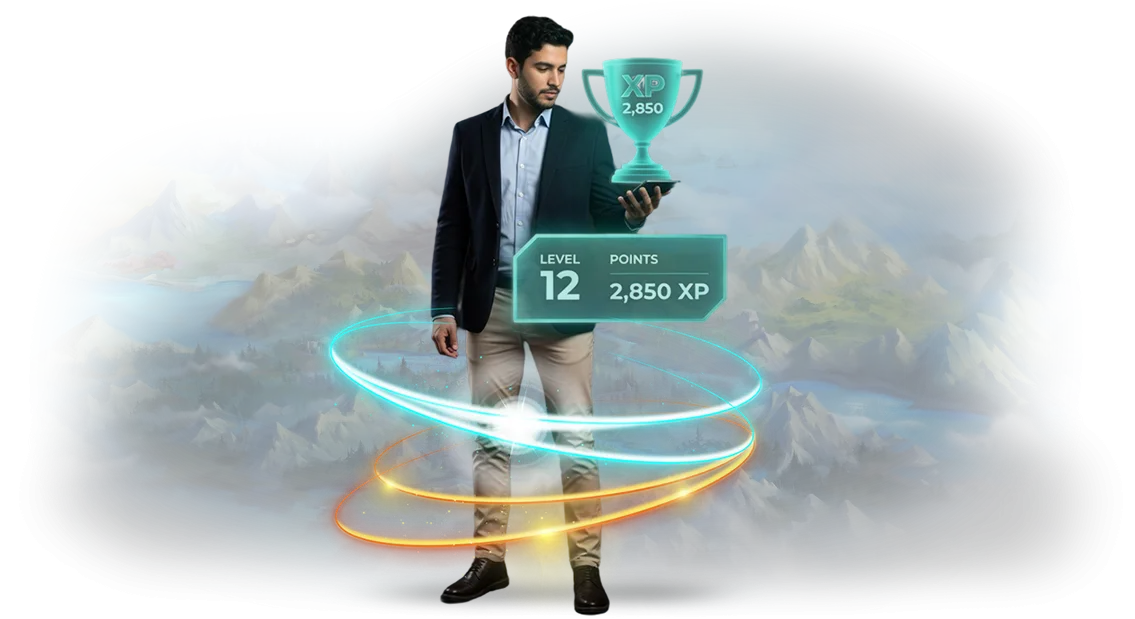
VR Gamification of Business Processes: Why Employees Lose Motivation
Employees grow tired of monotonous trainings and briefings. They go through the training formally, but a week later forget most of the material and return to work processes with old habits.
Staff engagement drops, employee motivation declines, and every new regulatory requirement meets internal resistance.
The problem is not the people — it's the format. Lectures and presentations don't provide emotional experience, and it is precisely this experience that cements a skill.
Without immersion in a situation, the employee doesn't "live through" the scenario, doesn't make mistakes, and doesn't see their consequences.
Processes remain an abstraction, and the business pays for downtime, excessive approvals, and mistakes that could have been prevented.
VR gamification of business processes shifts learning from passive listening to active action. The employee enters a realistic environment where they need to make decisions, respond to unusual situations, and see results immediately.
This taps into the natural interest in games, and staff engagement grows without force. VR learning solutions make it possible to practice rare and dangerous scenarios without risk to the business, anytime and anywhere.
We use these technologies to restore genuine motivation in employees and make processes clear, fast, and manageable.
Gamification of Business: 5 Benefits You Get Right Away
Gamification of business processes is no longer just entertainment — it is a working tool that quickly changes a company's metrics. Game mechanics in training and everyday tasks deliver measurable results within the first months of implementation.
Engagement growth. When employees see visible progress, a competitive element, and rewards, they complete tasks more actively, and interest in work noticeably increases. This affects customer service quality and the internal energy of the team.
Faster learning. Game-based simulators allow employees to master new skills 2–3 times faster: knowledge is reinforced by practice without interrupting the workflow. Employee training stops being formal and becomes an engaging experience.
Lower turnover. Constant feedback, achievement levels, and clear career milestones increase loyalty. People are less likely to leave a company where they see their growth and receive recognition.
Increased efficiency. Team competitions and gamified metrics encourage employees to do more without burnout. Productivity grows naturally, and managers get objective data for decision-making.
Stronger employer brand. Companies with modern digital tools and interesting learning programs attract strong candidates and become examples for the market.
For HR Directors
Gamification is an HR tool that combines onboarding, training, and motivation. You evaluate each employee's progress in real time, and corporate culture is strengthened through shared achievements.
For Department Heads
If your goal is fast results in specific business metrics, gamification turns routine processes into manageable, measurable ones. Clear rules and understandable metrics help align work with KPIs and show each employee's contribution to the overall result.
VR Gamification Formats: From Simulator to Team Game
The same tool can solve different tasks — from training to team building. We select a VR gamification format to fit a specific business goal: reduce errors, accelerate onboarding, improve negotiations, or strengthen team spirit. Below are typical scenarios most often requested by our clients.
| Format | For whom | What it gives the client |
|---|---|---|
| VR simulator | Manufacturing, service department, medical staff | Skill practice without risk to people or equipment. Mistakes on the simulator don't cost money — the employee arrives at the real site prepared. |
| Negotiation simulation | Sales managers, department heads | Safe practice of difficult conversations: handling objections, difficult clients, bargaining. The skill is established in 2-3 sessions and immediately transfers to real deals. |
| Team quest | Departments, project groups | Team building through joint problem solving in a virtual space. It shows who takes leadership, how roles are distributed, and where bottlenecks occur. |
| VR onboarding | New employees | Quick introduction to processes, product, and corporate culture. New hires start adding value 2-3 weeks earlier, and turnover during the probation period decreases. |
Formats are easy to combine: for example, first a VR simulator to practice basic skills, then a team quest for collaboration in adjacent roles. We design the scenario around your task, not the other way around.
We build our solutions on Unity for VR — this ensures stable operation on any headsets the company already has.
We measure the results together with you: by the number of trained employees, reduction of errors, speed at which new hires reach targets, and other metrics that matter to your business.
How Gamified Application Development Works: 6 Steps
Corporate gamification is not a game for the sake of a game, but a tool that must solve business tasks: training, onboarding, motivation. To make the result predictable rather than "whatever happens," development follows a clear framework. At each stage, the client sees intermediate results and controls the process.
1. Brief and task immersion We conduct interviews with you and key employees, and study the processes that need to be gamified. You receive a document with project goals, target audience, and success criteria — even before development starts, it's clear what we measure and why.
2. Task and audience analysis We determine which employee actions need to be reinforced and which simplified.
We analyze what motivates your team so the mechanics are engaging rather than "mandatory burden." You receive a description of use cases for different roles in the company.
3. Game mechanics prototype We create an interactive prototype of the future mechanics: how tasks look, "action — reward" loops, competitive elements.
You see and control the concept before the expensive development phase — changes to the prototype cost far less than changes to the finished application.
4. Scenario and visual style approval We finalize the story, role system, levels, and visual images. You receive a completed scenario document for approval, plus interface mockups in your brand style.
5. Application development We build the product on a professional engine according to all approvals. In parallel, we set up the reward and reporting system for administrators. You see intermediate builds and receive updates consistently — no surprises at the end.
6. Testing and launch We test scenarios with real users, collect initial feedback, and fix bugs. We launch the application, train your team, and hand over instructions. You get not just a product, but a working tool with support and a development plan.
What's Included in the Delivery: A Complete Kit for Launch
You receive not "source code on a disk," but a working tool that can be used in business immediately. The kit includes everything needed to launch gamification, train employees, and keep it up to date — without involving third-party developers.
Here's what's included in the delivery:
- Ready-to-use application — built and configured for your business processes, with virtual reality adaptation. It launches after a short briefing.
- Source code — remains your property. You're not dependent on us: you can develop the product with your own team or hand it to a contractor.
- Admin panel — a clear interface for managing scenarios, levels, and rewards. A manager can change the game rules themselves without involving a developer.
- Methodological materials — implementation scenarios, motivation recommendations, and typical mechanics for different departments. They simplify launch and help replicate gamification to other units.
- Documentation — instructions for installation, configuration, and operation. Written in language understandable to an administrator, not only a technical specialist.
- Employee training — we conduct a hands-on session for administrators and key users. After training, the team works with the system independently and trains others.
- Technical support — available by phone and messengers. We help during launch, answer questions, and support updates. Requests are processed within one business day.
How it works in practice: after the kit is handed over, your administrator masters the control panel in one day and launches the first scenario. From there, you decide what to change and how to develop the program. We stay in touch and step in when you need help or a new mechanic.
The delivery kit covers the entire cycle — from the technical side to training people. That's why gamification integrates into processes without downtime or a long warm-up period.
Case Study: How We Increased Engagement 3x
For Priorbank, we developed a corporate VR application on Unity that turned boring training into an understandable game. Before the project, employees took courses formally: the material was forgotten in a week, and test results were unimpressive.
The client didn't want just "another program" — they wanted a real increase in engagement and speed of staff training.
We created virtual branches with typical client scenarios — from opening a deposit to complex negotiations. Inside: points, levels, branch ratings, and instant feedback. Employees see their mistakes immediately, not at the end of the course, so they learn intentionally. Managers get clear analytics: who has already mastered the scenario and who needs help.
The result numbers speak for themselves. Staff engagement grew 3 times — according to surveys and in-app activity. Training took half the time: employees mastered service standards faster and made fewer mistakes.
The project covered more than 40 branches, and after the first launch, the bank ordered expansion into new areas — the contact center and claims handling.
This confirms that gamification in VR delivers measurable business impact, not just a "wow effect." We apply this approach to other clients' tasks — from onboarding new hires to sales training. Contact us to discuss your scenario.
How to Choose the Right Gamification Format for Your Task?
There's no one-size-fits-all answer. The choice of format is driven not by trends but by the business task: what you want to change in employee or customer behavior.
A VR simulator, a quest, and a simulation solve different problems, and it's important to understand which one you're facing.
If you need to practice skills in a safe environment — train equipment operation, sales, or actions in an emergency — choose a VR simulator. It immerses the participant in a realistic scenario where mistakes don't lead to real consequences but provide instant feedback.
Engagement and material retention increase many times over: the person doesn't listen to theory but acts.
When the task is to unite the team or launch a competition between departments, a quest works well. It's built on joint problem solving, unconventional approaches, and healthy competition.
The story and tasks can easily be "packaged" into brand values or internal regulations — participants absorb them through emotions rather than through a presentation.
Simulation is needed for strategic decisions and analytics. The participant controls a model of a business process, sees the consequences of actions in real time, and learns to notice interdependencies.
This format is for training managers, testing hypotheses, and practicing changes without risk to real operations.
It's easier to choose between formats together with an expert. During a consultation, we analyze your task, audience, and expected results, then propose a solution that delivers measurable impact — engagement growth, learning speed, improved team metrics. Leave a request — we'll select a format for your situation.
Frequently Asked Questions About Business Process Gamification
Implementing gamification raises questions for many managers. Doubts concern timelines, return on investment, and employee reactions. Below we answer the most common ones.
What if employees don't accept the game format?
Gamification doesn't turn work into a game; it embeds game mechanics into existing processes. Employees see clear goals, progress, and results — this engages even skeptics and strengthens team motivation.
How long does implementation take?
A pilot launch takes 4–6 weeks. During this time, we collect requirements, analyze processes, and design the scenario. You see initial metrics within a month, and fine-tuning continues without stopping operations.
How quickly will gamification pay off?
The effect is visible in key metrics: operation time decreases, turnover drops, quality improves. In team competitions, repeat order numbers grow by double-digit percentages in the first months. We provide an exact calculation after an audit.
What if the result doesn't show up?
We guarantee results. After the pilot launch, we analyze metrics, and if indicators don't grow, we refine the mechanics and scenarios at our own expense until the effect appears.
Why is VR needed in business process gamification?
VR enhances engagement and retention. Instead of flat tables, the employee enters a three-dimensional environment: they train on scenarios close to reality. This is effective for learning and for remote teams working in a shared virtual space.
Order Gamified Application Development for Your Business
Leave a request for a gamified VR application — and within one business day, we'll send a commercial proposal with cost calculation and timelines.
No abstract promises: first, we briefly discuss your task, then we suggest a format that specifically solves it — corporate training, product presentation, or team engagement.
After your request, you'll receive:
- Cost calculation for your use case — no hidden surcharges for revisions.
- Realistic launch timelines broken down by stages — from brief to final version.
- Demo access to a prototype or an example of a similar project so you can see how the mechanics work "live".
- Recommendations on scenario and metrics: how to measure results — from the number of active sessions to impact on sales.
- A clear integration plan: who does what, what data is needed from you, and at what point we step in.
- Consultation on format selection: VR simulator, interactive quest, or a hybrid with a mobile version.
We conduct all discussions in the language of your business — no technical details, only timelines, budget, and expected impact. To get started, just leave a request and roughly describe the task; from there, we'll propose a solution.
You can order development in one click — leave a request now, and within a day you'll know the cost, timelines, and next steps. If you need it urgently, we'll schedule a consultation at the nearest available time and answer all questions.