

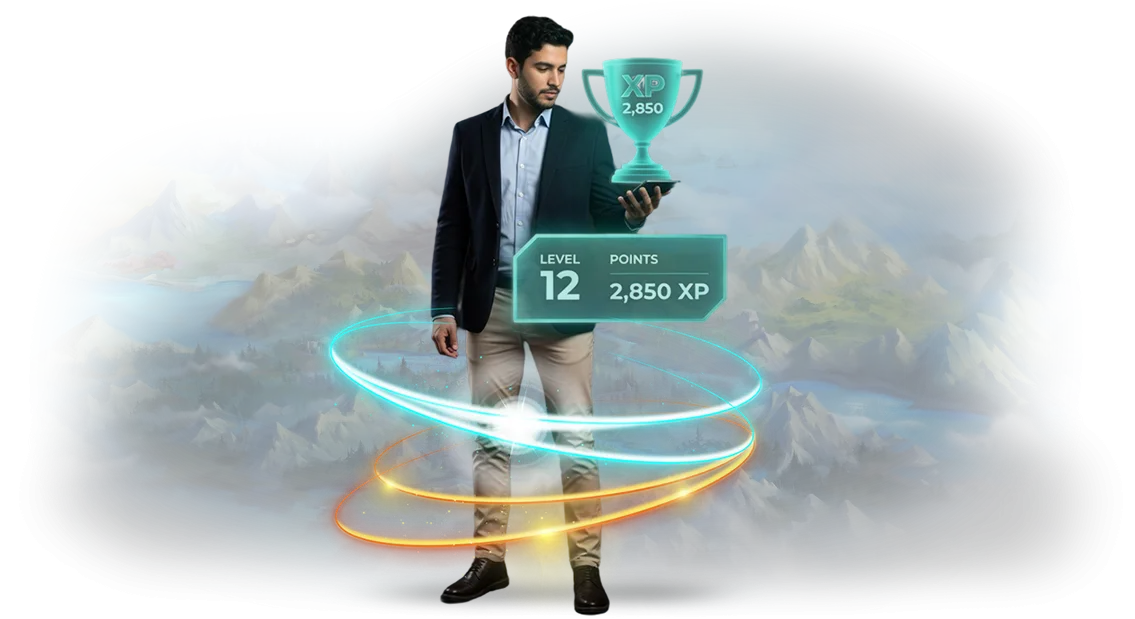
How Employee Onboarding Gamification Reduces Turnover
A new hire who leaves within the first three months costs the business more than it seems.
Beyond the direct costs of searching for a new person, the company loses mentors' time, resources invested in training, and, most importantly, the knowledge the employee has already acquired. Each such departure is double payment for the same work.
The problem is compounded by the fact that in the first weeks a newcomer feels lost: they don’t know where to go, whom to ask, or how to check their actions. Instead of diving into work, they spend energy on anxiety.
That’s why a large number of employees decide to leave within the first months — they never saw the results of their efforts and never felt part of the team.
Gamification of employee onboarding solves this problem systematically. Instead of boring rules and endless lectures, the newcomer gets a clear route with specific tasks and instant feedback.
They see their progress, unlock new levels, and understand how their actions affect the overall result. The person gets engaged faster and starts contributing several weeks earlier than the usual timeframe.
Reduced turnover here is not a promise but a consequence of a properly structured onboarding. When an employee sees a goal, receives support, and experiences quick wins, loyalty to the company develops.
And the faster a newcomer starts working independently, the fewer resources you spend on constant hand-holding, and the less temptation they have to look elsewhere. This lowers the cost of replacing an employee and retains valuable staff for the long term.
What the Business Gets from an Employee Onboarding Program
Business invests in onboarding not for the sake of procedure but for a predictable result: a new person must reach target productivity in 2–3 months, not six.
The onboarding program shortens that path: the employee understands processes faster, gets involved in tasks, and starts delivering value instead of spending weeks figuring things out.
Good onboarding directly affects turnover. When a newcomer has a clear plan for the first weeks, a mentor, and clear success criteria, they don’t leave within the first months — and that is precisely when most resignations happen. The company keeps the money that usually goes into new searches, hiring, and retraining.
Engagement is another measurable result. A person who feels structure and support from day one works with interest, not under pressure. They propose ideas faster, participate more actively in team life, and burn out less often.
As a result, the overall productivity of the department grows, not just the speed at which the newcomer ramps up.
An onboarding program is also a bridge between hiring and full-fledged work. The manager gets a transparent system: what happens with the employee each week, where they stall, and what help they need.
Instead of chaotic "you’ll figure it out as you go" — a manageable process for which HR and the line manager share responsibility.
We cover this need through gamification: we turn onboarding into a sequence of short steps with clear progress, feedback, and quick wins.
The employee sees their growth, the team sees the result, and the business gets a predictable path to productivity and reduced risks associated with newcomer departures.
Gamification Formats for Different Tasks and Budgets
Gamification is not one format for all cases but a set of solutions for a specific task and budget. One thing is to quickly bring a newcomer into work processes, another is to regularly maintain team momentum and motivate for results.
We select the mechanics for your scenario: from a light onboarding quest to a long-term competition system.
Below are the typical formats most often requested for working with employees. They differ in launch complexity and in which business indicators they primarily affect.
| Format | For whom | What it gives the client |
|---|---|---|
| Onboarding quest | Companies with regular hiring and a stream of new employees | Fast entry into the work rhythm: lower turnover during the probation period, less time on manual support |
| Employee competition | Sales departments, support, operations teams | Increased activity and plan completion: healthy competition raises KPIs without adding staff |
| Educational game | Departments where products, regulations, or standards change | Material absorption without boring lectures: employees apply knowledge in practice from day one |
| Team quest | Project groups and cross-functional teams | Better communication: fewer errors from misunderstanding, faster joint tasks |
| Long-term RPG mechanics | The entire company, when retaining strong employees matters | Higher loyalty and reduced attrition: people see progress and the connection between their tasks and business goals |
Formats are easy to combine: a quest at onboarding, a competition a month later, an educational game for a new task. We offer a solution for your timeline and budget — from a simple scenario that launches in a week to a comprehensive system with analytics for HR and managers.
How a Project Runs: From Brief to the First Game
We structured the work so that you always understand where the project stands and what you get at each step. No "black box": each stage ends with a clear result that you see and approve personally.
-
Brief and task immersion. We fix the goals: reduce the time for a newcomer to reach results, lower mentors' workload, increase engagement. We determine who will use the game and which business metrics we count as success.
-
Onboarding process analysis. We study your current employee journey: where motivation is lost, which stages drag, what prevents rapid integration. The output is a map of process points the game will address.
-
Prototype and scenario. We propose game mechanics and a storyline aligned with your corporate culture. We show how the employee progresses through stages, receives feedback, and sees their progress. You can make edits before development starts — this saves budget.
-
Design concept. We create the visual style: characters, interface, animations. We align the look so the game fits organically into your brand and appeals to employees.
-
Build and technical implementation. Our specialists assemble the game on professional equipment and time-tested tools. At this stage, we verify stability, loading speed, and correct display on all devices your employees use.
-
Focus-group testing. We run a pilot with a small group of newcomers, collect feedback, and refine the mechanics. You get real data on engagement before the full launch.
-
Launch and support. We integrate the game into the onboarding process, train administrators, and provide instructions. After launch, we stay in touch — adjusting the scenario, adding levels or new tasks as the company grows.
What’s Included in the Deliverable: A Ready-Made Kit for HR
You get not just a game but a ready-to-use tool for the HR department. The kit includes everything needed to launch and support onboarding gamification: from scenario to training materials. Nothing to fine-tune — just take and implement.
- Game scenario: a full cycle for a newcomer — from day one to completion of the probation period, with variations for different roles.
- HR guide: step-by-step instructions on how to run game sessions, embed them into the onboarding process, and adapt them to company objectives.
- Content rights: we transfer full rights to all materials — scenarios, texts, and mechanic descriptions. You can use and modify them without restrictions.
- Control panel for monitoring: clear statistics on stage completion — you can see where an employee gets stuck and how to speed up their path to full efficiency.
- Training materials for administrators: short video instructions and checklists so the HR team can launch the system independently, without external support.
- Launch plan: a two-to-four-week schedule with milestones and areas of responsibility — everyone knows what to do.
- Project result: defined measurable metrics — time to productivity, share of employees who successfully complete probation, newcomer engagement.
All materials are packaged in a clear structure so the HR department can start working immediately after handover. We also hold a short video meeting for the HR team — showing how to apply the tools to everyday tasks.
Case: How a Retail Chain Reduced Turnover After Hiring
The retail chain "Northern Labyrinth" Northern Labyrinth approached us with a sharp pain: after every seasonal hiring round, almost a third of newcomers left within the first three months.
Training on cash register rules and service standards took two weeks, but people didn’t stay — they were bored, didn’t feel connected to the team, and left for competitors for the same salary.
We proposed turning onboarding into a game: an employee progresses through stages "Trainee → Salesperson → Mentor" and earns ranks, badges, and real bonuses for completing work tasks.
Each newcomer gets a "digital curator" — the system prompts what to do next, while a live mentor only steps in when the player gets stuck. Interestingly, competition between stores started by itself: teams saw each other's progress on a shared screen.
After four months, we measured the result, and it exceeded the owner's expectations. Turnover among newcomers fell by 40% — a new employee now stays on average from three to one and a half months, and full mastery of all skills takes eight days instead of fourteen.
Sales by trainees who completed the game are 15% higher than those who studied with old instructions because they start offering add-on products faster.
The store manager said the key thing at an in-person meeting: "I used to spend time on control, now the system guides the newcomer itself, and I see who is stalling." The best proof of value is that six months later, "Northern Labyrinth" ordered gamification for shift managers and salespeople with five years of experience: the system was so well received that they decided to scale it to other roles.
For any business with a large workforce and turnover, this case is telling: gamification is not entertainment but a tool that reduces recruiting and retention costs.
If the cost of hiring one salesperson is substantial, including training, then 40% of retained newcomers per year means considerable savings for each store in the chain.
How to Choose the Right Gamification Format for Your Task?
There is no universal "magic" gamification format — the solution always depends on the specific task and the stage the employee is at. Some confuse gamification with one-off entertainment, others try to turn the entire work process into a game, which hurts productivity.
In practice, it’s important to separate two basic needs: quickly introduce a newcomer to the company or maintain their engagement over the long haul.
A short quest solves the onboarding task: new employees get a series of small assignments that guide them through key departments, documents, and people. This format is good for the first or second week, when reducing anxiety and giving a sense of quick success matters.
A long-term game works differently — it builds a habit and sustains interest for months when routine starts to take over.
The recommendation is simple: if your goal is to reduce turnover during the probation period and speed up full productivity, choose a short quest. If the task is to retain a valuable specialist and develop their skills, you need a long-term system with levels, goals, and rewards.
The optimal solution is often a hybrid scheme: a quick quest for onboarding, then a smooth transition into a long-term game. The team at our team helps you select and design such a path based on the business goal, not abstract mechanics.
The main rule is to start with a clear business metric: shorter onboarding time, reduced turnover, higher engagement. The story and reward system adapt to the format, not the other way around.
If you’re unsure where to start, come for a consultation — we’ll analyze your task and propose a scenario for a concrete result.
FAQ: What If the Game Doesn’t Work?
The client always asks: "What if the game doesn’t work?" That’s an honest concern — onboarding gamification affects a real process, and a mistake costs time. Our answer is a measurable result and risk management at every stage.
our team structures the process so the risk doesn’t materialize. First, we launch a trial version with a group of newcomers, check the metrics, and only then scale. If something doesn’t work as expected, we adjust it within the project at no extra charge.
What guarantees do we have that the game will work for us?
We don’t take on a project without measurable goals. At the start, we set indicators: the time for a newcomer to reach planned efficiency, the share of those who complete their probation period, and mentor engagement.
A trial run with a group of employees confirms viability before full rollout. If the effect is below expectations, we refine the scenario free of charge.
Who will support the game after launch?
For the first month, we accompany the implementation: answer questions, make edits based on feedback, and help mentors. Then we hand over documentation and train your team — HR staff and managers will be able to update content themselves. If needed, we remain on ongoing support.
Will the game interfere with regular onboarding processes?
Gamification integrates into the current onboarding program, not replaces it. We convert some materials into game format, add clear assignments and automatic feedback — this speeds up onboarding and reduces the load on mentors. Implementation takes 2–4 weeks, including approvals, and doesn’t require stopping work processes.
Launch Gamification and Get a Team Without Turnover
New employees don’t leave because of money — more often, boring onboarding "eats" them. Gamification turns the first weeks into a clear game with goals, rewards, and progress: a person gets engaged faster, sees their growth, and stays with the team.
For the business, that means lower hiring costs, faster time to full productivity, and a predictable result within the first month.
We’ve been doing such turnkey projects for over 10 years and work remotely all across the country. You don’t need to hire a separate developer or spend time understanding the mechanics — we take care of everything: from idea to launch and support. Right now, just leave a request to get a specific solution for your task.
Immediately after your inquiry, you will receive:
- a consultation on employee onboarding gamification
- a project cost estimate tailored to your team and business specifics
- a selection of suitable mechanics: quests, levels, competition, or collaborative scenarios
- a clear implementation plan with stages and timelines for the coming weeks
- answers to questions on how to measure gamification’s impact on turnover and onboarding speed
- examples of similar solutions for your industry
To order gamification, you don’t need to write a technical specification or describe processes in detail. Just leave a request — we’ll call you back, ask a couple of questions about the company, and offer a solution that will work for you.
Take the first step toward a team that stays. Fill out the form on the website — we’ll calculate the cost and prepare a proposal as soon as the next day.