

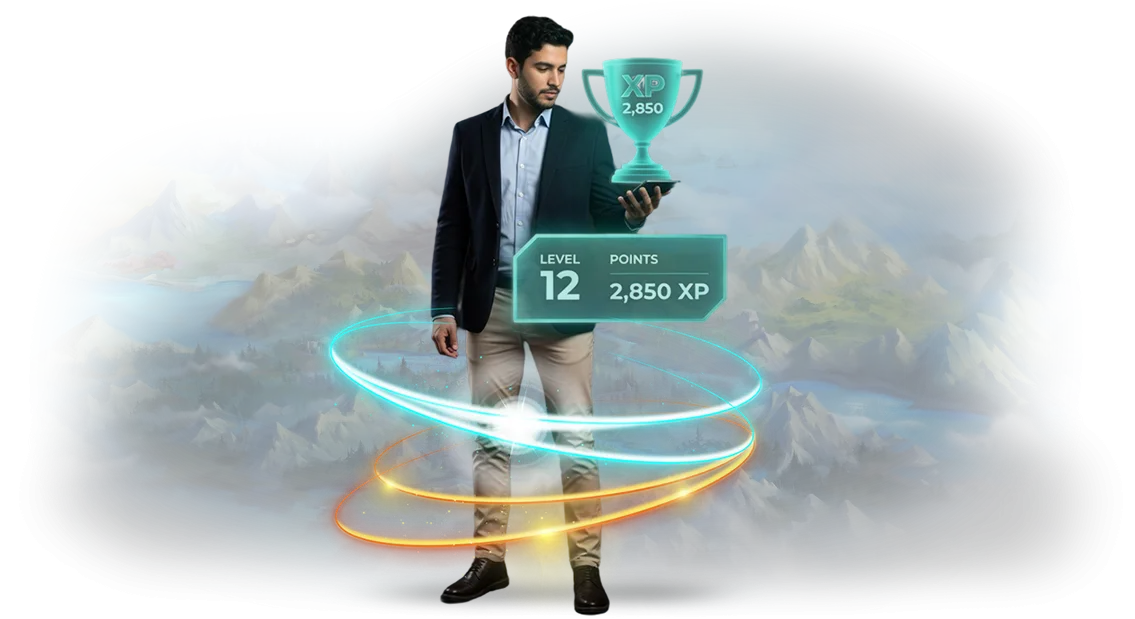
Gamification of Employee Retraining: How to Hold Attention
Employee retraining is a process that directly determines business agility. But when training comes down to lectures and mandatory tests, staff attention drifts, and knowledge never reaches practice. The result is lost hours, demotivation, and employees re-taking the same courses.
The problem is not the program content but the format. Adults learn better when they see personal results, compete with colleagues, and get quick feedback.
Gamification turns staff retraining into a clear game: tasks, levels, rewards for progress — all of this sustains interest without constant supervisor oversight.
For business, this means measurable employee engagement instead of “sat through it and forgot.” Employees themselves strive to close gaps because they find it interesting, not because they “have to.” This makes the motivation to learn intrinsic, and retraining results stick in everyday work.
We (our team) have been designing such systems for over 10 years: from simple leaderboards to full-fledged scenarios with team goals.
We start with a brief of business objectives, not with choosing a platform, so you get a solution that pays off through faster adaptation and lower turnover.
Want your staff retraining to deliver measurable results? Tell us about your challenge — and we’ll suggest which engagement format fits your team.
What Gamification of Company Business Processes Gives
Interest Instead of Coercion
An employee who is interested learns many times faster and more willingly. Gamification turns retraining into a game with clear goals, levels, and rewards — the person strives to complete the next stage on their own rather than clocking hours for formality’s sake.
This changes the attitude toward learning: instead of a boring obligation, there is excitement, healthy competition, and a desire to grow.
An engaged employee does not just master skills — they apply them enthusiastically in real work. For business, this means retraining investments pay off faster and produce measurable results, not just a checkbox saying the course was completed.
Fast Adaptation and Performance Growth
The faster an employee masters new processes, the sooner the company sees a return. Short game scenarios, clear stages, and instant feedback shorten the path from theory to practice.
The employee stops spending weeks getting up to speed and starts working confidently within the first few days.
This approach directly affects key business metrics: request processing speed, customer service quality, or sales plan fulfillment. Staff retraining stops being an “HR cost” and becomes a revenue growth tool.
Loyalty and Team Retention
When a company invests time and resources in a person’s development — and does it in an engaging format — the value of the job rises in the employee’s eyes. Retraining is perceived not as stress and a threat of dismissal, but as care and a benefit.
People stay where they can grow comfortably and enjoyably. Gamification reduces turnover among retrained employees — you keep experienced people and spend less on finding and hiring new specialists.
In the end, both business and team win: the company gets motivated professionals, and employees get a clear and pleasant growth path.
Gamification Formats for Employee Retraining
Employee retraining is not a lecture but a shift in familiar work patterns. If you simply hand out instructions, within a month people will fall back into old methods.
Gamification solves this: the employee joins the game, goes through scenarios, gets feedback, and locks in new skills. You don’t need to persuade anyone — the mechanics engage on their own.
Gamification formats differ in length, depth, and type of interaction. Short modules work for quick onboarding to a process, simulations work for complex competencies, and interdepartmental competitions work for team bonding. Below is a table to help you choose the option that matches your task and scale.
Format Guide
| Format | For Whom | What It Gives the Client |
|---|---|---|
| Learning games — quests, quizzes | Groups of up to 30 people | Quick engagement and knowledge checks in a light format |
| Simulations of work situations | Departments with high error risks | Practicing skills without consequences, fewer mistakes in real work |
| Interdepartmental competitions | Companies with several teams | Higher motivation and experience sharing between departments |
| Short interactive modules | Employees without leaving work | Material absorbed in small portions, constant engagement |
| Long-term level-based programs | For comprehensive retraining | Gradual skill development, motivation sustained for months |
Any format can be combined or adapted to your specifics. During a consultation, we will select the optimal set of mechanics for your task.
How a Learning Gamification Project Unfolds
Every leader values predictability when it comes to staff retraining. We have structured the process so you see results and understand what is happening at every step — from the first brief to program launch.
We start by diving into your business task. We find out who is going through retraining and why, what skills need to be developed, and what prevents employees from learning now.
Based on that, we design gamification mechanics that solve your specific problem, not just add points and ratings.
Program Implementation Stages
-
Brief and audit of current training. We gather information about employees, content, and retraining goals. You get a clear picture of where engagement is lost.
-
Scenario and mechanics design. We develop the game concept: storyline, tasks, levels, and a reward system tailored to your specifics. The output is a clear scheme of the future program.
-
Project approval and validation. We show the logic of the program, discuss timelines and expected impact. We make adjustments before development starts — you see the result in advance, without unnecessary risks.
-
Program development and assembly. We build the finished product: interface, scenarios, visual style. You get a working system, not a “constructor” that needs extra work.
-
Launch and employee engagement. We help roll out the program, train the team and administrators. First results are visible within the first weeks.
-
Support and analytics. We support the program after launch, collect data on progress, and adjust mechanics. You see performance growth, not just a completed-work report.
This approach removes uncertainty: you know in advance what the project will look like, when it will start working, and what effect it will bring to staff retraining. Everything else is our job.
What the Gamification Delivery Package Includes
When you buy gamification, you get not a presentation of ideas but a ready-to-run system that can be launched within days. The package includes all materials the HR team needs for employee retraining — from scenarios to clear reporting for management.
- Gamification scenario — a ready-made storyline, plot, and roles embedded in the retraining process. The employee understands the personal meaning: why to master a new specialty and what they will get at the end.
- Motivation mechanics — a transparent system of points, levels, rewards, and feedback. It works without manual counting, and HR sees who has joined the training and who needs extra attention.
- HR materials — announcement texts, email templates, feedback guides, and answers to common employee objections. You offload routine work and don’t have to invent from scratch how to engage the team.
- Launch instruction — a step-by-step plan: from assigning responsible people to scheduling stages and the prize fund. You implement retraining without an external consultant and in a tight timeframe.
- Reporting dashboard — clear metrics: completed modules, progress speed, activity by team. You see the training effect in numbers, not general words.
- Flexible business settings — mechanics adapt to your learning system, corporate culture, and team composition. The package remains useful even when retraining goals change.
- Start-up support — an onboarding meeting for HR and support during the first weeks. We answer questions and help you set up the process so gamification delivers results from the very beginning.
Case Study: How Gamification Accelerated Staff Adaptation to New Tasks
Logistics operator Northern Wind was implementing a new order management system. Only one in three employees managed to retrain within the set deadlines — the rest got lost in instructions, and mentors could not keep up with questions. Work stalled, and the launch was under threat.
We proposed replacing passive training with a game scenario. Employees trained in a team competition format: tasks gradually became harder, and the team earned points for successful operations and tracked its rating. The familiar game mechanics reduced the fear of the new system and sparked healthy excitement.
Within four weeks, training engagement grew by 84%, and retraining time dropped from three weeks to two. 96% of employees passed the assessment on the first attempt, and the number of errors in real work fell by 60%. Employees began solving complex issues on their own — previously only mentors did that.
The HR director at Northern Wind summed it up: “Gamification turned a mandatory course into an exciting competition. We got not just a trained team, but people who want to apply new skills. The adaptation speed exceeded expectations.”
This gamification case shows: engagement and retraining speed are measurable results. If your goal is to accelerate staff retraining and adaptation to new tasks, we will build the same process for your business.
How to Choose the Right Format for Your Task?
There is no universal format — the right gamification always grows out of a specific task.
It is important to understand what you want to achieve: quickly introduce employees to a new profession, deeply retrain experienced specialists, or practice hands-on skills to the point of automation.
This determines whether it will be a team competition, a storyline quest with levels, or a realistic simulation of a work situation.
We start with an audit of the retraining process: we study the current training program, materials, employee motivation, and the bottlenecks where people lose interest or fail to absorb the material. Only after that do we offer a format that solves exactly your problem.
For example, mass training on new standards works well with short game modules and quick wins, while complex technical roles require multi-stage scenarios where every decision brings the trainee closer to a real work task.
The second important factor is the audience. Experienced employees with many years of tenure perceive gamification differently than newcomers, and people without digital preparation may be intimidated by a complex interface.
Therefore, we choose mechanics that are clear and comfortable for your team while keeping the excitement and healthy competition. Engagement directly depends on how well the game “fits” the usual work rhythm.
A properly chosen format delivers measurable results: retraining accelerates significantly, employees reach the required performance level faster, and knowledge is cemented in practice rather than forgotten within a week.
If you are unsure where to start, we will conduct an audit and offer 2–3 options with an effectiveness forecast for your case. That helps you make a decision without the risk of wasting your budget.
Common Client Concerns Before Launch
Employee retraining is an investment that pays off only when the team is truly engaged. That is why we hear legitimate objections from leaders: will the game work, will employees refuse to participate, will the budget be eaten up by rework.
We mitigate gamification risks before the start — a short audit, a scenario tailored to your corporate culture, and a pilot on a small group. You see the first results within two to three weeks and make decisions based on numbers, not promises.
Below are answers to the main questions.
What if gamification does not work for your team?
We run a pilot in one department: within 2–3 weeks the engagement dynamics and training progress are visible. Based on the results, we adjust the mechanics and only then scale — you are not risking the whole project at once.
Is it expensive to rework after launch?
The system is designed modularly: scenarios and rewards change without rebuilding the entire platform. Post-pilot refinements are included in the estimate, so adjustments are not a financial surprise but a planned stage.
Will employees take the game seriously?
We show how the game helps master skills and get results faster — it is motivation, not entertainment. We adapt the mechanics to the team culture: competitive or cooperative formats, and we involve opinion leaders for natural engagement.
Ready to Strengthen Staff Training? Request a Gamification Plan
Employee retraining is not just learning new skills — it is a shift in familiar behavioral patterns. If people are not engaged, knowledge stays theoretical: courses are completed, but work continues as before.
Gamification turns personnel training into a measurable tool that accelerates employee growth and reduces resistance to change.
Request a gamification plan — and get a concrete implementation scheme for your task. We will analyze your process, find the points where motivation is lost, and propose mechanics that engage employees from day one.
The gamification request includes:
- A consultation on your current retraining system — we identify where mechanics will have the greatest effect.
- Target audience analysis: age, motivators, comfort zone — so gamification works specifically for your team.
- An implementation plan with stages, timelines, and responsible people — no theory, only practical steps.
- Examples of game mechanics for your business: quests, levels, team competitions, progress tracks.
- Recommendations for personnel training: how to embed game scenarios into daily processes, not separate “holiday” activities.
- Ways to measure results: which metrics will show growth in engagement, learning speed, and impact on business indicators.
Leave your request — and within one business day we will contact you, clarify the details, and prepare an implementation plan. We adapt the solution to the specifics of your team so that the first results appear within the first weeks. Get a practical tool that turns retraining into a growth driver, not a formal obligation.