

Recruiting mistakes cost you top candidates and time
Top candidates rarely wait. While you run three rounds of interviews and approve an offer internally, a valuable specialist is already accepting another offer — the market moves fast, and a pause of several days reads as employer indecision. As a result, you get not the candidate you wanted, but someone who simply had no better option.
The cost of such a mistake is not just time, but company money. An open position slows down projects, overloads the team, and delays the launch of new initiatives.
Every month of searching for the “ideal” employee costs more than it seems: lost revenue, burning deadlines, and the nerves of those covering someone else’s work.
Candidates also walk away for another reason: they feel bored and confused. Impersonal emails, long waits for a reply, and cookie-cutter interview questions all create the feeling that the company does not value people.
Strong specialists are especially sensitive to this: they want to see a modern approach before they even join.
This pain point can be addressed at the hiring stage.
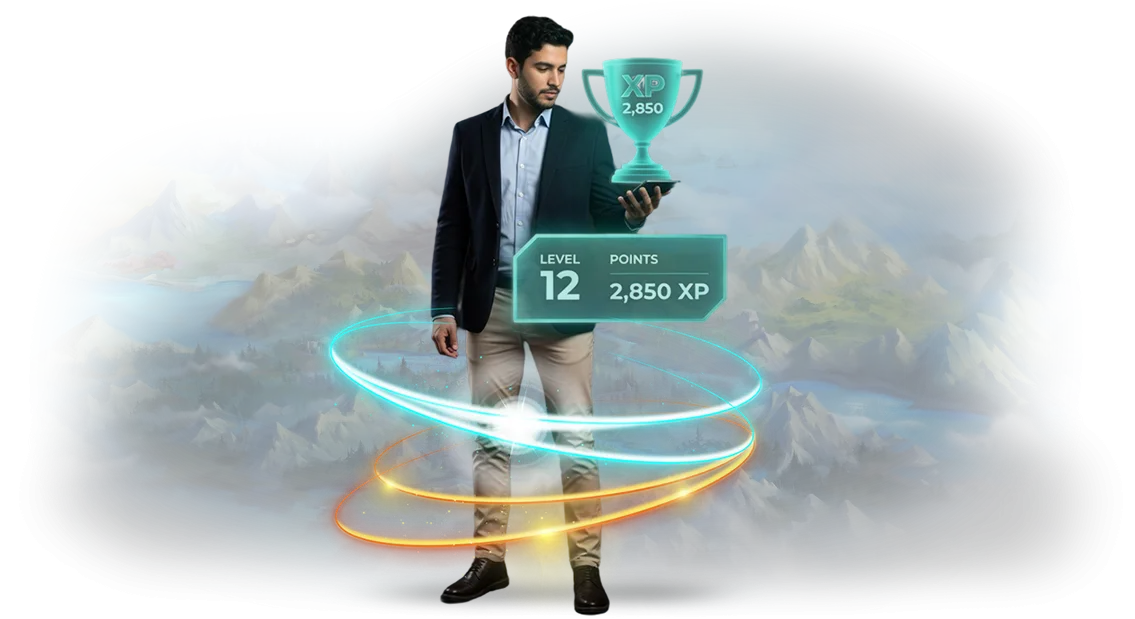
Gamifying recruiting processes turns hiring from a tedious routine into a transparent and engaging scenario: the candidate is engaged from the first touch, learns more about the company culture, and you make faster decisions based on real actions rather than just resumes and answers to standard questions.
What gamification brings to the employee hiring process
Recruiting gamification turns the boring process of applying for a job into an engaging interaction with the brand. The candidate doesn't just send a resume — they complete short game tasks, take surveys, and get instant feedback.
This lowers the barrier to entry and increases the number of applications, especially among young professionals used to interactive formats.
The benefits of game mechanics go beyond catching attention. Tasks modeled on real work situations let you assess a candidate's skills before the interview.
The HR specialist gets an objective picture, filters out unsuitable candidates early, and spends time only on those who genuinely match the vacancy. As a result, time-to-hire shrinks and the team fills the position faster.
Candidate loyalty is another important result. Gamification shows that the company cares about the applicant experience, keeps up with the times, and is not afraid of innovation.
This approach is memorable, boosts employer brand awareness, and increases the likelihood that even unsuccessful candidates will recommend the company or return later.
Hiring efficiency comes from transparency and speed. Game mechanics give candidates clear evaluation criteria, reduce stress, and make the process fair. For the business, this means lower cost per hire, less turnover, and higher-quality employees from the start.
It's important that gamification is well-thought-out and aligned with your goals. We design scenarios that strengthen corporate culture and don't turn hiring into a pointless game.
As a result, you get more motivated applications, fast onboarding, and a team that shares the company's values.
Gamification formats for different recruiting challenges
The same hiring process requires different tools: speed matters for mass recruitment, motivation for rare specialists, and precision for assessing soft skills.
We select the format for your task so the recruiter doesn't drown in resumes and the candidate understands from the first touch that you value their time.
Three formats for three tasks
| Format | Recruiting task it addresses | What the business gets |
|---|---|---|
| Quizzes for screening | Mass hiring: frontline staff, operators, sales managers | Fast pre-interview filtering, a wider candidate funnel, less manual recruiter work |
| Quests for recruiting | Rare professions: engineers, IT specialists, unique experts | Validation of real motivation and skills, engagement before the interview, memorable employer brand |
| Selection simulations | Soft skills assessment: teamwork, stress tolerance, customer orientation | Objective result instead of “liked it / didn't like it”; candidates demonstrate behavior rather than talk about themselves |
The formats can be easily combined in one process: a quiz filters out half of the applicant pool, a quest tests expertise, and a simulation completes the assessment.
You get a transparent hiring system where every stage works toward a result — from the first click to the employee's start date.
How we implement game mechanics in your recruitment
Implementing gamification in recruitment is not a one-off entertainment but a structured process that improves the quality of applications and accelerates hiring. To make the mechanics deliver results, we walk with you from task discovery to support of the launched solution. Below are the project stages we follow in every engagement.
- Brief — we dive into your vacancies, candidate profile, and current recruiting challenges. We find out at which stage applicants drop off and what prevents them from reaching the interview.
- Plan — we propose a gamification concept and select formats for your industry, from short HR quests to simulations of real work tasks. We immediately state timelines, budget, and the expected effect in numbers.
- Alignment — we show a prototype of the future mechanics and discuss the scenario and design. You provide feedback, and we adjust within a couple of days rather than months, so the launch isn't delayed.
- Implementation — we build game modules and integrate them into your recruiting funnel. At this stage, you see how candidates interact with the game at every step, from application to offer.
- Launch — we test the mechanics on a control group of real candidates and fine-tune the settings together with you. We train your team to work with the new tool so they can use it confidently.
- Support — we analyze metrics: conversion to applications, completion time, and the share of candidates reaching the interview. We refine the mechanics and help you scale it to other positions in the company.
What a candidate selection gamification project includes
Candidate selection is a series of decisions where every mistake is costly. Resumes and standard interviews don't show how a person will perform in real work, which is why companies are increasingly turning to games.
But gamification only works when it's not a single test but a holistic project for your funnel. Here's what this package includes.
- Game mechanics tailored to your recruiting funnel. Instead of abstract questionnaires, game tasks that recreate work situations. You test exactly the competencies that matter for the open position.
- Scenario and visual design from the brand's perspective. The candidate immerses in the company's story rather than taking a boring test. This increases engagement and leaves a positive impression of the employer.
- Integration with your applicant tracking system. Results from each game automatically flow into your funnel: the recruiter sees the outcome directly in the candidate's card, with no manual data entry.
- Training for recruiters and hiring managers. We explain how to interpret results, which signals are red flags, and which are a reason to invite the candidate to the next stage.
- Analytics for each candidate and the funnel as a whole. Stage conversion, completion time, comparative candidate profiles. You see who the strongest candidates are before the interview.
- Recommendations for using the game in different hiring scenarios. Mass recruitment, targeted positions, assessing internal employees during rotation — each scenario has its own application approach.
In the end, you get not just a set of materials but a working selection tool. After launch, the team uses the game as part of the standard funnel, and you get transparent data for hiring decisions.
Case study: how a game quest accelerated hiring at an IT company
At the IT company Selecta, hiring developers took up to two months.
There were plenty of applications, but most candidates were filtered out at the first interview — recruiters were drowning in manual screening, and the business was losing money and deadlines on every unfilled project.
We suggested replacing the standard introductory call with a game quest. The candidate enters a scenario that simulates the team's real tasks: reading code, finding errors, choosing the right solution.
Instead of a boring conversation, it's an engaging 20-minute challenge that reveals the specialist's level on its own.
The results of this gamification case exceeded expectations. In three months, the number of applications grew 2.5 times, and time-to-hire dropped from 45 to 18 days.
Meanwhile, 87% of candidates reached the end of the game — even those who didn't pass left positive feedback about the process. Importantly, the game not only reduced the recruiters' workload but also improved the quality of candidates reaching the final stage.
The company saved hundreds of employee hours and filled key positions without expensive job aggregators.
What the client values most is that this is not a one-off campaign but a systematic tool. The quest was so well received that the company rolled it out across all technical vacancies and ordered a new game for onboarding new employees.
A steady flow of quality applications and a short hiring cycle became their competitive advantage in the market.
Answers to questions about recruiting gamification
Recruiting gamification sounds promising, but managers naturally have doubts: will this format work for our company, how do we measure the real impact, and will it put extra strain on the IT team. Below, we briefly answer these questions so you can make an informed decision.
Will gamification work for any company?
Yes, if you choose the right mechanics. For mass hiring in retail or logistics, fast quizzes and competitions work well; for rare specialists, scenario-based simulations close to real tasks are effective.
We adapt the format to your industry, vacancy level, and corporate culture, so gamification fits naturally into the hiring process rather than looking like a foreign element.
How do you measure results?
We track specific metrics: time to fill, conversion from application to interview invitation, number of candidates reaching the offer stage, and the percentage who successfully pass the probation period.
We compare these figures with your current statistics — you see the changes in numbers, not vague statements. If needed, we set up a dashboard where results are visible in real time.
Will this overload the IT department?
No, because we handle the technical side. Gamification integrates into your current recruiting system without major restructuring — development, integration, and maintenance remain the responsibility of our team.
Your developers will continue working on priority tasks, while we ensure stable operation and updates of the mechanics.
Still have doubts? Write to us — we'll review your situation and show how gamification can speed up hiring specifically for your business.Shall we discuss gamification for your recruiting?
Shall we discuss gamification for your recruiting? Start with a short request — in return, we'll send a preliminary implementation plan, a cost estimate, and practical examples. No obligations: first you see how it works, then you decide.
The gamification request takes a couple of minutes and gives you:
- a personal consultation on your hiring process;
- a preliminary implementation plan with stages and timelines;
- a cost estimate for your scale — from 5 to 500 vacancies;
- examples of gamification for similar companies and roles;
- recommendations on metrics: time-to-fill, conversion to offer, candidate retention;
- answers to questions about how the system will fit into your current process.
After the consultation, you'll receive a clear implementation plan: what we change, in what order, and what results to expect. If the preliminary plan works for you, we move on to detailed development and launch. Typically, the first changes in the process are visible within a few weeks.
Leave a request — we'll get back to you within one business day and review your case. The sooner you start, the faster you'll see the impact on hiring speed and team satisfaction.
How to choose the right gamification format for your task?
Choosing the right format starts with the question, “What do we want to change in our hiring?” If you lack applications, a short intro game on the job posting page will help. If you need to filter out unsuitable candidates, use a game test at the screening stage.
If you need to assess skills, a case simulator that shows a person's real work style is best. Each stage of the recruiting funnel has its optimal format — and that's the first step to a solution.
Then we look at the audience. Students and graduates find it easier to engage with quick quizzes and trivia; managers and specialists prefer business simulations and decision-making scenarios.
Taking the candidate profile into account, we match gamification to both the task and the communication style people are used to, without spending the budget on unnecessary mechanics.
The third step is to agree on a success metric. It could be the number of candidates who complete the game, the share of suitable candidates based on game results, or average time-to-fill. A clear metric lets you compare formats and spot early on what needs to change in the scenario.
An implementation tip: start with one part of the funnel and don't overload candidates. It's better to replace one boring questionnaire with a game scenario and watch the reaction.
If the result is positive, we expand the mechanics to the next stages, gradually building a full system.
We help you choose the format before development even begins. During a short audit, we review your situation, suggest two or three suitable solutions, and explain the expected impact of each. You make an informed decision, and we handle implementation and launch.
In the end, gamification becomes not entertainment but a working recruiting tool embedded in your processes.