

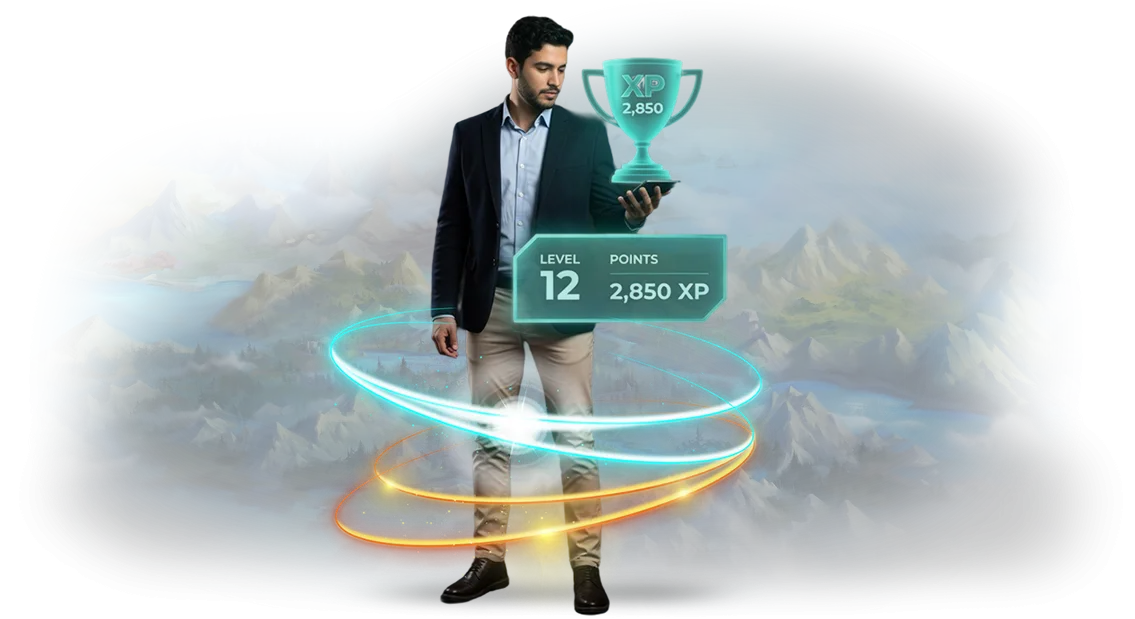
Gamification of team building: how to turn a team into a community
A formal corporate event or a one-off quest outdoors no longer solves the main task — it doesn't create a lasting connection between people. Employees return to routine, and team spirit dissolves until the next event.
Meanwhile, the business loses not only in communication speed but also in people's desire to give their full hundred percent.
Team gamification changes the approach to engagement: instead of coercion and boring regulations — clear goals, levels, rewards, and healthy competition.
When an employee sees their progress and contribution to the overall result, they stop being just a performer and begin to feel part of a living community. Such corporate team building works not for a single day but constantly — through game mechanics embedded in everyday work.
Engaging employees through play solves several tasks at once: internal motivation grows, connections between departments form faster, and turnover decreases.
People come to work not just to clock in but to participate in a common cause where their efforts are visible and rewarded. A manager gets a transparent picture of who engages in processes and how, and can support or redistribute the workload in time.
Gamification of business processes is not only about one-off activities. It's about systematic mechanics: common goals, team challenges, feedback, and recognition of achievements that work every day.
Game elements help turn routine tasks into a clear growth trajectory and corporate culture into a living environment where people want to stay and develop.
In the end, the team becomes a community united by shared values and interest. This directly affects business efficiency: projects launch faster, clients are retained better, and employees themselves recommend the company as a great place to work.
We help build such a system for your tasks so that the game brings measurable results within the first months.
What game mechanics in processes give a business
The idea of gamification itself is often perceived as "toys for employees," but the business result says otherwise. When routine processes turn into a system with clear goals, levels, and rewards, employees begin to see meaning in every action.
This directly increases loyalty: a person feels that their contribution is noticed and valued, not just "the plan is demanded."
The first thing a business gets is growth in measurable KPIs. Game mechanics don't replace work; they redirect attention to key indicators: request processing speed, service quality, sales plan fulfillment.
Employees themselves strive for target numbers because achievement becomes visual and personally meaningful. For a manager, this is a transparent picture of who moves toward results and how, without the need for total control.
For HR, gamification is a tool for retaining and motivating staff without constantly raising salaries. People need recognition, competition, and a sense of progress.
A system of points, ratings, and statuses creates healthy competition within the team and helps newcomers get involved faster through clear scenarios and quick wins.
Finally, game mechanics work to shape corporate culture.
Instead of abstract slogans about company values, employees get concrete actions for which they receive "pluses." This changes behavior: people begin to show initiative, help colleagues, and meet deadlines responsibly — not under pressure, but because it's beneficial and interesting for them personally.
We build a system that is embedded in your real business processes rather than existing separately from them. You get not just a motivational overlay but a manageable tool that reinforces the behaviors you need and converts them into measurable results for the company.
Gamification formats for business tasks
Gamification of business processes delivers results only when the format matches the task. You can't equally engage a team in a strategy session and in routine reporting — different mechanics are needed. We've identified three basic formats that cover most requests from team building to training.
| Format | For which tasks | What it gives the business |
|---|---|---|
| Team quest | Team bonding, employee introduction, identifying leaders | Live communication, role distribution, increased engagement |
| Business game | Process training, skill practice, hypothesis testing | Risk-free practice, ready-made solutions, competence assessment |
| Marathon | Long-term motivation, habit building, achieving plan targets | Systemic interest, competitive spirit, measurable efficiency growth |
A quest is a quick way to reset relationships in the collective and break down barriers between departments. A business game immerses participants in a simulated situation where they safely practice new skills and decisions.
A marathon stretches gamification over weeks and months, gradually turning desired actions into a lasting habit.
It's important to understand: formats don't compete but complement each other. For example, a short quest is a great warm-up before a business game, and a marathon with weekly mini-tasks reinforces learning outcomes.
We'll help you choose a scenario for your task or combine several formats into a single system adapted to your corporate culture.
We can also add elements of competition, collective achievement, or individual progress as needed — it all depends on the goal you set for gamification.
Turnkey team building development process
Turnkey team building development is a clear route without surprises. The development stages are structured so that you always know what's happening and can influence the result. We take on the entire journey: from the first brief to the game launch and post-event support.
- Brief and immersion in the task. We listen to what goals the team has: bonding, tension relief, engagement with a new strategy. We capture expectations on timing, number of participants, and format.
- Concept and scenario development. We propose game mechanics that solve a business task, not just entertain. We show how each stage of the game connects to the event's goals.
- Project approval. We discuss the scenario, rules, duration, and roles. We make edits before production begins — you get exactly the format you expected.
- Production and preparation. We prepare materials, tasks, characters, and all the technical parts. We work with professional equipment so everything runs smoothly on game day.
- Testing and gamification deployment. We run the mechanics on a pilot group, checking timing and logic. This eliminates surprises and lets us fine-tune the process before the official launch.
- Game launch. We run the event: hosts, coordinators, on-site technical support. Participants fully immerse themselves in the game, and you watch the result without organizational hassle.
- Support and analytics. We gather feedback and show which goals were achieved. If needed, we adjust the program and help run subsequent sessions.
This approach removes the client's main risk: the game "not landing" or failing for technical reasons. You control the key checkpoints, and we're responsible for readiness and results on the event day.
What's included in the gamification delivery
You receive not scattered mechanics but a complete package that can be implemented immediately after handover. Everything needed for launch and support is organized into a clear structure — from scenario to regulations.
What exactly you receive
- Game scenario — logic and mechanics described with your business processes in mind. It's clear how to play, what roles participants have, and how to achieve the goal.
- Game rules — simple and unambiguous wording that won't require additional explanations for employees.
- Methodological materials — instructions for the host, reminders for participants, task templates, and evaluation sheets.
- Gamification regulations and documentation — launch procedure, checkpoints, result evaluation criteria. You always see what works and what should be adjusted.
- Technical project support — assistance at launch and throughout the process: we answer questions and help adapt mechanics to changing tasks.
How this works in practice
All documentation is delivered in a convenient format — employees get involved faster, and you spend minimal time on explanations. If the task changes, we adjust the scenario so that gamification keeps delivering value instead of becoming a formality.
Important: the package includes instructions for self-updating the rules. This means you're not dependent on the contractor — the team can adapt individual elements without involving developers.
Case study: how higher engagement affected sales
When the coffee chain "Cup&Cake" with 15 locations faced falling sales, the problem turned out not to be the coffee quality. Guests returned less often, staff performed instructions formally, and standard motivations stopped working.
Management was looking for a way to boost revenue without big advertising investments — and we proposed gamification of business processes as a solution that affects the result through team engagement.
Instead of boring performance metrics, we launched game mechanics inside each location. Baristas earned points for service speed, friendliness, and suggesting desserts. Screens with location ratings appeared at the registers — this created healthy competition between teams.
Employees themselves began recommending profitable combinations to guests because it earned points for their coffee shop. In the end, the game became part of daily work rather than an extra burden.
The results were measured after a month. Staff engagement grew to 86% — virtually all employees participated in game scenarios daily. The average check increased by 12%, and the number of repeat visits by 18%.
On a peak day, 47 game sessions ran in two hours, and every fourth one ended with a dessert purchase. The costs of the mechanics paid off within the first month, and dessert sales grew by a quarter.
What this means for business
Gamification turned routine into a game, and the game into steady revenue growth. Sales growth was a consequence of engagement, not one-off promotions.
After two months, the client ordered an extension of the program to all 15 locations and returned to launch new mechanics for the summer season. A repeat order and scaling are the best proof that gamification works as a systematic tool for increasing profit.
How to choose a team building format for your task?
There is no universal "right" team building — what bonds a sales department can fail on a production floor. The choice of format starts not with the activity but with the question: what business task are you solving?
If you need to relieve tension after a tough quarter, that's one scenario; if you're launching a new product and synchronizing adjacent departments, it's quite another.
Key selection criteria are team composition, number of participants, available time and venue, and level of physical fitness.
For a team of 15 people of different ages, intellectual games and quizzes work well; for a large group of 100+ employees, team competitions with group rotation work better.
It's important that everyone feels included rather than a spectator — otherwise, team building turns into a "mandatory event."
Specific requirements of your industry are also considered. In companies with high workloads and strict corporate culture, formats are needed that relieve stress but don't break the chain of command. For remote teams — online games that unite employees from different cities.
For production teams — activities with clear physical limitations and no risks. We identify all these nuances at the brief stage.
Our task isn't to sell a ready-made scenario but to select one for your goal, budget, and corporate culture specifics. We offer 2-3 format options with reasoning on why each will work, and refine the mechanics after a test session.
You get not an abstract "team building" but a tool that measurably affects team interaction and work results. Tell us what task you're solving — we'll help choose the right format and adapt it to your team.
Frequently asked questions and client concerns
Any new tool in team management raises questions: will the project fall through, will employees refuse to participate, when will the payoff come.
This is especially relevant for team building tasks — after all, you need to unite people, not just launch a "toy." We've been implementing gamification in various industries for many years and know how to ease these fears.
Is gamification hard to implement, and who will handle it?
We take the entire process on ourselves: from task analysis to launch and support. You don't need to hire new specialists or halt department work. At the start, we conduct a short brief — then our team gets involved and proceeds according to plan.
What if employees don't want to participate?
Gamification is built on voluntary engagement. We use mechanics that appeal to different types of people: competitiveness, collective goals, personal progress, and public recognition.
In our projects, participation consistently exceeds 80% — this is the result of a well-designed system, not coercion.
When will the payoff come, and what guarantees do you offer?
First results are visible within the first month: increased activity, faster routine operations, reduced turnover. Specific numbers depend on the task — for some it's sales growth, for others it's reduced process time.
We set target indicators in advance and regularly report on them, so you see the effect in numbers, not just words.
If you still have doubts — write to us: we'll show examples of similar projects, tell you how we avoid typical risks, and together estimate the result for your team.Discuss your team building with an expert
Team building brings value when the game solves a specific task: speeds up introductions, improves communication, or unites the team after changes.
To hit the mark, it's not enough to pick a "fun quest" — you need a scenario tailored to your people and business processes. That's why it's best to start with a short conversation with an expert.
At the consultation, we'll analyze your situation and propose gamification options that deliver measurable results. After contacting us, you'll receive:
- Analysis of goals and audience: what matters to your team and how to translate it into game mechanics.
- Format selection for your task: bonding, engagement, training, change launch.
- A scenario concept with rules and roles clear to every participant.
- Cost calculation and timeline — aligned with your budget and schedule.
- A commercial proposal with implementation stages and responsibility areas.
- Recommendations on how to integrate the game into the overall event program.
This preparation saves time and money: you're not paying for abstract "entertainment" but immediately investing in a solution. Leave a request on the website — we'll send you a cost estimate and offer a time for a call. We'll discuss which team building will work for you.