

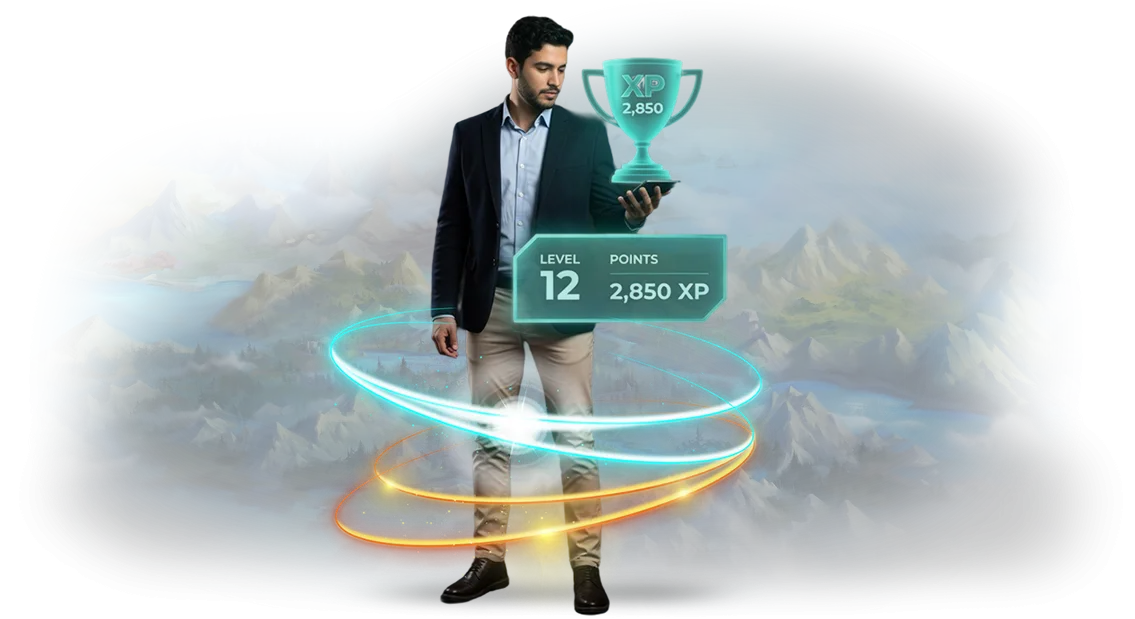
Employees lack motivation — performance management suffers
Employees are a business's main resource, but when they lose interest in tasks, overall efficiency drops. Deadlines slip, errors increase, turnover consumes the manager's time, and performance management turns into endless control instead of development. Sound familiar?
Most companies try to solve this with bonuses and fines, but such methods only create a short-term effect, and then team motivation fades again.
The problem goes deeper: people lack a clear connection between their efforts and the result. Monotonous processes and routine kill engagement, and the manager spends hours on persuasion instead of strategic tasks.
As a result, the business loses speed and profit, even though the team is objectively capable of more. This is where business gamification helps — not a game for its own sake, but a system that reshapes employees' attitude to work and brings the thrill back into everyday tasks.
Properly designed gamification makes performance management transparent and visible: everyone sees their goals, progress, and contribution to the overall result.
Employees begin to compete not with colleagues, but with their own previous indicators, and the manager gets a tool that motivates the team without constant pressure. These are not one-off activities, but an embedded mechanic that works on a daily basis.
We have been doing business process gamification for more than ten years and know how to turn routine operations into a source of energy for the team. Our approach is built around specific business tasks, not abstract trends.
Therefore, after implementation, you get not just an "interesting project", but measurable productivity growth and sustainable team motivation.
We improve performance management through game mechanics
Employees often do the bare minimum, and control turns into endless reports and meetings. Game mechanics turn work processes into a clear system of goals, feedback, and achievements — it motivates people from within, not through pressure.
Gamification gives a business four key results — KPI growth, engagement, loyalty, and transparency. Each one reinforces the others and contributes to a long-term effect.
KPI growth
When an employee sees progress in real time, they act more consciously: they close more tasks, process requests faster, and work with clients better. The mechanic makes goals visible — the person understands what result they will get. Department indicators grow without hiring or overtime.
Employee engagement
Game elements — levels, points, team competitions — turn routine into an interesting process. Employees get involved on their own because they are interested. This reduces turnover and speeds up onboarding for newcomers: the rules are clear from day one.
Employee loyalty
When the reward system is transparent and successes are noticed and appreciated, a bond with the company forms. People feel part of a team, not a cog in a machine. This retains valuable specialists and strengthens the employer brand.
Management transparency
The manager gets an objective picture: who works and how, where bottlenecks are, whom to support. Instead of guesswork — data for decisions. Management becomes predictable, and the team becomes predictable too.
Gamification formats for your business tasks
Every business motivates employees differently: one needs to increase sales, another needs to speed up request processing, and a third needs to keep the team during an intense season.
Off-the-shelf gamification doesn't work in such cases, so we select a format for a specific performance task and team character, and measure the result in business metrics.
Below are three basic formats we use most often in projects. They can work separately or in combination, depending on the goal.
| Format | For whom | What it gives the client |
|---|---|---|
| Competitions | For sales, support, and production teams | Revenue and KPI growth through healthy competition; meeting plans in tight deadlines |
| Quests | For teams working on complex projects and new employees | Immersion in processes without tedious briefings; quick attainment of target work speed |
| Ratings | For large teams and remote teams | Transparent system of leaders and those falling behind; clear who to support and how |
Note that the formats don't compete for the employee's attention — they switch and complement each other. For example, a rating sets the daily backdrop, a competition runs during sales periods, and a quest helps launch a new product.
This way gamification becomes not a one-off entertainment, but a performance management system that both employees and managers like.
How gamification implementation works: 6 steps
Gamification implementation usually scares clients with uncertainty: it seems complex, long, and expensive. In fact, it is a clear process with checkpoints, where you always know what is happening and why each step is needed.
We have gone through dozens of projects on improving team efficiency and built an approach that saves your time.
- Brief and immersion in business tasks. We start by discussing goals: what exactly needs to be improved — speed, quality, employee engagement. We collect information about processes and the team so that the mechanics fit your people and solve your task.
- Scenario and game logic. We think through how employees will engage with work: we set tasks, levels, rewards. All mechanics are aimed at real business results, not entertainment for its own sake.
- Prototype and approval. We create a visual mockup of the future solution and show it to you. You see details in advance and make edits — without surprises and expensive rework after launch.
- Preparation and integration. We configure the solution for your working tools so that employees don't have to learn a new system. Everything works inside the familiar environment and requires no training.
- Launch and support. We help announce the game, explain the rules, and sustain interest in the first weeks. We answer participants' questions and quickly adjust details.
- Analytics and development. We track activity and business indicators, see which mechanics work better. Based on data, we improve the solution so that it continues to bring value after launch.
You get not a one-off promotion, but a living system that grows with the business. We are by your side at every stage — from the brief to regular support and development.
What you get after launching gamification
Gamification brings results only when it becomes a clear system rather than a set of scattered activities. That's why we provide you with a full set of working tools: from rules and mechanics to analytics and training.
You receive a system that can be launched immediately and used every day — without additional configuration or developer involvement.
- Well-developed game mechanics: goals, points, levels, and rewards are tied to your performance indicators, not to abstract "points".
- Rules and regulations for employees and managers: everyone understands which actions produce results and how their contribution is evaluated.
- Analytics module with reporting: you see performance dynamics, team engagement, and growth areas without manually collecting numbers.
- Manager dashboard: control of key indicators for employees and departments in a convenient format — for quick management decisions.
- Team training: instructions, scenario analysis, and help at the start so that employees quickly get into the new system.
- Technical support after launch: the system works stably, all issues are addressed, downtime doesn't affect business processes.
- Refinements based on the first weeks: we adjust mechanics based on real data so that results grow and team interest doesn't fade.
Such a set covers the entire performance management cycle: goal setting, employee motivation, result control, and data-driven decision-making. The manager doesn't need to collect reports manually, and employees don't need to guess what to do next. Everything needed is already in the system.
Case study: how gamification increased engagement by 40%
In one project for a large retail chain Siti-Market, we encountered a typical pain point: the sales department formally fulfilled the plan, but quality indicators were falling — employees lost interest in routine operations, and turnover was growing.
Managers understood that bonuses and fines had stopped working. The task was not to "squeeze out more" but to bring engagement back into the process itself.
We developed a gamified performance management system: personal goals turned into seasonal missions, completing tasks gave points and unlocked collective bonuses, and current results became visible in a shared real-time rating.
Employees saw not an abstract KPI, but their own progress and contribution to the store's overall result.
Two months after implementation, engagement grew by 40% according to surveys, and operational task completion improved by a third. At the same time, turnover in pilot stores almost halved.
Implementation costs paid off within one quarter thanks to an increased average transaction value and reduced onboarding time for newcomers — training scenarios became part of the gameplay.
We also note the effect for managers: instead of manual control, they got transparent analytics and the ability to quickly adjust motivation mechanics. Later, the project was rolled out to all stores in the chain — the system became part of regular management.
This case shows: gamification is not entertainment, but a performance management tool with a measurable result. If you want to get the same effect in your company, tell us about your task — we'll show you what it could look like.
We answer questions before the project starts
Any new system raises questions — especially when it comes to team performance. We have collected the three most common ones we hear from managers before launch: employee adaptation, failure risks, and the speed of first results.
Will employees perceive gamification as a game and abandon their core tasks?
Gamification doesn't replace work; it makes achieving goals visible. We tune the mechanics to your business processes: points and rewards are awarded for real indicators — completed tasks, quality, deadlines. That's why the system quickly becomes a working tool, not entertainment.
Implementation happens in stages: first a trial group, then smooth scaling. Employees get used to the new format without stress, and you see the reaction before the full launch.
What happens if the system fails during an important promotion or reporting period?
Over ten years, we have handled launches in very different conditions. We use professional server architecture, backup channels, and mandatory load testing before launch.
During operation, we provide support — specialists are available, data is preserved, and emergencies are resolved quickly.
Guarantees are fixed in the contract: responsibility, response times, and action procedures for any risks. You don't face the problem alone.
When will the business see the effect on performance?
The first changes in activity are usually noticeable within the first weeks: employees get involved faster and see the connection between their actions and the result. Sustainable growth in indicators occurs after one or two work cycles, when the team adapts to the system.
Before launch, we define checkpoints and indicators that we will track together with you. You get not "improvement in theory", but concrete dynamics figures — easy to evaluate effectiveness.
Didn't find an answer to your question? Write to us — we'll show implementation examples in your industry and help estimate the potential effect for the team.Ready to discuss gamification for your business?
Gamification pays off only when it is tuned to your business tasks, not "just for the sake of the game". We build the program so that it gives a measurable result: growth in productivity, engagement, and process speed — without distracting the team from current tasks.
Leave a request, and within one working day we will prepare a preliminary plan: which processes should be digitized first, where the effect will appear fastest, and how to integrate gamification without stopping work.
What you get after your request:
- Initial consultation — we analyze your situation and honestly say where gamification will bring growth and where it isn't needed.
- Cost calculated after audit — a transparent estimate for your scale, without hidden fees or "fine print".
- Demo scenario — using your example, we show how the mechanic will work before development starts.
- Implementation plan — stages, timelines, and responsible people so you see the full project picture.
- Post-launch support — we help with employee adaptation and adjust mechanics based on first results.
We have been working remotely for over ten years, so our expertise isn't tied to your city — it doesn't affect quality or speed. And we formalize all agreements in documents, so you understand what you pay for and what result you get.
Leave a request via the form or contact us directly — let's discuss how gamification can improve your team's productivity. This is not binding, but it will give clarity on timelines, scope of work, and expected effect.
How to choose the right gamification format for your task?
The gamification format is not a matter of taste, but a derivative of two variables: the business goal and the target audience. If you need to speed up routine operations, personal progress with clear levels and rewards will work.
If the task is to raise team spirit and cross-functional interaction, collective scenarios with a shared result and public recognition of each contribution are more effective.
The second step is to understand who the users are. A young sales team responds faster to dynamic competitive mechanics with visible ratings, while experienced specialists value status, expert roles, and tracking their own growth without public comparison.
It is also important to consider the frequency of interaction: daily operational tasks require short reward cycles, while long-term projects require staged milestones and intermediate results.
There is no universal silver bullet. In one case, accumulating points and exchanging them for real privileges will work; in another, jointly achieving a goal with an open progress bar and a shared reward; in a third, a tournament bracket for periodic intensive sprints.
The main thing is that the chosen mechanic reinforces the desired behavior, not just adds a game for its own sake.
We help you get oriented before development starts: we analyze the task, audience, and current metrics, and propose 2-3 suitable formats with an effect forecast for each.
You get a clear picture — which scenario will lead to productivity growth faster, and which is better to postpone. Further design is based on this informed choice, not on abstract ideas.