

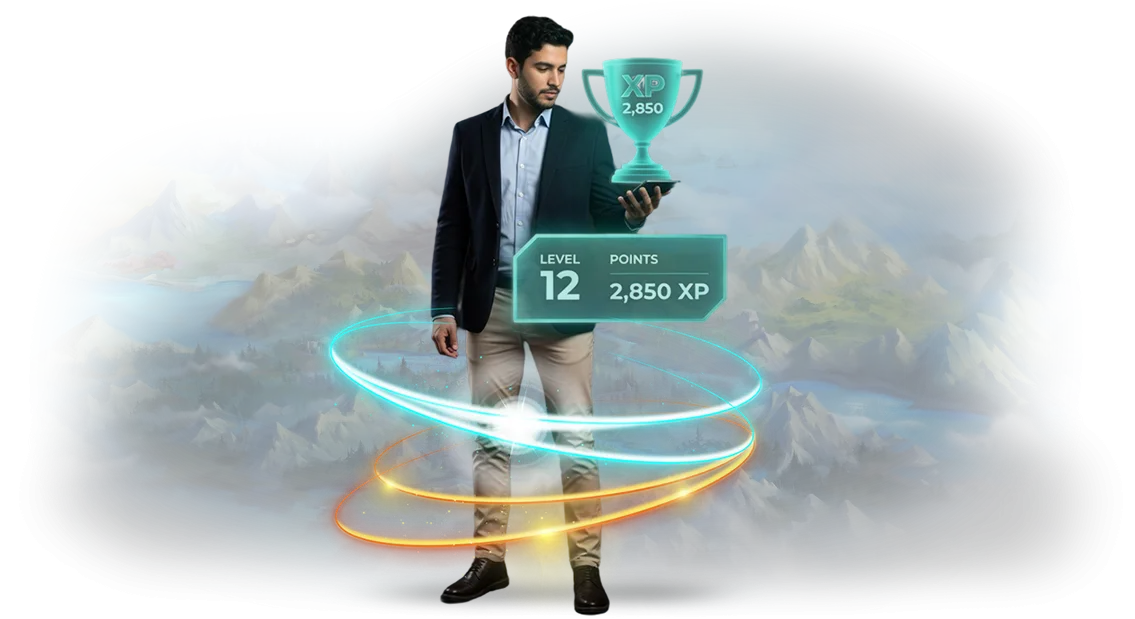
Gamification for Sales Managers: Boosting Department KPIs
Sales managers work under constant stress: repetitive calls, rejections, a demanding plan, and identical bonuses for results. A newcomer's enthusiasm fades after a couple of months, experienced employees burn out, and the sales department's KPIs start to slip.
Meanwhile, classic motivation methods—sales commissions, KPI tables, salaries—stopped being a source of energy long ago; they just record whether the goal was met or missed.
Business pays for results, but cannot force an employee to feel excitement through orders or raises. A manager sees that sales are falling not because of a lack of skills but because of a loss of engagement.
People mechanically work their shifts, don't get involved, and don't try to exceed the plan. This leads to missed quarterly targets, turnover, and lost revenue that competitors could capture.
Game mechanics for sales teams solve this differently: they turn routine into a competition with clear rules, quick wins, and visible progress.
Sales gamification is not about "playing a game;" it is a manager motivation system built into the work process: ratings, levels, badges, team challenges, and short sprints.
An employee starts seeing the link between their actions and results every day, not just once a month when the paycheck arrives.
A well-designed manager motivation system gives leaders a management tool that works without pressure or administrative levers. The salesperson themselves strives to close more deals because it brings status, recognition, and new levels.
At the same time, the excitement does not replace material motivation—it reinforces it: the employee earns more, and the sales department steadily raises its KPIs.
We design gamification around your company's specific business processes: we take into account the product specifics, funnel, deal cycle length, and your team's psychology. The result is a system that fits into daily work rather than distracting from it.
This is the lever that turns the sales department from a source of headaches into a predictable revenue engine.
What Game Mechanics Implementation Will Bring to Your Sales Team
Game mechanics turn the daily work of a sales department from routine into a meaningful race for results.
When a manager sees their progress compared to colleagues, they develop healthy excitement and a desire to do more, not just "sit out the hours." This directly boosts engagement—people start finding ways to close deals on their own instead of waiting for orders from above.
A transparent bonus system removes the main source of conflict in a team—subjective evaluation by the manager. Every manager action, whether it's a call, a meeting, or sending a commercial proposal, receives clear points.
The employee always knows how much they have earned and what to do to earn more. This clarity reduces turnover and creates an atmosphere of fair competition rather than backstabbing.
Sales growth becomes a natural consequence, not a goal imposed from above. Managers themselves strive to meet the plan because they enjoy leveling up, earning badges, and getting virtual rewards.
As a result, the average check rises, conversion to closed deals grows, and the best employees receive deserved recognition. The manager sees an objective picture: who is really pulling the team and who needs additional support.
Implementing gamification is not adding an extra burden on the department; it's a way to make the motivation system fairer and more effective. Your managers will start working with a spark in their eyes, and you will get predictable revenue growth without constant manual control.
The result becomes systematic: lower turnover, higher engagement, and sales growing month after month.
Gamification Motivation Formats: Choosing by Department Goal
When a sales department has no unified motivation system, each manager works at their own pace: some give their all at the end of the month, others lose interest after a bad week.
The game format should match your goal—a one-time boost before a promotion, retaining strong employees, or training newcomers.
Competitions give a quick surge but over a short distance, while levels act as a career track that retains people for a long time. Quests engage through hands-on learning, and team games level up weaker employees and strengthen experience sharing. Below is a table of typical formats and the business problem each one solves.
| Format | Suitable for | What it gives the department |
|---|---|---|
| Short-distance competitions | To energize the team before a promotion or end of quarter | Excitement, immediate sales growth, identifying leaders |
| Levels and statuses | To retain strong managers and build a career track | Predictability, higher average check, lower turnover |
| Quests and scenarios | To master a new product or teach objection handling | Fast skills without off-the-job training, engaging newcomers |
| Team games | To strengthen interaction within the department | Better overall results, fewer conflicts, mutual support |
Formats are rarely used on their own.
Levels provide a systematic framework and a clear growth path, and within them work short competitions—such as "salesperson of the week" or "best call script." This mix keeps interest in the moment and at the same time builds a habit of selling consistently.
We choose the format according to the department's current goal, and already at the brief stage we show how the game will be integrated into the managers' daily routine.
The result is a system that pays for itself through increased sales, not abstract "engagement" for the sake of a checkbox.
Gamification Development Stages: From Brief to Launch
We follow a transparent process: you always know what stage the game system development is at and what comes next. This removes chaos and lets you plan the motivation launch without missing deadlines. Below are the key steps a project goes through from brief to support.
-
Brief and analysis. We study your sales department: goals, metrics, current motivation methods, and points of demotivation. We record the manager's expectations and collect feedback from employees so that the mechanics really resonate with the team.
-
Game system concept. We propose a scenario: which manager actions will be rewarded, how points and levels are calculated, and which prizes and statuses motivate your specific employees. We show how gamification will fit into existing business processes rather than break them.
-
Rules and prototype approval. We detail the game mechanics in a clear mockup: leaderboards, rewards, feedback. You see the logic and make edits before development begins. This saves budget and time at the gamification implementation stage.
-
Implementation and setup. We transfer the approved scenario into the working environment: connect it to your deal and lead tracking tools, set up automatic point calculation and notifications. We test with real data so everything works reliably by launch.
-
Launch and training. We announce the start, introduce managers to the game rules, and show leaders how to read analytics and react to results. The first week is under our control: we quickly resolve issues and adjust settings.
-
Project support. We stay in touch after the motivation launch: we track engagement, analyze together what works and what should change. We offer mechanic updates so team interest doesn't fade and KPIs keep growing. You can request adjustments at any time without losing accumulated data.
What's Included: Complete Package for the Sales Department
The complete package for a sales department is not just access to software but a ready-made motivation tool. We set up the game in advance to fit your business processes and target metrics, prepare materials for the team, and stay in touch after launch. Nothing needs to be finalized on your own.
- Custom setup for your goals — we link the game mechanics to sales stages, target metrics, and manager roles. The game rewards exactly the actions that drive revenue growth.
- Leader instructions — clear guidelines: how to change tasks, add a new level, or adjust rewards. Managing motivation doesn't require contacting developers.
- Manager training — short videos and cheat sheets so every employee can understand in the first day how points are earned, where to see progress, and how to get a prize.
- Results analytics — clear reports on team engagement, goal completion, and deal dynamics. You see which mechanics work and what should be adjusted.
- Launch and ongoing support — we help implement the system, answer questions, and resolve tasks quickly. You're never left alone with the tool.
This package turns gamification into a clear working tool: managers quickly get involved in the game, the leader gets a manageable system, and the business gets predictable results.
Case Study: Gamification for Sales Managers Increased Revenue by 30%
We were approached by the sales director of a large construction materials distributor, VolgaOptTorg.
The department had 40 sales managers, but the plan was only 70% fulfilled: experienced employees were burned out, newcomers quickly lost interest, and negotiation conversion fell short of target values.
We analyzed the funnel and implemented gamification across all deal stages: personal rankings, team competitions, badges for difficult negotiations, and status prizes for leaders.
The system was integrated directly into the existing deal tracking, so managers saw their progress in real time and understood which actions brought them closer to results.
Results after two months
The department's revenue grew by 30%, and sales conversion increased from 12% to 18%. The average check rose by 8%, and the plan began to be exceeded at 105%.
The key point is that the effect lasts: gamification changes managers' habits; they find new techniques themselves instead of sitting out their hours waiting for the end of the shift.
Sales director's testimonial: "We expected short-term activity, but we got a new sales culture. Managers compete not in the number of calls but in the quality of negotiations and approach to the client.
Six months have passed, and the results are stable." This is exactly how gamification pays off: it's embedded in business processes, not existing on its own.
This experience can easily be adapted to your company. We'll find weak points in motivation, propose game mechanics, and configure them to your metrics to deliver measurable growth—like in the case described above.
How to Choose the Gamification Format That's Right for You?
There is no universal gamification format—what engages one team can fail in another.
The choice depends on your goals, the size of the sales department, the deal cycle length, and which metrics you want to improve for your sales managers: conversion, average check, plan fulfillment, or lead response speed.
That's why selecting game mechanics starts not with ready-made templates but with an analysis of your business processes. If the deal cycle is short, ratings and quick tournaments work. If deals are long, levels, achievements, and team goals work better. It's important that the mechanics don't distract from sales but reinforce the desired behavior.
We build custom terms for every project: you don't get a "boxed solution" from another market. First, we analyze your funnel, find bottlenecks and points of demotivation, and only then design a game system that hits exactly those areas. It can be an internal portal, CRM integration, or even offline activities.
At the same time, we look deeper than just "points and prizes." Choosing game mechanics is about your team's psychology: some need a public leaderboard, others need personal progress and continuous improvement of their own results, and others need collaborative tasks.
We take these characteristics into account so that every manager finds their own meaning and motivation in the game.
That's why at the start we offer a quick audit and, within a few days, give a recommendation on the format for your situation. You'll immediately see what the game will look like, which metrics it will affect, and how your sales managers will start delivering results.
Frequently Asked Questions About Developing Game-Based Motivation Systems
Before launching gamification, sales department heads ask the same questions: how difficult is it to implement the system, will it disrupt the workflow, will it pay off quickly, and will managers accept it. We've gathered answers to these typical objections.
our team has been implementing game mechanics in sales for over 10 years, so we speak the language of business, not technology.
Is it difficult to introduce gamification into an already functioning department?
No. The implementation is staged: first we analyze current processes, then we run a pilot with one team, and only then we scale. This avoids downtime and keeps control at every step. You get clear reports, and managers get a smooth transition without stress.
What is the payback period for a motivation system?
Payback is directly tied to sales: game mechanics push managers to make more calls and close more deals. With proper setup, conversion growth is visible within the first month, and the costs are recouped through increased revenue. We also offer a pilot project so you can evaluate the result before full implementation.
Won't employees get bored of the game after a couple of weeks?
Interest is maintained through constant updates to the mechanics: new levels, rewards, and team scenarios appear. We take into account the psychology of sales managers—some are motivated by competition, others by status growth. That's why the game engages both newcomers and experienced employees.
Does the system adapt to the specifics of our team?
Yes. We customize game scenarios for your department's specific tasks: priority products, seasonal periods, and the motivation characteristics of different roles. It's not a template solution but a tool that strengthens your KPI system and helps you achieve target metrics.
If you still have questions, ask them during a consultation—we'll look at your case individually.Launch Gamification in Your Company Within a Month
For a sales department head, the main question isn't "how to make it interesting" but "how to get results fast." Implementing game-based motivation often drags on for quarters: approvals, refinements, integrations.
We launch gamification within a month—because our process is streamlined and the ready-made modules have already been tested across dozens of projects for sales managers.
When you order motivation from us, you get a clear plan with exact deadlines. No prolonged buildup—only concrete steps, each one bringing you closer to the result.
Here's what fast implementation looks like at your company:
- Week one — brief and audit of the current motivation system: we identify which manager actions need to be reinforced.
- Days 7–10 — game scenario development: points, levels, competitions, and rewards tied to your key metrics.
- Days 11–14 — agreeing on the mechanics with you and adapting them to your sales process, not a "boxed" solution.
- Days 15–21 — connecting to your CRM and setting up reports: you see activity and results in real time.
- Days 22–24 — team training: one short webinar, and managers already understand the rules.
- Days 25–30 — launch of the game system and the first week of support: we adjust settings and answer questions.
As a result, within 30 days your salespeople work under the new motivation system, and you get the first numbers on activity. Ordering gamification for sales managers is simple: leave a request, and we'll start with a brief as early as next week.