

Why Paramedics and EMTs Lose Motivation to Train
Training for paramedics and EMTs is not a formality—it’s a matter of life and reaction speed in a critical situation. But when preparation turns into a routine obligation with tests completed just for show, interest fades faster than skills decline.
An employee sits through the hours, mechanically answers questions, and a month later cannot recall the key action algorithms.
Low engagement in training directly hits quality of work: errors in the field, incorrect interpretation of symptoms, delayed decisions.
As a result, not only patient risk grows, but also staff turnover—professionals burn out, feel their development is stagnating, and leave for competitors or the profession altogether.
For a manager, this means constant costs for finding and onboarding new employees to replace those lost.
The problem is compounded by the fact that classic lectures and briefings ignore the specifics of working under stress. A paramedic must make decisions in seconds, but if training takes place in a quiet office, the brain does not learn to act in an emergency.
Knowledge remains abstract, motivation zero—because the employee sees no link between a boring test and actually saving a life.
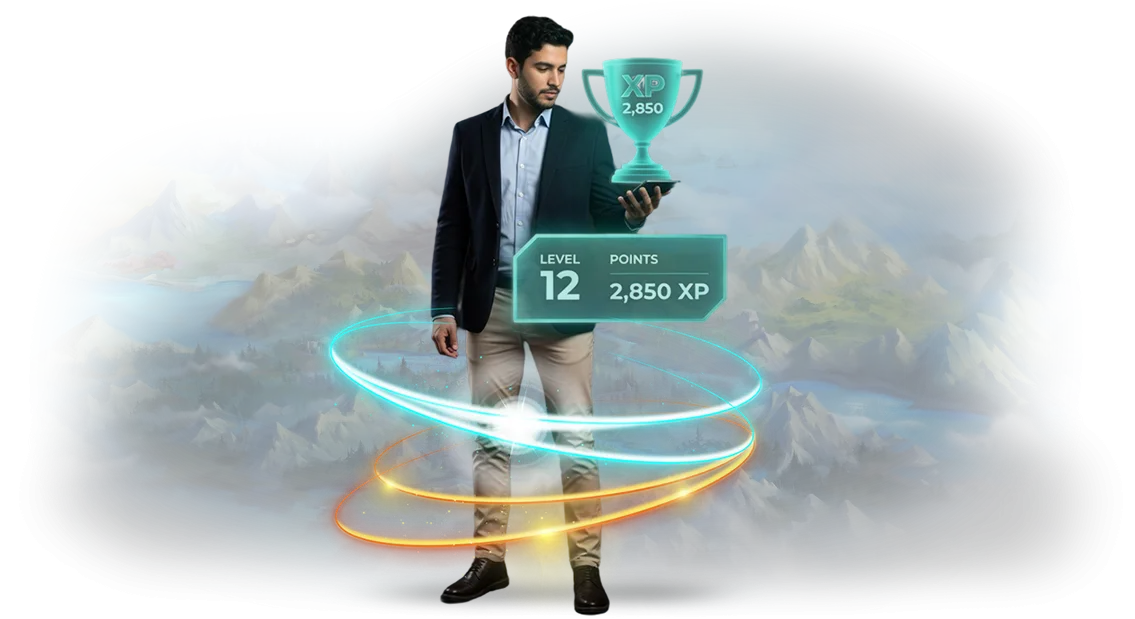
Gamification solves this through competitive elements and scenarios close to real-world pressure. When employees earn points, levels, and visible progress, their brain switches on the thrill of competition and the desire to be the best.
It turns training from an obligation into a challenge—and thereby increases engagement and actual knowledge retention.
We close this gap: we design game mechanics that integrate into your training system and motivate staff to develop without coercion.
The result is a higher skill level, fewer errors in the field, and a stable team that doesn’t scatter after the first tough quarter.
What Gamification Gives Your Medical Team: 5 Key Changes
Your team works at the limit every day: heavy workload, stress, irregular hours. Even passionate paramedics and EMTs gradually lose interest when the results of their work are neither visible nor rewarded.
Gamification solves this through a clear system of goals, points, and achievements—it strengthens staff motivation without administrative pressure.
Our team has been designing game mechanics for business for over 10 years. We adapt them to the specifics of mobile medical teams: your employees get visible progress, and you get a manageable, engaged team.
Increased Interest in Daily Tasks
EMTs and paramedics stop working on autopilot when concrete goals appear in front of them. Statuses, levels, and short-term tasks turn routine into a challenge: who completes the chart faster, who performs triage more accurately? A healthy competitive spirit emerges, along with the desire to do better work.
Accelerated Training Without Leaving Shifts
Simulation training and game scenarios allow rare but critical cases to be practiced. Instead of boring lectures—short interactive modules where a mistake has no consequences.
Game-based learning delivers results faster: knowledge is consolidated through practice, and skills become automatic.
Strengthening Team Spirit
Shared goals and inter-team competitions unite the crew. Employees start helping each other, sharing experience, and supporting newcomers. Joint game missions are a chance to feel part of one team, not loners in different ambulances. Teamwork becomes natural, not forced.
Reducing Turnover and Burnout
People leave not the profession but a dead end. Game-based motivation gives employees a sense of growth: they can see experience accumulating, new levels and ranks opening up. It acts like a career elevator without operational reshuffles. Within a couple of months, you notice seasonal resignations giving way to a stable core of crews.
Improving Service Quality
When correct actions earn points and mistakes bring clear feedback, work quality improves systematically. Protocol compliance, attention to detail, and reaction speed all improve. The result is higher patient trust, fewer complaints, and fewer repeat calls. This is a benefit that both managers and employees see.
Gamification Formats for Paramedics and EMTs: Solution Table
Paramedics and EMTs make decisions every day under time pressure and high stress. Classic briefings and lectures provide theory, but they do not train automatic responses or support motivation for continuous development.
Gamification turns training into regular practice with clear goals, competition, and rewards—employees engage on their own, and you get a predictable skill level.
The game format is chosen for a specific task: test knowledge, practice skills, or unite a crew. Below are five proven solutions that we adapt to the specifics of your ambulance station.
| Format | For whom | What it gives the client |
|---|---|---|
| Competitive medical quiz | All staff—EMTs, nurses, doctors | Knowledge growth through healthy competition, quick identification of gaps, engagement of even passive employees |
| Role-based emergency simulation | Mobile crews and dispatchers | Practicing algorithms in realistic scenarios, reducing the number of errors on calls |
| Team quest | Departments, shifts, substations | Strengthening team interaction, role distribution, a common goal and accountability for results |
| Knowledge marathon | The entire station or several departments | Regular repetition of protocols, building a learning habit, covering the whole team without leaving shifts |
| Personal rating | Highly motivated employees | Transparent reward system, increased engagement, lower turnover, and a clear picture of each person's achievements |
You can combine formats: for example, a knowledge marathon gives way to a team quest, and a personal rating becomes a basis for bonuses. We will help you choose the optimal combination and tailor the game to your protocols and regulations.
How Development Works: From Brief to Launch in 6 Steps
We understand: paramedics and EMTs have no time for complex instructions, and you have no time for lengthy approvals. That’s why the gamification development process is designed so you see results at every stage and can influence them without unnecessary calls.
- Brief and immersion into the task. You tell us about your team, its pain points, and goals, and we analyze which actions need to be strengthened: reaction speed, quality of chart completion, completing training. The output is a clear understanding of how the game will help you in numbers.
- Analysis and design of the game system. We study real work scenarios—what motivates employees, where they lose interest. We design mechanics: points, levels, competitions between crews—only what will fit into your process without disruption.
- Concept and approval. We show you a prototype of the future system using your own examples: how an employee receives a reward, how you see statistics. You make edits before resources are invested in development.
- Implementation—assembly and setup. We build the system on a professional platform, adapting it to your regulations and reporting formats. In parallel, we prepare instructions for staff—simple, no fluff—so implementation doesn’t require training.
- Project launch. We connect the system to your channels: mobile app, chatbot, or work portal. On launch day, everything works—no downtime, no missed shifts.
- Post-launch support. We monitor employee activity and adjust difficulty and level settings if we see a decline. You receive a monthly report on the effect: growth in engagement, task completion speed, and repeatability of desired actions.
At every stage, a personal manager is assigned to you—you always know what is happening and when the result will come.
For example, for one ambulance service, we went from brief to launch in 4 weeks: EMTs began competing on chart completion speed, and quality metrics rose by 17% within a month. We work this way on every project—transparently and focused on your benefit.
What's Included in the Delivery: A Kit for Launching a Game System
We have prepared a kit with everything needed to launch a game-based motivation and training system—from scenarios to customization for your processes.
You don’t have to assemble a solution from pieces: you get a single product that employees start using immediately after installation.
- Design document — a detailed description of game mechanics, roles, and rules. It becomes the basis for discussion with the team and further development of the system.
- Web version for workstations — employees complete scenarios, view ratings, and receive tasks through it. Convenient for stationary posts and the dispatch center.
- Mobile app for mobile crews — training and motivation are available right from a smartphone, even when an employee is on a call. No tie to a computer.
- Admin panel for managers — you manage scenarios, assign tasks, track each employee’s progress, and see the overall picture across the department.
- Training scenario library — ready-made situations for paramedics and EMTs: from standard calls to rare cases. We adapt scenarios to your regulations.
- Instructions and administrator training — we carry out setup together with your specialists, showing how to change scenarios and work with reports.
- Support at launch — we help you launch the system, answer employee questions, and adjust settings during the first weeks.
All of this is part of a single package, not separate options. The game is developed with the specifics of ambulance work in mind: the interface is clear to people who are used to acting under time constraints.
Case Study: How to Increase Engagement of Emergency Medical Staff
For one regional ambulance station—let’s call it Service 03—the main pain point was engagement among EMTs and paramedics. Highly demanding shifts, emotional burnout, and monotonous tasks led to part of the staff resigning, while new hires took a long time to find their rhythm.
We designed gamification that integrated into daily processes: employees earned points for the quality of their procedures, reaction speed to calls, and helping colleagues.
Instead of abstract KPIs, clear levels, team goals, and public recognition appeared—this created a sense of progress and value in their work.
What Changed After Implementation
| Metric | Result |
|---|---|
| Team engagement | doubled |
| Staff turnover | reduced by 35% |
| New hire training speed | 1.5x faster |
| Employee feedback | positive: 9 out of 10 |
These results were achieved not through control, but through interest and healthy competition. The team itself began to pull up underperformers because the department’s overall rating affected everyone’s status.
Managers got a transparent picture: who is ready for mentoring, who needs support, and which skills should be improved.
After three months, turnover decreased, and fewer employees came to shifts on the verge of burnout. Most importantly, the EMTs themselves asked for new task scenarios—gamification was seen as a development tool, not as control.
This case shows that the right game mechanics increase engagement even in the most stressful environments. If it works in emergency medical services, it will work in your company too—you just need to adapt the mechanics to your business process.
What If the System Doesn't Work? Addressing the Fears
Any new system in the work of paramedics raises questions: will it distract from tasks, will employees refuse it, will it bring real value? That’s normal—we encounter these doubts in every project and build the solution into the process in advance. Below are answers to the most common fears.
Employees won't use the system—what to do?
We design mechanics with paramedic motivation in mind: short cycles, clear value for the job. Before launch, we show the team how it makes everyday work easier, and during the pilot stage we adjust what doesn’t resonate.
Will implementation take a lot of time and break existing processes?
Integration is gradual: first we test it with one crew, then scale up. We don’t overload administrators with technical details—we handle all the setup; they only need basic interface skills.
What if gamification doesn’t deliver a measurable result?
We guarantee: before launch, we record the metrics that matter to you—reaction speed, number of completed tasks, satisfaction. After launch, we show the dynamics and change the game rules if we see the goal is not being achieved.
Who will support us after launch?
We don’t disappear after the project goes live. You keep a personal manager and tech support: they’ll help set up new levels, answer employees’ questions, and quickly respond to any difficulties.
Ready to Change Employee Motivation? Leave a Request
Shift schedules, overload, and constant contact with patients—standard motivation programs don’t work here. Paramedics and EMTs burn out faster, and staff turnover costs more than any bonus.
Gamification solves this problem: employees see progress, receive recognition, and compete in achievements without leaving their calls. As a manager, you get predictable growth in engagement and less resistance to change.
You can order gamification in a few steps: leave a request, get a consultation, and an accurate cost calculation. We’ll prepare a brief with mechanics tailored to your team—even if you’re not yet sure what exactly you need.
This is not binding: you make a decision after our proposal. The calculation arrives within one business day, not after a week of waiting.
After you contact us, you receive:
- a brief describing game mechanics for your crew’s tasks;
- a preliminary cost calculation—the budget is clear before work begins;
- consultation on gamification implementation experience in medical institutions;
- feedback within one business day—no week-long waits;
- an implementation plan with stages and timelines, not vague promises;
- an understanding of how gamification will affect engagement and turnover in your team.
We discuss every point during the consultation, so the request is not a formality but the start of a working dialogue. Fill out the form—and we’ll send you the calculation and answer questions about your situation.
Gamification will start working for you after the first implementation stage, and your employees will feel the changes within the first month.
How to Choose the Right Gamification Format for a Task?
Choosing a gamification format starts not with technology but with a question: what exactly do you want to change in the work of paramedics and EMTs? If the task is to practice action algorithms in emergency situations, scenario simulations with decision options are needed.
If the learning goal is to unite a shift crew, team quests work better. If it’s important to regularly refresh protocols—short quizzes built into the shift are the answer.
The second step is the employee audience. EMTs and paramedics have irregular schedules, high workloads, and minimal free time. So the format must be concise: 5–10 minutes per task, access from a smartphone, no installation of complex software.
Any extra step before starting the game kills motivation. It’s better to choose simple mechanics that people without special training can understand than to chase visual effects.
The third point is evaluating results. It’s easier to choose a game when metrics are defined in advance: the number of completed scenarios, decision time, and reduction in errors.
If gamification doesn’t affect them, the format was chosen incorrectly, even if employees like the game itself.
A practical recommendation for selection is to run a pilot with one crew. It will take a couple of weeks and show which format actually works in your conditions.
After the pilot, you can scale the solution to the entire service, understanding how employees react to the mechanics and what results the game delivers. This approach reduces risks and helps you make a data-driven decision, not a guess.