

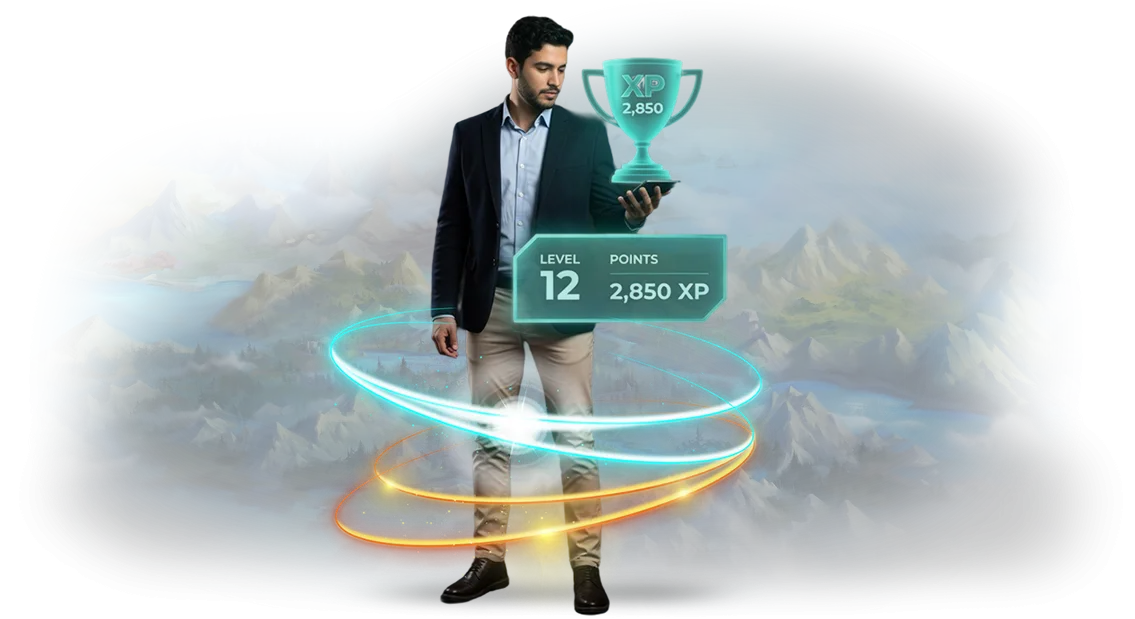
Facebook Instant Games platform: how to turn routine into a game
Routine is the number one productivity killer. Employees lose interest in repetitive tasks, processes stall, results decline. Sound familiar? Most managers deal with this every day, but not everyone knows the solution lies in game mechanics.
Facebook Instant Games platform is a ready-made environment for business gamification. Right in the familiar social network interface, you can launch short game sessions that engage employees and customers without complex setups or training. The game is available in one click — this lowers the barrier to entry and boosts reach.
Game mechanics — points, levels, competitions, rewards — turn routine tasks into an engaging quest.
Employees start competing for results, they strive to meet the plan on their own instead of just “clocking hours.” Increased engagement directly leads to higher productivity and better work quality.
For business, this is not just entertainment but a goal-achievement tool: staff training, new-hire onboarding, sales stimulation, customer promotions.
Every process can be packaged into a game that delivers measurable results — higher conversion, more repeat orders, lower turnover.
We help you implement gamification based on Facebook Instant Games platform tailored to your needs. We design game scenarios, configure mechanics, launch, and support. Tell us about your process — we’ll show you how to turn routine into a game.
What gamification of business processes delivers: 5 key benefits
Gamification of business processes is no longer just entertainment — it is a tool that directly impacts commercial metrics. Game mechanics turn routine tasks into an engaging challenge, and employees start acting more proactively and deliberately.
When we talk about projects on the Facebook Instant Games platform, we mean ready-made solutions that launch quickly and require no installation — they fit into the work rhythm without friction.
Employee engagement multiplies because instead of dull instructions, people get clear goals, levels, and instant feedback. An employee sees their progress, understands which actions produce results, and strives to meet the target faster and better.
The ability to compete with colleagues adds excitement, and team leaderboards create healthy competition within the department. As a result, gamification holds attention on tasks even in monotonous operational processes.
Turnover decreases because work no longer feels like routine. When people receive recognition for achievements and see that their contribution is noticed, an emotional bond with the company forms.
Bonuses, rewards, and titles for completed goals increase satisfaction — employees are less likely to look elsewhere. For business, this means a stable team and savings on constant hiring and onboarding.
Employee training accelerates: new specialists master processes faster through interactive scenarios. Instead of long presentations and instructions — short game modules with immediate knowledge checks.
A newcomer learns by doing and making mistakes in a safe environment, not at the expense of customers. Information retention also improves: in a game, people remember several times more than when passively reviewing materials.
Sales growth is another tangible result. Gamifying bonus rules, plan achievement, and objection handling motivates managers to make more calls and conduct negotiations more effectively. Each completed stage gives a visible reward, which encourages repeating successful behavior. The outcome — higher average check, conversion, and overall revenue with the same personnel costs.
Finally, customer loyalty increases — if gamification also covers external processes. Loyalty programs based on game mechanics encourage buyers to return more often, participate in promotions, and recommend the company to friends.
Regular customers bring stable revenue and become brand ambassadors. An integrated approach using game platforms delivers all five benefits at once — we help you implement them into your operating model turnkey.
Gamification formats for your business goals
There is no universal game: a quest immerses people in a story, a quiz spreads quickly, a competition makes them come back. So first we analyze your objective — sales growth, employee training, or brand awareness — and only then choose mechanics.
Below are the basic formats that cover 90% of business scenarios. We combine them and adapt them to your audience, and thanks to no-install launch, users play right from their feed.
| Format | Who it suits | What it gives the business |
|---|---|---|
| Quest | Retail chains, showrooms, training programs | Holds attention for 5–10 minutes, walks the user through key product touchpoints, collects leads |
| Sales simulator | Sales departments, call centers | Practices objection handling on real scenarios, increases manager confidence and average check |
| Quiz | New product promotion, education | Fast reach through result sharing, gently tests knowledge and builds interest |
| Competition | Loyalty programs, sports clubs | Creates excitement and regularity: users return for a better result |
Formats are easy to combine: for example, a quest with quiz elements and a leaderboard. We launch the game on the Facebook Instant Games platform — millions of active users and instant start without installation.
After release, you get clear analytics: how many people played, where they dropped off, and how the game affected sales. This approach turns entertainment into a measurable sales and training channel.
How the project goes: 6 steps from brief to launch
Let me walk you through the project. Each of the six development stages is clear and transparent: you know in advance what you will get and how long approval takes.
No “surprises” in the middle — before starting, we fix the goals, audience, and success criteria, then move in short iterations.
- Game brief and task immersion. We define which business goal gamification must address: retention, engagement, training, or repeat order growth. Output — a document with tasks and success criteria.
- Audience research. We look at who your users are, what interests them, and which mechanics they are familiar with. This reduces the risk of “we made it beautiful, but nobody plays.”
- Prototype and scenario. We show what the game will look like: storyline, screens, reward system. You see and “touch” the future product before full development.
- Project approval. We approve the prototype, the cost calculated after audit, and the schedule. After that, development begins without changing the rules of the game — and if edits are needed, they are made through a clear procedure.
- Development and testing. Our engineers build the platform, integrate it with your systems, and test it on real scenarios. You get a stable version for launch.
- Gamification launch and support. We roll out the game, monitor metrics, and make targeted improvements. At the end — a report and a development plan.
What is included in the delivery: a turnkey package
You get a ready-made tool, not a “semi-finished product.” The delivery package includes everything needed to launch gamification on the facebook instant games platform: game design, integration with your systems, a control panel, and employee training.
- Game design and mechanics. We develop the scenario, levels, reward system, and balance — so that players return and take targeted actions. Everything is adapted to your business specifics.
- Integration with your systems. We connect the game to your CRM, loyalty program, or customer database. Data on player actions is transferred to your analytics — you see results in numbers.
- Control panel. You get a convenient interface for configuring promotions, changing prizes, and viewing statistics. You can change conditions without developers.
- Training and instructions. We provide clear guides for administrators and employees. We run a short training session — the team quickly masters the tool.
- Launch and technical support. We help with launching on the Facebook Instant Games platform, monitor stability, and promptly make adjustments. You are never left alone with questions.
As a result, you get a working turnkey project: from idea to activities that regularly deliver results. All that remains is to inform customers and watch engagement grow.
Case study: how we increased engagement by 40%
A trading company faced a typical problem: new employees were slow to get up to speed, and standard training materials did not hold attention.
Staff went through training “just for show,” so errors in customer interactions kept recurring, and activity in corporate programs remained low. Management understood: they needed something that would genuinely interest people and help them master processes faster.
We proposed turning boring regulations into a game simulator on the Facebook Instant Games platform. Employees competed with each other, completed short rounds, and immediately saw their progress.
The game ran in the browser — no apps to install or separate time to allocate: training was embedded into the workday and felt like a break, not an obligation.
The project results exceeded expectations. Employee engagement grew by 40%: staff became more active in corporate initiatives and more willing to learn new standards.
Training time was cut in half — new hires reached the required qualification level in two weeks instead of a month.
At the same time, errors in challenging situations notably decreased, and managers received transparent analytics for each employee: who is ready to work and who needs extra support.
The economic effect was immediate too. The company brought new people up to speed faster, reduced retraining costs, and improved service quality.
After the successful launch, the client expanded the project to other departments, and the game simulator became a permanent onboarding tool. For us, this is confirmation: proper gamification delivers measurable value to business, not just “fun for fun’s sake.”
What you need to know about developing games for Facebook?
The main thing to know about developing games for Facebook: it is not entertainment but a working tool — it retains customers, engages employees, and increases repeat visits.
The platform already has an audience, and the built-in game format launches without installing apps or extra barriers. That is why a corporate game on Facebook works faster than on your own website with zero traffic.
The cost of gamification is affected by mechanics complexity, content volume, and integration with your business processes. A simple quiz is noticeably cheaper than a multi-level strategy or training simulator.
Leaderboards, rewards, and connection to your customer accounting system increase the budget, but they are exactly what deliver tangible business value.
Development timelines depend on scope: a typical project takes from two to three weeks up to two months. During that time, we design the scenario, create the design, build the mechanics, and launch it on Facebook. We plan testing and approval time in advance — this guarantees a predictable result.
We choose mechanics for your goal, not for fashion. Need reach — short contests with sharing. Need staff training or regular customer return — story-driven games with levels and accumulating bonuses.
We match the format to your budget and objective so you get a measurable effect: more registrations, leads, repeat orders.
Frequently asked questions about implementing gamification
Implementing gamification often runs into the same doubts: won’t it be too expensive, won’t employees refuse to play, what if the result never appears. That’s normal — before launch, it is hard to imagine how mechanics will affect business.
We have been through dozens of projects with such concerns and know how to eliminate risks even at the planning stage. Here are answers to the main fears managers have.
Won’t it be too expensive?
Gamification does not require a huge budget if you start with a pilot. We calculate the cost for your specific task: you can build a simple mechanic for a sales department in a few weeks, or you can build a large-scale platform — the price will depend on the goal and scope.
We calculate payback in advance: for example, a 5% increase in repeat orders or a 20% reduction in new-hire training time quickly covers the investment. A transparent cost calculated after audit before starting helps you decide what scope is justified right now.
Will employees refuse to play?
Gamification is not about coercion but engagement. We use mechanics most people enjoy: competition, recognition of achievements, visible progress. Usually within the first weeks, 70–80% of the team joins, and the rest follow when they see colleagues earning bonuses and statuses.
Importantly, participation does not look like “a game for the sake of a game”: every element is tied to real work tasks. Employees quickly see the benefit for themselves — recognition, higher rating, pleasant rewards.
What if the game does not deliver results?
Before launch, we define the metrics used to evaluate the effect: conversion growth, task completion speed, repeat customer visits. If indicators do not improve, we do not wait — we change the mechanics and test another approach.
This is an iterative process, not “launch and forget.” Thanks to the platform’s flexibility, adjustments are made quickly, so the project almost always reaches its target metrics within the first months.
If you still have doubts — below we have collected answers to questions that most often come up in meetings with department heads.Order a game platform for your business
You do not need just a game — you need a tool that engages customers and delivers measurable results. We develop a Facebook Instant Games platform turnkey: from the first consultation to launch and analytics. You control every stage and get a working solution embedded in your business.
What is included in a gamification order
- Consultation and audit — we analyze your task, target audience, and the points where gamification will deliver a quick effect. You get a plan with clear steps, not generic words.
- Prototype and game scenario — before development starts, we show the mechanics and design of the future game. You see the product with your own eyes, make edits, and decide without surprises.
- Turnkey development — we create a game for your brand and configure it for social networks and messengers. You do not need to assemble a separate team or dig into technical details.
- Testing and launch — we test the game on real users, fix issues, and publish it on the platform. You get a launched product, not a “concept on a shelf.”
- Analytics and metrics — we connect data on engagement, retention, and conversion. You see how the game affects repeat visits and sales, and can improve it based on facts.
- Support and growth — after launch, we monitor performance, update content, and help add new mechanics. The game does not stand still; it grows with your business.
Leave a request for a consultation — in 20 minutes we will discuss how gamification fits into your business and propose a first-step plan. You get a result, not a process: from prototype to a launched game with analytics.