

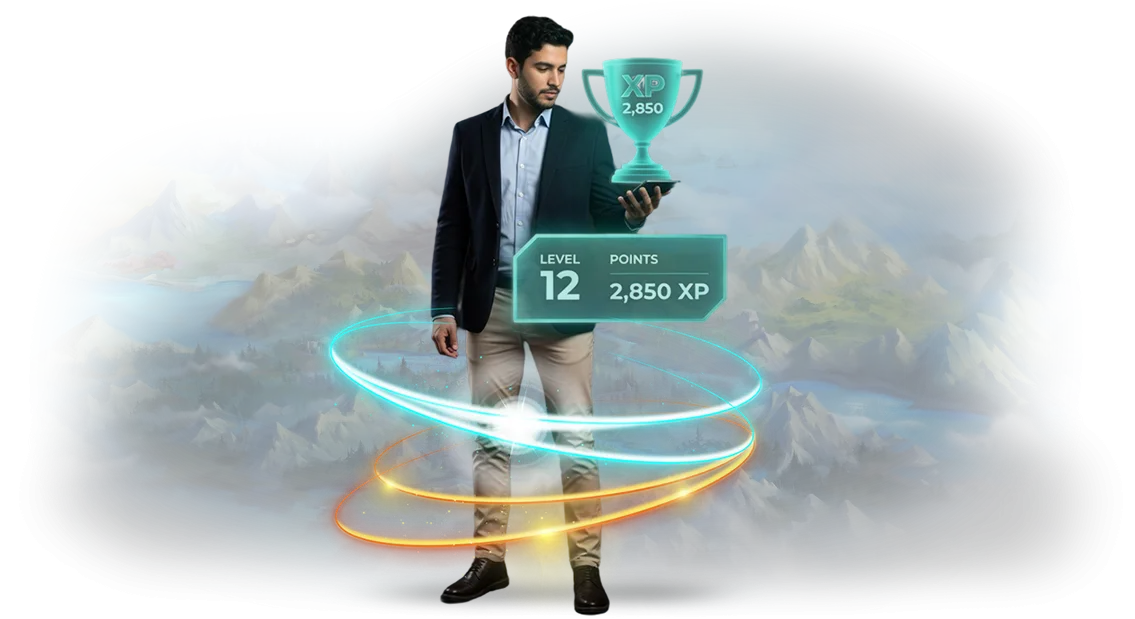
Without a Facebook Instant Games Developer, You Lose Customers and Profit
Customer attention has completely moved to social networks: they scroll through feeds, watch stories, and happily play the short games that competitors launch. Meanwhile, your business keeps talking to customers with outdated methods — discounts, surveys, static banners.
The result is predictable: audiences remember bright formats and go where it’s interesting, and you lose not only reach but also real sales. Every day of delay costs you direct losses: those who could have stayed with you make a repeat purchase from a more active competitor.
And these aren’t random people — these are your potential buyers who would like to come back but see no reason to. Every day the gap between you and those who have already implemented gamification into their business processes grows.
A professional turnkey game developer solves this problem: creating mechanics that hold attention, increase customer engagement, and turn ordinary brand interaction into an engaging process.
We make social media games part of your sales funnel — from a simple quiz to a full loyalty program.
You don’t need to dig into technical details: we handle the idea, development, launch, and support, while you get a measurable result — growth in repeat orders, contact base, and revenue.
This isn’t entertainment for likes; it’s a working tool that pays off through higher conversion and sets you apart from competitors. We close this task completely — from brief to first results, with clear timelines and post-launch support.
What Gamification Delivers: Growth in Engagement, Leads, and Brand Awareness
Increased Engagement
Game mechanics turn routine actions into an engaging process. Users return more often, spend more time, and are more willing to complete target steps — from registration to repeat purchase. An active audience itself follows new promotions, so retention costs less.
Lead Generation and Contact Base
A game is a natural reason to leave data: for participating, the user gets bonuses or a chance to win a prize. Contacts are collected in exchange for value, unobtrusively and with the player’s consent.
Each launch brings dozens and hundreds of new leads, which are then used in email campaigns and repeat sales.
Brand Awareness
Game scenarios are remembered better than banners: a person spends several minutes with the brand and gets strong emotions. People want to share results with friends, which means the company gets free reach in social networks and messengers. This sets the business apart from competitors who use standard advertising.
Customer Loyalty
Points, levels, and rewards for activity form a habit of returning. The user sees their progress and gets a reward for each step — from review to purchase. This turns one-time buyers into regulars who recommend the brand themselves, reducing the cost of acquiring new customers.
Gamification Formats for Your Business Goals
For a business, it’s important to choose the right gamification format: one game should quickly engage a newcomer, another should move a customer through the sales funnel, and a third should retain regular users.
We take proven game mechanics as a basis and adapt them to a specific brand’s goals. At the first brief, we analyze your business model and determine which mechanics will bring a measurable result, not just a bright picture.
Games launch directly from social networks and messengers — users don’t need to download a separate app. This lowers the entry barrier and increases the number of participants. Below are the main gamification formats used by our clients and the benefits for different scenarios.
| Format | Who It’s For | What It Gives the Client |
|---|---|---|
| Quizzes | Companies with a broad audience | Quick engagement, increased reach through result sharing |
| Quests | Brands with a product line | User gets familiar with the assortment and reaches the target action |
| Accumulation games | Retail, delivery, education | Loyalty program in game form, repeat visits |
| Arcades | Promotions and contests | Emotional reward, virality through leaderboards |
Each format can be combined with another: for example, a quiz with accumulation points, or a quest with a final arcade. This way you get not just a game, but an engagement system that works on several business tasks at once — from acquiring to retaining customers.
How We Implement Gamification: Project Stages for the Client
We understand: you don’t want to get into technical details, you need a predictable process and a clear result. So we structure the work so that you always know what’s happening at each stage and feel in control.
Development Stages: From Brief to Launch and Support
-
Brief and goals. We hop on a call and discuss your task: what should change in employee or customer behavior. You receive a document with goals and timelines — we lock in expectations before work begins.
-
Concept and mechanics. Within 3-5 days, our analysts prepare 2-3 game mechanic options. You choose the one that fits your business best — we don’t start development without your approval.
-
Project approval. We show a prototype of the future game so you can see the logic and design “live.” We make edits until you say “this is exactly right.”
-
Development and testing. Our engineers build the product with professional equipment and proven tools, testing it against real usage scenarios along the way. You see intermediate results.
-
Game launch. We deploy the solution on your platform without involving your specialists. We conduct a short training session for your team so everyone understands how to use the new tool.
-
Support and refinement. After launch, we stay in touch: we answer questions, fix feedback, and develop the mechanics for new tasks on request. This reduces risks and extends the product’s life.
Your Role Is Clear: Decisions at Key Points
You make decisions at every significant step, and we handle the technical work. Thanks to this approach, you get a game that actually solves a business problem, not just a formally delivered project.
No unexpected “surprises” or hidden stages — only a transparent process where you always understand what you’re paying for.
What You Get in the End: Scope of Delivery and Guarantees
After launch, you get not just a game, but a ready-made motivation tool that immediately goes to work. We provide all documentation, access, and training — all you have to do is announce the mechanics to your team and watch the results.
- A ready-made game adapted to your task. Works on all popular devices, loads quickly, and requires no installation — this lowers the entry barrier to a single click.
- Control panel and analytics. You see who plays, how often, and what results the mechanics bring. We configure reporting to your metrics: conversion, repeat visits, completion speed.
- Training for your team. We run an online session: how to launch the game, change conditions, and view statistics. You don’t depend on developers for routine issues.
- Ad integration and monetization. If you want the game to pay for itself, we integrate ad formats and configure revenue — without hurting engagement.
- Technical support. During business hours, you can contact us with any question. Average response time is within a day, and critical issues are resolved on a priority basis.
- Work guarantee and updates. If something breaks or a browser stops supporting the mechanics, we fix it promptly. The game doesn’t get left unattended after launch.
- Regular improvements. Once a quarter, we offer enhancements: new levels, rewards, scenarios. You get not a static product but a living mechanic that evolves with your business.
Case Study: How Gamification Increased Conversion and Paid Off
We implemented a game mechanic for a coffee shop chain with delivery: the client wanted to increase conversion from advertising to order.
We used the Facebook Instant Games platform as the basis — the user launches the game directly from the ad, without installing an app or going to a website.
This removed the main barrier: while a person plays for 30-60 seconds, the brand creates a positive experience, and at the end the mechanics offer a discount on the first order.
Results after two months: conversion from ad to target action grew 2.4 times, and customer acquisition cost dropped by a third. The campaign paid off by the fourth week — because players didn’t just click, they actually returned for the discount and made repeat orders.
We then scaled the mechanics to other client products and received a follow-up order for a new game. A month after launch, we recorded a 40% increase in repeat purchases.
The secret isn’t the game itself, but the embedded business scenario: every game element pushes the user toward the desired action — subscription, order, registration. We design mechanics so that entertainment works for sales, not separately from them.
If you want the same predictable result, we’ll start with a short audit of your funnel and show where gamification will have the greatest impact.
How to Choose a Gamification Format for a Non-Standard Task?
When standard game formats don’t fit, it may seem like gamification has to be postponed. But it’s precisely for non-standard tasks that custom development delivers maximum results: the mechanics are born from your business process, not squeezed into someone else’s template.
We don’t start by choosing a “game” — we start with the question: what should change in the behavior of employees, customers, or visitors?
Need to engage people in training — we design a simulator with levels; need to motivate repeat purchases — we build a reward system; need to collect feedback — we use an interactive survey. The format becomes a derivative of the task — that’s the main principle.
When standard solutions aren’t enough, we offer customization: we take proven mechanics and adapt them to your audience and scenario. This is faster and cheaper than building from scratch, but it looks like a fully custom solution.
For example, we tie game elements to an existing motivation system or a client bonus program. We work across different platforms, including Facebook Instant Games, so the format is not technically limited.
To choose the right format, an outside perspective matters. We analyze your process, find attention drop-off points, and offer two or three options with an effect forecast. You choose based on business metrics, not mechanics descriptions.
This approach has already helped clients with non-standard tasks: from in-store activations to new employee onboarding — engagement grows several times over.
The main thing is not to pick a “nice game,” but to find mechanics that solve your task. Come with a description of the situation — together we’ll determine the format and design gamification for your business.
Frequently Asked Questions and Concerns Before Ordering Development
Before ordering gamification, doubts are normal: you’re investing a budget, and you want a predictable result. We work transparently — we fix timelines and cost, show intermediate stages, and stay in touch after launch. Below we address the main objections.
How much does gamification development cost?
The cost depends on the format and scope: from a simple mechanic for a promotion to a full game platform with a personal account and ratings. At the first meeting, we evaluate the task and give a budget range. It doesn’t change during the process — unless you yourself decide to expand the feature list.
The range for typical projects is calculated after an audit. This is a fixed price for an agreed result, not “an hour of work that might never end.”
How long will the launch take?
A typical project takes from 3 to 8 weeks depending on complexity. We immediately break the work into stages with dates, so every week you see what’s already done and what comes next.
Delays are rare: before the start, we assemble a team specifically for your task, and inside the project we use proven tools. You get not a promise, but a calendar plan with checkpoints.
Who handles the game after launch?
We don’t disappear after the release. We set up monitoring, track user behavior, and fix errors promptly — this is especially important in the first weeks.
If you want to develop the mechanics further, we add new levels, rewards, and scenarios in separate stages. This way the game doesn’t become outdated and keeps delivering results, instead of turning into a static page.
What guarantees do we have for quality?
We guarantee timelines and quality by contract: we specify stages, acceptance criteria, and responsibility. We show intermediate versions so you see the result, not “secret development in a black box.”
If something goes wrong during a test launch, we fix it before delivery, not after lengthy approvals. You accept the work only when it meets expectations.
Didn’t find your question? Write to us — we’ll give an honest answer and a realistic assessment of your task.Ready to Discuss Your Project? Leave a Request — We’ll Build a Solution
Leave a request — and we’ll build a solution for your task. Based on a short brief, we’ll prepare an individual proposal: we’ll calculate the cost, timeline, and scope of work so you immediately understand the budget and expected result. This way you make a decision without hidden conditions or surprises.
The first step is a consultation where we analyze your idea, explain how gamification will affect retention and revenue, and suggest the optimal implementation format.
We share experience from dozens of projects — we tell you which mechanics will pay off and which ones are better to avoid.
- Consultation and audit of your current game mechanics
- Individual proposal for your goals and budget — no templates
- Transparent cost and timeline calculation before the project starts
- Working prototypes at every stage — you see the result, not a “black box”
- Post-launch support, updates, and refinement for a growing audience
- Training for your team and documentation for independent management
- Priority queue for start right after signing the contract
We work with clear agreements: we fix the scope, timeline, and cost, then follow the plan. You won’t have to control every step — you get intermediate results and communicate with engineers directly.
Don’t put off the decision: leave a request through the form — and within one business day you’ll receive a calculation and an action plan. This lets you secure personal terms and priority queue for the start. Ordering development here means getting a measurable result, not abstract promises.