

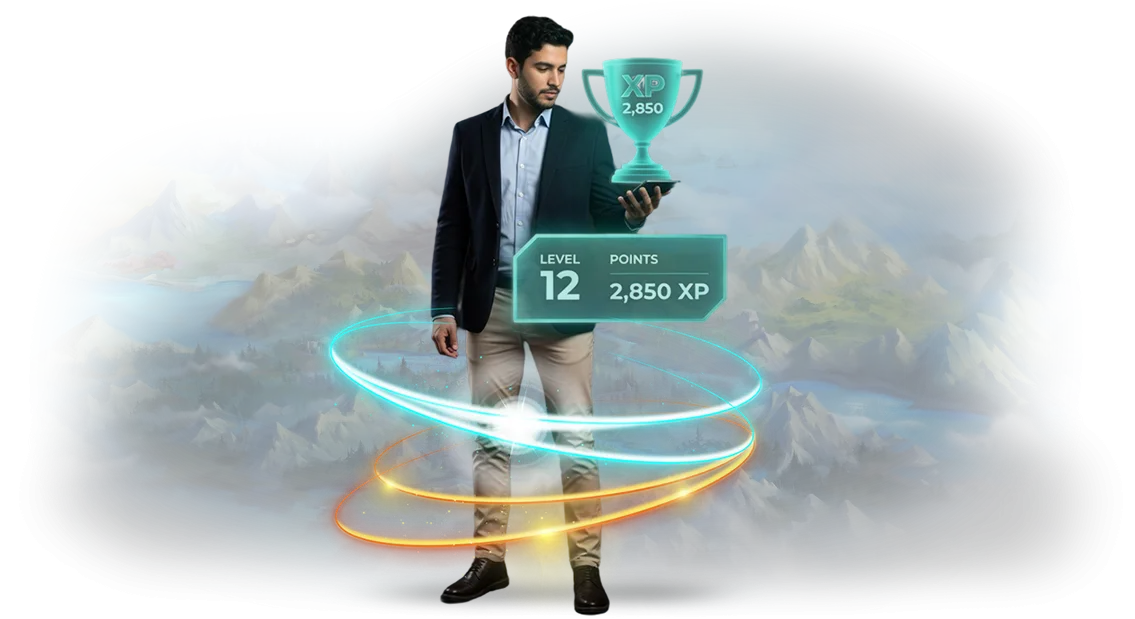
Why Customers Don't Come Back: Loyalty Program Gamification Is Failing
Acquiring a new customer costs several times more than retaining an existing one, yet most loyalty programs remain nothing more than a set of discount coupons.
A guest gets a card, accumulates points, and stops coming back after a few months — because they're simply not interested. Discounts stop working, competitors copy your promotions, and loyalty becomes a formality rather than an emotional connection with the brand.
The problem is that the classic "buy — get a bonus" system doesn't engage the customer. It gives no reason to return tomorrow, sparks no excitement, and doesn't turn a purchase into a small achievement.
As a result, a business spends its budget on marketing while repeat sales keep falling — because the customer doesn't feel that their journey with the company has become any more interesting.
That's where loyalty program gamification comes in. We turn routine purchases into a game: the customer sees progress, earns rewards for actions, competes with themselves or others, and unlocks new levels and statuses.
This isn't a "discount for the sake of a discount" — it's a system that holds attention and builds the habit of coming back.
Loyalty gamification taps into a person's natural desire to finish what they've started, grow, and gain recognition. When a guest sees that they're one step away from the next level, they come back — and bring friends.
Customer retention stops being a headache, and repeat sales grow without constantly increasing discounts.
We help businesses build a loyalty program like this: we analyze your customers' behavior, find the points where you lose them, and design mechanics that make them want to return.
Every element — from point accrual to status privileges — works toward one goal: turning one-off purchases into long-term relationships. And this is no longer an experiment, but a proven tool that we adapt to your business goals.
What You Get from Game Mechanics in Business
Loyalty program gamification turns ordinary purchases into a living game: the customer sees progress, earns rewards for actions, and comes back again.
Instead of one-off discounts, you build long-term relationships — the buyer is personally motivated to return, because every visit brings them closer to a new goal.
The main result is growth in repeat visits without additional advertising spend. When a customer understands that "two more orders — and their status goes up", they choose you over a competitor nearby.
Thanks to accrual mechanics and levels, the number of repeat purchases grows within the first months after launch.
Game elements engage even those who used to buy irregularly. Quests, bonuses for reviews, friend invitations, or completing simple steps — all of this holds the audience's attention and creates a habit of interacting with the brand.
Engaged customers are more willing to try new products and services, which directly increases the average order value: instead of one item, the cart gains extras, because the game mechanics nudge them to "top up to the next reward".
There's also a separate effect: brand awareness. Game mechanics are memorable, people tell their friends about them and share results on social media. Every program participant becomes a brand ambassador, and your reach grows without expanding the ad budget.
At the same time, you get transparent analytics: you see which mechanics work best and adjust the program to customer interests in a timely manner.
In the end, gamification of business processes pays off through systematic growth in key metrics: purchase frequency, average order value, share of repeat orders, and the number of new customers from referrals.
You get not a one-off promotion, but a manageable tool that delivers stable revenue and strengthens your market position.
Loyalty Program Gamification Formats for Your Goal
Loyalty program gamification formats solve different problems: some speed up purchases, others retain regular customers, and still others turn buyers into a community. There's no universal template — it's important to match mechanics to your business model and audience behavior.
We don't pick a format off the shelf; we choose it based on your goal: growing the average order value, visit frequency, social engagement, or bringing back dormant customers.
Our engineers combine mechanics so they drive a specific metric rather than being "a game for the sake of a game".
| Format | For whom | What it gives the customer |
|---|---|---|
| Points and cumulative cashback | Retail, coffee shops, online services | Growth in repeat purchases and loyalty without complex rules for the customer |
| Levels and statuses | Premium services, B2B, salons | Retention of valuable customers, desire to spend more for status and privileges |
| Competitions, leaderboards | Chains, events, apps | Excitement and emotion, a surge of activity and viral reach through social media |
| Mix&Match: points + levels + challenges | Large retail, marketplaces | Maximum engagement at every stage of the funnel and targeted work with different audience segments |
Each format strengthens the loyalty program in its own way. Points deliver predictable growth, levels deepen relationships, competitions generate excitement and free word-of-mouth from participants, and Mix&Match offers a comprehensive solution for several goals at once.
The key is that the mechanics are clear to the customer within 10 seconds and lead them toward the target actions you've built into the scenario.
Project Launch Stages with Our Team
Every project starts with the questions "what problem does gamification solve" and "how do we measure the effect". We structure the work so you see results at every step, not just after launch.
- Brief and goals — we document what you want to achieve: growth in repeat purchases, engagement in the loyalty program, or a higher average order value. We define the metrics we'll use to measure success.
- Audience analysis — we study your customers: what motivates them, which mechanics they're used to, which rewards are truly valuable. This protects you from the "we spent the budget but users didn't engage" scenario.
- Mechanic selection and economics — we choose the format: points, levels, challenges, quests. We calculate the rewards budget and forecast ROI so gamification doesn't eat into profit.
- Prototype and approval — we put together an interactive mockup of the future system. You see how a participant moves through the journey, earns points, and exchanges them for prizes. We make adjustments before development starts — that saves time and budget.
- Technical implementation and integration — we embed the mechanics into your loyalty program, website, or mobile app. We set up automation: bonus accrual, statuses, notifications. Everything works without manual input from your staff.
- Test launch and calibration — we check how the system behaves in reality on a limited group of users. We adjust the settings so participants don't lose interest and the business gets a predictable result.
- Launch and analytics — we open full access to all customers. We track key metrics in real time: number of participants, average order value, repeat purchases. We send a weekly report and suggest improvements.
This sequence helps avoid the main risks — "we built the wrong thing" and "we launched it, but it didn't work". You control every stage and know exactly what you're paying for.
After launch, we stay in touch: we refine the mechanics, add new scenarios, and make sure gamification keeps delivering value to your business.
What's Included in the Delivery and What You Get in Your Hands
A loyalty program stops being an abstract idea after launch. We hand over not "code" but a working tool that your team runs independently: with clear rules, training, and analytics.
Here's what you get:
- Ready-made program mechanics — configured levels, rules for accruing and redeeming points, and action scenarios based on customer behavior.
- Rules for participants — simple terms that don't raise questions from customers or cause disputes with staff.
- Design mockups for every touchpoint — card designs, screens, push notifications, emails, and posters, so the program looks like one cohesive whole with your brand.
- Staff instructions — step-by-step customer interaction scripts, procedures for unusual situations, and answers to frequently asked questions.
- Team training — we run sessions with those who will administer the program, work with analytics, and support participants.
- Analytics dashboard — you see who participates, which promotions drive growth in average order value, returns and repeat visits, and which mechanics need refinement.
- Update guidelines — how to adjust terms, add promotions, and manage seasonal offers without involving developers.
After launch, we don't disappear. We support you through the first weeks of operation, help fine-tune processes, and hand over clear reporting: what's growing, where the bottlenecks are, what has paid off.
All documentation stays with you — you run the program as a standalone tool without depending on a contractor.
Case Study: How We Increased Repeat Sales by 40%
For the gift store chain Lavka Podarkov, the main pain point was that customers came in for one item and then disappeared for months.
Discounts and standard loyalty cards worked poorly: the average order value stayed flat, and repeat purchases accounted for less than a third of sales. So the client asked us to retain customers without constant promotions that were eating into margins.
We redesigned the loyalty program into game mechanics: every customer got their own level, visible progress toward the next reward, and personal challenges — "come back for a holiday gift", "collect a series of purchases".
Our engineers set up automatic scenarios so the system itself told customers how many points they were short of a nice bonus. The customer doesn't need to calculate anything — the app shows the path to the reward and nudges them at the right moment.
Six months later, repeat sales were up 40%, and the share of customers who returned within a month of their first purchase had doubled. The average order value also rose — people gladly topped up their cart to reach the next game level.
The chain's director noted: "For the first time, we see customers coming back for new purchases on their own, not just because of discounts."
This result isn't luck — it's a well-tuned model that we adapt to each specific business. It can be applied to a coffee shop, an online store, or a service salon.
The numbers depend on your industry, but the mechanics are proven: clear goals and a sense of progress retain customers more reliably than one-off promotions.
How to Choose the Right Format for Your Goal?
Choosing a gamification format starts not with trendy mechanics but with your business goal. If the aim is to retain regular customers, you need one reward model; if it's to attract new ones, you need another.
So first, together with you, we define what the project should deliver: more repeat orders, a higher average order value, more activity in the app, or additional customer data.
Then we match the mechanics to your audience's specifics. For example, in the mass market with frequent low-cost purchases, simple accrual scenarios with fast rewards work well. For the premium segment, status levels, exclusive privileges, and personalized scenarios matter more.
We factor in the average order value, interaction frequency, and seasonality — so gamification feels like a natural part of the customer journey rather than a forced game.
We also work through the specific requirements of your business. The loyalty program needs to work correctly with your accounting system, mobile app, or website.
If you have offline locations, we design a scenario for the cashier and QR codes; if it's an online store, automatic point accrual after payment. We choose a format that doesn't create extra manual work for your staff or confuse users.
In the end, you get not an abstract "game for customers" but a tool that solves a specific business problem. We usually prepare two or three mechanic options with audience behavior forecasts, then run a pilot on part of the customer base and scale based on the results.
This approach removes most risks before full launch and allows you to adjust the program before it loses appeal.
Frequently Asked Questions and Objections Before Launch
Before launching loyalty program gamification, many executives have the same doubts: will we make the deadline, will the project blow the budget, how will it integrate with our current CRM, and what happens if customers don't react.
That's normal — over 10+ years we've launched dozens of similar programs and learned to close these risks at the planning stage. Below are honest answers to common objections, without technical details or fluff.
How long does launch take?
Simple mechanics — points, levels, a welcome game — launch in 2–4 weeks. Complex programs with quests and integration with your system take from 6 weeks.
We fix the exact timeline in the contract after a short brief, and you see the first results within the first month of operation.
Is it expensive? What does the budget consist of?
The budget depends on the depth of the mechanics: the cost of a simple program is calculated after audit, and a multi-level one with game scenarios requires an individual estimate. Before we start, we show a transparent cost breakdown and discuss every line item.
Payment is phased: you're not paying for "the process" — you're investing in a measurable result, growth in repeat purchases and conversion.
Is integration with our system difficult?
We connect to popular CRM and POS systems, or provide a lightweight module that works alongside your database. The program can be a standalone page or a mini-app — the customer doesn't notice the technical details.
The launch doesn't interrupt your business operations, and all participant data automatically flows to the right departments.
What happens if the mechanics don't work?
We don't abandon the project after launch. For the first 2–4 weeks, we monitor engagement and conversion, and if we see weak spots, we adjust the scenario: we change rewards, rules, event frequency, and acquisition methods.
The contract includes our commitment to refine the program until it hits the target metrics, so you're never left alone with the problem.
If you still have doubts about timelines, budget, or compatibility with your processes — send us a few details, and within one working day we'll prepare a cost estimate for your specific task. You'll get not an abstract promise, but a clear plan with numbers and dates.Ready to Discuss Your Project? Leave a Request
We understand: the decision to introduce gamification into a loyalty program requires assessing the benefits, timelines, and budget.
So you don't need to approve the project right away — just leave a gamification request, and we'll prepare everything you need for a well-considered decision.
What you'll get immediately after reaching out:
- Consultation: we'll look at which game mechanics suit your loyalty program and your customers.
- Cost estimate: a transparent quotation for your scale — no hidden fees or fine print.
- Implementation plan: a step-by-step schedule with stages, timelines, and our points of contact.
- Practical examples: we'll show how gamification boosted repeat purchases and average order value in similar projects.
- Metric recommendations: we'll advise on how to track the effect — customer retention, order frequency, and lifetime value.
- Honest assessment: if gamification won't deliver the expected result in your case, we'll tell you directly before work begins.
No obligations: we won't start any work without your decision. Within 1–2 working days, you'll receive specifics, not generalities.
Leave a request for loyalty program gamification right now — by tomorrow you'll know how to turn an ordinary bonus program into a tool that increases revenue.