

Gamification of Employee Onboarding: How to Reduce Turnover
One in two new employees leaves within the first few months — and this is not a hiring problem, but an adaptation problem.
The company spends serious money on recruiting, training, and knowledge transfer, yet the newcomer never gets a chance to deliver value because they lose motivation as early as the second week.
The reason is almost always the same: onboarding is reduced to lectures, regulations, and "sit and watch." The new hire doesn't see their own progress, doesn't understand what earns praise, and quickly burns out from uncertainty.
As a result, turnover grows, team spirit suffers, and managers repeatedly launch the expensive hiring cycle all over again.
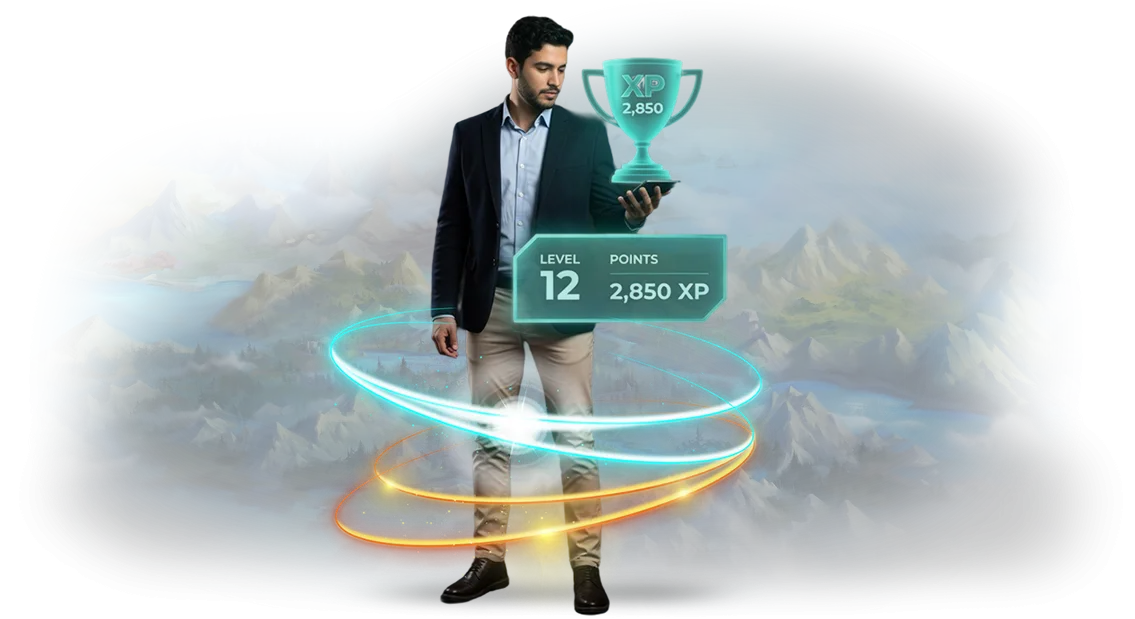
Onboarding gamification solves this pain point. We turn the first weeks of work into a clear path with goals, levels, and rewards — the employee sees their competence growing, receives feedback, and achieves quick wins.
Instead of an abstract "familiarize yourself with the documents," they get concrete tasks, quests, and achievements that engage them from day one.
The result is reduced turnover among new hires, accelerated time to productivity, and stronger employee motivation. People plug into processes faster, feel part of the team, and are less likely to leave because they find growth exciting.
This is exactly how gamification turns onboarding from a costly necessity into a tool for retaining valuable talent.
We help companies implement this kind of onboarding — from scenario design to launch and support. If you're familiar with the losses caused by poor adaptation, let's discuss how to change that for your specific goals.
What You Get: Engaged Employees and Transparent Results
A newcomer who doesn't understand why they're here and what's expected of them means wasted weeks of adaptation and a quiet exit in the first months.
Onboarding gamification turns the first 30–90 days from tedious routine into a clear trajectory: the employee sees their progress, rewards, and the connection between their tasks and business goals — and this noticeably accelerates their path to full productivity.
You get three measurable outcomes: engagement, retention, and speed of results. The employee completes training on their own, helps colleagues, and takes on additional tasks to reach levels — so you don't need to spend resources on manual control.
Retention grows not through bonuses but through a sense of progress and recognition, which is critical in the first months of work. As a result, adaptation shifts from "observe and memorize" into an active process with clear stages and quick wins.
For managers, the main bonus is transparency. You can see which newcomers have already mastered the tools, who is stuck on a specific topic, and who is ready to work independently.
Instead of guesses — facts: for each employee, you understand the pace of completing stages, engagement level, and readiness for real tasks. These are the same data you use for team capacity planning, but collected automatically and presented in a convenient format.
The key pain points this solution addresses: reduced turnover during the probation period, less mentor time spent on routine questions, and a clear growth map for every new team member.
We adapt the mechanics to your corporate style and internal policies so employees see familiar context rather than an abstract game. This way, you get not "just another system" but a working tool that pays for itself faster than a single vacancy gets filled.
Gamification Formats for Different Business Goals
The same game mechanics don't fit every task: training a newcomer and practicing sales skills require different approaches. If onboarding is built as a competition, the newcomer will burn out; if it's purely passive learning, they'll lose engagement.
That's why we match the format to the goal: accelerating time to competency, teaching the product, or rehearsing difficult situations.
In practice, most companies use one of three core formats — or a combination of them. Here's how each one addresses business objectives.
| Format | Who It's For | What It Delivers to the Client |
|---|---|---|
| Quests | Newcomers who need to get up to speed quickly | The employee goes through the steps on their own and absorbs the processes without lectures. Onboarding speeds up. |
| Simulations | Sales and support teams where real scenarios matter | Practice on safe examples: the employee learns to handle objections with no risk to the client. |
| Competitions | Teams that need stronger engagement | Higher activity and KPIs, leaders receive recognition. Works well for recurring tasks. |
Game mechanics are not an end in themselves but a tool: quests rely on progress and rewards, simulations on feedback, and competitions on public recognition.
We combine them to hit your metric — reduce turnover, accelerate reaching target performance, or increase the share of successful deals.
How the Project Works: From Brief to Launch and Support
We've structured the process so you can see progress toward the goal — fast adaptation of new employees. Below are the stages every project in our team goes through.
Work Stages
- Brief and audit. We examine your current onboarding: where newcomers get lost and what slows down time to productivity. The output is a list of bottlenecks that gamification will close.
- Plan and approval. We lock in scenarios, rewards, and expected metrics: adaptation time, engagement, program completion. You approve the plan before development starts — no surprises.
- Mechanics development. We build quests, levels, and feedback embedded into the work processes. New employees experience training as a game, not a tedious obligation.
- Pilot and testing. We launch the mechanics with a group of newcomers, see what works, and simplify what doesn't. Adjustments are made before the full rollout — this saves time and budget.
- Launch. We integrate gamification with your HR management system and train your HR specialists. Employees start using it right away, with no long ramp-up.
- Support. We analyze data, adjust task difficulty, and add new elements. You get not a one-off product but a living tool that evolves with the company.
Each stage comes with a clear report and full transparency on what you're paying for. In the end, gamification becomes part of company culture and delivers fast employee adaptation.
What's Included in the Delivery: A Complete Kit for Launch and Growth
After launch, you don't get a bare program but a complete kit for a confident start and further growth. Everything is packaged so your employees and HR team can use the system without constant involvement from developers.
The delivery includes:
- Game mechanics scenarios — ready-made storylines tailored to your onboarding process: they keep the newcomer engaged and guide them through the next steps.
- Administrator guides — simple step-by-step documents for configuring levels, rewards, and roles. Your specialists can make changes on their own.
- Admin panel — an intuitive interface for managing content and tracking employee activity. You can see who has completed a stage and who needs help.
- Training materials for employees — short tips and video instructions that help newcomers quickly learn the rules and join the game.
- Access for your team — flexible distribution of permissions across HR staff, managers, and administrators. Everyone sees only what they need for their work.
- Updates package and documentation — instructions on adding new scenarios and adapting the mechanics as your company grows. You're never locked into one developer forever.
As a result, you get a working tool and everything you need to manage it in-house. This reduces dependence on the contractor and lets you develop gamification together with your business.
Case Study: How We Reduced Turnover and Accelerated Time to Results
Coffee shop chain Черный кот faced a pain typical for retail: due to high turnover, every third new location opened understaffed, and newcomers only reached the target sales level after two months.
Training was standard — instructions and tests that employees completed just to check the box. We proposed turning the first weeks of work into a game so that newcomers would want to understand the product and service on their own.
We built the adaptation as a story-driven quest: each employee gets a character, progresses through levels, completes real tasks (first sale, proper product display, handling objections), and earns points.
We added a competition between shifts within teams — this created healthy excitement and a willingness to help newcomers. No additional programs needed to be installed: all mechanics worked through a convenient mobile interface showing progress and mentor hints.
After three months, we measured the impact. Turnover among newcomers dropped by 40%, and time to average performance was cut in half — from eight weeks to four. The share of employees who successfully completed their probation period grew from 65% to 88%.
Location managers noticed that teams got to work faster, and hiring became easier: candidates themselves ask about the opportunity to complete the "quest."
Today, this system has become the foundation for training all new employees, and we continue to develop it together with the HR department: adding seasonal scenarios and personal trajectories.
For us, this is confirmation that well-designed gamification pays off — it reduces the burden on mentors and the direct losses from attrition.
How to Choose a Format for Your Team's Specifics?
There is no one-size-fits-all format: a five-person team and a distributed department have different specifics. Onboarding gamification in a compact team solves one set of problems; at scale, another. That's why we always start by analyzing your conditions, not with a ready-made template.
The main selection criterion is the business objective. If newcomers need to get up to speed quickly, we use competitive mechanics with immediate feedback. If the priority is to reinforce long-running processes, we add levels, accumulation, and team goals. This way, the game becomes not entertainment but a way to build lasting work habits in your people.
We also take into account where your employees are: in the office, remotely, or in the field. For each context, we choose a format — desktop, mobile, or blended. During the consultation, we ask not about the platform but about your adaptation problems.
The answer determines the launch timeline (often 2–4 weeks) and budget: you don't spend money on mechanics your team doesn't need.
Bottom line: choosing a format is transparent logic, not guesswork. We present a framework grounded in numbers: time to results, reach of engaged newcomers, and turnover in the first months.
Reach out for a consultation — in one conversation, you'll understand which option fits your team's specifics, and you'll see the result in your own employees.
Answers to Frequently Asked Questions and Concerns
We understand: before launching onboarding gamification, questions arise — will it derail timelines, how hard is it to implement, and what happens if something goes wrong. We answer the main concerns so you can make a decision with complete clarity.
Isn't gamification too complicated to implement?
No. We handle the entire technical side: from scenario design to launch and support. All you need to do is participate in the brief and approve intermediate results — just like with regular development, only with a more visual and engaging outcome.
How long does the launch take?
A typical project takes 3–5 weeks — a ready-made game scenario integrated into your adaptation program. If you need a simpler version with basic mechanics, we'll get it done faster.
Exact timelines are recorded in the contract after the brief, so you'll know the start date precisely.
How will this fit into our current processes?
Gamification works as an additional layer on top of your existing training system: we integrate it with your LMS or corporate portal without disrupting familiar processes.
Employees don't need to learn new tools — they complete onboarding in a familiar environment, but with game elements.
What guarantees that this will bring value?
We put specific metrics in the contract: time for a newcomer to hit target performance, completion of adaptation stages, and engagement in the first months. Before launch, we test on a small group, adjust the mechanics, and only then scale.
We also provide post-launch support — making adjustments promptly whenever we see something that can be improved.
Have other questions? Bring them up at the brief, and we'll design a solution tailored to your specifics.Start Your Project: Get a Plan and Cost Estimate Within 1 Day
Every day of stalled onboarding costs you time and money: a new employee takes longer to reach full productivity, and probation-period turnover hurts the team and your reputation.
We remove the uncertainty: submit a request — and within a day you'll have a plan, an estimate, and a solution presentation adapted to your task.
What you get after submitting a request:
- An onboarding gamification implementation plan: specific stages, timelines, and responsible parties on our side.
- A cost estimate tailored to your task — a transparent quote with no hidden surcharges or fine print.
- A solution presentation: how game mechanics will engage new employees, reduce turnover, and accelerate time to results.
- Examples from our projects for your industry — with verifiable numbers.
- A list of data we need from you to get started, plus questions to nail down your goals.
The estimate is prepared by a team with 10+ years of experience in digital product development. We don't offer a one-size-fits-all template: we take your specifics — headcount, processes, culture — and calculate accordingly.
If the project turns out to be impractical, we say so honestly and advise how to proceed without unnecessary spending.
Once you receive the package, you can compare it with other contractors, show it to your management, or discuss the details with us right away. Either way, you gain clarity and save weeks of independent research.
Submit a request — within 1 day you'll understand what your gamification project looks like, what it costs, and where to start.