

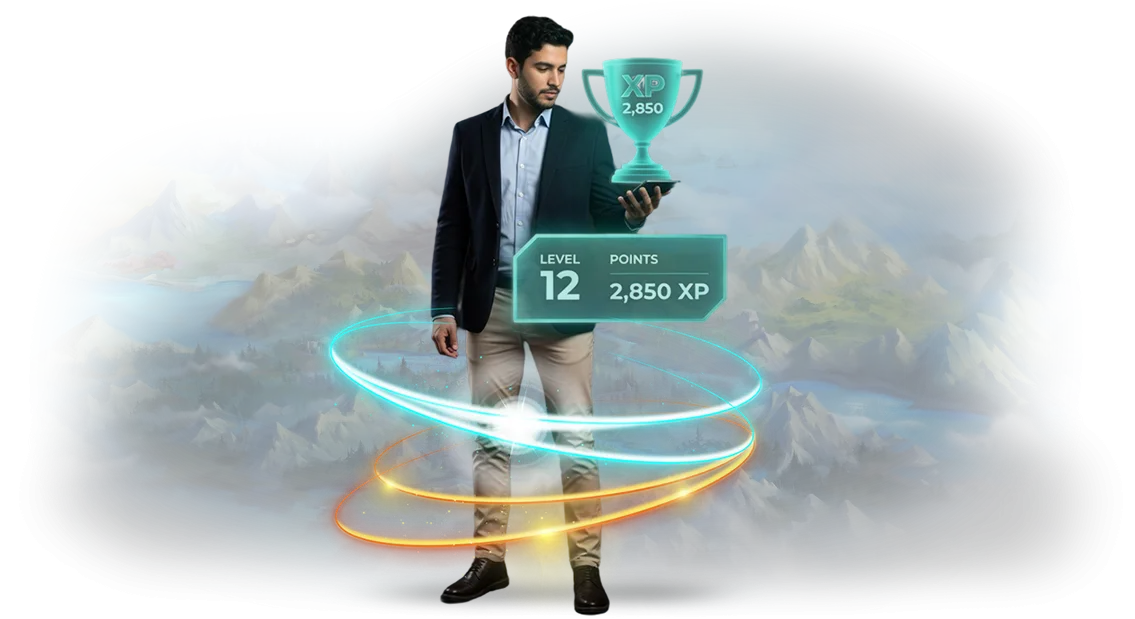
Why Serious Games Solve the Motivation Problem
Employee training programs often become a formality: people complete courses just to "check the box," and a month later cannot apply the new knowledge.
A manager invests budget in training but sees neither improved performance nor measurable results — engagement in learning remains low, and motivation fades after the first sessions.
Serious games solve this problem at the psychological level. Instead of passively watching lectures, an employee enters a scenario where they must make choices, overcome obstacles, and see the consequences of their decisions. Gameplay holds attention and creates the desire to return — exactly what classic trainings lack.
For language learning, we apply the serious game design model for language learning in the cultural context. It immerses the employee in work and everyday situations in a foreign language, where cultural peculiarities become part of the task.
This way, learning stops being abstract word memorization — it turns into an engaging experience that people want to continue.
For business, this means obvious benefits: staff engagement increases, employees practice the language on their own and retain the skill longer.
The company gets a team ready to use new knowledge in negotiations, client work, and internal communication — without endless control from the manager. Gamification of business processes here works not as entertainment but as a tool for real development.
What Business Results You Will Get
You get not "training for the sake of a checkmark" but an increase in employee engagement that is immediately visible in the numbers. Unlike boring courses, a serious game leverages people's natural desire to compete and achieve results.
This reduces turnover, increases loyalty, and makes the team regularly return to the material without reminders.
Learning proceeds two to three times faster because the employee absorbs the language through real scenarios from your cultural and business environment, not through abstract exercises.
Mistakes and successes in the game provide instant feedback, so the skill is consolidated in weeks, not months. This means translations, negotiations, and work with foreign clients become more confident.
Such a game strengthens the employer brand: you show that you invest in people's development in a non-standard, caring way. It works both for external recognition — participants share their progress on social media — and for the internal atmosphere within the company.
Finally, you get practical results, not abstract assessments. In the game, every skill is tied to a business task: you conducted negotiations, processed a request, supported a client conversation.
Thus, you see which competencies already contribute to revenue and which are worth improving. That is why language gamification becomes a fast-return investment rather than an expense item.
Which Serious Games Suit Your Task
Every business scenario requires its own game format — and the result directly depends on it. If the goal is regular language practice, one approach is needed; if preparation for complex negotiations, another.
We compared three formats we use most often in language learning projects with cultural context in mind.
| Format | For Whom | What It Gives the Client |
|---|---|---|
| Corporate simulator | Employees who need daily language practice in work tasks | Fast practice of typical situations, automated learning, progress control without schedule dependence |
| Scenario simulation | Managers and executives working with foreign partners | Preparation for non-standard negotiations, understanding of cultural specifics and communication style, reduced risk of mistakes |
| Quests | Teams that need to unite and boost motivation | Engagement through competition, learning language and traditions in a game form, relieving "learning stress" |
The corporate simulator drills specific work situations: an employee can complete a business meeting scenario in 15 minutes and immediately get an error analysis.
Scenario simulation prepares for non-standard situations — here it is important not only to know the right phrases but also to sense the partner's reaction and account for the communication norms accepted in their culture.
Quests add excitement: teams solve tasks related to customs and etiquette, and in the process absorb the language unobtrusively.
We select the format for your task and audience, not vice versa. At the preliminary meeting, we will analyze which scenario will deliver the maximum effect for your area and adapt it to the cultural environment of your employees and clients.
How the Project Work Unfolds
The project is built as a partnership: you see intermediate results at every stage and can influence them. This approach removes the main risks — mismatched expectations and missed deadlines.
Project Stages
- Brief — we define the goals, audience, and cultural context in which employees use the language. You get a precise understanding of what the game will do and why.
- Concept — we propose the storyline, mechanics, and task types, and align scenarios and dialogues with your objectives. Even at this stage, you can see how the game will fit into the training.
- Prototype — we show a short version that can be tested with employees. You see the product in action before full development and decide whether to continue.
- Development — we fill the game with exercises, feedback, and scenarios. We regularly show intermediate versions so that edits do not pile up by the final release.
- Testing — we collect completion and engagement metrics and refine the difficulty. The game is tested with a real audience before launch.
- Launch — we deploy the solution in your infrastructure, onboard users, train administrators, and support the first days of operation.
- Support — we stay in touch: update content, add scenarios, and adapt mechanics to changes in the business.
As a result, you get a working training tool integrated into the company's processes and a team that stays with you after launch.
What the Final Delivery Includes
You receive not just game files but a ready-made tool that can be immediately implemented in training and used without involving developers.
The package includes everything needed for launch, result tracking, and further project development — from methodological materials to updates.
Here is exactly what we hand over after the work is completed:
- Ready-to-use language learning game — a full-fledged product adapted to the cultural context of your audience. The game works on any employee device: computer, tablet, or smartphone — without any loss of quality.
- Methodological materials for the teacher — detailed lesson scenarios, a guide for integrating the game into the curriculum, and recommendations for assessing progress. The teacher won't have to "reinvent the wheel" — they get a complete system.
- Instructions for launch and administration — clear guides on installing the game, configuring access for employee groups, and tracking their performance. This works even without a technical specialist on staff.
- Training for your team — we provide a demonstration and answer questions so that your employees confidently use the product from day one.
- Access to updates and technical support — we support the project after launch: fix bugs, update content, and consult your teachers when needed.
Most importantly, all exclusive rights to the game and its content transfer to you. You can freely refine scenarios, change difficulty levels, and expand the game for new business tasks at any time, without notifying the developer or paying extra.
Essentially, you get a working training system, not a "box with a game." We handle the technical part so that you can focus on the main thing — effective employee training.
Case Study: 40% Increase in Staff Engagement
Standard language trainings in service companies often become a formality: employees take a test, but a month later forget the words and don't know how to react to a non-standard request.
As a result, the organization pays for training twice — first for the course, then for mistakes in communication with clients.
We moved the language learning process into a safe game environment.
For the hotel chain "Amarant" (name changed), we developed a serious game where employees, playing the role of administrator, train dialogues with foreign guests — from check-in to complaints about noise in the room.
Every response takes into account the cultural characteristics of the guests, so the game prepares for real communication, not for an exam.
Implementation Result
After two months, staff engagement in training increased by 40% — this is the measured share of employees who regularly complete game sessions rather than just doing the task for the sake of a checkmark.
The average time for a new employee to start working independently with standard dialogues was cut in half.
This development case shows how game mechanics pay for themselves in business. The client quickly noticed the difference and ordered an adaptation of the game for a second department — turning the project into a scalable training tool without new strategic costs.
What If You Have Specific Requirements?
"Specific requirements" sounds like a risk: extended deadlines, an unpredictable budget, a result that won't fit into your processes. For us, it is a working scenario.
Every company has its own vocabulary, communication standards, and cultural characteristics — these are exactly what make corporate training useful rather than "just another course."
That is why we do not offer a ready-made template; we adapt the game to your tasks. Methodologists and engineers study your context: who employees communicate with, which speech patterns are needed in negotiations, where misunderstandings with foreign clients arise.
For example, for an international hotel chain, we built scenarios around dialogues with guests from different cultures — with an emphasis on etiquette and nuances that cannot be found in textbooks.
Importantly, adaptation does not turn into development from scratch at enormous expense. We have a proven base: tested game mechanics, a set of scenarios, and a methodological framework. We fill them with your cases, data, and requirements.
As a result, timelines and budgets remain predictable, and the game becomes "yours" — employees recognize their own workday in it, not an abstract situation.
The more non-standard the request, the more interesting the outcome.
Specific requirements are not a limitation but a reason to create a game that will fit perfectly into your business processes and deliver measurable benefits: greater confidence in negotiations, fewer communication errors, and higher customer loyalty.
Frequently Asked Questions About Collaboration
Before we begin, let's address the doubts that most often arise for managers before ordering a serious game for language learning. Briefly on the main points: timelines, guarantees, integration with existing systems, and post-launch support.
How long does development take?
The timeline depends on the scope of the scenario and the number of language levels. Usually, a working prototype appears within 3-4 weeks, and the full launch takes 3-5 months. At the start, we fix the stages and dates in a plan so that you can see progress every week.
What guarantees do you provide?
We guarantee that the game works stably on the required devices and helps achieve the stated learning goals. We support the launch and the initial content filling. If any element works differently than agreed, we fix it free of charge during the warranty period.
Is it difficult to integrate the game into an existing system?
At the first stage, we study your infrastructure: corporate portal, learning platform, or customer management system. We design the game module so that it works without replacing your tools. We provide employee progress data in a convenient format.
What about support after launch?
After the release, we stay close: user technical support, updating the word and scenario database, and refining mechanics based on feedback. Choose a convenient format — from one-off edits to ongoing support.
Discuss Your Task with an Expert
Discussing the task at the start saves months of edits after launch. Language gamification works only when the game mechanics align with the learners' goals and the cultural characteristics of their perception.
Our expert helps verify this in a single call: they analyze the audience, the motivation scenario, and the format that will actually deliver results.
Leave a request for a consultation — after the conversation, you will receive a proposal with specific solution options and a cost calculated after audit. No abstract ideas, only what can be implemented in your project.
What you get after contacting us:
- Analysis of your task and learner profile — we understand who will play and how to maintain interest.
- Recommendations on game format and cultural adaptation — so that mechanics do not contradict your audience's habits.
- Cost calculated after audit in several options — from a basic scenario to a full-fledged product with content.
- Project plan with stages and timelines — you can see when the first tests and launch will happen.
- Answers to questions about teacher preparation, integration with learning materials, and post-release support.
- Examples of similar projects and lessons learned — what worked and what didn't, and how it affects your plan.
We don't sell a "box"; we design a solution for your task. Fill out a short form — we will call back within one business day and outline the first steps. There’s no obligation to proceed.