

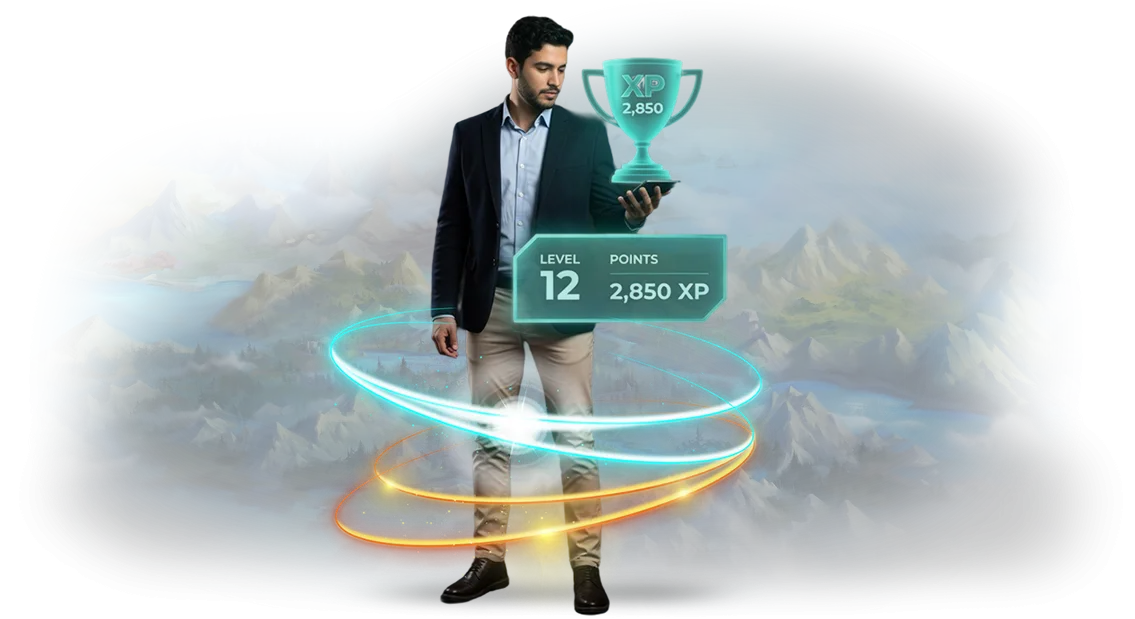
Serious Game Design Framework: How to Bring Back Engagement and Growth
Employees are increasingly working on autopilot: tasks get done, but without passion. Engagement is declining, metrics are stagnant, and attempts to motivate with bonuses have only a short-term effect. Business spends resources, yet results don’t improve — a familiar pain for many managers.
The reason isn’t laziness, but the fact that processes have lost their meaning. Repetitive operations, endless reports, and a lack of feedback kill interest.
Meanwhile, competition for employee attention is enormous — if work doesn’t bring satisfaction, they leave or stay and burn out.
For the company, this means direct losses: lower productivity, higher turnover, and lost clients due to indifferent service.
A manager tries to patch the problem with one-off events, bonuses, or penalties, but without a systematic approach, motivation doesn’t become part of daily work.
We help break this cycle with the serious game design framework — a proven methodology for building gamified processes. It turns routine actions into an engaging scenario with clear goals, levels, and rewards.
Employees begin to see their contribution to the overall result, and the business sees growth in key metrics — engagement, quality, speed.
We don’t just add badges and points. We design a holistic system that integrates into your business processes and delivers measurable impact. From the pilot stage, you’ll see how team behavior changes, followed by sustained momentum. Bring back passion for work and performance growth with us.
What You Get from Implementing Gamification: 5 Measurable Benefits
Growth in Key Metrics
Game mechanics turn routine actions into short scenarios with a clear reward. We rely on the proven serious game design framework and adapt it to your objectives. Employees get distracted less often, so conversion and task completion speed increase. We set measurable goals and typically see improvement in 3–5 key metrics within 1–2 months.
Transparent Gamification of Processes
Clear rules and visible progress bring clarity to daily work. Each participant sees how their actions affect the overall result — this reduces staff turnover and disputes. You get a manageable process without ‘manual’ control, and managers save time on task assignment.
Customer Loyalty
Reward mechanics keep customers engaged and motivate them to return more often. Clients are more willing to participate in promotions, accumulate bonuses, and recommend you to friends.
The share of repeat orders and the average check grow — a loyal audience becomes a source of stable revenue.
Increased Sales
Competitive elements and status accumulation encourage more frequent purchases. We link gamification to sales goals: quizzes, marathons, exclusive offers for top-ranked leaders. This delivers predictable revenue growth without discount wars or devaluing the product.
Team Effectiveness
Gamification of training and goal setting increases employee engagement. They acquire skills faster, share ideas more readily, and help colleagues. Productivity grows through healthy competition and visible collective progress — not through coercion or overtime.
Cooperation Formats: Choose the Right One
Every company approaches gamification with a different level of readiness: some need a quick experiment in one team, others need a complete overhaul of motivation and engagement.
To cover both scenarios, we have developed three implementation formats based on our serious game design framework — from a pilot project to a comprehensive transformation.
The format is selected according to your request, budget, and timelines. In any case, you get a well-thought-out game mechanism rather than a set of one-off promotions: employees become engaged in the process, and results are easy to measure.
Implementation Options
| Format | Who it suits | What you get |
|---|---|---|
| Pilot project | Sales, service, or HR departments — a unit with a clear KPI | Launch of a game mechanism for a single task in 2–3 weeks, minimal risks, measurable result, and a basis for scaling |
| Employee training | An internal team that wants to develop gamification on its own | We hand over the serious game design framework, tools, and templates, and teach your specialists to create game scenarios themselves |
| Turnkey gamification | A company ready to systematically restructure processes and motivation | Full cycle: audit, design, implementation, training, and support. Game mechanics are embedded into daily operations and supported by our team |
Don’t know which format to choose? Start with a pilot project: it’s the fastest way to see the effect of gamification in your environment. Then we’ll help you scale the success to other departments.
How a Project Works: 7 Steps from Brief to Support
We work transparently: you always see what happens at each stage of implementation and what result you’ll get. All agreements are documented, so there are no surprises along the way — neither in timelines nor budget.
Each step is accompanied by short reports, so you can monitor the project without unnecessary meetings.
- Briefing and task analysis. We examine your goal, audience, and current processes. We determine which business problem gamification solves and how we’ll measure its effect.
- Prototype and concept. We show how the mechanism will work with a visual prototype. You make edits before development starts — saving time and budget.
- Project approval. We lock in scope, timeline, cost, and control points. You get a clear work plan and understand each party’s responsibilities.
- Game mechanism design. We design points, levels, and rewards — all tied to your business metrics, not to abstract ‘fun’.
- Development and implementation. We integrate the mechanism into your systems and workflows so the company’s day-to-day operations don’t stop.
- Testing and gamification launch. We run a pilot with a real group of employees or customers, fine-tune the mechanism, and only then launch it to the entire audience.
- Technical support and development. We monitor metrics, answer user questions, and refine the mechanism to keep interest alive. You get a stable, working tool that delivers results.
What’s Included in the Delivery: A Complete Launch Package
Implementing the serious game design framework is not just a set of mechanics but a comprehensive solution that works toward a measurable business result.
We hand over everything you need to launch gamification without stopping current processes and to see its effect from the first days.
- A game system embedded in your processes: a ready-made motivation mechanism tailored to the company’s objectives. Employees get clear goals and feedback, and you get an engagement management tool.
- Integration with existing tools: the system works with your HR, CRM, and accounting systems. Data isn’t duplicated, and employees don’t need to switch between programs.
- Dashboard and reporting: clear metrics for engagement, goal achievement, and team performance. You see which mechanics are effective and can adjust course in time.
- Turnkey staff training: short instructions, training materials, and a workshop for managers. The team works confidently from day one; you don’t need to hire a separate specialist.
- Regulations and documentation: descriptions of game scenarios, rules, roles, and evaluation criteria. Internal standards that are easy to pass on to new employees and use for scaling.
- Post-launch support: assistance, answers to questions, refinements, and system development as the business grows. We stay close after implementation so gamification works without disruptions.
- Measurable project results: you get recorded metrics before and after implementation — reach, engagement, task completion speed. This is the basis for calculating ROI and justifying further investment.
Case Study: How Gamification Increased Plan Fulfillment by 35%
The gamification case we most often show new clients is a project for the federal electronics retail chain M.Video.
Sales associates perceived the plan as an abstract number, motivation dropped by the end of the month, and the sales department spent hours manually monitoring metrics. The department heads wanted to improve efficiency without changing the compensation system.
We launched a game mechanism within the workflow: each employee saw their progress in a personal dashboard, could compare results with colleagues, and store teams participated in a common rating.
Statuses, levels, and rewards updated automatically — for staff, this became an engaging routine rather than extra reporting. The successful project was up and running within a month of launch, without stopping operational processes.
Project Results
Over two months, plan fulfillment grew by 35%, and sales of related products and services increased by 22%. Turnover among sales associates dropped by 18% because people stopped working ‘blind’ and received clear feedback for every step.
Client feedback after launch confirmed the value of the approach: the HR director noted that employees asked for the first time what mechanics would appear next month.
Six months later, the chain scaled the solution to 500 locations — the repeat order was the best proof of the result.
How to Choose the Right Framework for Your Task?
The right framework is neither the trendiest nor the one used by a competitor, but a solution for your specific task. There is no universal approach: what boosts sales rarely works for staff training or customer retention.
Therefore, the first step is to clearly define the business outcome: revenue growth, faster onboarding, lower attrition, or higher loyalty.
You should start choosing not by studying mechanics but by analyzing the situation. Your selection criteria should include: who your audience is, how ready they are for game elements, how often they use the product, and what truly matters to them.
Then we assess which processes can be improved without adding unnecessary complexity for employees and customers — gamification should fit into daily work, not create extra barriers.
A common mistake is choosing a framework based on ‘I like this case’ or chasing the number of mechanics. An overloaded system quickly becomes tiresome, and business metrics don’t grow.
In practice, an effective solution is often simpler than it seems: a few clear mechanics, a transparent connection between actions and rewards, and understandable progress. Such an approach pays off faster and is easier to scale to new teams or products.
We select the framework for your task: we conduct a short audit, propose two or three solution options, and explain the differences in timelines, cost, and impact. Together you choose the option that delivers fast, measurable results and is also easy to develop further.
Turnkey gamification — from setting the goal to launch and support — lets you focus on business rather than implementation details.
Ultimately, the right framework is the one you’ll still be using months later because it brings value and people like it. If you’re unsure about the choice, start with a short consultation: we’ll help you find a solution that works in your specific conditions.
Frequently Asked Questions About Gamification Implementation
We understand: before ordering gamification, several practical questions arise. Below are honest answers about timelines, budget, compatibility with existing systems, and result guarantees.
How much does gamification implementation cost?
The cost depends on the scale: a ready-made mechanism for a sales department is one budget, while a comprehensive motivation system for the entire company is another. At the briefing stage, we lock in the price and timelines so you know the investment volume before work starts.
Typically, the project pays off through increased conversion and task completion speed. That’s why we offer a pilot launch in one department — so you see the effect before scaling.
How long does a project take?
A typical timeline is three to eight weeks depending on the complexity of the mechanics and the number of integrations. We break the work into stages and show a working prototype by the middle of the project.
If you urgently need to launch a campaign by a specific date, we’ll choose a simplified format that can be deployed in two to three weeks.
How difficult is it to integrate gamification with our systems?
The modern platforms we work with connect to most corporate services: CRM, knowledge bases, and learning portals. We handle the integration — you don’t need to hire separate developers.
The main thing is to determine where the system will get data about employee or customer actions. Then we’ll set up automatic data exchange.
What guarantees do you provide on results?
We take responsibility for the mechanics working without failures and for the stated business metrics being achievable. In the contract, we record specific metrics: growth in engagement, completed tasks, or repeat inquiries.
After launch, we stay in touch and support the project for at least a month — adjusting the balance of rewards and levels if we see that something is not fully refined.
What if employees don’t participate?
The key factor isn’t the mechanics, but how the task is framed and the reward system. We design a scenario in advance that appeals to different personality types: competitive people, team players, and those who like collecting achievements.
Together with you, we figure out how to embed gamification into the workflow so participation is natural rather than an extra burden. If needed, we provide brief training for managers.
Ready to Discuss Your Project? Submit a Request Today
We understand: gamification is not entertainment, but an efficiency management tool. We embed it into workflows so you get measurable results — from employee engagement to growth in repeat sales.
Submit a gamification request — we’ll review your task and suggest an option that fits your business. The approach is based on the serious game design framework, adapted to your industry, budget, and timelines. You don’t need to dive into details — we handle the project side.
What you get after your inquiry:
- Consultation — we analyze the task and suggest which mechanics will deliver results.
- Gamification request — we record goals, audience, and success criteria before work starts.
- Cost calculation — a transparent estimate within a few days, with no hidden fees.
- Personal proposal — a format tailored to your budget, timelines, and scope: from pilot to full implementation.
- Contact us — submit a request in one click, and we’ll respond within one business day.
Not sure you need gamification? Come for a consultation — we’ll tell you where it delivers quick results and where it’s better to start with simple solutions. You’ll get an honest assessment and an action plan, not a sales pitch for unnecessary options.
Fill out the form — we’ll discuss your project as soon as tomorrow. This doesn’t obligate you, but you’ll know how to turn routine into an engaging process.