

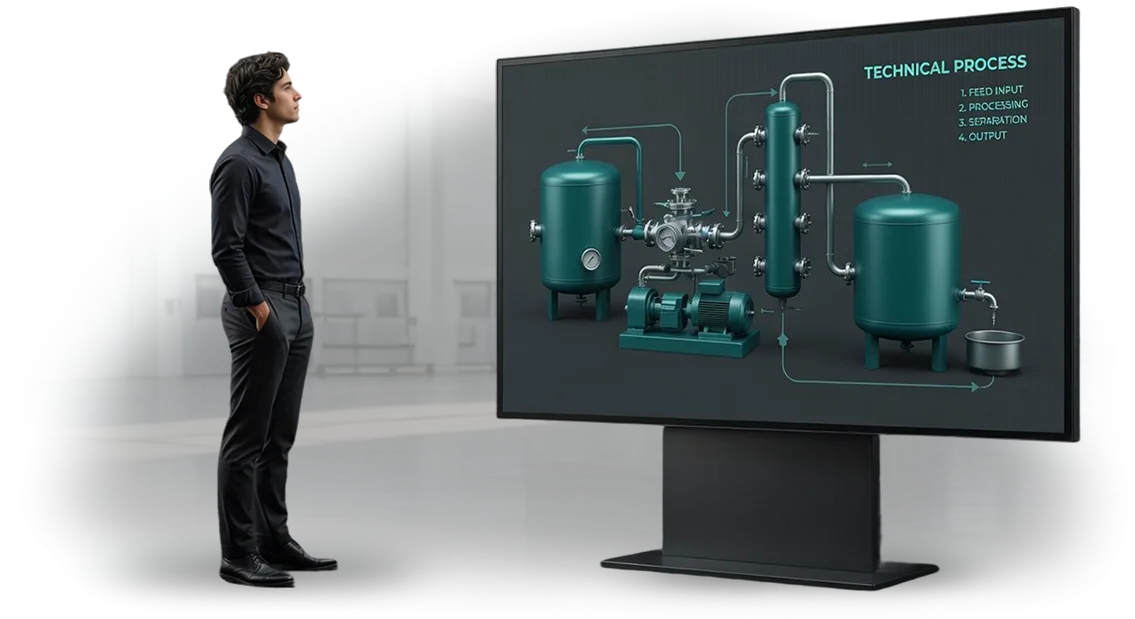
3D Advertising in Training: Why Instructions Don't Work
Even the most detailed text manuals are rarely read to the end, which means knowledge stays on paper. An employee acts on intuition, repeats the same mistakes, and the company pays for it with time and money every time.
The problem is not people, but the delivery format: the brain ignores boring information and easily remembers dynamic visuals. That is why 3D advertising in training is becoming a tool that actually changes employee behavior, not just introduces them to instructions.
3D advertising is a way to present a complex process in a three-dimensional, visual format, like a high-quality promotional video, but with real business value.
Instead of flat diagrams and long paragraphs, the employee sees the sequence of actions with their own eyes: where to get a tool, how to perform the operation correctly, what to pay attention to.
Such video instructions hold the attention of even those who usually skip through any documents, so knowledge is absorbed from the first viewing and applied in practice.
The effect of this approach quickly shows in metrics: the number of errors caused by human factors decreases, new hires adapt faster, and managers stop spending time on repeated explanations of the same things.
Employee training turns from an obligation into a tool that saves resources and improves work quality.
We help companies implement 3D advertising and video formats in corporate training so the result is measurable and visible within the first weeks, and employees no longer see instructions as just another item on a checklist.
Benefits of Video Instructions: Faster Training, Fewer Errors
Video instructions replace impersonal texts and verbal explanations with a clear visual workflow. From day one, an employee sees the correct actions — and these are the main benefits for business.
Benefit: Fast Onboarding of New Hires
Instead of spending a week studying manuals, employees get several short videos covering key operations. A new hire reaches full working pace in 2–3 days and starts adding value within the first week.
Benefit: Fewer Work Errors
Video captures the correct sequence of steps, so employees don't act randomly. Fewer defects, less rework, and fewer conflicts with clients — the results show up in operational metrics.
Benefit: Savings on Instructors
One video replaces dozens of repetitive lectures. Mentors handle only complex questions, while basic training happens without their involvement — freeing up hours for real tasks.
Benefit: A Single Knowledge Standard
All employees learn from the same materials regardless of experience, location, or tenure. This levels work quality, simplifies control, and reduces dependence on a specific instructor.
Benefit: Control and Reporting
Managers see who completed the training and who did not, and understand the team's actual skill level. Video instructions eliminate the question, “Why doesn't the employee know how to work?”
“After implementing video instructions, onboarding for new hires was cut from two weeks to three days, and the number of errors in order processing fell by half.” — Head of a retail chain
3D Advertising Formats for Corporate Training
Employees don't watch long instructions — that's a fact. 3D advertising in corporate training solves this problem differently: dynamic visuals hold attention, a three-dimensional image shows the process from any angle, and text takes a back seat. This format is easier to remember, and the employee starts working independently faster.
At the same time, 3D advertising is not a single template but a set of formats. We select the option for a specific task: sometimes a short video is enough, sometimes interactive content is needed, and sometimes a clear diagram works best. Below are the three main formats we use in employee training projects.
| 3D Advertising Format | Suitable For | What It Gives the Client |
|---|---|---|
| Short 3D videos | Mass personnel, new hires | Fast integration into work: up to 3 times faster than text instructions, with fewer incorrect actions |
| Interactive 3D simulations | Employees with high responsibility | Skill practice without risk to the business: mistakes are made in the simulator, not in real work |
| Animated 3D diagrams | All employee categories | Simple explanations of equipment and processes: fewer questions and errors caused by misunderstanding |
We often combine formats: a short video for everyone, a simulation for work authorization, and an animated diagram as a quick-reference guide at the workstation.
This creates a training system that covers both the employee's first encounter with the topic and ongoing reinforcement.
You don't have to choose on your own — our engineers will assemble the right format for your task and audience, show you a sample before we begin, and adapt it for your corporate portal. You'll get a working training tool, not “video for the sake of video.”
How Development Works: From Brief to Launch and Support
To ensure the result truly simplifies employee training and doesn't remain just a “nice video,” we've built a transparent seven-step process.
You always know where the project stands, what the deadlines are, and what you'll get at the end — without missed timelines or unnecessary approvals.
- Brief. We gather information: who we're teaching and what, which errors need to be eliminated, and how much time an employee can spend watching. As a result, you get the structure of the future video, even if you don't have a technical specification.
- Script. We write clear text that explains actions step by step without overloading it with jargon. You read and edit it before production begins.
- Style approval. We agree on the visual style, duration, voiceover, and subtitles. We lock in edits and the final delivery date — so there are no surprises.
- Production. We create the video with animation and 3D graphics that show the process in detail. The employee sees exactly what to do, even with complex equipment or a detailed sequence of actions.
- Editing and voiceover. We assemble the final video, add the narrator's voice and subtitles. The finished version can be used in an LMS, webinars, or on the internal portal.
- Testing. We show the draft to several employees and check how easily they absorb the material. We make final adjustments before the official launch.
- Launch and support. We deliver the files in the required formats, help with hosting and access setup. If processes change, we update the video at your request so training always stays relevant.
What's Included: A Complete Kit for Launching Training
The client receives not just videos, but a ready-made training system that can be launched immediately after project delivery. We provide the full set of materials and access rights so your team can manage the content without involving developers.
The standard delivery includes:
- Finished video instructions — final videos in the required formats for uploading to an LMS, messengers, or a corporate portal.
- Source materials — all working files, scenes, and graphic elements. You can make edits yourself or order fragment updates from us.
- Methodological guidelines — scripts, timings, and cheat sheets for employees. These help reinforce the material and serve as on-the-job references.
- LMS integration — we set up course uploads, link content to employee profiles, and configure completion tracking.
- Administrator training — we run a short workshop for your specialists: how to add users, track progress, and export reports.
- Update guarantee — if your company's processes change, we promptly update the affected fragments so instructions never become outdated.
We transfer content rights and all access credentials, so you aren't dependent on us after the project ends. Updates and refinements are available through post-launch support — under a separate agreement or as one-off orders.
As a result, you get a working tool that reduces the time needed to onboard new hires and eases the load on mentors. Everything you need to get started is already included.
Case Study: How Training Videos Reduced Onboarding Time by 40%
For a retail chain with high staff turnover, onboarding stretched to a week and a half. Training materials were scattered, mentors repeated the same instructions manually, and mistakes in the first weeks of work cost the company both time and money.
We proposed replacing text manuals with a series of short 3D instructions. Instead of abstract diagrams, employees got visual scenarios: how to work at the checkout, how to display merchandise, how to interact with customers.
An employee sees the process through the eyes of an experienced colleague and immediately remembers the correct procedure.
The effect exceeded expectations: onboarding time dropped from ten days to six — a 40% reduction. New hires reached independent work faster, probation-period turnover decreased, and the burden on mentors fell by nearly half.
The chain's operations director notes: “We used to spend two weeks on onboarding; now employees are up and running within a week. The key point is that they make 30% fewer errors, and that directly affects revenue and team morale.”
For the business, this means a quick return on training investment: every shift saved is money that stays in the company. And the 3D format makes instructions universal — they work for both new employees and the ongoing upskilling of existing staff.
How to Choose the Right Video Instruction Format for Your Company?
There is no universal video instruction format — what works perfectly for one company may fail in another. That's why the choice starts not with a flashy video, but with three questions: which employees need training, how complex the processes are, and how often they change.
The first criterion is the nature of the business. If you're dealing with simple operations like filling out reports or using a system, short screen recordings with voice narration are enough.
But for complex equipment, production lines, or products with internal structure, full 3D visualization is indispensable. This is not just 3D advertising that grabs attention — it's a way to show what can't be seen with the naked eye and thereby reduce the risk of errors. This format costs more, but it pays off faster: onboarding time shrinks and defects decrease.
The second criterion is the audience. New hires need detailed, step-by-step videos with emphasis on each action; experienced employees need short reminder clips they can quickly refresh in memory.
If your workforce includes different generations, clarity and a calm narrative pace are essential — and again, graphics help because they don't depend on the viewer's level of preparation.
The third criterion is budget and update frequency. For stable processes that don't change for years, it makes sense to invest once in a full animated video.
If regulations change every quarter, a modular format is more practical: individual short videos can be replaced without reshooting the entire course.
We select the format individually: we analyze your tasks, audience, and budget, then propose a solution that actually works. In the end, you get not just a video, but a tool that reduces training time and improves work quality — without overpaying for unnecessary features.
Frequently Asked Questions About Developing and Updating Video Instructions
We've collected answers to five common questions about the development and updating of video instructions. If your question isn't listed, write to us — we'll discuss the details.
How long does development take? A typical 3–5 minute video takes 2–3 weeks including all approvals. For complex scenarios involving multiple departments, we plan up to 4 weeks. The exact timeline is fixed in the contract before we start, so you can plan your training launch.
Will the video match our corporate style? Yes, we integrate every video into your corporate identity: brand colors, fonts, logo, and standard design templates.
First, we approve the visual layout and the narrator's voice, so the final video looks natural in your communications and doesn't conflict with your brand guidelines.
How often do instructions need to be updated? If regulations change a couple of times a year, an annual update is enough.
If processes are more dynamic, it's better to set up ongoing support: we make updates quickly as changes occur, so employees always see the current version instead of learning outdated rules.
Will we receive the source files? Yes, we hand over the source files, working versions, and all materials used. You can make minor edits yourself with your team or order updates from us — either way, video quality won't be affected.
What if an error is found in the finished instruction?
We provide a 30-day guarantee: if the flaw is our fault, we fix it free of charge and return the updated video. If an error is found later, we won't leave you hanging — we'll suggest options for revision.
After that, you can sign a maintenance agreement, and we'll keep your instructions up to date with any changes in your processes.
Order Effective Video Instructions for Your Team
Our team has already helped dozens of departments move employee training into short video instruction formats. Start with a brief — we'll take care of everything else: task analysis, script, production, editing, and adaptation to your requirements.
What You Get After Ordering
- Video instructions tailored to your process — from 2 to 15 minutes, in a format employees actually watch to the end.
- A clear script without jargon — a new hire gets up to speed in 1–2 days instead of a week.
- A single training standard — all branches and departments follow the same rules without discrepancy.
- Fast updates — when a process changes, there's no need to reshoot everything; we adjust the relevant fragment.
- View analytics — you see which videos are effective and which ones raise questions from employees.
- Post-launch support — we answer questions and make edits while the instruction is in use.
“It used to take a week to train a new employee on the checkout; with video instructions, it takes two days. Errors were cut in half, and mentors' time was freed up for other tasks.” — Head of training center, retail chain
Ordering video instructions for your team is not “just another project” — it's a tool that pays for itself within the first month. Leave a request on the website: in 30 minutes we'll discuss your task, show examples, and propose a solution that fits your budget. Just write to us — we'll handle the rest.