

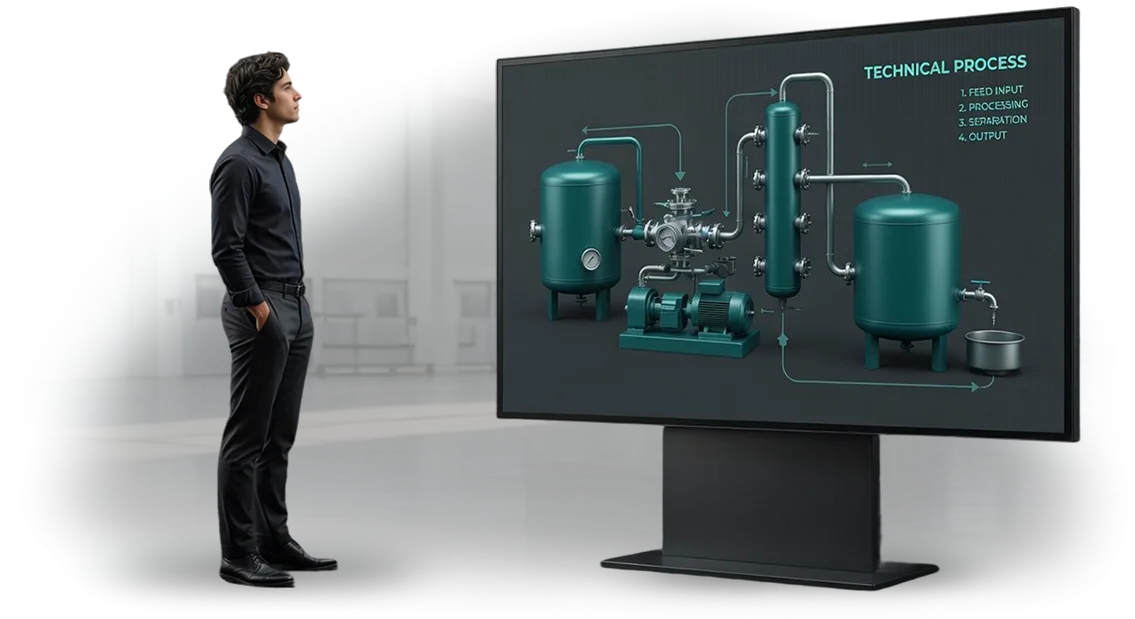
CAD-Based 3D Modeling for Clear Video Instructions
Training new employees is always a risk: while a person is figuring out the process, the company loses time and money on mistakes. Text regulations and flat diagrams don't give the full picture, so workers struggle to remember the sequence of actions and often act incorrectly. As a result, both onboarding speed and work quality suffer.
The solution is CAD-based 3D modeling. We take your drawings and models and turn them into visual video instructions, where every component, every part, and every step is shown in three dimensions and easy to understand.
The employee sees not an abstract diagram, but an exact copy of the equipment or product they work with. This format is perceived faster and remembered for a long time.
Visual training directly reduces the number of errors. When a person sees the correct sequence of actions in 3D animation, they don't need to guess or look for hidden nuances.
This is especially important for complex operations where the cost of a wrong step is defects, breakdowns, or even personnel safety. Video instructions based on 3D models give employees confidence and reduce the burden on mentors.
The company our team has been creating such solutions for businesses for over ten years. We work remotely, take your CAD data, and turn it into training videos that are easily integrated into a distance learning system or used as standalone material. You don't need to restructure production — just send us the drawings.
The result is faster onboarding, fewer errors, and stable work quality even for beginners. If you want to turn technical documentation into clear video lessons, let's discuss your task and show examples on similar scenarios.
What 3D Graphics Brings to Employee Training
New employees face the same problem: complex equipment and processes cannot be understood from paper instructions. The first weeks are spent figuring out how things work, and errors at work cost the business downtime and ruined materials.
3D graphics solves this problem — it shows a part, mechanism, or operation from any angle, down to the internal structure.
When training is built on realistic 3D models, the employee sees not a flat image but a three-dimensional object in action. This accelerates onboarding many times over: a newcomer memorizes the sequence of operations faster and starts real work with greater confidence.
Instead of a week to get up to speed, it takes two or three days, and mentors stop wasting time repeating themselves.
Using 3D models from CAD allows you to show components and parts that are hidden from view when assembled. The employee sees in advance what happens inside the mechanism and therefore understands what incorrect actions lead to.
As a result, the number of errors during assembly, setup, and repair decreases — meaning fewer defects and rework.
The benefits of 3D graphics are not limited to training newcomers. The same video content is used for upskilling experienced employees and for standardizing processes: everyone performs the work according to a single benchmark without deviations. This directly affects service quality and the company's reputation in the eyes of clients.
Such videos are also cost-effective for businesses. A 3D training created once is used for all new employees, requires no purchase of consumables, and doesn't put expensive equipment at risk.
Investment in visualization pays off through reduced downtime, fewer errors, and faster employee ramp-up to full productivity.
We combine CAD-based 3D modeling with professional production expertise so that employees understand their tasks the first time. If you need clear instructions that truly reduce costs — this is the format that pays off from the first month.
CAD-Based 3D Modeling Formats for Training
When it comes to training employees to work with complex equipment, the format of the material presentation decides everything.
The same component or process can be shown in different ways: from a clear CGI video to an interactive layout where the employee assembles and disassembles a component themselves.
The key is to choose a format that matches the task: quick familiarization, skill practice, or comprehension control.
Below are the main formats of 3D instructions we produce at our team. They cover different training scenarios: from initial onboarding to regular qualification checks.
| Format | For whom | What it gives the client |
|---|---|---|
| CGI instructions | Mass training of new employees | A single standard: everyone sees the correct sequence of operations, with no discrepancies in interpretation |
| Technical animation | Demonstration of hidden mechanisms and processes | The employee understands what happens inside a component, not just memorizes movements |
| Interactive layouts | Practical skill practice | Safe training on a virtual copy — errors don't lead to equipment breakdown |
| 3D cross-sections and diagrams | Repair and maintenance services | Quick access to component internals, faster diagnostics, and reduced downtime |
We always discuss the choice of format at the start: you describe the task and audience, and we propose the optimal solution for your budget and timeline.
In most projects, two or three formats are combined — for example, an overview CGI instruction at the beginning of a course and an interactive simulator for final assessment.
This approach has already helped several manufacturing companies reduce onboarding time and lower the number of errors when working with equipment. Tell us about your task — we'll advise which CAD-based 3D modeling format will deliver maximum effect.
Project Stages: From Model to Finished Instruction
We work to a transparent procedure so that at each step you understand what's happening and what result you'll get. Below is the typical path from an original CAD model to a finished video instruction, which we have followed many times.
-
Brief and task analysis We determine which operation or process the instruction is needed for, who will watch it, and on what devices.
We identify complex components that are important to show in detail and determine the presentation format — from a short video to a full training course.
-
Plan and estimate Based on the brief, we propose the structure of the future instruction, the number of scenes, duration, and timeline. We agree on the plan so you know the scope of work in advance and get no surprises at the final stages.
-
Preparation of 3D models We take your CAD model and adapt it for rendering: remove unnecessary parts, add cross-sections, transparency, and accents. If there's no model, we create it from drawings or samples, maintaining geometric accuracy.
-
Draft visualization We make test frames of key scenes: angles, lighting, action sequence. You see the "skeleton" of the video and make edits before we launch the final render.
-
Implementation and render We create the full animation with pointers, part highlighting, and voiceover. Professional equipment and streamlined tools allow us to deliver consistent results within the agreed timeline.
-
Approval and adjustments We hand over the finished draft for review. You send edits on text, timing, or emphasis — we make changes and approve again.
-
Launch and support We deliver final files in the required formats and integrate them into your training system or LMS. We stay in touch: if the instruction needs to be updated for a new version of equipment or regulations, we'll do it quickly.
What's Included in the Delivery of 3D Models and Video Courses
When you order corporate video instructions, it's important to know exactly what will remain with you after the project is completed.
We deliver not just a finished video, but a package that can be used for training, onboarding new hires, and even for updating materials by your own team.
The delivery includes:
- 3D models based on your CAD data. We accurately reproduce the parts, components, and mechanisms needed for training — without distorting geometry or appearance. The employee sees exactly the equipment they work with.
- Training animations. Disassembly and assembly, mechanism movement, the correct sequence of actions — everything that's hard to explain with text becomes visual and memorable.
- Professional voiceover and subtitles. A narrator's voice and text explanations help absorb the material even in a noisy workshop or without sound.
- Editing and post-production. The finished video is packaged in the required format so it can be immediately uploaded to a distance learning system or corporate portal.
- Project source files. You get the source files, meaning you can make edits when equipment or processes change — without a full new development cycle.
- Methodological recommendations. A brief description of the scenario and course logic, so you can understand how to best use the videos and update them yourself if needed.
This is not a "one-time video" but a complete training foundation. All materials remain your property, and you can adapt the content to new tasks at any time.
Case Study: How 3D Instructions Cut Training Time in Half
For the manufacturing company TechnoProm, training new employees was a bottleneck: onboarding took up to two weeks, and errors when working with equipment led to downtime and defects.
Standard text instructions and presentations didn't produce the needed effect — newcomers memorized the algorithm only after several repetitions on real equipment.
We converted key operations into 3D instructions based on CAD models. The employee sees every component, the sequence of actions, and typical mistakes from any angle, even before approaching the machine.
This eliminated the fear of "breaking something" and accelerated memorization of the sequence.
Results
Training time was cut in half: from 10 working shifts to 5. The number of errors during the first independent shifts decreased by 40%. We also noted that employees reach planned productivity faster — on average in 3 days instead of 7.
Workshop managers also appreciated that 3D instructions are equally clear to newcomers and experienced employees during retraining. Technologists now update instructions only when the design changes, rather than rewriting them from scratch.
What This Means for Your Business
This approach pays off not only in manufacturing — it works anywhere there are complex operations: from assembly to working with software.
After the first implementation, TechnoProm ordered instructions for three more sites — because they saw measurable results with their own eyes.
We structure every case study so you can evaluate the effect in numbers: training speed, error reduction, time to independent work. If you want to try this approach for your task — we'll show how it would look on your specific operations.
How to Choose the Right 3D Graphics Training Format?
The choice of a 3D graphics training format depends on the task you're solving. If employees need to master working with complex equipment or software products, CAD-based 3D modeling allows you to show parts and processes that cannot be seen in reality.
But there is no universal solution — the format must correspond to the specifics of your production and the team's skill level.
Start with the training goals. Videos with detailed 3D visualization are suitable for reviewing the sequence of operations, finding components, and understanding how mechanisms work.
If the task is to quickly onboard newcomers or conduct regular safety briefings, short modules focused on key actions are a better fit. To choose correctly, it's useful to audit current instructions and typical employee errors.
Separately, assess the specifics of the equipment on which the videos will be viewed. The power of workstations and screen resolution determine how detailed the 3D graphics can be.
We select a level of model detail so training runs smoothly both on employee computers and on tablets in the workshop. The technical side remains on us — you get a clear and consistent result.
Also, consider the audience's experience. For new employees, step-by-step scenarios with highlighting of important areas and pauses for repetition are effective. For experienced specialists, emphasis on complex components and non-standard situations is enough.
The right format is a balance between production costs and the speed of reaching the required skill level, so we always start by discussing your tasks and only then propose a solution.
Frequently Asked Questions About Creating Video Instructions
Before ordering video instructions, business owners and managers ask the same questions: how long will development take, how is the cost calculated, and what needs to be prepared on their end.
We've collected answers to the most common questions so you can plan your project without surprises and unnecessary back-and-forth.
How long does it take to create a video instruction?
Timelines depend on the complexity of the product, the number of operations, and the depth of detail. As a rule, development takes from 5 to 15 business days — the exact schedule is fixed in the contract and we stick to it. If the task is urgent, we can offer an accelerated format without losing quality.
How is the cost calculated?
Each project is evaluated individually after the brief: the number of scenes, the need for CAD-based 3D modeling, voiceover, and editing all matter. Before work begins, you receive a transparent estimate with no hidden fees — the final cost and terms are clear upfront.
What are the requirements for drawings and models?
To start, a 3D model in CAD format or a set of dimensioned drawings is enough. If source materials aren't available yet, we can recreate the model from a sample or photographs. This removes the barrier for companies that haven't digitized their products yet.
Can video instructions be updated after a new product version is released?
Yes, this is provided for. You receive the source files, so you can make edits and order updates without creating the video from scratch. Regular customers get adjustments on special terms — so you save your budget with every product change.
Request a Quote for Video Instruction Development
Leave a request and we'll prepare a quote for video instruction development based on your tasks and CAD models. Over 10 years, we've made hundreds of training videos for manufacturing, assembly, and equipment maintenance, so we know exactly what affects cost and timelines.
CAD-based 3D modeling allows you not just to "bring a drawing to life" but to show the employee each component from the right angle. This reduces training time and lowers the number of errors during assembly and maintenance.
Employees memorize the sequence faster — meaning less downtime and fewer defects. So that you can evaluate the format, after your request you'll receive:
- Consultation — we'll analyze what kind of video instruction your employees need and how to use it in training.
- Work examples — we'll show real 3D modeling projects and finished video instructions.
- Accurate estimate — we'll fix the cost, timeline, and scope of work with no hidden additional fees.
- Implementation plan — we'll list the stages, control points, and the format of the final result.
- Answers to questions — we'll explain how to integrate the instructions into your training and assessment system.
For the quote, you can send a drawing, a list of operations, or simply describe the task — we'll clarify the rest during the consultation. No obligation on your part: we send the quote, and you make the decision.
The request takes a couple of minutes — fill out the form below or message us. We'll respond within one business day.