

Staff errors at ophthalmology centers: how to avoid them?
In ophthalmology centers, every workstation is expensive, and an inexperienced employee costs even more. New staff arrive often — and leave just as often, taking with them months of training investment.
Staff errors when working with high-precision equipment lead to schedule disruptions, downtime, and service costs that eat into profits.
The difficulty with training is that knowledge is passed on “by word of mouth” — mentors explain in their own way, and at the critical moment there is no one around.
In ophthalmology, a mistake can cost not only time but also patient trust: improper handling of equipment is a risk to health and to the clinic’s reputation.
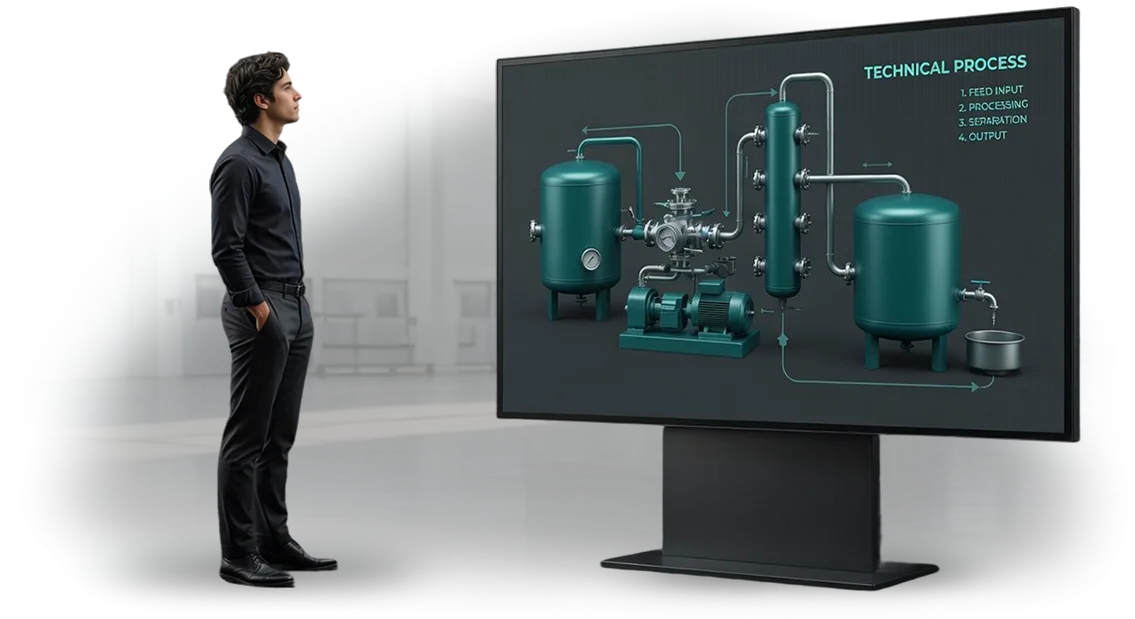
Video instructions solve this problem systematically. We record the benchmark sequence of actions for your specific equipment — based on CAD drawings, we create clear 3D models that show every step without ambiguity.
Staff training no longer depends on who explains and how: a new employee quickly reaches working speed and acts as confidently as an experienced colleague.
The main result is predictability. Fewer errors during preparation for patient visits, careful handling of expensive equipment, and reduced downtime. The video can be reviewed at any time: when onboarding a new hire, after a break, or when a new equipment model arrives.
This reduces turnover, saves administrators’ time, and lowers the workload on those who previously handled training.
A training video is not a one-off recording but a working tool that pays off from the very first prevented failure.
We build the instruction around your center’s specific tasks so that staff understand not only “how to press the button” but also “why this step exists.” This approach quickly reduces the number of employee errors and makes the center’s operations more stable.
What does a professional video instruction give your clinic?
In an ophthalmology clinic, every employee affects reputation and results. When equipment operation is explained “verbally,” discrepancies appear: someone does it one way, someone another. A video instruction turns the clinic’s accumulated experience into a single, clear standard.
New employee onboarding speeds up significantly. Instead of lengthy mentoring, a new doctor, nurse, or administrator gets access to understandable videos — and by the second or third day already works more confidently.
Senior colleagues are not distracted from patient appointments, and the time to full productivity shortens.
A single standard is safety. When everyone performs procedures the same way, the number of errors and risks decreases. A video instruction captures the correct sequence of actions: from preparing the examination room to communicating with the patient. Each step is repeated precisely, regardless of shift or experience.
Staff training becomes transparent. The manager can see which employees have completed the material and can bring attention back to important sections during reviews. The clinic gains a quality control tool that remains relevant as the team grows and new rooms open.
Such a video instruction works as a reference that employees return to in any non-standard situation. It relieves mentors and allows the clinic to scale training without losing quality. Patients see a consistent level of service at every appointment.
Formats of training videos for ophthalmology centers
Training employees at an ophthalmology center cannot follow a one-size-fits-all template: a newcomer needs to quickly learn the regulations, an experienced doctor needs to understand new equipment, and an administrator needs to master patient appointment workflows.
When the right video format is chosen for each scenario, training takes less time, and knowledge is retained without constant mentor involvement.
The table below will help you choose a format for a specific task.
| Video format | Purpose | What it gives the client |
|---|---|---|
| Interactive training | Practicing actions on a simulator, training ophthalmologists to work with new equipment | The employee tries on their own without risking patients; mistakes are reviewed immediately |
| Video walkthrough | Standard procedures: examination, diagnostics, preparation for surgery | Uniform quality standards, fast onboarding of new employees |
| 3D animation | Explaining equipment structure and processes inside the device | Complex content becomes visual, and the material is better remembered |
The interactive format works when it is important to practice the skill before entering the examination room. The employee makes decisions on their own, and the system shows the result.
This is especially valuable when training ophthalmologists to work with new equipment — the risk of errors is reduced even before the first real procedure.
Video walkthroughs are convenient for regular repetition: short videos on protocols and actions in non-standard situations are always at hand. They can be reviewed before a shift or used as part of an onboarding course.
3D animation based on equipment drawings shows the mechanics of the device from the inside. This makes it easier to understand why a particular step is performed, so employees act consciously rather than mechanically.
Formats can be easily combined in one training program — this covers both basic knowledge and practical skills.
How we create video instructions: 5 steps
We have structured the process so that you always understand at which stage the project is and when you will receive the finished video instructions.
You approve key milestones and accept results step by step — this is especially important for ophthalmology centers, since training launch deadlines must not slip.
- Brief and materials audit. You send current instructions, regulations, and CAD drawings of the equipment. We clarify the scenarios for complex procedures and record the timeline and scope.
- Script and storyboard. We break the training into short modules — from preparation to typical employee actions. You receive a text script describing each frame, and after approval we move on to video production.
- Creation of 3D models and animation. Based on the drawings, we build accurate equipment models so the employee can see it from any angle, including hidden components. Intermediate frames are shown for approval.
- Voiceover, subtitles, and editing. We add professional voiceover and text explanations. The final video is assembled into a single instruction according to your internal training structure — by role, complexity, and stages.
- Implementation and support. We deliver files in the required formats and help set up access in your learning management system. After launch, we collect feedback from staff and make revisions.
The typical cycle — from script approval to finished videos — takes 3-4 weeks; exact deadlines are fixed in the contract before work begins.
What is included in the delivery package
The full delivery package covers all stages of training — from the employee’s first introduction to the equipment to verification of readiness for independent work.
You receive not just individual files, but a complete system that can be launched in an ophthalmology center immediately after handover.
- Source materials — all versions of the videos, 3D models, and textures created from your drawings and technical documentation. They remain yours and can be used for other tasks: presentations, instructions, internal regulations.
- Finished video instructions — edited videos adapted to your clinic’s standards: equipment operation procedures, patient interactions, and typical procedures. Everything is already aligned with your regulations.
- Editing and adaptation for formats — each instruction is output for screen, tablet, or phone without losing quality. Employees can study at work or at home, at their own pace.
- Interactive knowledge testing system — after each block, the employee answers questions and completes a practical scenario. The system immediately shows where gaps exist and where the material has been correctly mastered.
- Training tracking system — an automatic log: which employees have completed the instruction, when, and with what result. The administrator sees the full picture and can remind those who have not finished in time.
- Administrator training — we transfer the skills needed to manage the system: how to add new employees, update materials, upload changes, and export reports. Your team works independently.
- Support and updates — when a new version of equipment appears or a procedure changes, we revise the instructions. Training always remains relevant, without the need to order development from scratch.
This is a complete working set that eliminates “raw” materials and ambiguity. After handover, you do not need to figure anything out or look for contractors to finish the work — everything is already packaged, configured, and ready to launch in the ophthalmology center.
Case study: how we accelerated onboarding at an ophthalmology center
Task
A new employee at an ophthalmology center spent up to three weeks learning diagnostic equipment, and even after that, every fourth procedure required rework due to incorrect settings.
We received a request from the clinic network Visus: speed up staff onboarding and reduce the number of errors when working on complex devices.
Solution
Instead of flat instructions, we developed interactive video instructions based on 3D equipment models created from CAD drawings.
The employee sees the device from all sides, breaks it down into components, and practices algorithms on a virtual simulator — without risking damage to expensive equipment.
Result
A month after launch, the number of errors decreased by 40%, and new employee onboarding time was cut in half — to one and a half weeks. Clinic managers noted that staff became more confident with the equipment, and repeat calls to technical support almost disappeared.
The project received a continuation: the clinic ordered 3D instructions for three more workstations.
This approach scales easily: the same 3D models and diagrams can be used for maintenance, quality control, and training at other branches of the network.
How to choose the right video instruction format for your clinic?
The choice of format begins not with technology, but with answering the question: who is this video for and what is it for?
In an ophthalmology center, some instructions are needed to quickly train new employees on diagnostic equipment, while others are needed to standardize the actions of experienced doctors and nurses.
Therefore, we first analyze the clinic’s objectives, and then propose a suitable genre: a complete step-by-step guide or a short reference video.
New employees are better served by a format that shows each control element in close-up, with on-screen explanations and pauses for repetition.
Experienced staff usually need a concise instruction with control points: how to prepare the device, which settings to apply, and what to check after the procedure. This approach accelerates training and reduces the risk of errors during independent work.
We also take the learning environment into account. If employees train in groups under a mentor, long video lessons with analysis of complex situations will work well.
If the clinic uses an internal learning portal or plans to regularly refresh knowledge, we choose short series of videos with a clear structure that are easy to review.
It is also important to consider the devices on which the videos will be watched: a desktop computer, tablet, or even smartphone — this affects editing and font sizes on screen.
A good practice is not to guess the format in advance, but to test it on one instruction. We make a pilot video based on your scenario, show it to the staff, and together evaluate: is it clear, convenient, memorable?
Only then do we launch the full series of video instructions for the entire clinic. This approach eliminates the risk of spending your budget on an unsuitable format.
If you are currently thinking about which video will suit your ophthalmology center, let’s discuss your tasks at a consultation. We will describe the options, recommend the optimal video selection for staff training, and prepare a sample.
You will receive materials that are actually used in practice, not a collection of videos with no application.
Frequently asked questions about developing video instructions
Before ordering a video instruction, most clinic managers have the same questions: will deadlines be missed, what happens if the equipment changes, and will the final cost exceed expectations. Here is how we address these risks at the brief stage and record our agreements in the contract.
What if the equipment model becomes outdated or breaks?
We build 3D models from your CAD drawings, so the geometry and components exactly match the specific model. If the clinic changes the configuration or a new modification comes out, it is enough to update individual scenes rather than reshoot the entire video. At the brief stage, we record which changes are included in warranty support.
What are the development timelines?
A standard video takes two to four weeks depending on the complexity of the equipment and the number of scenes. The exact schedule is fixed in the contract: you receive a calendar plan with dates for interim approvals and can see at any time what stage the project is at.
How is the cost calculated, and will there be hidden payments?
The cost is fixed in the estimate after the brief and does not change during the process. It includes modeling, texturing, voiceover, and editing.
If you decide to add new scenes during the work, this is discussed separately, but you approve all changes before they start — no surprise surcharges after the fact.
What if the video is not liked or does not suit the staff?
Before the final render, you see draft versions of each scene and make adjustments. We refine the video to a result that is clear to a newcomer and raises no questions among experienced staff.
The number of iterations is fixed in the contract so you can be confident: the task will be solved rather than stuck in endless approvals.
Request a cost and timeline estimate for your clinic
Every clinic faces the task of training staff to work with equipment. Text instructions do not provide the needed effect — employees learn material faster with visual examples.
We create video instructions from your CAD drawings so that new specialists can get to work without long introductions and mistakes.
To receive an accurate estimate and work plan, submit a request. The process takes just a few steps:
- You submit a request on the website — we contact you within one business day.
- We clarify the tasks: which instructions are needed, for which equipment, and how many employees will be trained.
- We analyze the drawings and determine the scope of 3D modeling.
- We calculate the cost and timeline — you receive a transparent estimate.
- We prepare a commercial proposal with the work stages.
- Along with the proposal, we send a checklist: everything you need to prepare to get started.
In the commercial proposal, you will find answers to the main questions: cost, timeline, scope of work, and the format of the result. We will also attach a checklist to help you prepare for cooperation and not miss anything.
What is already included in the estimate:
- an audit of your CAD drawings and complexity assessment;
- recommendations for video instruction scenarios;
- a list of development stages with approximate timelines;
- options for working within your budget;
- cooperation terms and quality guarantees.
Submit your request now — and in a few days you will know exactly how much it will cost and how long it will take to create video instructions for your clinic.