

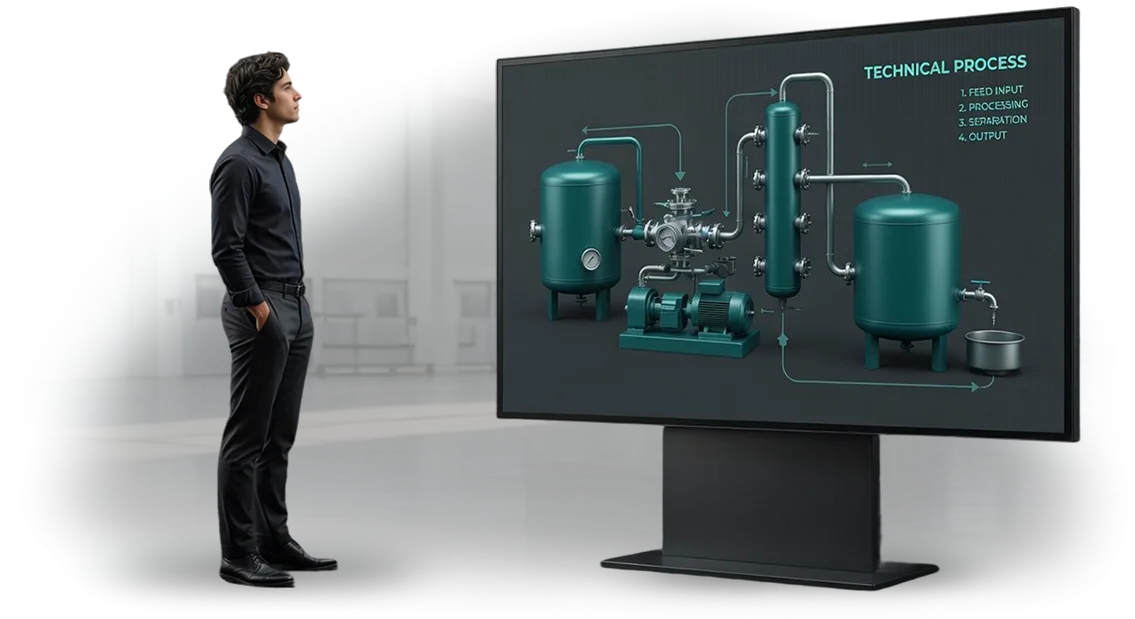
Exploded view animation: how to avoid assembly errors?
A familiar situation: a new employee assembles a unit, skips fasteners, confuses the order of operations, overtightens threads. The result is defects, downtime, rework, and unhappy customers.
In complex products, even experienced technicians make mistakes during maintenance or repair. Exploded view animation solves this problem: instead of a flat diagram and a long text, the employee sees the exact sequence of actions on a 3D model.
This animation shows the product in an exploded state: parts move apart neatly along axes, assembly proceeds step by step, and all connections and their correct order are visible. It is not just a nice video but an accurate reflection of the real structure.
The employee understands in advance how the unit is designed, where each part goes, and why the sequence matters. All doubtful points become obvious before the work begins.
Onboarding time is reduced, the number of assembly errors drops, and quality becomes predictable. A video instruction can be rewatched, paused, and revisited at complex stages—no need for a mentor to be nearby at every step.
This is especially important when staff turnover is high and production is scaling, when the knowledge of experienced employees needs to be transferred to newcomers quickly and without loss.
We create corporate video instructions with exploded view animation for your product and equipment. First, we analyze the structure and typical assembly errors; then we produce a clear video that integrates into your training system. The result: your employees work more confidently, and your production runs more consistently.
What problems do visual video instructions for staff solve?
New employees make mistakes because no one has shown them the process live, and written instructions are interpreted differently by each reader. Experienced specialists spend time repeating explanations, and when a key worker leaves, their knowledge goes with them. The result is defects, missed deadlines, and overloaded mentors.
Video instructions with exploded view animation solve these problems systematically. An employee sees the structure and sequence of actions exactly as they happen in reality—without needing to decode drawings and text-based regulations.
- Fewer errors and defects. A clear breakdown of each unit and the correct assembly sequence reduces the number of wrong actions by newcomers and experienced workers alike. The result is less rework and waste.
- Faster training and onboarding. A new employee starts contributing sooner: instead of spending a week studying instructions, they watch a short video and move straight to practice. Time to full productivity is cut dramatically.
- Process standardization. All employees perform operations the same way—the way the company defines them, not whichever way "each person finds convenient." This simplifies quality control and audits.
- Knowledge stays in the company. The expertise of the best specialists is captured on video and remains available after they leave. A mentor is no longer needed to explain the same operation to every new person.
A production manager who introduced such instructions notes:
"After replacing paper regulations with video instructions, defects among newcomers dropped by nearly half, and training now takes two days instead of two weeks." Shop manager at a machine-building plant
These results are achievable without restructuring production processes—you only need to produce the animation once and integrate it into the training system.
Animation formats for different types of equipment and tasks
Different tasks call for different animation formats. An exploded view helps understand the structure, but repair or safety work requires other scenarios.
A newcomer on the line needs one format; an experienced mechanic needs another—the video should answer their specific question, not show everything at once.
We select the format for each specific operation. The employee receives not just a video but a ready-made instruction—they can act immediately. Below is a table to help you choose the right format. It covers typical scenarios, from first assembly to emergency repair.
| Format | Tasks it's for | What it gives the employee |
|---|---|---|
| 3D overview | New equipment | Understanding of the design and operating logic |
| Exploded view | Assembly and disassembly | Shows the sequence of actions and where each part fits |
| Step-by-step video instruction | Maintenance | Lets employees repeat actions at their own pace |
| Failure animation | Diagnostics and repair | Quickly identifies the malfunction |
| Safety video | Hazardous work | Makes it clear how to avoid injury |
This approach reduces time-to-competency and the number of repair errors. It also reduces downtime and the cost of replacing parts. We prepare a format after a briefing, show a pilot on one unit, and only then produce the full series. If you are unsure, start with a single unit—you will see the effect on a real task.
How video instructions are developed: from brief to rollout
We structure the development process so you always know where the project stands and what exactly you will receive.
Every step is agreed with you—from the initial brief to the final launch—so the video instructions align precisely with your internal regulations and real working operations.
-
Brief and audit. We gather requirements together with your experts: we examine typical employee mistakes, complex units, and frequent questions. We also review existing materials to see what already works and what needs replacing.
-
Script plan. We break the process into short, logical steps and determine where exploded view animation is needed, where regular filming is enough, and where simple diagrams and text prompts will do. You receive the structure of the future video before production begins.
-
Structure approval. We present the script and storyboard and discuss wording and emphasis. We make corrections before animation starts—this saves time and eliminates rework at the final stage.
-
Animation development and filming. We create the exploded view: we take the device or mechanism apart part by part, show the assembly or disassembly sequence, and add explanations. In parallel, we prepare video fragments for "live" operations if they are required.
-
Voiceover, text, interface. We record a narrator or use subtitles, depending on how your employees are used to consuming training content. We add neat prompts so they do not distract from the main content.
-
Testing with real users. We show a draft version to 2-3 employees with different skill levels. We see where questions arise and refine the video so it is clear from the first viewing.
-
Launch and file delivery. We hand over the finished materials in all required formats: for your learning management system, internal portal, or in-person training sessions. After launch, we stay in touch and make targeted edits as needed.
What's included in the delivery of corporate training video
You receive not just a finished video but a working tool for employee training. We structure the project so it can be used immediately—without rework, additional filming, or unnecessary approvals.
Here is what is included:
- Ready-made training videos in a format that can be uploaded directly to your corporate portal or learning management system.
- Adaptation to required formats—versions for computers, tablets, and phones, so employees can learn at a convenient time and place.
- Subtitles—help employees follow the material when watching without sound in the office or on the go.
- Source materials—all project elements: graphic files, text scripts, and intermediate versions. You are not dependent on us if you want to make edits with your own team or hand the work to another contractor.
- Usage guide—a short implementation memo: where to upload the video, how to track views, and how to quickly update the video when regulations change.
- File with script and timecodes—simplifies approvals and lets you quickly reassemble the video for a new task if needed.
This package answers the question, "What do we actually do with this video?" You receive a clear tool that works immediately after handover: employees complete their training, you see the results, and you can make changes easily when needed.
Case study: how a factory reduced assembly time by 35% using 3D instructions
The assembly shop at the SpetsMash factory was losing up to 12% of production due to defects in the assembly of complex units. New employees needed a month of training: they confused the sequence of operations, reworked jobs, and stopped the line.
Paper instructions and drawings did not save the situation—workers spent time reading instead of doing.
We developed a series of animated 3D instructions for the factory that show every assembly step in three dimensions. The employee sees how parts connect, in what order, and with what force—without reading drawings or guessing.
Updating a procedure now takes hours, not weeks: you simply re-render the animation for the new configuration.
Results appeared in the first month. Assembly time for one unit fell from 40 to 26 minutes—the 35% quoted in the headline. Defects dropped threefold, to 4%, and newcomer training shrank from a month to a week.
Six months later, the factory ordered a second series of instructions for the neighboring shop, and one year after that, it made 3D standard part of its corporate training system.
This case is not about nice pictures but about measurable value for production: fewer reworks, faster ramp-up to planned capacity, and stable quality regardless of employee experience.
For a manager, this means lower costs from defects and training without capital investment in equipment. We can achieve the same result at your facility—taking into account your units, procedures, and shop floor specifics.
What if I have specialized equipment and unique processes?
If your equipment does not resemble standard models, that is not an obstacle—it is the very reason to order an exploded view animation. Generic training videos do not help when processes are unique and machinery requires a special approach. We create animation for a specific object rather than force your task into ready-made templates.
Adaptation starts with your materials: drawings, photographs, 3D models, technical documentation, and, if necessary, an on-site visit. Our engineers break down the equipment to the smallest parts and reproduce it in animation in line with your regulations.
The result is that the employee sees your exact machine, your unit, your sequence of operations on screen—not a generic diagram from a catalog.
A custom approach is especially valuable for complex and rare units: when the original manual is outdated or missing entirely, an exploded view helps restore the correct assembly sequence and transfer the experience of key specialists to newcomers.
This removes the risk of costly errors, breakdowns, and downtime because the employee understands in advance how their specific object is built and what can happen if the sequence is broken.
We do not impose a single standard for all tasks. For each client, we determine the level of detail, presentation pace, and emphasis so training takes minimal time and the material is as clear as possible.
Already at the brief stage, you receive a plan for how your object will be shown, and you can adjust it before work begins, if needed.
Your specifics are our direct task. Tell us about your equipment and process features, and we will propose a format that fits seamlessly into training, shortens the time to bring a new employee up to speed, and keeps knowledge within the team.
Frequently asked questions about timelines, cost, and approvals
Before ordering training video instructions—from simple slides to videos with exploded view animation—managers most often ask about timelines, cost, revisions, and guarantees. Here are our answers based on dozens of projects, with no fine print.
How long does it take to create a video instruction?
A typical project takes 3-4 weeks. The timeline depends on the number of scenes, the need for exploded part animation, and the speed of approvals on your side.
We fix dates in the contract and send intermediate results—you can see progress and don't have to worry about the work stalling.
How much does it cost?
The cost is determined at the task definition stage: format, video length, and level of detail. After the plan, you receive an exact estimate and milestone-based payment: an advance payment to start and a final payment after acceptance. No hidden surcharges: if the input parameters don't change, the price stays the same.
How many revisions are included in the cost?
After each stage, you receive a version for comments. The contract includes two to three rounds of revisions—that is usually enough. Additional changes are quoted separately at an agreed rate. This way, you keep control over your budget.
What guarantees do you provide?
The main guarantee is a result that matches the approved script. If we find a technical error after delivery, we fix it free of charge. If we miss the deadlines in the contract, we compensate and speed up the work. We take the risks on ourselves.
Order a production video instruction and avoid downtime
Equipment downtime is a direct loss: every hour of downtime costs money, and employee errors hurt quality and deadlines. A video instruction with a unit breakdown (exploded view) shortens training from weeks to days.
To get started, simply order a production video instruction—leave a request, and we will show you how it works.
What you get after contacting us
A no-obligation consultation: we will help you determine which instruction format you need and give you a sense of budget. You get specific answers tailored to your production process, not general observations.
- a customized commercial proposal with exact cost and timeline;
- process review and recommendations on what to show first;
- samples of our work—including exploded view animation for your industry;
- a clear work plan from script to finished video;
- support during implementation and instruction updates when equipment changes.
After the meeting, you will have examples and an understanding of the solution—without pressure or obligations. You can quietly compare and choose. This is not just a presentation of capabilities—you will see how we solve similar tasks.
Submit a request on the website or call us—we will send a commercial proposal and answer your questions within one business day. Exact timelines and cost will be recorded in the proposal—no surprises. One call saves weeks of downtime, so there is no reason to put it off.