

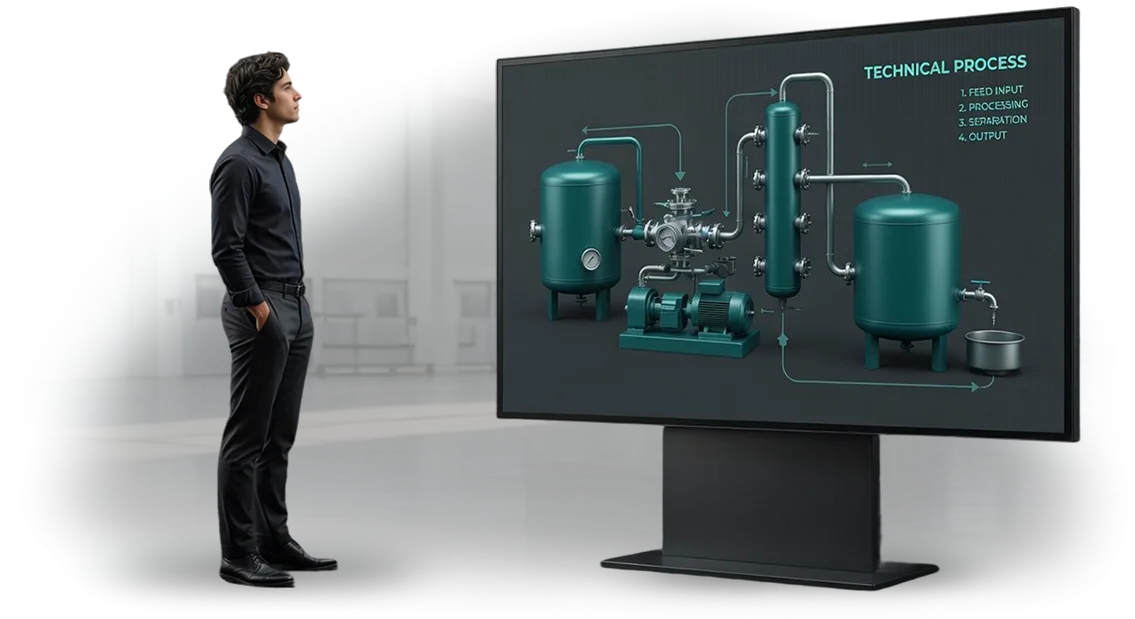
Complex instructions? Fusion exploded view animation solves the problem
Flat drawings and text instructions require employees to think abstractly and rely on experience. A new employee loses a lot of time trying to match projections with real parts, and errors during assembly or maintenance lead to downtime and rework.
As a result, staff training drags on for weeks, and every new piece of equipment creates another headache.
Fusion exploded view animation technology solves this problem: a mechanism or product is shown in 3D, with components separated and a clear sequence of actions. The employee sees not conventional lines but realistic 3D animation that makes it easy to understand what follows what.
An exploded view in motion helps people master the process faster and remember the order of operations without memorizing instructions.
Business gets tangible results: shorter training times, fewer defects during assembly and repair, and confidence even among new employees. Video instructions can be reused, used for remote training and certification — this takes the load off experienced engineers and mentors.
We develop such 3D animations for your products and equipment. Our specialists turn assembly drawings and 3D models into clear videos that your employees can review at any time. Training becomes visual, fast, and does not require an expert to be present in person on every shift.
What a high-quality exploded view brings to a company in training videos
A high-quality exploded view turns a complex process into an understandable sequence: the employee sees how a unit is built and in what order to assemble it. Instead of reading multi-page instructions, a person watches a short visual video and immediately understands what to do.
That is why such video instructions accelerate training and significantly reduce errors in work. Let's look at the key benefits for a company.
Fast onboarding of new employees
A new employee starts working much faster because they see the equipment from the outside and inside. Learning a procedure takes days, not weeks, and the newcomer begins working independently sooner. The company gets a return from each new team member faster.
Reducing errors and defects
A visual instruction shows every step, so the employee is less likely to miss parts or assemble units incorrectly. This reduces the number of errors, breakdowns, and rework — especially in assembly, repair, and maintenance operations.
An exploded view removes guesswork: the person does not try to “recall” the instruction but simply sees the correct order of actions.
Relieving mentors
Experienced employees stop spending time repeating the same explanations to every newcomer. The video instruction answers typical questions, and the mentor gets involved only when a non-standard situation arises. As a result, the team gets more useful work done instead of repeating the same routine.
Team engagement
Animation holds attention and takes the employee to the end of the instruction — unlike dense text, a video is not something you want to abandon halfway. People remember the material better, work more confidently, and stop more often to ask for clarification.
This reduces tension on the production floor and makes the work process calmer and more predictable.
Animation formats for different employee training tasks
Standard lecture-style video often fails the main training goal — a new employee cannot apply the knowledge in practice. Text instructions do not save the situation either: they are skimmed diagonally, and complex operations are perceived differently by different people.
That is why the choice of animation format directly affects how quickly a person becomes productive and how many errors occur in work.
How to choose a format
Rely on two criteria: the complexity of the object and the depth of skill mastery.
For simple processes, 2D graphics are enough; for equipment with internal components, use 3D animation with part breakdowns; for hands-on practice, use interactive instructions where the employee chooses the scenario themselves.
| Format | For whom and when | What it gives the client |
|---|---|---|
| 2D animation | Simple procedures, onboarding of new employees, general rules and standards | Fast creation and easy updates when procedures change. Employees remember the sequence of actions faster without being overloaded with details |
| 3D animation | Complex equipment, repair and maintenance, devices with mechanisms | Visual demonstration of internal structure and operating principle. Reduces training time by 20-30% — no need to disassemble the actual unit or wait for a mentor to visit |
| Interactive instruction | Training for emergency situations, knowledge checks, skill practice | The employee makes decisions in a simulation and sees the consequences. Errors happen in a safe environment, not on a real object. Ideal for certification |
A well-designed training program usually combines all three formats: 2D introduces the topic, 3D shows the structure, and interactive practice reinforces the skill.
Our engineers design such packages for a specific task — you get not a collection of videos but a system that genuinely improves staff performance.
How we create animation videos for complex processes
A complex manufacturing process is hard to explain in words — the employee needs a visual diagram that shows each component and the sequence of operations.
We turn your instructions and drawings into a short animated video: it is clear from the first viewing and does not require repeated explanation.
The process is designed so that you see the result at every step and can make revisions without missing deadlines. Here is how we work:
- Brief and immersion — we study your process, collect source materials, and clarify who will watch the video. You receive a technical specification and approve it.
- Script and storyboard — we describe the presentation logic: which parts, in what sequence, and where to place emphasis. You see the text script before animation begins.
- Style test — we offer 2-3 visual style options to choose from. We agree on one so we can move forward without rework.
- Animation creation — we assemble the video on professional equipment, showing parts in cross-section and the assembly sequence. You receive a draft version for review.
- Edits and finalization — we make corrections according to your comments within the quoted estimate. We deliver the final file in the formats you need.
- Launch and support — we hand over the source files and the finished video and help integrate it into your training system. If the instruction needs to be updated, we make changes quickly while maintaining a consistent style.
The whole process takes 5-15 working days depending on complexity. You pay a fixed amount for the project, not by the hour — so you can plan your budget without surprises, and we are responsible for deadlines and results.
What is included in the developed video course with 3D animation
After the course is launched, you get not just a series of videos but a ready-made training system that works without involving developers.
The delivery includes everything needed for launch and completion tracking: from final videos to recommendations for integration into company processes.
- Final videos in the required resolution and format — with 3D animation and exploded views that clearly show the structure and the sequence of operations.
- Project source files with 3D scenes and layers — allow you to make edits in-house or order updates from us without reshooting the entire course.
- Accompanying documentation: script, timings, and a description of on-screen actions — simplifies approval and knowledge transfer within the team.
- Implementation recommendations: at which training stages to show the videos, how to combine them with practice and assessment tasks — increases the effectiveness of the course.
- Methodological materials for mentors: checklists, self-assessment questions, and example walkthroughs — help reinforce the material and control results.
- Adapted versions for different formats: for mobile devices, presentations, or printed instructions — covers all usage scenarios.
- Updates and support for the agreed period — if processes or equipment change, you won't be left alone with outdated material.
Each element of the package is aimed at helping employees master work operations faster and ask mentors for help less often. This reduces the load on experienced specialists and speeds up the time it takes for new hires to reach the required productivity.
Case study: how we reduced technician training time with exploded views
Standard regulations and drawings do not work well when you need to quickly train technicians to assemble complex equipment.
Everyone who has led a new product line knows this: by the time an employee reads the instructions, finds the right component, and understands the sequence of operations, an hour has passed, and defects still occur.
We were approached by ZavodGidroMash, a manufacturer of pumping stations, which faced the task of halving the onboarding time for new technicians during a workshop expansion.
Paper instructions did not help: experienced employees spent weeks transferring knowledge to newcomers, and assembly accuracy suffered because of incorrectly tightened connections.
What we did
Instead of rewriting text instructions, we developed a series of animated video instructions with exploded views.
On screen, the technician sees the unit “break down” into parts and be assembled back in the correct order — with the required tightening torque and checkpoints indicated.
The videos replaced part of the mentor-led training and began to be used right on the shop floor: a worker opens the needed component on a tablet and follows the animation. Visual, clear, without reading drawings.
Implementation results
The measurable effect appeared after two months. Basic technician training time dropped from six weeks to three and a half — that is 40% less. Assembly speed for a typical unit increased from 25 to 15 minutes, and the share of errors when connecting pipelines fell by a third.
Workshop management noted that newcomers stopped bothering senior foremen over small issues.
And when the plant released the next pump model, we quickly adapted the same videos for it and trained staff without interrupting production — this cost three times less than in-person training.
The case showed that exploded views pay for themselves already on the first batch of trained employees. If you have a similar task — reducing staff training time and lowering the number of errors — we can build such a process for your equipment.
How to choose the right animation format for a specific production task?
When a production team needs to reduce onboarding time and minimize errors, choosing the right video instruction format becomes part of the solution.
The choice starts not with a software tool but with the production task: training new employees, repair, quality control, or maintenance — each scenario requires a different effective format. We select it based on what exactly a person needs to understand and remember within a limited time.
For training new employees, step-by-step instructions with pauses and emphasis on critical operations work well. An exploded-view animation prepared in Fusion helps show how internal parts connect to each other and removes fear when working with expensive equipment.
Experienced staff only need an overview video that details problem areas, so they can quickly refresh their knowledge.
When choosing a format, it is important to consider where the employee will watch the video: in the workshop on a smartphone or in a classroom at a computer.
A short one-to-two-minute video is convenient as a quick reference, while an extended course with knowledge-check blocks is for introductory training. We always assess the context of use to avoid overloading people with excessive information or distracting them from work.
At the briefing stage, we analyze common employee errors, work scenarios, and training effectiveness criteria together with you. This allows us to choose a format that solves your specific production task without rework and unnecessary costs.
If you are not sure which option suits you, start with a consultation, and we will recommend the optimal solution for your budget and deadlines.
Common client concerns — we answer
Before a project starts, clients ask the same questions: will deadlines slip, will the budget be enough, what happens if the material becomes outdated. That is normal — any investment should be predictable. So we answer the main fears directly.
Budget — how much does it cost and will there be hidden fees?
The cost is fixed in the contract before work begins. You receive an estimate broken down by stage: script, graphics, editing, voiceover. Additional payments are possible only if you change the task yourself — for example, by adding new scenes. This is always discussed and agreed in advance.
Deadlines — will you make the target date?
We discuss the delivery date at the start and build in a buffer. The schedule with milestones is fixed in writing, and we report progress every week. If we see a risk of delay, we warn you in advance, not on the last day.
What about guarantees if you don't like the video?
We offer two rounds of revisions at no extra charge — one for the script and one for editing. If after that you still do not accept the work, we return part of the prepayment. These terms are written in the contract, so you take no risk.
How do we update videos when instructions change?
We build projects by semantic layers, so small changes — replacing numbers, a logo, or an individual step — are made quickly and cheaply. You can set up a support plan: you send us the changes, and we add them to the video within a few days.
What if the video is needed urgently, within a week?
We sometimes take urgent orders if the team is available. At the start, we clarify the realistic date and suggest the optimal format: we shorten the script and simplify the graphics to meet the deadline. This is cheaper than delaying the launch of employee training.
Still have questions? Write to us — we will show examples of similar tasks and calculate the budget and timeline for your date.Order development of video instructions with 3D animation
Order the development of a video instruction — and get a training tool that actually works: employees learn processes faster, make fewer mistakes, and do not distract mentors over small issues.
3D animation with exploded views clearly shows the structure of components and the correct sequence of actions, without long texts or confusion.
We start with a consultation: we analyze your task, show examples of similar solutions, and suggest the optimal format. Then we create a test fragment of the future video — you see the style, detail level, and presentation before approving the estimate.
After that, we fix the budget and turnkey deadlines so you know exactly what you are paying for and when you will get the result.
What you get after contacting us:
- Consultation: analysis of your task, selection of the format and structure of the video instruction.
- A test 3D animation fragment before the main production work starts.
- A fixed estimate without hidden extra charges — the development cost is known in advance.
- Turnkey deadlines, specified in the contract.
- Finished videos in all required formats: LMS, corporate portal, messengers.
- Delivery of source materials with the ability to make revisions.
- Support during implementation and adjustments after launch.
If you need a video instruction for employees — leave a request. We will discuss your task, show examples, and offer a solution for your budget. The first consultation is non-binding.