

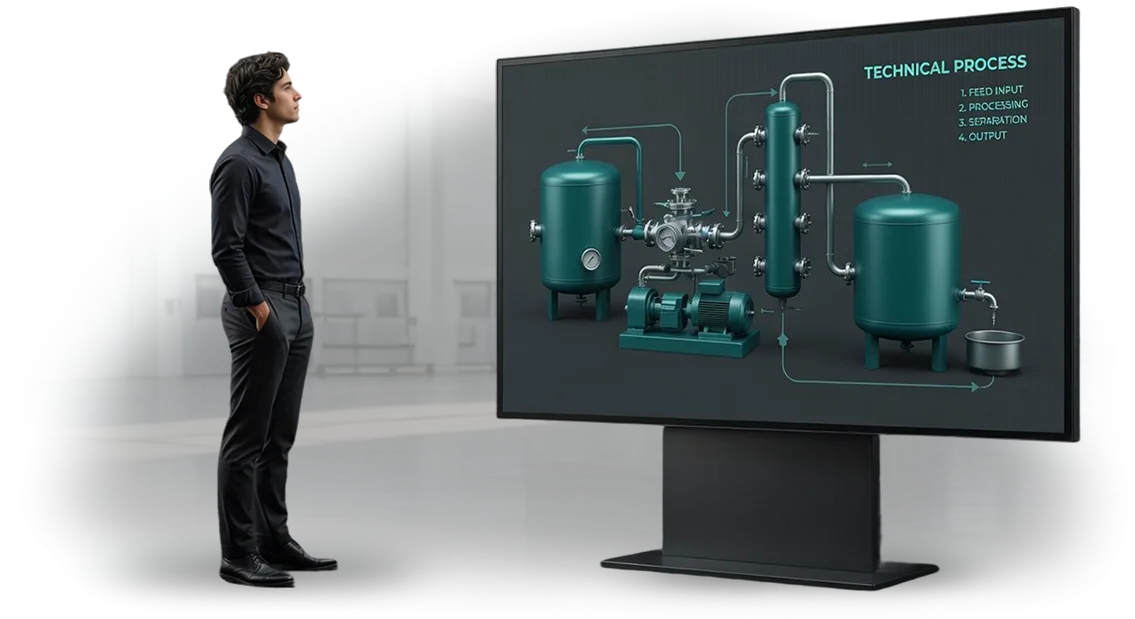
Employee mistakes cost too much? CGI 3D process animation is the way out
Traditional employee training is always a compromise. Either you pull experienced specialists away from their work to explain processes to newcomers, or you order expensive shoots with real equipment that become outdated after the first update of the regulations.
In both cases, the result is the same: employee mistakes cost the business direct losses — defects, missed deadlines, damaged client relationships.
The worst part is that the staff are not to blame — the way the material is presented is.
Text instructions and static diagrams do not reflect the real sequence of actions, while “live” shooting only shows what happened to be in frame, without the ability to look inside a complex assembly or process.
The employee is left alone with an abstract diagram, so they act blindly and make exactly the mistakes you later review at your staff meetings.
CGI 3D process animation solves this problem radically. Instead of flat images and video recordings, the employee gets a clear 3D visualization of a production operation, assembly of a unit, or work with equipment — with strict adherence to safety rules and the step sequence.
This employee training format makes it possible to look into any detail, repeat a complex fragment in slow motion, and see the process through the eyes of a real professional, not just in general terms.
Corporate training based on video instructions with CGI graphics delivers a concrete business result. The material is perceived on an emotional level and is remembered much better than text, which means new employees reach working proficiency faster and make fewer mistakes.
Reusing the videos for onboarding new hires saves hours of your mentors’ time and eliminates the human factor in knowledge transfer. Even if the most experienced specialist goes on vacation or leaves, their expertise remains in the company as an accurate 3D model of the process.
What benefits do CGI videos provide for employee training
New employees often drown in text regulations and diagrams: to understand a process, you need to read dozens of pages, and questions still remain. Video instructions solve this problem, and CGI animation makes them truly visual.
Instead of abstract descriptions, the employee sees the exact sequence of actions, the internal structure of mechanisms, and the logic of the process — so the material is absorbed faster and remembered for a long time.
First, CGI videos provide a unified training standard. All employees, from beginners to experienced specialists, see the same reference process: the correct sequence of operations, safe work practices, and the expected result.
This is especially important for companies with multiple branches or shift schedules — there are no more discrepancies in how different mentors explain the same task. Mistakes caused by differences in interpreting instructions become a thing of the past.
Second, animation accelerates onboarding. A newcomer no longer needs to sit next to a mentor for weeks and memorize how things work. They just watch a three-minute video that clearly shows the entire work cycle.
Onboarding becomes shorter, and the new employee starts contributing faster. The company spends less on internships and reduces the load on experienced specialists who previously had to take time away from their work to train.
Third, it is direct savings. CGI-format instructions do not require stopping production or renting locations for filming — the process is modeled and animated in a digital environment.
A video created once can be used to train all new employees and updated when regulations change. The number of errors and associated downtime decreases, which means work efficiency and task quality improve.
The main thing the client gets is a predictable result: employees reach the required level faster, make fewer mistakes, and follow unified standards. Training stops depending on the mentor’s personality and mood, and the company gets a scalable personnel training system.
CGI animation pays for itself after the first group of trained employees and continues to work for the business for years.
Formats of 3D video instructions for different tasks and industries
Each training task has its own 3D visualization format. The same process can be shown realistically, as a diagram, or as an exploded model.
It matters that the video is understandable to your employees and solves a specific task: introductory training, advanced training, or safety briefing.
Our specialists select the 3D animation style according to the specifics of your production and the audience’s level of preparation. This allows you to show the process with the necessary degree of detail without overloading the video with unnecessary information. The table below shows the main formats we use.
| 3D graphics format | For whom | What it gives the client |
|---|---|---|
| Photorealism | For employees working with complex equipment | Shows the structure and details without expensive filming, clearly explains the operating principle |
| Isometric view | For new employees and warehouse staff | Provides an overall picture of the process, easy to read even without special training |
| Exploded view | For service engineers and repair crews | Shows disassembly and assembly step by step, reduces errors during maintenance |
| Stylized 3D animation | For mass training and introductory briefings | Keeps attention, simplifies complex topics, improves memorability |
| Animated 3D processes | For all employees during safety briefings | Clearly demonstrates the action algorithm and consequences of violations |
At the briefing stage, we determine which format will be most effective for your industry and employees. The right choice of style reduces production costs — you pay only for the level of detail your specialists actually need.
How a training video is developed: from brief to launch
We structure the work so that you see the result at every stage and can influence the process without losing time. Below is the typical project path: from the first brief to a finished video instruction that is integrated into employee training.
Work stages
- Brief and task audit. We analyze which employees and which processes need training, and which mistakes currently cost the most. We record goals, target audience, and success criteria.
- Script and storyboard. We turn the technological process into a clear visual sequence: steps, emphasis, pauses. We approve the text and logic before production begins — this saves time on revisions.
- Creating 3D models and environments. We build digital copies of equipment, tools, and work areas. At this stage, you see how the key shots will look and make edits before the final render.
- Process animation. We “bring the models to life”: we show the sequence of actions, movement of parts, and interaction with equipment. This is where the clarity that cannot be conveyed by text is born.
- Interim approval. You receive a draft video and a list of changes made. We adjust duration, emphasis, and details — without additional iterations.
- Final render and editing. We put together the clean version with sound, subtitles, and graphic explanations. We check that the instruction looks correct on screens of different sizes — from tablet to projector.
- Delivery and implementation. We hand over source files and final files, help integrate the video into the training system: corporate portal, distance learning course, or internal training center.
Timing and control
At every stage, you know what is happening and when the next result will be ready. A typical project takes from two to six weeks, depending on process complexity and the number of scenes. We work to a fixed estimate: agreed edits do not increase the budget.
After launch, you receive an instruction that can be updated: we change individual scenes or redo the animation for a new version of the equipment without starting the project from scratch.
What is included in the delivery package of a video instruction
When ordering a video instruction, it is important to understand what you get as a result. We deliver not just a video file, but a working package that you can use immediately: from the script to content rights. This allows you to launch training without additional work and protects your investment.
Here is what is included in the delivery:
- Ready video — CGI 3D process animation with voice-over narration and subtitles. The video is adapted for viewing on screens, in distance learning systems, and on the internal portal.
- Script and shot-by-shot plan — a detailed description of each episode, lines, and actions. You can easily make edits or adapt the content for related tasks.
- Project source files — all working files used to assemble the video. They remain with you, so you are not dependent on the studio for future updates.
- Teacher’s guide — recommendations for integrating the video into the learning process, typical knowledge-check questions, and practical exercise scenarios.
- Content rights — full right to use the video inside the company without restrictions on the number of employees or term. This eliminates risks during audits and internal checks.
- Company-branded version — the logo, corporate colors, and intro/outro are built into the video so the material supports brand recognition and does not look like a third-party file.
Each item in the package is checked before delivery. You receive documents and files within the agreed time frame, and after launch we remain available for consultations — so the video instruction truly reduces errors and accelerates newcomers’ transition to working rhythm.
Case: how a video instruction cut onboarding time at a factory
We were invited to a machine-building plant: onboarding for new employees took almost two weeks, and mistakes on the line still kept happening.
A large part of the time was spent on lectures and reading paper instructions, and mentors spent their shifts explaining things to each new group.
The task
Management wanted a format that would prepare a newcomer without an instructor present and reduce the amount of defective output.
We proposed a series of CGI 3D animation video instructions: the employee sees the process through the operator’s eyes — from turning on the machine to actions in an emergency situation.
Such animation shows the internals of the mechanism and the logic of operations where filming real equipment falls short.
Solution and result
We made 12 short videos on key operations: sequence of actions, typical mistakes, and response to failures. Each video lasts 3–4 minutes and answers the question “what to do if something goes wrong?”
Three months after implementation, onboarding time was reduced from 12 days to 4. The number of mistakes made by new employees during the probation period dropped by almost 60%. Mentors stopped repeating themselves — newcomers review the needed video on their own.
The plant ordered a second series of instructions for maintenance staff and included the videos in certification. Now this is the training standard for all production sites of the company.
How to choose the right video instruction format for your production?
There is no universal “correct” format — the choice depends on the specifics of your production, the complexity of operations, and the skill level of your staff.
For one task, a schematic 2D animation is enough; for another, you need a 3D CGI model of the equipment with every component detailed. That is why we start not with video, but with an audit of your production processes.
Three-dimensional graphics are justified for complex, multi-stage, or hazardous operations where the cost of a mistake is too high.
When an employee sees the process “from the inside,” can examine each element and its interaction with others, they form the correct sequence of actions faster and make fewer mistakes.
For simple instructions, we offer more economical formats — the decision is always based on the task, not on a universal template.
The audience is equally important. New employees need the most detailed presentation with an emphasis on basic steps; experienced specialists only need a video focused on bottlenecks, non-standard situations, and changes in regulations.
Within a single project, we combine the level of detail so that each employee receives information appropriate to their experience.
To choose the right style, we conduct a consultation and a technical analysis of your production: we study technological maps, standards, and safety requirements, and talk with technologists and site managers.
As a result, you receive specific format recommendations — with a clear explanation of why exactly this option will reduce training time and lower the number of mistakes. Tell us about your task, and together we will choose a solution that will work toward your result.
Frequently asked questions about creating training video instructions
Before a project starts, we always hear the same questions: how much it costs, how quickly it will pay off, and whether we will miss the launch. That is normal — you are responsible for the result to your management and employees.
So below are answers to the four main fears clients bring to us when ordering training video instructions.
How much does developing a training video instruction cost?
The cost depends on the complexity of the script, the number of 3D scenes, and the level of process detail.
But the final cost is always calculated after audit for your specific task: you receive an estimate before work starts and do not pay extra for “unexpected expenses.” The main guideline is not the budget, but the effect: one video instruction replaces hours of repeated explanations and reduces employee errors.
What are the deadlines for such projects?
We work in stages: brief, script, 3D modeling, animation, editing. At every stage you see the intermediate result and make edits — so the final deadline is not a surprise. On average, a project takes 3–5 weeks, but we fix the exact schedule in the contract before work begins.
What if we are not satisfied with the result?
We include an approval cycle in the project: you comment on the script, the draft animation, and the final version. Edits at each stage are included in the cost — you do not pay for “rework,” but refine the video to a comfortable level. Our goal is not to “hand over the work,” but to create an instruction that is convenient to use.
Will our employees be able to watch it?
Nothing needs to be installed for employees: the video instruction works through a browser, internal portal, or LMS. CGI 3D process animation shows actions in large, detailed views, so even a new employee understands the sequence from the first viewing. You will not need special equipment or technical training for staff.
We do not take on a project if we are not confident it will benefit your business. That is why, during the consultation, we show examples of similar tasks and discuss specifically how a video instruction will cover your need — without obligations and unnecessary presentations.Order video instruction development and reduce training time
Leave a request — and we will conduct a consultation, clarify the task, and prepare a detailed work plan with a fixed estimate before the project starts.
You will get a transparent timeline, an understanding of deadlines and costs, and a personal manager who will support the project from brief to launch.
Work stages for a video instruction
- Brief and analysis. We clarify which department and processes need the instruction, and study the specifics and target training metrics.
- Script and storyboard. We develop a script in the employees’ language and approve the logic and key scenes.
- Creating 3D process animation. We model the work environment and operations in detail, showing nuances that are difficult to convey with live footage.
- Voice-over and editing. We add a professional voice, subtitles, and accents so the material is understandable to employees of any skill level.
- Focus-group testing. We show the draft to real users, collect feedback, and make edits.
- Launch and support. We hand over the final file in a convenient format and remain available for prompt adjustments.
Why it is convenient to order from us
- Fixed estimate — the cost does not change during the work.
- Work plan with dates for each stage — you always know what is happening.
- Personal manager available — no intermediaries or loss of context.
- Free edits to the script and voice-over until approval.
- Support after launch — we help adapt the instruction to new process versions.
- Over 10 years of experience — we have prepared dozens of instructions for production, logistics, and service.
Contact us right now: leave a request for a consultation and get a cost and timeline estimate within one business day. We will start with a short call to find out which video instruction will reduce your employees’ training time and deliver a quick result.