

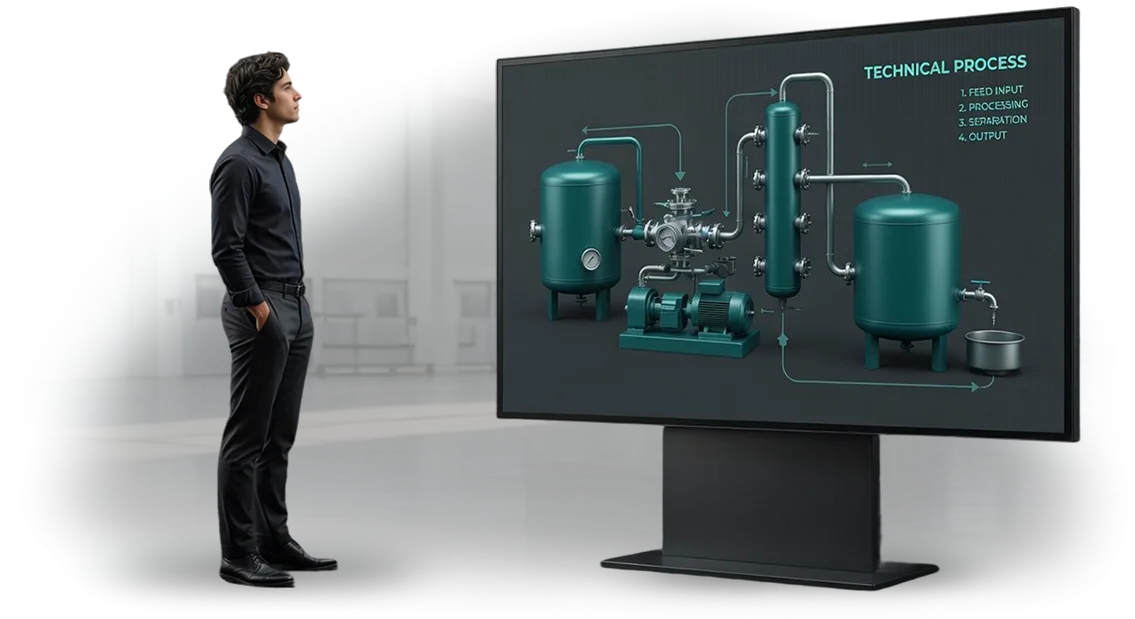
Reduce Errors: Video Instructions for Railway Transport
Errors by railway transport personnel result in more than just downtime — they create safety risks, damage to expensive equipment, and schedule disruptions.
Even an experienced employee can miss a critical step when performing a non-standard operation, especially when the instructions are described in 40 pages of text.
In such situations, the cost of a wrong action is measured not in minutes, but in the potential consequences for passengers and equipment.
Conventional training — lectures, memos, exams — provides a theoretical foundation but does not build a clear sequence of actions under pressure. Video instructions close this gap: the employee sees each component and each step in action, not just an abstract diagram.
This is especially important for exploded views of railway transport, where one needs to understand the internal structure of an assembly and the disassembly/reassembly order. A visual video answers questions that text descriptions leave open to interpretation.
Modern video instructions are built on professional 3D graphics and real production processes. We create videos that can be paused, replayed, and repeated on screen — at one's own pace and without risk to equipment.
This changes the approach to employee training: newcomers settle into their roles faster, and experienced staff less often turn to mentors for clarification.
As a result, the number of errors caused by human factors decreases, and the overall level of safety in transport improves.
Managers get a manageable tool that is easy to integrate into the training program and use for work authorization.
Video instructions are equally effective for railcars, locomotives, and depot equipment — and it is an easy-to-understand format that employees actually watch to the end.
Implementing this kind of training directly reduces operational risks and thus protects the most important thing: the uninterrupted and safe operation of railway transport.
What a 3D Video Instruction Delivers: From Faster Learning to a Unified Standard
Railway transport employees work in an environment where the price of an error is measured in human safety and equipment integrity. Classic text instructions and diagrams take a long time to study and leave room for misinterpretation.
A 3D video instruction eliminates this problem: exploded views of assemblies and mechanisms show the structure and sequence of actions visually, with no need to decipher drawings.
Faster learning is a natural result of visual clarity. A new employee understands the structure of the braking system, bogie, or pantograph more quickly when seeing it in motion rather than reading an abstract description.
The time spent on initial onboarding is reduced severalfold, while the quality of knowledge retention grows — the employee performs operations confidently and deliberately from the first days.
A unified training standard is another key benefit. When all employees — from fitter to team leader — study the same video sequence, dependence on any particular mentor's experience is removed.
This is especially important for enterprises with a distributed structure and multiple sites: the same video guarantees the same knowledge and the same actions at any location.
Risk reduction is directly tied to better training quality. A video instruction makes it possible to examine complex and hazardous operations in detail, freeze a frame, return to the needed segment, and show typical mistakes before they lead to consequences.
As a result, the number of incidents goes down, there is less downtime and fewer expensive repairs, and the safety department gets a clear tool for knowledge verification.
In the end, the enterprise gets a measurable effect: faster onboarding of new employees, fewer operational errors, and greater process stability. A 3D video instruction pays for itself by reducing the cost of retraining and preventing emergency situations.
It is not just a training video but part of a knowledge management system that works for the enterprise's safety and efficiency every day.
Formats of Video Instructions for Railway Transport
For railway transport, video instructions solve different tasks: from training new employees to quickly refreshing the skills of experienced crews.
The format must match the scope of the task — a comprehensive program for an entire depot does not suit a short quick-reference card at the locomotive.
The table summarizes the main formats we use in projects for railway enterprises:
| Format | For whom and when | What the client gains |
|---|---|---|
| Full training course | New employees, working with equipment from scratch | Unified knowledge system, fewer errors during onboarding |
| Assembly module | Repair crews for disassembling and assembling a specific assembly | Faster skill refresh, less downtime |
| Operation video instruction | Drivers and dispatchers for daily actions | Consistent execution, reduced risk from human factors |
| Exploded view with 3D demonstration | Complex equipment, part interaction | Clear mechanism structure without opening the assembly |
| Algorithm quick-reference | For review before a shift or in an abnormal situation | Employee confidence, quick response |
The choice of format depends on the scope of the task. If the goal is to train the entire depot staff, we go with a full course including testing and a pass/fail assessment. If the task is narrow, we produce a short 3–5 minute module that can be reviewed before work.
The video scope also varies: from a single assembly to an entire train. We help determine which format will deliver the greatest effect for your enterprise and put together the optimal package.
As a result, employees absorb the material faster, and the manager sees a measurable outcome: fewer errors, faster onboarding, and consistent quality of work.
How a Video Instruction Is Created: From Task to Implementation
We structured the process so that you can control every stage without getting into technical details. You do not need to understand filming, editing, or 3D modeling — you get clear control points, deadlines, and a finished result that solves your employee training task.
- Brief and task audit. We record which operation an employee must master, who will watch the video, and what result you want to measure — from error reduction to onboarding speed.
- Script and production plan approval. We present the video structure: which assemblies and mechanisms will be shown, and how live footage combines with 3D exploded views. You approve the logic before production starts — this saves time and budget.
- Development of 3D models and drawings. For railway transport, accuracy is critical: every bolt, valve, and assembly is reproduced according to your documentation. You get a visually accurate instruction, not an abstract animation.
- Interim review and corrections. A few days after the start, we show a rough version of a key scene. If the emphasis needs to shift, we make edits before the entire film is ready.
- Video production and voiceover. We record the narrator's script and synchronize it with the graphics and editing. The result is a video of the right length, with emphasis on critical steps and no unnecessary filler.
- Final video approval. You receive the final version, review it with subject-matter experts, and approve it. Edits within the approved script are made at no additional charge.
- Implementation and support. We deliver files in all required formats and help set up integration with your learning management system. If procedures change later, we update the video on request.
As a result, you get a ready-to-use video instruction that brings employees up to speed quickly and reduces the load on mentors. All stages are recorded in a project schedule, so you always know when the result will be ready and what is happening at any given moment.
What Is Included in the Deliverable: A Package for Your Training System
The entire package is delivered as a ready-made solution for your training system. You get not just a video but a full-fledged tool: from materials to loading configuration in your LMS.
Nothing needs to be figured out or finished — the project specialists hand over a complete package and help you get it running.
The package includes:
- Final video instructions for servicing and repairing railway transport assemblies with 3D exploded-view demonstrations. Formats are selected for your training system.
- Video segments with step-by-step breakdowns of operations: from preparing the work area to checking the result. Each episode can be used separately in the training program.
- Supporting documentation: a user guide, an episode map, and recommendations for incorporating the material into training programs.
- Methodological tips for instructors and mentors — how to conduct sessions with video instructions and verify knowledge retention.
- LMS integration setup: uploading courses, assigning employees, and collecting viewing and completion statistics.
- Technical support during implementation and ongoing project support — updates and refinements on request.
The project outcome is a unified training standard for all specialists. Employees master procedures faster, and you get measurable data on who completed the training and when. This reduces the number of errors in equipment maintenance and makes onboarding predictable.
Case Study: How a 3D Video Instruction Cut Assembly Time by 30%
Railway transport places high demands on assembly accuracy: even a small error can lead to train downtime and expensive repairs.
Our client — rolling stock manufacturer "TransMash" — faced a typical problem: new employees took a long time to grasp text instructions and drawings, training took up to two weeks, and the first independent assemblies still had defects.
We proposed replacing flat diagrams with a 3D video instruction for a key assembly.
our team specialists developed a 3D model with an exploded view: on screen, the part breaks down into components and is reassembled in the correct order, with visual cues and emphasis on important points.
The employee sees the entire process with their own eyes rather than trying to reconstruct it from a drawing — so they remember the sequence the first time. The instruction can be opened on a tablet or computer right at the workstation.
The result was measured: assembly time for the unit dropped by 30%, the error rate fell by half, and new employee training time decreased from two weeks to four days. That means faster ramp-up for newcomers, fewer defects, and mentors freed for their core tasks.
After the first success, the company ordered video instructions for five more assemblies — they are now used both in the training center and on the production floor.
This case shows: such an instruction pays for itself with the first group of newcomers, because saved time and materials cover the development cost.
Plus, it becomes a unified training standard that does not depend on any particular supervisor's experience and directly affects operational performance.
How to Choose a Video Instruction Format for Your Enterprise's Specifics?
The choice of video instruction format directly depends on the equipment employees work with and the level of competence they need to reach.
For railway transport enterprises, where repairing and maintaining complex assemblies involves risk and high responsibility, a simple video is not enough — the employee must not only see the sequence of actions but also understand the internal structure of the mechanism.
Therefore, the first selection criterion is equipment complexity: the more parts and dependencies, the more detailed the video must be.
The second criterion is the current level of staff training and turnover rates. If the enterprise regularly trains new specialists, a modular format is worth choosing: short videos for each operation that are easy to update and combine.
If the goal is advanced training for experienced workers, full scenarios with an in-depth review of abnormal situations are more effective.
This affects not only training convenience but also the budget: modular solutions take more production time but save on reshoots when procedures change.
For railway transport specifically, 3D video instructions with exploded-view demonstrations are optimal. They make it possible to show the internal structure of a braking system, engine, or coupling mechanism in motion — without disassembling the real assembly.
This format is especially valuable when parts are large or hazardous to dismantle, and a repair error can be costly.
3D visualization answers the question "what does it look like inside," giving the employee an accurate picture of how parts interact and the order in which they are removed.
Budget affects format selection in a non-linear way. Simple filming with an instructor may be cheaper at the start, but when equipment changes, it has to be reshot — meaning paying again. 3D models created once are easy to adapt to new modifications: just update the model itself.
For enterprises with a diverse fleet of equipment, this means long-term savings on updating training materials, and for trainees, knowledge that stays current.
We help you choose a format based on your enterprise's specifics, headcount, and real training needs. Request a consultation — we will analyze which type of video instruction will deliver the right result in your conditions and propose a solution that fits your budget.
Frequently Asked Questions About Video Instruction Development
Clients in the railway transport sector often ask how long it takes to create training video instructions, how to update them, and whether it is difficult to integrate them into the existing personnel training system.
These are important practical questions: the answers determine when employees will start learning with new materials and whether the familiar training process will need to change. Below, we address the most common concerns.
How long does it take to create a video instruction?
On average, one instruction takes 2–4 weeks: we analyze procedures, examine specific equipment assemblies, write the script, and edit the video. If multiple videos are needed, we can parallelize the work and reduce the total time by up to 30%.
What if the equipment or technology changes?
We do not redo the entire video — only the needed scenes and the voiceover. This kind of update takes a few days, so employees always work with current instructions, and old materials do not pile up.
Is it difficult to integrate video instructions into existing training?
No, they fit easily into any training program: they work for instructor-led sessions, self-study, or placement in an e-learning system. You do not need to restructure your processes — just add high-quality visual material.
How can we check that employees have absorbed the material?
On request, we add knowledge-check questions or set up view tracking in your record-keeping system. That way, you know exactly who completed the training and how well they understood the topic.
Order a Video Instruction for Your Enterprise
Ready to simplify employee training and shorten onboarding time? Order a corporate video instruction for your enterprise — we will guide you from the first consultation to implementing the finished material.
After your request, you will receive:
- A consultation on the format and content of the future video instruction, taking into account the specifics of railway transport.
- Cost and timeline estimate for your tasks — with no hidden surcharges or unnecessary options.
- An analysis of work processes and typical employee errors, so the video addresses exactly your needs.
- A script and storyboard of the future video for approval before production starts.
- A pilot project — a short trial segment of the instruction, so you can assess the quality and style before full production.
- Help with integrating and adapting the video into your training system.
The pilot project is an opportunity to see the result before full payment. We create a demonstration segment with your equipment or process, you test it with employees, and then make a decision. This way, you know what you are getting and do not risk your budget.
To get started, just leave a request on the website — we will prepare an estimate within one business day. Describe your task, and we will suggest the optimal solution and handle all stages: from script to final edit.