

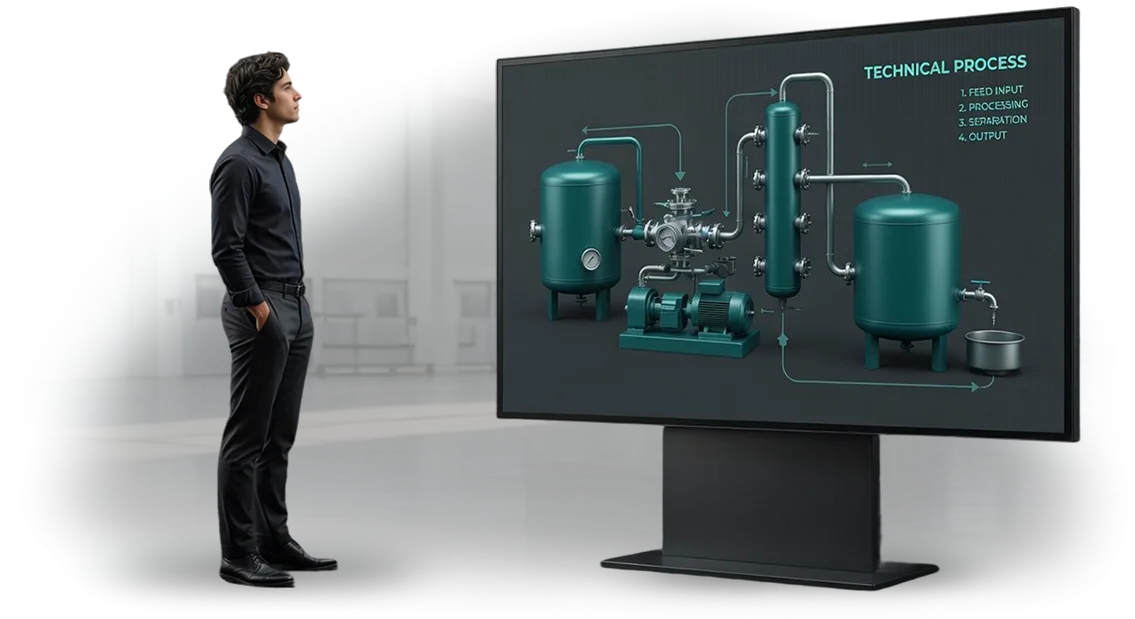
Cinematic Visualization in Training: Why It Matters
Employees rarely watch training materials for fun. Usually, it's a forced necessity: checkbox-style instructions, flat graphics, a voice-over, and text-heavy slides. This kind of video doesn't hold attention—and that means it doesn't build the right skills.
Within a few days, staff forget key steps, then come mistakes, repeat questions, and wasted mentor time.
Cinematic visualization changes this. It uses the same techniques as film: expressive lighting, thoughtful composition, smooth camera movement, and detailed 3D scenes. The viewer isn't just watching an instruction—they're immersed in the process and living it.
This video format reads as a complete story, and the brain remembers stories far better than abstract diagrams. As a result, employees absorb procedures more easily and repeat actions more accurately in practice.
For business, this means a predictable training outcome. New employees reach the required level faster, make fewer mistakes in non-standard situations, and company standards are applied consistently.
Managers don't have to spend weeks personally walking through the same process—the video content works on its own, at any time, for any number of people.
Cinematic execution also elevates the company's status. Training like this looks modern, premium, and respectful of the employee. That means higher engagement and a stronger desire to work through the material—instead of closing the window a minute after it starts.
That's exactly why corporate training with quality visualization pays off faster than traditional presentations and text-based instructions.
What You Get from High-Quality Training Videos
Training video instructions with cinematic 3D visualization are a tool that turns scattered mentor experience into a single company benchmark. Our team create videos that address the core business challenges: onboarding, quality, and predictable staff performance.
Here's what changes when visual video instructions replace text-based procedures.
- Faster onboarding. A new employee watches the video at their own pace and gets straight to work. Time to target performance drops by 1.5–2 times—you get a return on new hires sooner.
- Fewer errors. The video shows the correct sequence of actions with no room for misinterpretation. Operational errors fall, which means less rework, fewer missed deadlines, and less wasted spend.
- A single process standard. All employees, across all branches, see the same correct story. Instead of mentors explaining things differently, you get consistent results at every location.
- Convenient quality control. A video instruction is easy to use as a checklist during certification: managers always know what employees were taught and what they should be able to do. Training no longer depends on one key specialist and doesn't fall apart when that person leaves.
The result—stable team performance even on stressful days and regular shifts. A quality video pays for itself through fewer errors and faster onboarding, and once launched, it stays in the knowledge base and works for you around the clock.
Training Video Formats for Your Task
The format of a video instruction directly affects how quickly an employee absorbs the material and starts working without mistakes. Each situation calls for its own type of training video: a short introduction, practice on a complex procedure, or supervised training in an LMS. We produce all the main formats and help you choose the right one for your case.
A full video gives a complete picture and suits mass training. An interactive video prompts employees to make decisions as the story progresses—the skill gets reinforced without risks. An LMS module integrates into your system and lets you track who has completed the training.
| Format | Who it's for | What it delivers |
|---|---|---|
| Full video | New employees, mass training | Fast immersion in procedures, less mentor time |
| Interactive video | Complex procedures, algorithm practice | Decision-making without real-world risks, fewer errors in practice |
| LMS module | Distributed teams, mandatory training | Completion tracking, automated reporting, a single standard |
If you have many new hires, choose a full video. If the procedure is complex and the cost of an error is high, go with an interactive video. If you need to guarantee that every employee has studied the material, use an LMS module.
Better yet, let us make the choice: we'll review the script, the audience, and your training system, recommend the optimal format, and produce a cinematic-visualization video that people will actually want to watch to the end.
How Work on Your Project Proceeds
We structure the process so you always understand where the project stands and what comes next. No black boxes: each stage is fixed in the plan, and you get checkpoints for review and approval.
In the end, you're not just buying a video—you're taking part in its creation and getting exactly what your employees need.
- Brief and immersion. We collect the requirements and study your audience and business processes. You define which skills employees should gain after watching, and we propose the structure, style, and presentation approach.
- Planning and estimate. We lock in timelines, stages, and the list of videos. You get a schedule with clear approval points so production runs without rushes or delays.
- Script and storyboard. We create a written script and visual sketches of the future scenes. You see what the material will look like before the expensive animation stage starts—and can adjust the focus.
- CGI animation production. We build 3D scenes and simulate equipment operation and employee workflows. We use cinematic visualization techniques so the video looks engaging, not like a dry instruction manual. On intermediate renders, you verify the accuracy of the details.
- Client approval. We show a rough cut with voice-over and timings. You give feedback on logic, tricky spots, and duration—we make changes before the final render.
- Launch and adaptation. We deliver the finished videos in the formats you need: for LMS, internal portal, or YouTube. We set up access and help with integration into your company's training system.
- Support after delivery. We update videos when procedures or equipment change. You can come back to us months later and quickly get an up-to-date version without redoing the entire project.
Each stage takes a predictable amount of time, and you always know who is responsible for what. This workflow lets us produce training video instructions that actually get used—not filed away in an archive.
Full Delivery Package for Training Video Instructions
When the project is complete, you get not just a set of files, but a ready-made training system. We hand over the full delivery package—from final videos to materials that help employees quickly master the new processes. Everything is structured; all that's left is to launch the training.
The standard package includes:
- Final video instructions—in several resolutions and formats, ready for use on the corporate portal, in the LMS, or at a general meeting with no additional processing.
- Project source files—when procedures or equipment change, you can quickly make edits without ordering a video from scratch.
- Methodological guidelines—implementation scenarios, knowledge-check options, and tips for integrating the videos into your current training programs.
- A text version of the instructions—subtitles and a printable summary for employees who prefer reading, as well as for accessibility compliance.
- A usage guide—a short manual covering which formats suit different systems, how to upload the videos, and how to organize access.
- Post-delivery support—for an agreed period, we answer your team's questions and make small edits free of charge.
This package covers the needs of HR, system administrators, and employees themselves. You won't have to look for another contractor for minor refinements.
The videos are produced in a cinematic visualization style—polished and on-brand. Once you receive the package, you can launch training the very next day.
Case Study: How We Increased Training Speed by 40%
A project for a network of 14 car dealerships, AutoPrime, is a classic industry example of how training problems cost businesses too much.
New sales managers spent two weeks in preparation but still knew the procedures poorly by the time they faced clients: errors in deal paperwork, missed sales, and fear of handling objections.
We replaced part of the lectures with compact training videos using cinematic visualization. These are not typical screen recordings or slides, but short films that show the employee the optimal behavior scenario: from greeting to closing the deal. All in the company's brand colors, with real procedures, and in the clear language of sales.
Implementation Results
The headline number—training time dropped by 40%. Instead of two weeks, a new hire is ready to work in eight business days. Knowledge quality also improved: the number of document-processing errors fell by a third, and the average final test score was 4.7 out of 5.
This project is a success not only because of the metrics. The training department stopped running through the same material ten times, and the videos themselves became a knowledge base: senior employees revisit them when they need to recall a rare scenario.
We use the AutoPrime training case as a model for other networks because it shows that cinematic visualization pays off through reduced turnover and fewer errors already in the first quarter after implementation.
Answers to Frequently Asked Questions About Development
We often hear the same concerns from clients: will the video be ready in time for an important date, will it cost more than planned, and what happens if the result isn't what we wanted?
For training video instructions in a cinematic visualization style, these questions are especially important—because at stake is not only the budget, but also how clearly employees understand the material.
We structure the work to remove these risks before we even start. We fix stages, timelines, and acceptance criteria in the contract, show intermediate versions, and discuss every decision. Below are answers to common questions—if you have your own, just write to us.
What are the development timelines?
A standard 1–2 minute training video takes 3–6 weeks. Under a tight deadline, we can speed up the process by working on the script and animation in parallel, but we're always honest about where the reasonable minimum for quality lies.
How is the cost determined?
The price depends on the runtime, scene complexity, and the number of revisions. Before work begins, we fix the estimate and don't change it without your consent. If you want to add new scenes along the way, we'll discuss it separately—without unexpected surcharges.
Do we need to prepare anything?
Procedures, presentations, and expert recordings are enough. We handle all the 3D graphics, animation, and editing ourselves. All we need is access to a specialist who can comment on the script and answer a couple of questions—everything else is done remotely.
What if we don't like the result?
You see the video at intermediate stages, not just at the end. Two or three rounds of revisions are included in the cost, so we refine the details until you accept the work. The final decision is always yours—we don't hand over the video "as is."
Book a Consultation on Video Instruction Development
Let's start with a short conversation about your task. If you need training video instructions that employees actually watch and use, a consultation is a quick way to understand the scope of work and the budget.
In 30–40 minutes, we'll cover which scenarios are worth producing in CGI, how to speed up production, and where you can save without losing quality.
At the meeting, we'll gather the input and propose solutions for your format—from one-off videos to a series of procedure videos. You'll get recommendations on script structure, visualization style, timelines, and cost.
our team does this based on 10+ years of experience in corporate video and training, so you see a realistic picture as early as the consultation stage.
After you reach out, you receive:
- A checklist of questions for preparing the brief—an easy way to align the task within your team;
- A format assessment for your specific audience: linear instruction, interactive video, or short micro-lessons;
- A cost calculation for video production based on the number of scenes, 3D detail, and timelines;
- A plan of stages and approval checkpoints so you can control the process without extra meetings;
- Recommendations for integrating the videos into your LMS;
- Preliminary timelines—when the videos will be ready and start working for your employees.
The consultation comes with no obligations. Send us your materials—we'll get back to you with an answer and a turnkey proposal: from script to editing and delivery.