

Why Instructions Fail Without Microscopic Visualization
Employees don't absorb complex procedures when they only see text or static images. They mechanically memorize steps but don't understand what actually happens inside the process—and in an unusual situation, they act blindly. This leads to defects, wasted time, and retraining.
Ordinary instructions and even camera footage don't show the essence: how material moves, where stress builds up, why color or temperature changes. For the employee, this remains a "black box," meaning they can't make the right decision in practice.
Ineffective instructions cost businesses more than it seems: every error on the production floor means rework, downtime, or a safety risk.
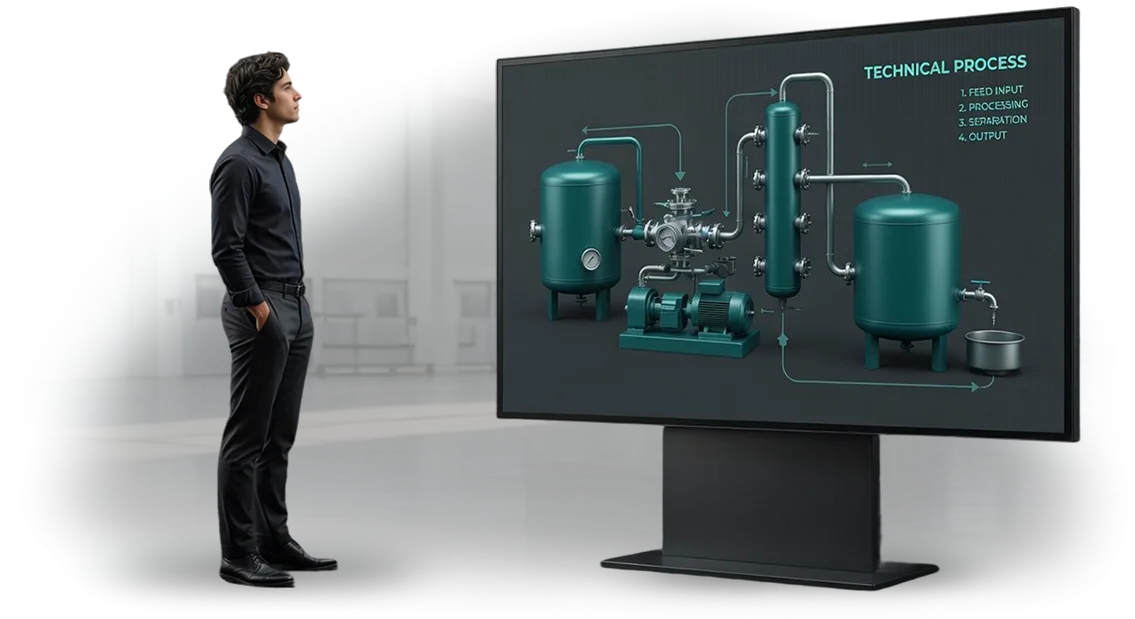
This is exactly where microscopic visualization helps. 3D animation for training makes processes invisible to the eye visible—cross-sections of parts, fluid movement, component interactions at the micro level.
The employee sees not an abstract diagram but an accurate model of what actually happens in the equipment. This builds deep understanding that stays with them for a long time.
Training video instructions with this level of detail turn complex production processes into a clear sequence. A new employee gets up to speed faster, an experienced one makes fewer mistakes, and the quality standard stops depending on personal interpretation.
We create exactly these kinds of videos: we break your process down to the micro level, build 3D scenes that accurately reflect the physics, and assemble them into an instruction that employees understand from the first watch. This closes the main problem—the gap between the procedure and a person's actual actions.
What 3D Animation Gives to Corporate Training
Employees skim through ordinary text instructions and static images—information doesn't stick, and questions come up in practice. 3D animation makes training a visual scenario: the entire process is visible down to the smallest detail from the first viewing.
Weproduce such videos on professional 3D equipment—and here's what it gives a business.
Engagement Instead of Boredom
Dynamic animation holds attention better than any document. The employee watches the video to the end instead of skimming pages. This is critical when dozens of people are learning the material at the same time.
Long-Lasting Memorability
Visual images are remembered better than text. Microscopic visualization shows details that can't be seen with the naked eye and forms a clear mental model of the process. A month later, the employee recalls key steps without a cheat sheet.
A Single Standard for Everyone
Everyone sees the same actions and emphasis—there's no inconsistency in interpretation. The instruction for an experienced worker and a newcomer looks the same. This levels out the quality of operations across all departments and simplifies knowledge checks.
Fewer Errors and Defects
When a person understands how to perform an operation, the risk of accidental violations drops. New employees get into the rhythm faster and make fewer mistakes. The business loses less time and material, and quality improves.
Training Video Formats: Choose Yours
Each training task requires its own format, and there is no universal solution. Some need a full process overview, some need a detailed breakdown of equipment, and some need an "inside" view that can't be shown on a real production floor.
We help you choose the 3D video format for your scenario: from a short process animation to an interactive video with knowledge checks.
The table below shows the main training video formats we use in corporate projects.
| Format | For Whom | What It Gives the Client |
|---|---|---|
| Full animated video | New employees, trainees | A single training standard: the employee quickly gets into the process without pulling mentors away |
| Equipment disassembly and assembly | Maintenance and service teams | A clear instruction on assemblies and parts, fewer errors during servicing and repair |
| Microscopic process | Technologists, production operators | Shows what the eye can't see: reactions, material structure, precise stages. Ideal for microscopic visualization |
| Interactive video | All employee categories | Built-in questions and scenarios—the employee immediately reinforces knowledge and gets feedback |
We choose the format based on the specific task: if employees work with their hands, we focus on process animation and disassembly; if you need to check comprehension, we add interactivity.
This is not "video for the sake of video" but a tool that reduces the time it takes an employee to reach results and decreases the number of errors on the production floor.
How Development Works: From Brief to Launch
Working on a corporate training video is not a one-off draft but a structured process of five to seven stages. At every step, you see what's happening and can make edits before the result goes into production.
This approach eliminates the situation where, after weeks of work, you get "something wrong" and have to start over.
We take on the entire development of the video instruction—from the brief to integrating the course into your training system. Below is the typical route that all our projects follow.
-
Brief and immersion in the task. We define the audience for the video, what employee actions need to be shown, and what result counts as success. The output is a short document with goals and constraints.
-
Training script. We write the text and break the material into logical blocks. Here we also decide where microscopic visualization will strengthen understanding and where a simple diagram is enough.
-
Script approval. You receive a finished script and storyboard—a textual and visual description of every frame. Edits are made at this stage, when changing something is quick and inexpensive.
-
3D modeling and animation. We create three-dimensional objects, processes, and environments. At this stage, the video becomes visual: complex assemblies, hidden mechanisms, and internal processes become visible.
-
Editing, voiceover, and final assembly. We combine scenes, add narrator text, subtitles, and emphasis. You receive a finished file for viewing.
-
Course implementation. We help package the video for your training platform: the right format, duration, and integration into the program. Employees get access to the instruction without extra technical steps on your side.
-
Post-launch support. If inaccuracies come up during use or a procedure changes, we quickly make adjustments to the video. Updates take days, not months.
The entire cycle—from brief to course implementation—takes on average 2–4 weeks depending on the complexity of the material. You always know what stage the project is at and control every step.
What's Included in the Delivery: A Complete Package for the Training Department
When a training department receives only finished videos, implementation often stalls. Without scripts, it's hard to adapt the material; without a method guide, trainers work blindly; and updates have to be ordered from scratch. We put together a package where everything is thought out—from the script to post-launch support.
The delivery includes:
- Finished video instructions—a series of CGI videos with microscopic visualization. Employees memorize material faster, and you get a single training standard for all branches.
- Video scripts—a detailed storyboard with text and explanations. This is the basis for translation into other languages, adaptation to new procedures, or reshoots.
- Methodological recommendations—a step-by-step guide for the trainer: how to embed the video into the program, what tasks to give after viewing, and how to check comprehension.
- Project source files—editable graphics, animation, and editing formats. You can make changes with your own team or order revisions from us without losing quality.
- Instructions for the learning management system—a step-by-step file that lets you upload the videos to your LMS in minutes, with proper navigation and access settings.
- Update support—if procedures change, we quickly update the videos or scripts. Training always stays current.
As a result, you get a working system, not just a set of videos. The training department only needs to assign the course—the technical and methodological issues are already solved. These materials also help during training audits and rapid knowledge transfer to new employees.
Case Study: How a 3D Instruction Cut Training Time in Half
An electronics manufacturing company faced a typical industry problem: preparing operators to work on complex equipment took weeks, and due to staff turnover, the process had to be restarted every few months.
The first shifts after training were accompanied by defects and downtime—newcomers confused the sequence of operations and didn't understand what was happening inside the mechanism.
How the 3D Instruction Changed the Process
For Elektron Plant, we developed a training video in the microscopic visualization style.
Instead of flat diagrams and text instructions, the animation shows the assembly of a unit from the inside: how parts move, where friction occurs, and what an inaccurate installation of an element leads to.
The material clearly explains what previously had to be explained in words or shown on real equipment under a mentor's supervision.
The video was integrated into the new employee onboarding program. First, operators spent two days studying the video and reviewing critical points, then moved to hands-on practice under a supervisor.
Within a week, the first group of 30 people was working at a normal pace, whereas before it had taken about two weeks. Total training time was cut in half.
Implementation Results
- Time to independent work—from 8 days down to 4.
- The number of errors during the adaptation stage fell by a third.
- Operators ask fewer questions about basic operations and move faster to the nuances of quality control.
- Mentors freed up time for their current work instead of repeating the same material.
Two months later, the workshop manager noted that newcomers produced fewer defects than previous groups—and six months later, the company ordered two more videos for other areas.
For the owner, this is not just savings on training but a sustainable result: stable assembly quality and fast staff adaptation without dependence on the human factor.
What Does Microscopic Visualization Give for Complex Processes?
Microscopic visualization is a way to show employees what cannot be seen with the naked eye: the internal structure of mechanisms, chemical reactions, and the interaction of parts at the micro level. This is often where the causes of breakdowns, defects, or inefficient work lie.
For complex production processes, such visual clarity becomes the key to fast and correct training. Instead of abstract diagrams, the employee sees how everything actually works and understands the logic of each stage.
This changes the approach to instructions: they stop being detached text and become an accurate model of reality.
From a business perspective, this produces measurable results: time-to-competency shrinks, the number of errors drops, and the quality of operations improves.
Training becomes predictable—every employee absorbs the material equally deeply, regardless of experience or ability to read drawings.
This is especially valuable where showing the process live is impossible or dangerous: work with microelectronics, pharmaceuticals, or chemical production. Micro-level 3D animation lets you look inside the process without risk, equipment shutdown, or unnecessary costs.
As a result, employees perform tasks with more confidence, and the enterprise gets a stable quality level. Microscopic visualization closes the main gap in training—between the instruction and real understanding—by helping people see what is hidden from the eye.
Answers to Frequently Asked Questions About Creating Video Instructions
Clients rarely ask about technology—they care about deadlines, complexity, and how the video will work in daily routine.
Weproduce training video instructions with 3D animation in the microscopic visualization style, so we've gathered honest answers to the main questions.
How long does it take to create one video instruction?
Usually two to four weeks. The deadline depends on the number of scenes, the level of detail, and the frequency of edits. We show a preliminary version right away so you can see the result and make adjustments along the way, not at the end.
What if the process changes?
The videos can be updated. We build the project modularly: individual fragments are replaced without reshooting the entire animation. This takes from a few days to a week, depending on the scope. This way, the instruction always matches the current procedure.
Is it hard to integrate video instructions into our internal processes?
No. We analyze your procedures, adapt the script to the specifics of your work, and deliver a video that can be used in the training system, on a portal, or during onboarding. The employee simply presses "play" and repeats the action.
What guarantees do we have that employees will understand the video?
We test the draft version on real users and make changes before final approval. 3D animation in the microscopic visualization style shows details that can't be seen in ordinary video, so employees absorb the material faster.
Order a Corporate Video Instruction with 3D Animation
Employees learn material better when they see the process from the inside—at the microscopic visualization level. These are exactly the kinds of video instructions that help bring newcomers up to speed faster, reduce errors, and lower the load on mentors.
We take on the entire journey: from idea to a finished video that integrates into your training system.
To order a video instruction, you don't need to understand the technology. Just leave a request—and the next day you'll receive a development brief, a production plan, and a cost calculation. During the consultation, we'll clarify the tasks, audience, and scenario. After that, 3D animation for business will make complex processes clear and memorable.
Why You Should Start With Us
- The request is simple—describe the task in your own words, we'll handle the rest.
- Development brief: we lock in goals, deadlines, and the expected result before the start.
- Cost calculated within 1 business day—no hidden items or long approvals.
- Production plan: you see the stages and understand what you get at each step.
- Consultation with an expert: we'll advise which video instruction format suits your employees.
- One contractor for the entire job: script, 3D animation, voiceover, and editing all in one place.
- Support after delivery: we make edits if the video needs to be fine-tuned for your training program.
Leave a request now—and by tomorrow you'll have a brief, a plan, and a clear cost. After that, all that's left is to approve the script and, a few weeks later, receive a video instruction that truly works for training your team.
Translate the above into English. Preserve structure exactly.