

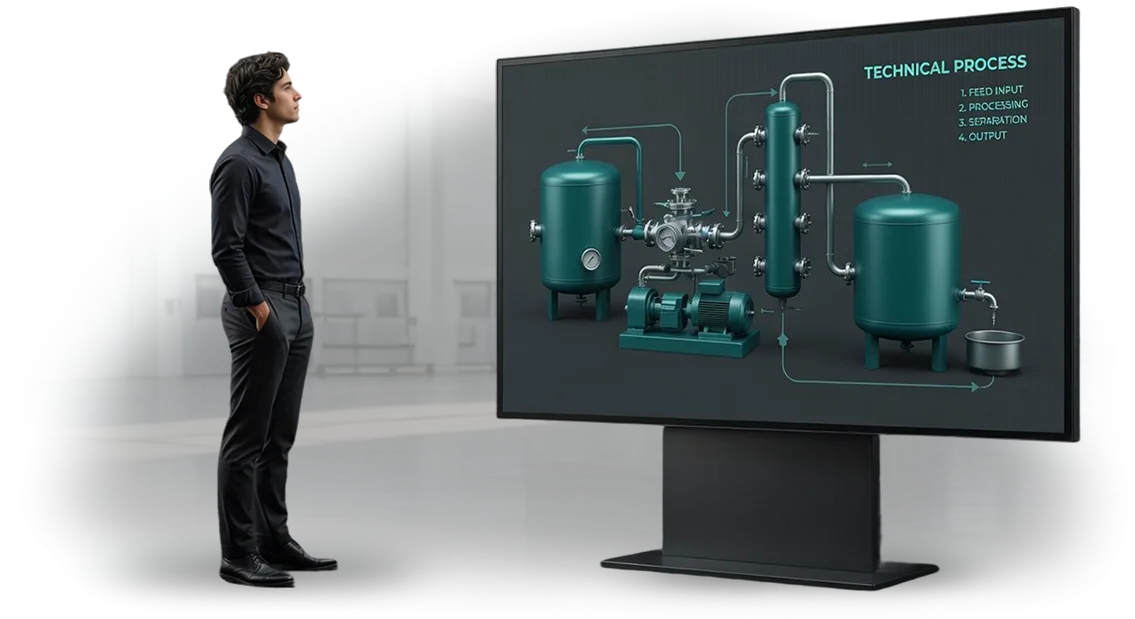
The Cost of Mistakes with Renewable Energy Equipment
Employee mistakes when working with power equipment cost more than any fine: halted generation, failure of expensive components, and in the worst case — a threat to human life.
An accident at a renewable energy facility also means a loss of trust from investors and regulators, which affects all future projects.
Most often, the cause is not negligence but insufficient staff training. An employee may know the theory perfectly but not understand how the equipment actually behaves in an abnormal situation.
That is why staff training becomes not a formal checkbox but a key element of the overall safety system.
Text-based instructions and lectures do not work here: a complex component cannot be understood without seeing it from the inside. What is needed are visual materials that show how equipment is disassembled and assembled, where typical mistakes occur, and what they lead to.
Video instructions with exploded-view demonstrations give the employee the complete picture before they ever touch a real object.
We help close this gap: we produce detailed training videos that turn complex technical information into clear steps. Instead of abstract slides — realistic models and analysis of critical situations.
This format is equally effective for quickly onboarding new hires and for retraining an experienced team when equipment or procedures change.
The business benefit is obvious: fewer accidents, less downtime, stable output, and a protected reputation. A trained employee is not an expense item but an investment in the uninterrupted operation of your power facility. And the earlier that investment is made, the fewer losses you will incur in the future.
What a Video Instruction Delivers: Fast Training Without Risks
A video instruction for employees is not just a video — it is a tool that directly affects how quickly staff reach full working capacity and how low the accident rate is.
In the energy sector, the cost of a mistake is especially high, so training must be not only fast but also safe.
A ready video instruction lets a newcomer master processes several times faster than classic manual study or mentor supervision, while the quality of knowledge does not depend on the experience of a particular instructor.
Fast training is achieved through clarity: the employee sees every step, the sequence of operations, and the correct actions with the equipment. They do not need to mentally reconstruct text — they simply watch and repeat.
This shortens the adaptation period from weeks to just a few days, meaning the new specialist starts adding value to the company sooner. This is especially important when you need to scale a team or fill a staffing need in a tight timeframe.
Risk reduction is the second key benefit. The training format allows employees to practice actions without real contact with hazardous objects. Employees learn through visual scenarios, including abnormal situations, and act more confidently on site.
This reduces the likelihood of injuries, equipment damage, and mistakes that lead to downtime. The company gets predictability: every employee knows how to act correctly, not through trial and error.
A single knowledge standard solves the “broken telephone” problem, where every mentor teaches differently. A video instruction embeds the same algorithms for everyone — from newcomer to experienced worker.
This is especially valuable for distributed teams and branches: you can be confident that every unit operates by the same rules. Combined with a knowledge check after viewing, you get an objective picture of staff readiness.
As a result, costs go down: less time spent on training, fewer mistakes and outages, and less turnover caused by employee uncertainty.
A video instruction pays for itself because the team works cohesively and safely, and management spends less effort on supervision and “firefighting.” It is not a one-time recording but a long-term asset that can be used for retraining, knowledge refreshers, and introducing new work standards.
Formats of 3D Instructions: Which One Fits Your Task?
Which 3D instruction format will pay off in your specific case? It depends on the skill level of employees, the complexity of the equipment, and the outcome you want the training to deliver.
Newcomers need a complete picture, experienced specialists need a quick refresher on a component, and quality control requires verifying actions before going out to the site.
This is especially relevant in renewable energy, where a mistake during maintenance of a wind turbine or substation leads to serious losses.
We have compiled the basic video formats we use in corporate training. Use your goals as a guide — and choose the right option.
| Format | Suitable for | What it gives the business |
|---|---|---|
| Full training film | Onboarding new employees, learning procedures | Single knowledge standard, reduced adaptation time |
| Modular video instructions | Refresher before repair work, professional development | Fewer mistakes, less equipment downtime |
| 3D exploded-view breakdowns | Studying the internal structure of generators, panels, substations | Deep understanding of construction, safe work without experimentation |
| Interactive scenarios | Knowledge checks and authorization for complex operations | Control over material comprehension, confidence in staff actions |
These are not just videos — they are ready-made tools that integrate into your training system. At the start of the project, we help you choose the optimal format and then adapt the animation to the specifics of your equipment. You get a video instruction that solves a specific problem and does not collect dust in an archive.
How We Create 3D Instructions for Renewable Energy
We have structured the development of video instructions so that you are never dealing with a “black box.” At every stage of creation, you see the result, make edits, and approve the work — and we bring it to completion.
- Brief and audience analysis. We find out what tasks employees perform, where mistakes most often occur, and what level of preparation newcomers have. This forms the basis of the script.
- Script and storyboard. We break down each operation into steps, align the narrative logic, and verify that the text matches your enterprise’s procedures.
- 3D models and exploded views. We create accurate visualizations of the equipment, showing the internal structure of components and mechanisms. This way, employees see not only “what to press” but also what happens inside.
- Voiceover and subtitles. We record narration in clear language and add neat explanations. The material can be watched with sound on or off.
- Intermediate review and approval. You receive a draft version and submit edits on content and details. We make changes without losing the launch timeline.
- Launch and handover of materials. We deliver the finished files in the formats you need: for an internal portal, training system, or video hosting platform. We provide clear recommendations on placement.
The full journey from brief to launch usually takes two to four weeks for standard processes and one and a half to two months for complex equipment. Every stage of creation is documented — you always know where the project stands and when it will be ready.
What Is Included in the Delivery: A Complete Training Launch Kit
Video files alone are not enough to launch training — you need a kit that can be quickly put into practice. That is why we assemble the delivery so that you have everything you need: from finished videos to usage rights and teaching materials.
The kit includes a complete set for training employees in renewable energy. You receive not scattered pieces but a single system that reduces preparation time and makes the training process transparent for management.
- Ready 3D video instructions for assembling and maintaining equipment with exploded-view demonstrations. The videos can be used in a distance learning system or in classroom sessions.
- Time-coded scripts — you know exactly which segment to show and when, so every training stage is logical.
- Methodological guides for the instructor and the employee: goals, control questions, practical tasks. This helps measure training outcomes.
- Source project files — if needed, you can make changes to the video or create new versions without contacting a contractor.
- Unrestricted usage rights with no limits on the number of employees or branches. The materials stay fully with you — they are your asset.
- Warranty and support during the warranty period: we fix any issues and help adapt the kit to your tasks and equipment specifics.
As a result, you get a complete training launch kit for renewable energy. This eliminates the need to search for materials and approvals, and new employees start contributing faster — with minimal preparation costs.
Case Study: Reducing Accident Rates in Wind Turbine Maintenance
Maintaining wind turbines is work where the cost of a mistake is measured not only in money but also in people’s health. Crews have to disassemble components at height and work with complex hydraulic and electrical equipment.
At the same time, every mechanic works in their own way: one relies on experience, another on an outdated instruction. As a result, the same repair is performed differently, and the risk of an accident remains high.
How We Solved It
A company operating a fleet of wind generators in the renewable energy sector approached us with this challenge. We developed a series of 3D video instructions for repair crews.
Instead of flat diagrams and text procedures, employees received clear exploded views of components, disassembly and assembly animations, and highlights of hazardous operations and typical mistakes.
The Effect for the Company
The implementation results speak for themselves. Over the first year of using the instructions, accident rates during maintenance dropped by 42%, and training time for new mechanics was cut by almost half.
The company continued the partnership and ordered similar instructions for other types of equipment.
Why did it work? 3D instructions eliminate the main problem — inconsistent understanding of processes. Every employee sees the same reference sequence of actions, and hazardous zones are visually highlighted.
The outcome depends less on the experience of a particular technician, and processes become reproducible. For management, this means predictability: less downtime, fewer injuries, and stable work quality. Above all, this format is easy to scale to other sites and areas.
How to Choose the Right Format for Your Task?
There is no universal format — what works perfectly in a logistics warehouse is useless for training staff to service wind turbines. The choice depends on what employees need to master: safe operating procedures, fault diagnostics, or repair procedures for a complex component.
Start with the question: “What problem will the video solve?” If employees need to understand the internal structure of equipment and the sequence of disassembly — 3D instructions with exploded views are optimal, allowing them to examine the mechanism from the inside without risk or production stoppage.
If the main goal is to standardize actions at the workplace, step-by-step videos with real footage and voiceover commentary are suitable. And for knowledge assessment, it is better to use short trigger videos with check questions at the end.
Different employee groups require different approaches.
Operations engineers need detailed breakdowns of components and emergency scenarios; newcomers need overview videos with the basic logic of how systems work; technical staff need instructions with an emphasis on safety procedures.
The right format accelerates onboarding and reduces the number of mistakes by ensuring the same level of understanding across the entire team.
The format is also influenced by viewing conditions: whether the video is used on a tablet near the facility, in a training room, or in a distance learning system. The length of the videos, their interactivity, and the ability to return to a difficult fragment all matter.
We help you decide on the right format for your actual conditions during a consultation — without obligation.
Send us your task description with details: number of employees, equipment specifics, and expected outcomes. We will propose a suitable format and show examples of similar renewable energy projects.
Frequently Asked Questions About Developing Video Instructions
Any video instruction is an investment in staff training and operational safety. To help you make your decision with confidence, here are answers to the questions managers most often ask before starting a project.
How long does it take to develop a video instruction?
The standard cycle is 2 to 4 weeks, depending on the complexity of the script and the amount of equipment. You will see the first rough-cut version within the first 10 working days after the brief.
The timeline depends not on editing speed but on the number of review iterations on your side. We set deadlines and milestones in advance so you know when you will receive the finished material for launching training.
What does it cost?
The cost is calculated after audit and depends on the number of operations, the complexity of the exploded views, and the duration of the final video.
The estimate includes everything: script, 3D modeling, voiceover, editing, and a final version adapted for different screen formats.
You receive a fixed estimate before work begins, and it does not change during the process. No hidden surcharges for “equipment complexity” or “additional edits within the approved script.”
Do you understand the specifics of our particular equipment?
Renewable energy is one of the key areas where we have already delivered projects. We do not just animate a model — we study procedures, technical charts, and the operating principles of the equipment so that the exploded view matches the real structure.
If you have technical documentation, design documentation, or 3D models — great, we will use them. If not, our engineers will reconstruct the geometry from photographs and descriptions with high accuracy. The key point is that you approve the script and visual style before rendering starts.
What about warranty and updates after project delivery?
We are responsible for the functionality of all links and correct video playback for six months after delivery. If an error is found, we will fix it free of charge.
Updates are a separate process. If an operation changes in the procedure or a new component is introduced, you send us the edits, and we produce a new version of the video according to the agreed pricing schedule.
This way, your employees always train on current information, not on content that is three years out of date.
We understand that the decision to develop a video instruction must be well considered. That is why at the first brief, you receive an assessment of timelines, budget, and a list of required source data — with no obligations on your side.Order Development — Get Working Video Instructions
Leave a request on the website or in a messenger — within one business day you will receive a cost and timeline estimate. This is non-binding: you make the decision when you see all the figures and the plan.
Immediately after your request, we conduct a short consultation: we clarify the equipment types, number of employees, complexity of operations, and training goals. Based on this, we put together a work plan — which videos are needed, in what format, and what to emphasize.
When you order video instruction development from us, every stage is clear and transparent. Here is what you get after contacting us:
- cost and timeline estimate for your project — no hidden surcharges or unnecessary work;
- personal consultation with a technical specialist on script and graphics;
- development plan with stages and checkpoints — you see what is delivered and when;
- adapted script for your specific equipment models and procedures;
- ready video instructions that integrate into your training system;
- complete file package and methodical materials for launching training;
- post-delivery support — we answer questions and help with implementation.
We handle all the complexity — from working with equipment and 3D graphics to editing and voiceover. All you need to do is approve the script and accept the result.
Leave a request through the form on this page or contact us using the details at the top — within a day you will have a concrete plan and an understanding of the budget.
You can order development from any city: we work remotely and have already delivered projects for companies in various regions.