

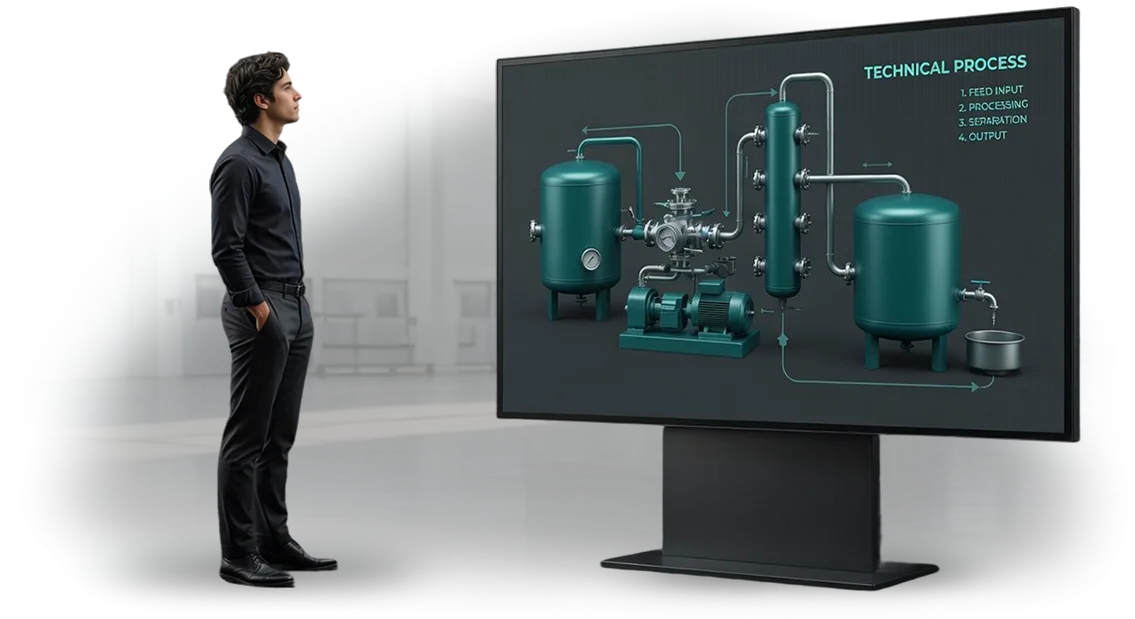
Employees Don't Remember Instructions — Data Visualization Solves This
Employees are unlikely to read through thirty pages of text regulations — it's boring, time-consuming, and hard to remember. As a result, processes get disrupted, mistakes repeat, and every such mistake costs the company time and money.
Why does this happen? The human brain processes visual information many times faster than text, yet most instructions still consist of paragraphs, tables, and diagrams.
Complex processes that need to be explained to a new hire or an employee from an adjacent department get lost in bureaucratic jargon, and key steps are ignored.
Data visualization changes the picture. We turn regulations and instructions into short, clear videos where each step is shown sequentially and understandably.
Instead of abstract text, the employee sees a first-person visualization of the process — what to click, what decision to make, what result should be achieved.
Such training truly takes little time: a three-minute video is absorbed better than an hour of reading an instruction manual.
At the same time, information stays in memory longer, which means employees return with questions less often, get into the work rhythm faster, and make fewer mistakes during onboarding.
For business, this is also measurable savings: there's no need to pull senior specialists away for repeated explanations of the same thing, and any new employee can be quickly trained to a single standard. When a process changes, it's enough to update one video rather than rewrite a pile of documents.
It's exactly these video instructions we develop for corporate training — with clear data visualization and logic that reduces the number of mistakes and makes onboarding fast.
What Results Video Instructions Deliver for Business
Faster employee onboarding is the most visible benefit: a video instruction shortens a new hire's path to independent work by 2–3 times. Instead of a week of reading regulations and peppering a mentor with questions — 15–20 minutes of clear breakdown of typical operations.
Fewer mistakes is the second key benefit. In a text instruction, everyone understands things their own way, while a video shows the only correct sequence of actions.
This is knowledge standardization: both a new employee and an experienced one do things equally correctly because they see the benchmark.
Next — savings on retraining. A video can be rewatched at any moment: in a disputed situation, before a reporting period, after a process update. No need to gather a group and distract a mentor — the knowledge base works on its own.
| Before Implementation | After Implementation |
|---|---|
| New hire onboarding — 2–4 weeks with a mentor | Full working mode in 3–5 days |
| Errors caused by different interpretations of regulations | A single standard of action for all employees |
| Retraining — from scratch every time | Rewatching the video at any moment without distracting the mentor |
| Knowledge checks — based on actual inspections | Clear assessment system before work access is granted |
See what this means in practice. Employees get up to speed faster, make fewer mistakes, and managers stop spending time "spoon-feeding" the same instructions. Each video is essentially a ready-made training template that scales without the author's involvement.
One of our clients — a distributor of industrial equipment — implemented videos for its service department and reduced installation errors by a third within a quarter, and repeat visits to sites by almost half. You'll agree, such numbers speak for themselves.
We create educational CGI videos with 3D animation in a data visualization style: we show processes from the side that can't be seen in real life — internal structure, algorithms, sequences. This works where regular video and text instructions fall short.
Data Visualization Formats for Training Videos
Data visualization in training videos is not just a pretty picture, but a way to cut explanation time and improve memorability.
The same process can be shown with a diagram, a 3D model, or a simulation, and the choice of format determines how quickly an employee starts applying knowledge in practice.
We break down four main CGI video formats and advise which one best addresses a specific business task — from mass training to practicing complex operations.
| Format | For Whom | What It Gives the Client |
|---|---|---|
| 2D animation | Mass training, regulations, onboarding of new employees | Quick and simple explanation of processes, easy to make edits when instructions are updated |
| 3D instruction | Working with complex equipment, assembly, repair, service maintenance | Clear demonstration of the device and sequence of actions without needing to stop production |
| Simulation | Dangerous, expensive, or rare operations | Safe practice without risks, defects, or downtime — the employee builds the skill before real work |
| Interactive video | Knowledge assessment, adaptive learning, practicing algorithms | The employee chooses the scenario themselves and immediately sees the consequences of errors, while you get statistics on material comprehension |
The key point — don't chase the most spectacular format, but choose the one that solves your task: reduce training time, lower the number of errors, or prepare an employee for a non-standard situation.
We'll help you pick a format for your specific needs, show examples of similar projects, and prepare a cost estimate for the required scale. Leave a request — within 2–3 days we'll offer a suitable data visualization option for your training materials.
How We Create Video Instructions for Your Company
We structure our work so you see results at every stage and understand what you're paying for.
The video instruction creation process is divided into six clear steps — from the initial brief to the finished video that your employees will start using right after launch.
- Brief and task analysis. We discuss exactly which operation or process needs to be explained: where employees most often make mistakes, what skill level the audience has. We record goals and the desired outcome — for example, reduce errors when working with equipment or speed up new hire onboarding.
- Video instruction script. Based on the brief, we write the script: we break the action into short steps, formulate the narrator's text and emphasis points. You receive a document showing what exactly appears in the frame, in what order, and which key moments are highlighted.
- Choosing the style and data visualization. We determine how objects will look: a realistic 3D model, schematic animation, or a combined option with infographics. Here we also decide how to show processes — for example, through cutaways, magnified details, or dynamic captions.
- Animation production. We create 3D scenes, set up motion and lighting, and add data visualization that helps employees quickly read the information they need. You receive intermediate renders of key frames to make sure the style matches expectations before the final edit.
- Approval and revisions. We show a draft version of the video and make adjustments to the text, emphasis, and timing. At this stage, it's easy to change wording, rearrange scenes, or alter the visualization — edits don't break the project because all elements are already assembled modularly.
- Launch and support. We deliver the final file in the formats you need — for LMS, a corporate portal, or offline training. If necessary, we provide post-launch support: answer employee questions, adapt individual frames, or rebuild the video for an updated version of the instruction.
This workflow guarantees that the video instruction solves exactly your task, not just looks good. You participate at key decision points without spending time on technical details and always know when you'll receive the finished result.
What's Included in the Video Instruction Delivery
You receive a complete training product, not just a "video as is." We handle the entire journey: from idea and script to integration into your distance learning system.
You don't need to look for third-party scriptwriters, editors, or LMS specialists — everything is covered within the project.
The delivery package includes:
- Training video script — a well-developed structure: introduction, step-by-step instructions, breakdown of common errors, and reinforcement of material. The text is written in plain language, understandable to employees of any skill level.
- Storyboard — a visual plan of each frame with a description of the animation and text. You see in advance what the video will look like and make edits before production begins, not after.
- Voiceover and background music — professional narrator recording with the right intonation and a finished soundtrack that holds attention and sets a work-ready tone.
- Final videos in all needed formats — for the training portal, mobile devices, offline viewing on a laptop, and playback in your LMS. No need to re-encode anything.
- Subtitles and text transcript — for working in a noisy environment, without sound, and for employees with hearing limitations. This also simplifies creating tests based on the video.
- Methodological recommendations — a short guide on how to integrate the video into your training program, where best to place it, and how to check material comprehension.
- Integration with your LMS — we upload the video to the system, configure access, and verify that the materials open correctly for all employees. If needed, we generate a viewing report.
The entire delivery is handed over as one package: you immediately get a working training module, not scattered files. If something needs to be fixed after launch, we'll make edits within the support framework, without long approval chains and bureaucracy.
In the end, you spend minimum time on launching training and immediately get a tool that reduces employee errors and speeds up their onboarding.
Case Study: How Video Instructions Cut Onboarding by 3x
For a manufacturing company with 300 employees, new hire training was a bottleneck: getting up to speed took a full month, and assembly errors cost time and materials.
Text instructions and live lectures produced inconsistent results — everyone remembered the process their own way, and there was no unified standard for performing operations.
Managers spent up to a third of their working time on repeated explanations, and some new hires left, overwhelmed by the volume of information.
We proposed replacing the scattered materials with a series of training videos featuring 3D animation and clear data visualization. Instead of abstract diagrams — a step-by-step demonstration of each operation with emphasis on critical points where errors most often occurred. The employee sees the correct algorithm from start to finish and replicates it in practice.
The implementation results exceeded expectations. Onboarding time was cut by 3x — from a month to ten days — and the number of errors in standard operations dropped by almost half.
For the company, this meant not only saving mentors' time but also a noticeable acceleration in new hires reaching full productivity.
A quarter later, the company ordered videos for two more production areas — video instructions became part of the corporate training system.
Experienced employees also use them as a quick reference in non-standard situations, and shop floor managers stopped being distracted by repeated explanations.
The case showed: properly presented data visualization works like a quality standard that doesn't depend on the mentor's personal experience.
How to Choose a Video Instruction Format for Your Business Specifics?
There's no straightforward answer to the question "how to choose a video format" — a universal instruction won't work equally well in a small company and a large holding. The format is determined by three factors: headcount, operational complexity, and training goals. These parameters set both video duration and level of detail, and the way material is presented.
For a small team with similar processes, short 3D videos with data visualization are optimal. They show the sequence of actions in a couple of minutes, and animation tailored specifically to your scenario removes unnecessary information. The result: the employee remembers the algorithm faster and immediately applies it on the job.
For a large business with multiple departments, a modular system is more convenient: a base video describes the common standard, while additional blocks cover the specifics of a particular position.
This structure lets you create content once and reuse it for new employees without full reshoots. Data visualization here works as a common language between different departments and reduces training costs.
The industry also affects video format choice. Manufacturing prioritizes safety rules, retail — customer service standards, a medical center — precision of algorithms.
In each case, training animation emphasizes exactly the moments where a mistake costs the most and shows the correct behavioral model without long texts and instructions.
The final decision comes after analyzing your situation. We start with a brief, study the audience and processes, then propose the optimal format and training animation tailored to your business goals.
This saves budget and reduces preparation time, and the result is measured by how fast an employee gets up to speed and by the reduction in error rates.
Frequently Asked Questions About Implementing Training Videos
Before launching training videos, every client has practical questions: how quickly will we see results, what's included in the budget, and how will the videos hold up six months from now. We answer directly — no fine print or hidden conditions.
Timelines are agreed upon at the start of the project and recorded in the work plan. For a typical 5–7 minute scenario, the full cycle — from script to finished video — takes 3–4 weeks. If you need an urgent version, we use ready-made templates and compress the approval stages.
The cost is calculated based on your specific task: number of scenes, visualization complexity, presence of a narrator. After the brief, you receive a transparent cost estimate without add-ons along the way.
The finished videos work with your company's internal systems: we upload files in the required format and set up access through the corporate training portal. Employees can watch from any device — computer, tablet, smartphone — without losing quality and with copy protection.
Updates won't require reshooting everything from scratch. The instructions are built on a block principle: if a regulation changes or a new step appears, we only replace the needed segment. This approach saves budget and speeds up the release of a new version many times over.
What if the process changes in a few months?
This is a normal situation, and we account for it in the video structure. Every instruction is divided into independent episodes, so edits are made surgically — without rebuilding the entire video.
If needed, we update the script, re-record individual fragments, and change 3D scenes. You receive an updated video within a few business days, not months. We use this approach in all projects, and clients come back to us for updates when their internal processes change.
Submit a Request for Video Instruction Development for Your Employees
Submitting a request for video instruction development is easier than it seems: start with a short message — we'll guide you through the rest. You'll get format advice, see a demo video before full production begins, and know exactly how long each stage will take.
We work as a single team with your internal methodologist or scriptwriter: we handle the script, storyboard, 3D animation, and voiceover. You don't need to study technical details — just approve key decisions.
You can order video instructions with one click, and the process then follows a transparent workflow.
After you reach out, you receive:
- A consultation and format selection for your task — from a short screencast to a detailed 3D video with data visualization.
- A clear video development plan with stages and timelines — you always know what will be ready and when.
- A demo version of the future animation before full production — you see the style and presentation in advance and make edits.
- Support at every stage: approvals without "black boxes," quick response to comments.
- Finished files for your distance learning system, corporate portal, or internal video channel.
How collaboration proceeds after your request:
- You submit a request on the website or in a messenger — it takes a minute.
- We hop on a call, listen to your task, and answer questions.
- We prepare a proposal for the script and visual approach.
- We show a demo video — you see what employee training will look like.
- We produce the full version with your edits incorporated.
- We deliver the final files and stay in touch after launch.
This approach eliminates surprises: you understand in advance what result you'll get, and your employees get material that genuinely helps them on the job. Submit your request right now — at the next stage, we'll begin preparing your demo video.