

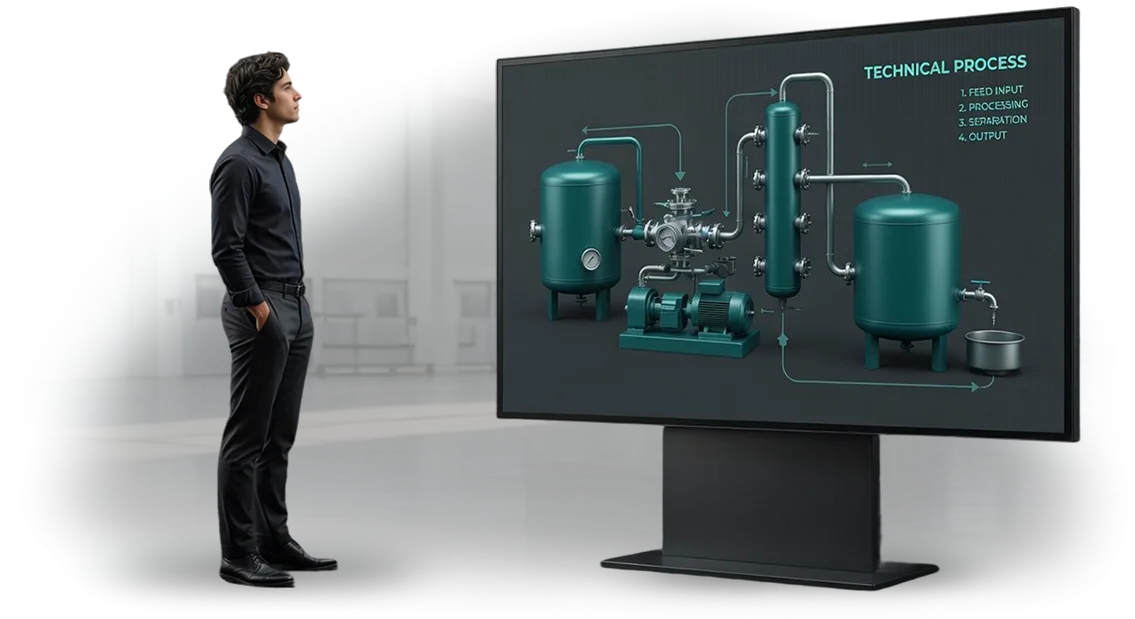
Why training without the X-ray effect doesn't deliver results
When an employee watches a standard video instruction, they see only a flat picture, not the essence of the process. Equipment, mechanisms, and work algorithms remain a "black box" — and the new person has to guess, try, and make mistakes.
This is exactly what ineffective videos look like: they waste time but don't provide understanding, and employee training drags on for weeks.
This leads to higher staff turnover: the employee doesn't feel confident, makes mistakes, receives criticism, and leaves. The company searches again, trains again, and loses money again.
The problem isn't the people but the format — ordinary instructions don't show the internal logic of processes and therefore don't answer the new hire's main question: "how does this actually work?"
The X-ray effect closes this gap. The video instruction becomes transparent: the employee sees what happens inside the mechanism, how parts move, where the leverage point is, and what will happen if they do it wrong.
Such visual instructions are understood without additional training — information is absorbed instantly and remembered for a long time.
We've been solving exactly these training problems for several years now using corporate videos with 3D animation. Our clients reduce time-to-competence and lower error rates because new employees stop "learning the hard way" and start working correctly right away.
What CGI training gives you: benefits for your company
Employees skim through ordinary instructions and presentations, and forget them within a week. Training on real equipment is expensive and takes people away from work. CGI videos with the X-ray effect solve both problems: they are visual, short, and equally clear to everyone.
We develop corporate video instructions that employees watch to the end and apply on the job from the first try. Here's what this gives your company:
- Faster training. An employee understands the process in 5–7 minutes instead of an hour-long lecture. Onboarding is quicker, and new hires start working sooner.
- Uniform service standards. Everyone follows one reference sequence of actions. No more "however they're used to" variation — only a proven scenario.
- Fewer errors. The X-ray effect shows the internal structure and hidden components — the employee sees what would happen if they make a wrong move. Errors decrease, and quality becomes more consistent.
- Skills development. Even experienced employees find new details in the videos. Regular course updates keep the team's level high without interrupting production.
After each video, you can reinforce the material with a short quiz or checklist. This way you see real progress, not just a "viewed" checkbox. Training becomes a manageable process that delivers measurable results — less waste, higher speed, and satisfied employees.
Video instruction formats with the X-ray effect for business tasks
The same process can be shown in different ways — and how quickly an employee masters it directly depends on that.
A regular video sequence shows what to do with your hands but doesn't explain what happens inside: why a part must fit exactly this way, how an order status changes, what happens in the system when a button is pressed.
The X-ray effect removes this "blind spot" — it makes the internal logic visible. Combined with other formats, it covers everything from initial onboarding to practicing rare emergency scenarios.
We've prepared a table so you can match a format to your typical situation.
| Format | For whom | What it gives the client |
|---|---|---|
| Classic video lesson with 3D animation | New employees, mass hiring | Fast immersion in procedures without a long introductory course |
| Interactive video with choices | Specialists at remote sites | Knowledge checks right inside the video, no separate test needed |
| X-ray effect for hidden processes | Maintenance teams, IT administrators | Shows the internal structure and helps avoid typical mistakes |
| "Schematic breakdown" style | Managers and adjacent teams | Explains the process logic to colleagues without requiring technical knowledge |
Whatever you choose, you'll get a video that's clear on the first viewing. We adapt each format to your corporate style so the video fits easily into your existing training system — including through standard LMS modules.
The X-ray effect here isn't just decoration but a tool that cuts instruction time and error rates: employees see not "do it this way" but "why this way and what happens if you do otherwise."
If you're not sure which format fits your task, describe the process you need to show, and we'll propose a turnkey scenario.
How we work: stages of creating your video instruction
Creating a video instruction is a process where you remain the main participant, not an outside observer. We've broken the work down into five transparent stages: from the first brief to the launch of the finished program.
At every step, you get an intermediate result, understand the timeline and cost — no surprises and no hidden add-ons.
-
Brief and task immersion. We start by talking about your audience, complex operations, and training goals.
You leave a short call with a clear understanding of how the X-ray effect will help employees see internal processes faster, while we gather the full picture for the future video.
-
Plan, estimate, and timeline. We propose a concept, storyboard, and presentation options for the videos. We lock in the exact development cost and a schedule for each stage — you know the budget and delivery date in advance, and we're responsible for meeting them.
-
Script approval. We hand over the text and a description of the visual sequence. You make edits at the document level rather than after the animation is complete — this saves your time and guarantees the final video matches your expectations and corporate style.
-
Production with quality control. We create 3D visualization in the X-ray-effect style and show intermediate versions.
We check every frame against the script, action logic, and brand style, while you watch the video "come to life" and get the chance to influence details in time.
-
Launch and support. We deliver the finished video in the required format and help integrate it into your training system.
After launch, we stay in touch: if you need to update the instruction, change the emphasis, or add new steps, we'll do it quickly — without "re-selling" the project from scratch.
This workflow gives you control and confidence: you always know what's happening, how much it costs, and when it will be ready. And the result is a video instruction your employees will truly understand and remember.
What's included in the delivery: a complete training package
Work on an educational video proceeds in stages: from defining the task to the final version. Each stage ends with approval — you receive intermediate materials and see how the project is moving toward the goal. This rules out situations where the result appears on the last day and doesn't match expectations.
The final delivery isn't just a video file but a package that fully covers the training task. You get:
- Finished videos in several formats: for your learning management system, for messengers, and for display on internal screens. No need to recode or adapt anything.
- A script and shot-by-shot plan — if procedures change, you can easily update the material without reshooting from scratch.
- Voiceover and subtitles: the video is clear in any workplace, even if an employee watches without headphones.
- Source 3D scenes and animation elements — you get usage rights and the ability to edit. This means the project remains your asset, not a rental from a contractor.
- An implementation guide: recommendations on where to place the video and how to verify that employees have absorbed the material.
- Usage rights without restrictions on time, territory, or number of employees — including for future updates of the instruction.
This package lets you launch training immediately after project delivery and quickly adapt the material to new tasks if needed. You pay once, and then use the video as an ongoing tool.
Case study: 40% training efficiency improvement
We developed a series of training videos for a large manufacturing holding company. The problem was typical: new hires spent up to two weeks studying instructions and diagrams, and assembly errors led to defects and lost time.
Instead of flat drawings and text procedures, we created CGI videos with the X-ray effect — the animation shows the internal structure of components and mechanisms "in cross-section." The employee literally sees what happens inside the machine and remembers the sequence of actions many times faster.
Implementation results
Three months after the training launch, measurements showed significant changes. Below are the key metrics before and after.
| Metric | Before | After | Effect |
|---|---|---|---|
| Course completion speed | 5 days | 3 days | 40% less time |
| Assembly errors | 12% | 7% | 1.7x reduction in defects |
| Time to independent work | 4 weeks | 2.5 weeks | 40% faster onboarding |
The head of the training center noted: "Previously, new hires kept asking mentors questions over and over; now the video clearly shows all the nuances." Retesting six months later confirmed a lasting result — errors and training time remained at a low level.
This case is a typical example of how CGI training pays for itself through reduced onboarding time, fewer defects, and higher productivity. We're ready to deliver the same result at your company — start with a pilot project to measure the impact on real data.
Frequently asked questions and concerns: answers before you start
Before launching educational video instructions, most clients have the same doubts: will the video become outdated in a year, how quickly can edits be made, and who keeps track of relevance in the first place.
These are normal questions — the answers determine whether the video will keep delivering value for a long time or end up as an archive on a shelf.
We hear them from every other client, so we answer right away, before the project starts. Our approach is not "make it and forget it" but support throughout the entire lifecycle: from script to regular updates. Below are answers to the most common objections.
What will happen to the video in a year — won't it become outdated?
We structure the script so the core story remains relevant, while changes — for example, a new button or a different step order — are made surgically. Typical edits don't require a full reshoot; a single segment can simply be replaced. This takes days, not months.
How do we make edits after launch?
You send us a list of changes; we make them and return an updated version. Edits come in two types: small ones — replacing text, highlighting an element — and larger ones, such as adding a new process.
Either way, you get a clear procedure: how to submit a request, how long it will take, and what's included in the cost.
Who is responsible for content staying up to date?
We are — the contract includes a support period. We assign a contact person and agree on a review frequency. If your company's processes change a few months from now, you simply write to us and we update the video.
Regular maintenance is also available under an annual subscription — audits and timely edits without any effort on your side.
Order your educational video instruction today
You already know what training videos with the X-ray effect look like: the equipment is "seen through," and the employee views its internal structure as if holding it in their hands.
This format speeds up onboarding and reduces errors — and ordering a video instruction for your task is easier than it seems.
Right after you reach out, you'll get:
- A consultation on creating the video: we'll discuss where the X-ray effect will strengthen the training and which segment is better shown with regular 3D animation.
- A cost estimate for your scenario — with a fixed budget before the start and no hidden add-ons.
- A demo video with the X-ray effect on your material — you'll see the future training format even before signing the contract.
- A clear production plan: script, voiceover, 3D scenes, editing — with dates and checkpoints so you can control the process.
- Implementation recommendations: where to place the video instructions and how to measure their impact on training speed and error rates.
All we need from you is the materials and a rough scenario. We'll take care of the rest: prepare the demo, finalize the details, and move on to full video production. You'll get not an abstract promise but a working tool that employees will understand at first viewing.
How to choose the right format for your task?
There's no one-size-fits-all training format: what works for onboarding new hires won't work for practicing complex production processes.
That's why we first determine what the video is meant to solve — fast onboarding, upskilling, emergency-response practice, or demonstrating how equipment works.
The style also depends on this: from minimalist diagrams to realistic 3D animation with the X-ray effect, which lets you show the internal structure of components and mechanisms.
Each industry has its own familiar scenarios and pain points.
Manufacturing needs clarity for assembly and repair; logistics needs clear sorting and packaging algorithms; healthcare needs careful instructions for working with equipment; and retail needs quick training cards for staff.
We've built a library of solutions across different fields, so we offer not abstract templates but a format that has already proven itself in similar conditions.
What also matters is how employees will watch the material: on a tablet on the workshop floor, on a computer in a training room, or on a smartphone on the go. Runtime, level of detail, and even the density of supporting text are adjusted accordingly.
Our experience shows that the same topic can be presented in completely different ways — and we let clients compare options before approving the final style.
So we suggest starting with a short brief: tell us who needs to be trained and on what, and we'll show you 2–3 suitable formats with examples and explanations of why they'll work in your specific situation. This first step helps us scope the work accurately.
You'll quickly get oriented, see the difference in presentation, and decide which option suits your team best. Leave a request or give us a call — we'll find the optimal solution for your task and budget.