

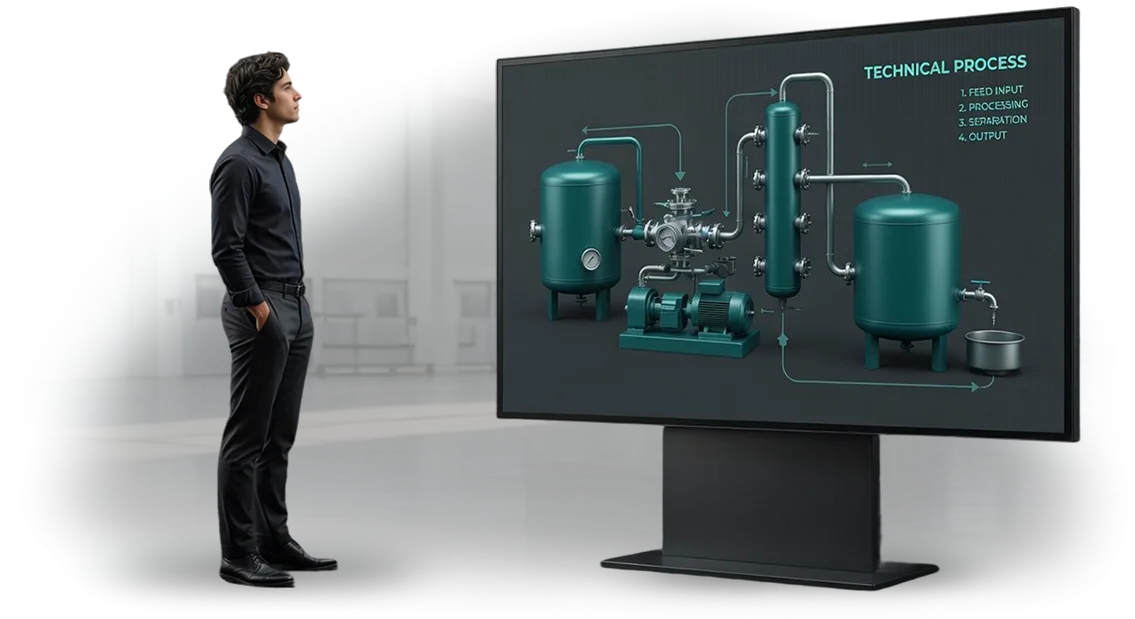
Employees Don't Read Instructions: Low-Polygon Graphics to the Rescue
Employees don't read long text instructions — a fact that costs businesses mistakes, fines, and wasted time. Even the most detailed manual remains unclear when it has to be studied page by page and diagram by diagram.
Staff training turns into a formality: everyone "listened," but in practice they keep working the old way because they didn't remember the key points.
An alternative that genuinely engages is video instructions for employees in low-polygon style. Simple 3D graphics show the process step by step, without unnecessary details and visual noise.
This format holds attention, looks modern, and is easy to remember: the employee sees a concrete action, not abstract text. Training engagement grows because watching a short video is easier than working through a multi-page document.
That's why we create training CGI videos with 3D animation in low-polygon style. Bright geometric characters and clear scenes explain any task — from working with equipment to service standards.
This addresses the client's main pain point: employees actually watch, understand, and apply what they've learned.
What Will You Get from Implementing Video Instructions?
Fast Onboarding
New employees start working from day one instead of learning for weeks. Short video instructions with clear 3D graphics replace multi-hour lectures and thick manuals: a newcomer watches the video, repeats the actions, and immediately joins the workflow.
For the company, this reduces adaptation time by 30–50%. The manager spends fewer resources on mentoring, and the employee reaches planned productivity faster. Our team structure videos so that every step is clear without additional explanations.
Fewer Employee Errors
Most errors happen not because of carelessness but because of ambiguous instructions. Videos show the correct sequence of actions from different angles, so the employee sees every nuance and doesn't guess "how it should be done."
As a result, the defect rate drops, rework and customer complaints decrease. This is especially important in manufacturing, logistics, and service industries, where the cost of an error is high — from a spoiled batch to a conflict with a client.
A Unified Training Standard
When training happens through video, all employees receive the same knowledge — regardless of the mentor's experience or location. You no longer depend on "verbal knowledge transfer," where everyone explains things differently.
Unified standards make business scaling easier: opened a new location — launched training with the same videos. Operation quality becomes predictable, and control becomes transparent.
Higher Engagement
Monotonous slides and texts are tiring, while quality animation holds attention. Low-polygon graphics look stylish and modern without overloading with details — employees see training not as a boring obligation but as a useful and interesting format.
Higher engagement means better material retention. Employees are more willing to review instructions before complex tasks, which means knowledge gets applied in practice instead of being forgotten within a week.
Training Video Formats in Low-Polygon Graphics
The video format directly affects how quickly an employee masters the material and how long they retain the skill. In low-polygon graphics, stylized imagery removes visual noise — the newcomer's attention is focused on the action, not on interface details.
That's why we match each training task with its own format: from full immersion in the process to practicing a skill in a safe environment.
Three Formats for Different Tasks
| Format | Audience | What It Gives the Business |
|---|---|---|
| Full course, 5–7 minutes | New employees, complex multi-stage operations | Fast time-to-productivity: material is absorbed in one viewing, mentor load is reduced. |
| Short modules, 1–2 minutes | Current employees, retraining, policy reminders | The module fits easily into the workday — the employee refreshes the skill without leaving their tasks; errors decrease. |
| Interactive simulations | Work with risks, expensive equipment, rare scenarios | Safe skill practice: the employee trains without consequences, and the chance of an error on a real site drops. |
Businesses often use a combination of formats: short modules for regular repetition, a full course for onboarding, simulations for controlling complex areas. This way training covers all stages — from an employee's first day to certification.
We'll help you build a lineup of videos for your specific needs and advise on where to start to get results from the first month.
How Turnkey Video Instruction Development Works
We've structured the process so you control every step and understand what's happening with your budget and timeline.
No "black box": you always know what you'll get at the end, and we handle production — from the brief to the finished video and its performance evaluation.
-
Brief and task analysis. We start with a short interview with you and future viewers. We define which operation the employee must master, where errors most often occur, and in what format the team finds it easiest to learn.
-
Script and storyboard. We turn the instruction into a clear script: steps, emphasis, pauses for memorization. We describe each scene with words and simple images — you see the future video before animation even starts.
-
Script approval. We discuss the text and logic: we remove the unnecessary and add important details from your practice. We approve the final version — only then do we start producing 3D animation in low-polygon style.
-
Production. We create characters, objects, and environments and bring every instruction step to life. At this stage you receive interim versions of key scenes and see what the future video looks like — no surprises at the end.
-
Voiceover and editing. We record a narrator's voice or use your own speaker, add subtitles, accents, and the final cut. We deliver the finished video in the formats you need — for LMS, video hosting, or an internal portal.
-
Launch and support. We help embed the video into your training system and briefly brief the team. After a month we collect feedback and analytics: how many people watched to the end, which steps caused difficulties, and what might need to be reshot or expanded.
This approach is already used by companies from different industries — for example, equipment distributor TechTrade reduced new employee onboarding time by 30% thanks to a series of short video instructions. We stay with the project after launch, so you're never left alone with the result.
What's Included in the Video Instructions Delivery Package
You get not just finished videos but a complete package for launching training and future use. Everything we deliver is specified in the contract — this covers reporting requirements and removes risks associated with copyright.
- Finished video instructions in formats suitable for your learning management system, internal portal, and messengers. The videos can be used immediately after acceptance, without additional transcoding.
- Animation source files — 3D scene and layer projects. You can make targeted edits with your own team or order updates from us without paying for development from scratch again.
- Methodological materials: script, timing, and key messages for each video. This is convenient for content review, expert approval, and adapting training to different roles.
- Video content rights — full transfer of usage rights. You can freely publish the videos inside the company, on external resources, and repurpose them without further approvals from us.
- Closing documents for accounting and the work acceptance certificate. No unexpected costs or hidden conditions — only transparent project delivery.
- Warranty support: within the agreed period, we make small edits for free — changing a logo, contacts, or job title on screen without affecting the essence of the training.
This package saves your team time: no need to look for freelancers for minor tweaks or reshoot a video because a phone number changed.
Most importantly, you get an asset that stays with you forever and keeps working toward knowledge standardization even after the project is closed. We'll discuss the remaining package details at a preliminary meeting and document them in the contract.
Case Study: How a Company Simplified Staff Training
A manufacturing company with several workshops and high staff turnover took up to two weeks to onboard new hires. Mentors were constantly distracted by explaining the same operations, and employees still made mistakes because of inconsistent instructions.
The company approached us with a request: make training fast, clear, and independent of any particular mentor's experience.
Solution: Low-Polygon Videos Instead of Text Manuals
We developed a series of training video instructions in low-polygon style. This format deliberately simplifies details and focuses attention on the sequence of actions — the employee sees not a blueprint but a clear algorithm.
The videos were uploaded to the corporate system and became available on any device: smartphone, tablet, or computer.
Training Results: Numbers and Client Feedback
The effect was felt within the first quarter. Onboarding time dropped by 40% — from fourteen days to eight. Errors among new employees in the first month fell by a third, and mentors returned to their core tasks instead of endless repetition. The implementation case showed that video instructions work even under conditions of high turnover.
The production manager who ordered the project highlighted the key point: "Training used to depend on the mentor's personality; now all newcomers have the same foundation.
The low-polygon videos turned out to be understandable even for those who had never worked with equipment." After the first results, the company ordered a second series of instructions for other areas — the best proof of the video instructions' effectiveness.
If your business faces the same challenges, we can design a similar system for your processes. We'll explain how it would look for your operations and show video examples during a consultation.
How to Choose the Right Video Instruction Format for Your Task?
To choose the right training video format, it's worth evaluating four parameters: headcount, operation complexity, budget, and update frequency.
They determine which option will bring the most value to the business instead of becoming an expensive video that goes stale in a month.
Start with the number of employees who need to be trained. For a large team, modular videos work better: they can be completed at a comfortable pace, revisited for tricky episodes, and don't require pulling everyone away from work at the same time. For a small group, a single video that fits into a team meeting or briefing is sufficient.
The second criterion is operation complexity. The more steps and non-standard situations, the more detailed the presentation needs to be. 3D animation wins here: it can show internal structure, hidden components, and correct movements that can't be captured on camera.
Low-polygon graphics is especially convenient in this regard: it simplifies perception, focusing on the essence rather than unnecessary details.
The third factor is budget — but look at it not as a one-time expense but as an investment in reducing errors and speeding up time-to-competence for newcomers.
A quality CGI video pays for itself through a long service life: it gets watched hundreds of times without losing quality. If savings are needed, you can choose a format with limited animation or focus on key scenes.
And finally, think about how often instructions change. For frequently updated processes, flexibility is key: break content into short blocks so only the changed part needs replacing.
For stable procedures, a full-length video instruction that won't need to be touched for years is a good fit.
The conclusion is simple: the right format is one that accounts for scale, complexity, budget, and relevance. If you're unsure, come to a brief — we'll help you choose a format and calculate the cost. No overpaying for unnecessary options — only what actually solves your problem.
Frequently Asked Questions About Implementation and Guarantees
Developing training video instructions is a process that always raises questions for the client. When it comes to implementing them into employee training, predictability and confidence matter: will deadlines slip, will videos go stale, who's responsible for the result. We answer the main concerns — briefly and to the point.
How long does video course development take?
Timelines depend on the scope and complexity of the script. But you always know them before we start: we document the stage plan in the contract and stick to it. Typically, one video takes two to four weeks — with full approval at every step.
Is it hard to integrate the videos into our training system?
No. We deliver finished files in a standard format accepted by any learning platform. Your employees just press "play" — no additional setup from IT is required.
What if rules change and videos go stale?
That's why we build videos from separate modules: you can replace only the needed fragment instead of reshooting the entire video. If you come to us for an update, it will be faster and cheaper than creating new material.
What quality and refund guarantees do you provide?
We guarantee that the result will match the approved script. If you spot discrepancies after final approval, we'll fix them at our expense. And if it becomes clear during the process that we can't complete the task, we'll return your prepayment.
Order Video Instruction Development and Get Results
Clear video instructions save training time and reduce errors — employees master processes faster and bother mentors less. Low-polygon videos hold attention and explain even complex procedures in simple language. We make such videos turnkey: from script to final edit.
To order video instructions, you don't need to understand production. Describe your task — our expert will suggest the optimal format and runtime, and within one business day you'll receive a cost estimate for developing the training video. This doesn't obligate you in any way.
What you get when you order:
- Expert consultation: we clarify goals and audience and choose a style that suits your employees.
- Transparent pricing for training video development: we fix the estimate before starting, with no hidden fees.
- A concrete plan and deadline: you know when you'll receive the finished video and what happens at each stage.
- Full production cycle: script, voiceover, 3D animation in low-polygon style, editing, and subtitles.
- A finished video in all required formats: for the internal portal, messengers, and in-person training.
- Post-delivery support: we'll refine the video based on feedback if you want changes.
Leave a consultation request — we'll call back at a convenient time, answer your questions, and prepare an individual proposal. You can order video instructions today: just fill out the form on the website, and by tomorrow you'll know the exact cost and timeline.