

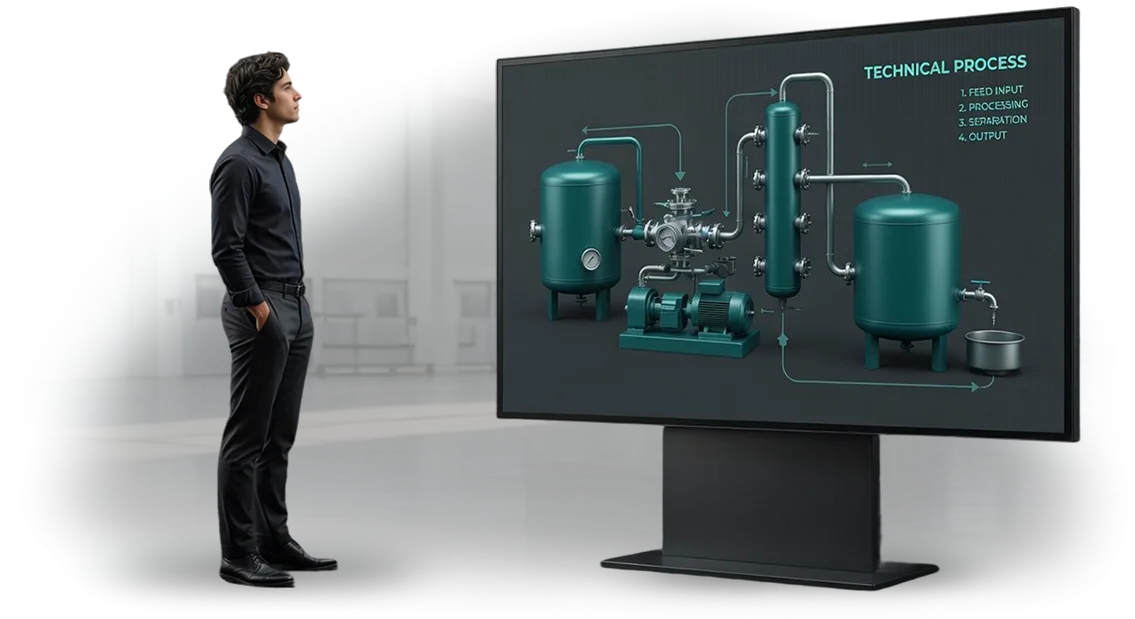
Why employees don't remember instructions
Instructions are written, regulations are approved, staff training has been conducted — yet in practice, employees repeat the same mistakes over and over again.
The reason is not people's inattention or the quality of the text: slides and PDFs describe a process in words, while the brain remembers an action when it sees it.
The more complex the equipment and the less experience an employee has, the higher the cost of misunderstanding — ruined material, a missed deadline, a repeat visit by a specialist.
This is especially noticeable where the process is hidden from view: inside a machine, a chamber, a pipeline, a housing.
Words can't show this, and a drawn diagram doesn't answer the employee's main question — "what will I see at this moment and what should I do next." This is where endoscopic visualization comes in: we show the path from the inside, through the operator's own eyes, and training video instructions turn into a clear route with distinct decision points.
When an employee sees the process from the inside, material retention grows without pressure or repeat training sessions.
They recognize the situation on a real site because they have already "been through" it on screen — and they act more confidently on their very first working day.
Employee mistakes go away not because they were punished for a violation, but because the person understands the logic of the process rather than memorizing a sequence of steps.
For a department manager, this is a direct saving of mentors' time and a reduction of losses from defects. A new employee reaches independent work faster, and experienced specialists are distracted less often by explanations.
We take care of this task: we create training video instructions that employees actually watch to the end and apply in practice.
What endoscopic visualization provides in training
An employee who "just presses buttons according to the instructions" breaks down at the very first non-standard case. They don't understand why the sequence is exactly this way and what will happen inside if a step is skipped.
Endoscopic visualization removes this problem: instead of a diagram on a slide, a person sees internal processes as they actually occur — from the inside, in motion, with cause-and-effect relationships.
When a specialist observes how the flow moves through internal channels and what changes at each section, training stops being rote memorization.
Visual learning delivers understanding of the technology: the employee explains on their own why an action leads to a result, rather than reproducing a sequence from memory. This is the level at which an instruction turns into professional judgment.
For a department head, this is direct economics. Understanding of the technology directly reduces errors: fewer repeat operations, less downtime due to incorrect actions, a shorter period for a new employee to reach independent work.
Having once invested in visual material, you reuse it in onboarding, professional development, and internal standards — without re-shooting for every change in the regulations.
A separate value is a unified standard. When everyone sees the same internal processes in the same presentation, discrepancies between shifts and branches disappear.
A new person gets the same picture as an experienced colleague and fits into the overall quality level from the first days.
Training video formats for your task
The format of a video determines not "beauty," but how quickly an employee reaches the required level and how many times they return to the instruction.
That is why we first break down the task: whom we are teaching, what skill we are testing at the output, and in what conditions the person will watch the material — at the line, in the workshop, or at the workstation. This determines the length, the delivery, and the depth of immersion.
Below are the working scenarios that clients most often come to us with. The same product or process can be covered both by a short module and by a full-fledged course — we discuss the choice of format before the start so you don't overpay for extra minutes.
| Format | For whom | What it gives the client |
|---|---|---|
| Short module | Line personnel, shifts, newcomers | Quick onboarding into the role, fewer mistakes in the first weeks |
| Series of modules | An entire department, standard operations | Modular learning: you can retrain in a targeted way when changes occur |
| Video with endoscopic visualization | Engineers, service, technical specialists | Shows internal processes and components where a camera cannot reach |
| Full course for employees | Complex specialties, long onboarding | A single knowledge standard, less load on mentors |
| Safety instruction | Everyone working at the site | Clear actions in an emergency, lower risk of injuries |
How to choose a format
Look at two questions: how much a person needs to remember in a single viewing, and how often the material will change. If the skill is simple and updates are rare, a short module is enough.
If it is about the internal structure of equipment, where endoscopic visualization is needed, the video removes the main pain point: the employee sees the process from the inside rather than reading a description.
We assemble formats into a single learning loop — short videos for review, a course for employees for deep immersion. This way the material works both for a newcomer and for an experienced specialist, and you don't have to order everything anew every time a process changes.
How the project runs: from brief to implementation
The process is structured so that you approve the result at clear stages, rather than getting involved in production. Each step ends with a document or decision that can be shown to colleagues and management.
- Brief and learning objectives. We discuss the task: who we are training, which employee mistakes need to be eliminated, and how we will know that the training worked. The output is a short document with objectives and acceptance criteria.
- Script and storyboard. We write the text and the sequence of shots, including endoscopic visualization where the process needs to be shown from the inside. You approve the script before production begins — revisions at this stage are free in substance and inexpensive in time.
- Approval with the instructional designer and expert. We check terminology and logic with your internal expert. This removes the risk that the video is technically polished but teaches the wrong thing.
- Production: filming and 3D animation. We assemble scenes, animation, and voiceover using professional equipment. You receive intermediate versions, not a "surprise" at the end.
- Acceptance and revisions. We show the finished video and make revisions according to pre-agreed criteria. We lock in the final version and hand over the source files.
- Implementation in training. We help place the materials in your learning system, cut short versions for different roles, and prepare accompanying assignments.
- Course support. After launch, we monitor how employees progress through the material and update the videos when processes or equipment change.
This order saves your time: you get involved at three or four points where your decision is truly needed, rather than at every iteration. Describe the task — we will come back with a timeline estimate and a stage-by-stage plan.
What is included in the delivery
The client receives not "animation files," but a ready-to-use training kit that can be put to work immediately: videos, scripts, methodological materials, and usage rights.
Below is exactly what will be included in the delivery and how each element helps train employees faster.
- Ready-made training videos — edited videos with 3D animation in the style of endoscopic visualization: processes are shown from the inside, without filming expensive equipment and without risk to real samples.
- Training scripts — written out step by step: what the employee should understand, at what moment, which actions to reinforce. Ready for edits to fit your regulations.
- Subtitles and voice-over text — the employee absorbs the material both by ear and by eye, including in a noisy workshop or when watching without sound.
- Versions for mobile and for display on a large screen — a single video works both in headphones on a shift and during group training in a hall.
- Methodological materials — brief reference guides and check questions, so that training ends with an assessment, not just viewing.
- Usage rights — the materials remain yours: show them to new employees, place them in your internal system, update them as processes change.
Separately, we hand over the source files and a clear storage structure — if equipment or regulations change, the video can be revised rather than ordered anew.
Such a kit covers the entire cycle: from the first showing to skill reinforcement, and does not require your team to understand video production.
How to choose a format for the task?
Start with the question "what should the employee learn after watching" — it almost always determines the format on its own.
If you need to understand how complex equipment is structured or show a process that isn't visible to the eye in reality, 3D visualization wins: it breaks the mechanism down into understandable layers and guides the viewer step by step.
If the task is to practice an action hands-on, we add interactive scenes with choices and feedback. When it's more important to quickly and uniformly communicate a regulation to hundreds of people, a short linear video with a clear structure is enough. The format is chosen for the result, not the other way around.
Specific requirements aren't a reason to complicate everything. We break the task into parts and look at where detailed visualization is truly needed and where a simple solution will do. This way the course stays understandable for the employee and doesn't get bloated in volume.
We adapt the same material for different roles: basic steps for a newcomer, subtleties and common mistakes for an experienced employee. One storyline works for several audiences and doesn't require re-shooting for each department.
The training budget is not just production, but also the time employees spend away from work.
That's why we show in advance what the estimate is made up of and where you can save without losing meaning: shorten the length, reuse ready-made scenes, assemble a module from what's already been filmed. You see what you're paying for and can set priorities.
The selection criteria are simple: what skill are we testing, how many people are we training, how often will the material be updated. Answer these three questions — and the format will determine itself.
If you're unsure, describe the task: we'll come back with an assessment and a plan, and propose an option for your case.
Result: training implementation case study
A manufacturing company with several sites came to us with a typical pain point: new hires take too long to reach independent work, while experienced employees make mistakes in operations that rarely repeat during a real shift.
Text-based regulations and live briefings did not help — people could not remember the sequence of actions because they never saw the process from the inside.
We proposed a format of educational CGI videos with endoscopic visualization: the camera literally "enters" the equipment and shows what happens at each step.
This approach removes the main problem of classic training — the gap between the diagram on paper and the real picture inside the unit.
What changed after implementation
Before launching the course, the company tracked how much time a new hire spends under a mentor's supervision and how often errors occur during maintenance. Afterward, they compared the same training metrics across three sites.
- The onboarding period for new hires was cut almost in half: employees reached independent work noticeably sooner.
- The number of errors when performing rare operations decreased — employees stopped "guessing" the sequence.
- Mentors freed up time: instead of repeated explanations, they referred to a short video.
- The material is reused with every new hiring wave — without re-shooting and repeat site visits.
We should separately note an effect the client had not included in the original brief: the videos began to be used when reviewing incidents.
Instead of long arguments about "how it actually happened," the team opens the relevant fragment and sees the process from the inside — this accelerated both training and internal reviews.
Client confirmed the result with a repeat order: first we made a course for one type of equipment, then expanded the line to the remaining areas. For us this is the main indicator — when training solves the task so well that it is scaled across the entire production.
Common customer concerns
Doubts before placing an order are a normal part of the decision. Below we address the ones that come up most often: they concern not "how it's made," but "what will happen to our training going forward."
What if the equipment or the procedure changes?
We build the video from the start so it can be updated in parts: scenes, captions, and voiceover text live separately from one another.
When the equipment model or the sequence of actions changes, we redo the relevant fragment rather than shooting everything again — the timeline and labor costs for updating the course drop severalfold.
The customer gets a library that lives for years rather than becoming outdated after a single revision of the instructions.
Will employees even watch this?
The main risk in training isn't the technology — it's the audience's indifference. That's why we build the script around real workplace situations an employee faces, not around a formal instruction: we show the consequences of a mistake and the correct sequence of actions.
Endoscopic visualization here works toward engagement — a person sees the process from the inside rather than reading a paragraph in small print, and stays attentive until the end of the video.
What if something breaks or won't start on site?
Technical failures in training are almost always related not to the video itself, but to how it's delivered to the employee.
We provide materials in formats that open on any work device and in the company's learning system, and we check playback in advance on typical configurations.
If you have your own portal or internal system, we'll embed the video there so the employee doesn't have to search for a file but simply opens the course.
Who is responsible for the result after delivery?
After launch, we stay in touch: we answer questions about the materials, help with edits when processes change, and advise on how to integrate the videos into onboarding and professional development programs.
It matters to us that the training actually reduces the number of errors and the time it takes a newcomer to reach independent work, rather than just sitting on a disk.
If you have a concern that isn't on the list, raise it at the start. An honest review of risks before work begins is cheaper than redoing the course after launch.
Let's discuss your training challenge
Describe the task — what process needs to be explained to employees, how many people are being trained, and where they most often make mistakes.
We'll come back with an assessment and a plan: we'll break down the scenario, propose a delivery format, and show you what the finished module will look like. No generic words — only specifics for your situation.
What you get after reaching out
- Task breakdown and training plan — which topics we cover, in what order, and what result we're aiming for.
- Project estimate — timelines, scope of work, and team composition for your budget and schedule.
- Pilot module — one short video so you can see the style and quality before scaling up.
- Script and storyboard — we align on the delivery logic before production starts.
- Support at every stage — from the first brief to integration into your learning system.
- Edits and revisions — we make changes along the way until the result fully meets your needs.
Why this works
Endoscopic visualization lets you show internal processes as if the employee were seeing them with their own eyes — without expensive equipment and without health risks.
This format is especially valuable where a mistake is costly: medicine, industry, complex technical maintenance.
We work with professional equipment and well-tuned tools — the client gets consistent results and predictable timelines. Over years of practice, we've built dozens of training modules for teams of various sizes, and most clients come back with new challenges.
How to get started
Tell us which process needs to be explained and by what deadline. We'll study the materials, ask clarifying questions, and come back with a training plan, a project estimate, and a proposal for a pilot module. After that — the decision is entirely yours.
To order video instructions, it's enough to describe the task in two or three sentences. We'll discuss the project, show examples, and propose the optimal delivery format for your goals.