

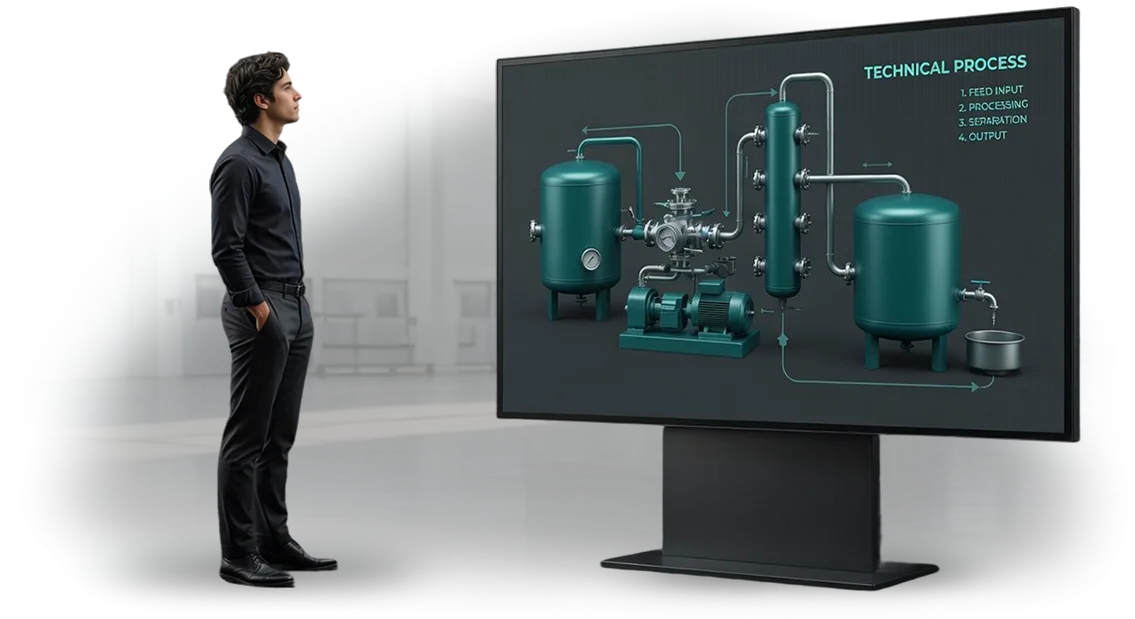
Corporate Video Instructions: The Power of Stylized Animation
Employees do not finish reading long text-based regulations—a familiar pain point for any manager.
A 20-page instruction manual goes unread, and the same mistakes keep happening on the shop floor: equipment breaks down, processes slow down, and everything has to be explained again from scratch.
Even a detailed document does not guarantee that the staff actually absorbed the procedure and remembered it.
Training video instructions in the form of stylized animation solve this problem. Short videos with clear visual cues hold attention, explain complex topics in simple terms, and do not require the employee to make an effort to read.
Animation can show the entire process—from equipment startup to an emergency situation—in a way that is impossible in text or live-action footage.
Corporate training becomes faster and more effective: a new employee masters the material in minutes instead of hours, and replaying a video takes less time than searching for the right section in a manual.
Employee engagement grows because animation is easier to digest and meets less resistance than a formal document. Staff training stops being a formality—it becomes a clear and memorable process.
Stylized animation not only simplifies comprehension but also creates a single work standard: all employees see the exact same algorithm, with no discrepancies or personal interpretations.
This reduces the number of errors, speeds up onboarding for new hires, and saves mentors' time. We create such video instructions for your business needs—from production processes to safety regulations—so that training delivers measurable results.
Benefits of Stylized Animation for Business
Stylized animation is not just a way to decorate training; it is a working tool that directly affects the speed and quality of employee preparation.
Corporate video instructions in this format are perceived as modern and accessible content, rather than a boring manual everyone keeps putting off.
Material retention is the main advantage. People remember up to 80% of what they see, especially when complex processes are presented through vivid images and metaphors. Stylization simplifies production diagrams, removes unnecessary noise, and focuses attention on what matters.
After watching, an employee can reproduce the step-by-step procedure even weeks later—without going back to the manual.
Engagement grows through an emotional connection. Characters, narrative, and dynamics hold attention until the end of the video, whereas a typical presentation loses the viewer by the second minute.
When an employee is interested, they do not just watch the video—they consciously absorb the information. The result: fewer questions on the job and more confidence in their actions.
A uniform training standard is another important business benefit. A stylized video fixes the correct sequence of actions and eliminates discrepancies between mentors and branches.
All new employees receive the same reference scenario, which is especially critical for processes with high safety or quality requirements.
Clear visualization helps show what cannot be seen in reality: the internal structure of equipment, hidden mechanisms, or complex interactions between departments. Stylized animation makes the abstract concrete and makes dangerous operations safe to demonstrate. Training becomes accessible even to beginners without special preparation.
Finally, onboarding of new employees is faster. Instead of a long immersion in text-heavy manuals, a person receives a short visual video that brings them up to speed in 5–10 minutes. The load on mentors decreases, and the new hire starts contributing to the company sooner.
In the end, stylized animation pays off through increased productivity, fewer errors, and more systematic training within the organization.
Formats of Training Video Instructions for Your Business Task
Some tasks are covered by a short video instruction; others require an interactive scenario. The right format determines how quickly an employee starts applying the knowledge and how firmly it sticks. Below are typical scenarios and suitable formats.
| Format | For whom | What it gives the client |
|---|---|---|
| Video instruction | New employees, mass workforce | Quick introduction to standards without interrupting work tasks |
| Animated video | Complex processes, hidden mechanisms | Visibility of internal structure, fewer errors |
| Interactive video | Critical skills, comprehension checks | Engagement and knowledge verification right in the viewing process |
| Training course | Long program, regular updates | Structured training with progress tracking |
We choose the format for each specific task: compact video instructions for fast onboarding, animated videos for hazardous production, interactive scenarios for knowledge testing. This reduces training time and increases its effectiveness.
If you are not sure where to start, we will send you a short questionnaire about your audience and, within one business day, propose the optimal format for your business goals.
How an Educational Video Is Developed: Project Stages
The technical specification is the foundation on which the entire project is built. We start with a brief where you describe the training objective, and we refine the details: who your audience is, what actions need to be explained, and what style should be used.
After that, you receive a script and storyboard—you can review them before production begins, so any edits are made without wasting time or budget.
Once the script is approved, we move to production—modeling, animation, and voiceover. At this stage, you receive intermediate versions for review, employees are not distracted from work, and the training process starts as soon as the video is ready. As a result, you get a video that explains complex operations quickly and consistently.
- Brief and technical specification — you describe the task, we create a plan and timeline. We set goals, audience, and success criteria.
- Script development — your scriptwriter or ours writes text that explains the steps in clear language. Approval is done in a format convenient for you.
- Storyboard and style — we show what each frame will look like, along with examples of stylized animation. You see the material presentation in advance.
- Video production — we refine the animation, add graphics and voiceover. At key milestones, we send previews for review.
- Final version — we make the last edits and deliver the finished file in the required formats and resolutions. This usually takes no more than a week.
- Training launch — we help integrate the video into your learning management system and share recommendations for engaging employees.
At every stage, you know what is happening and when the next result will be ready. Approvals take minimal time—we strive to make sure you never wait more than a day for a response.
This helps us meet the agreed deadlines and deliver a video that immediately solves the training task.
What Is Included in the Delivery of a Corporate Video Instruction
When ordering a training video instruction, you want to receive not just a file but a working tool you can use without any headache. We put together a complete package: from script to usage rights—you get everything you need to launch training inside the company.
The delivery includes:
- Script and storyboard — the text of the explanations and a frame-by-frame plan of the future stylized animation video. You approve the logic before production begins, rather than redoing the result afterward.
- Editing and voiceover — finished video fragments assembled into a single instruction with narrator text and subtitles. No "raw" footage—only carefully calibrated timing for the specific task of your employees.
- Final video in the required formats — for your learning management system, messengers, or in-person presentations. The video can be uploaded directly to the training portal and used on any device without additional transcoding.
- Source materials — all working project files and graphic elements. If you later want to make minor edits yourself or update figures a year from now, you will not need to order production from scratch.
- Video rights — full rights to use the video inside and outside the company. You can distribute the materials to any number of employees and platforms without additional fees.
In addition, we define the number of revision rounds in advance—usually we make adjustments to text, graphics, and editing until full approval. This way, you get a predictable result: a clear instruction that genuinely reduces time-to-competency and lowers the number of errors.
Example: How a Video Increased Course Completion by 40%
The corporate university of a manufacturing company faced a typical problem: employees would start mandatory courses but never finish them.
Standard text instructions and slides failed to hold attention—course completion was low, and the training department spent time on endless reminders.
We suggested replacing part of the dull lectures with stylized CGI videos featuring 3D animation. Instead of static diagrams, employees received short videos that explained in two to three minutes how to properly work with equipment, complete documents, or act in an emergency.
The client did not have to change the learning platform—the videos easily integrated into existing courses.
The result exceeded expectations: course completion rose by 40%. Average completion time dropped, and the number of questions to the training department's support service noticeably decreased—employees absorbed the material from the first viewing. Additionally, the video reduced the load on mentors: new hires got up to speed faster.
This case shows that even expensive training will not deliver results if it fails to hold attention. Stylized animation turns mandatory routine into a clear and memorable format—so the company gets well-trained employees without the extra cost of repeat courses.
We scale this approach to any industry, from retail to manufacturing, and record measurable improvements in training in every project.
How to Choose the Right Format for Your Task?
There is no universal answer—the choice of animation depends on three things: what training goal the employee faces, who will watch the video, and what budget is allocated for the video.
Stylized animation handles abstract diagrams, machinery, and processes that cannot be shown with a camera. A simple instruction can be made as slides with narrator text—it is inexpensive and quick. But when it comes to complex equipment or safety procedures, it is better not to skimp on clarity.
Start with the learning goal: what skill or rule should the employee internalize after watching. A step-by-step procedure is easier to show with flat 2D graphics, with emphasis on each action.
But analyzing the structure of a machine or a sequence of operations with invisible parts becomes clearer in 3D animation, where you can "look inside" the object and show it from all angles.
Keep your audience in mind: beginners need a calm pace and more explanations; experienced employees need only the key changes and control points.
Budget and timelines also influence the choice of format. Stylized animation is the sweet spot: it looks modern but is less expensive than photorealistic 3D graphics.
At the same time, such videos are easy to adapt to different scenarios—you can change the emphasis, add new frames, or re-record the voiceover without reshooting from scratch.
If you need to train regularly and the audience is large, it makes sense to create a modular series of short videos instead of one long film.
To avoid guessing, come for a consultation: we will analyze your task, look at the materials you already have, and help you choose the animation.
We will propose two or three formats with cost and timeline estimates, show examples of similar projects, and select an option that solves the training task rather than just pleasing the eye. This way, you get a video instruction that truly works toward results.
Common Concerns: What If the Video Becomes Outdated or Is Not Well Received
Clients often worry that a training video will lose relevance: a regulation might change, software might be updated, or an internal process might simply change. Especially if the video is made in stylized animation—it may seem difficult and expensive to redo. In reality, this is a solvable task, and we take it on.
We provide guarantees on the video and support the project after launch. The contract defines the scope of revisions, and we build the animation in a modular way: individual scenes can be easily replaced without reshooting the entire video.
So updating a course takes days, not months. Brand characters and style remain recognizable; only the content changes—employees continue learning in a familiar format.
In addition, we adapt the video to your corporate style in advance: we use your colors, characters, and scenarios so the video feels "native." And if the course needs to be expanded a year later, you come back to us as the contractor, and we quickly produce new episodes in the same style. Support and content relevance are part of our work, not a separate paid service.
What if the regulation changes tomorrow and the video becomes outdated?
We design the video so that the core scenes remain unchanged. Changes affect only specific steps—we replace them as part of warranty revisions or for a separate small budget. You receive the updated version within a few days, rather than creating a new course from scratch.
Order a Corporate Training Video
To order a corporate training video, you do not need to be a technical specialist. It is enough to describe the task: what employees need to learn, in what form it is most convenient to present the material, and what deadlines matter.
We handle the turnkey development—from script to a final video that employees will actually enjoy watching.
After the project starts, you receive:
- A dedicated manager—a single point of contact who keeps you informed at every stage and answers questions without "hand-offs along the chain."
- A clear work plan with dates and results for each stage—you always know what is happening with the project and when the draft will be ready.
- The script and storyboard before animation begins—you see what the video will look like and make edits before resources are invested in rendering.
- Intermediate video builds—you evaluate the progress by actual results, not by words, and provide feedback whenever convenient.
- A finalized video in the required formats—the finished file can be uploaded directly to a corporate portal or learning system.
- Methodological guidance on implementation—how to integrate the video into the training process so that it actually changes employee behavior rather than sitting in an archive.
Instead of long approval processes—one short call or a message exchange. Leave a request for a consultation to discuss your task and calculate the project for your scope and timelines.
We will prepare an initial estimate within one business day and propose a format that is easy to approve within your company.