

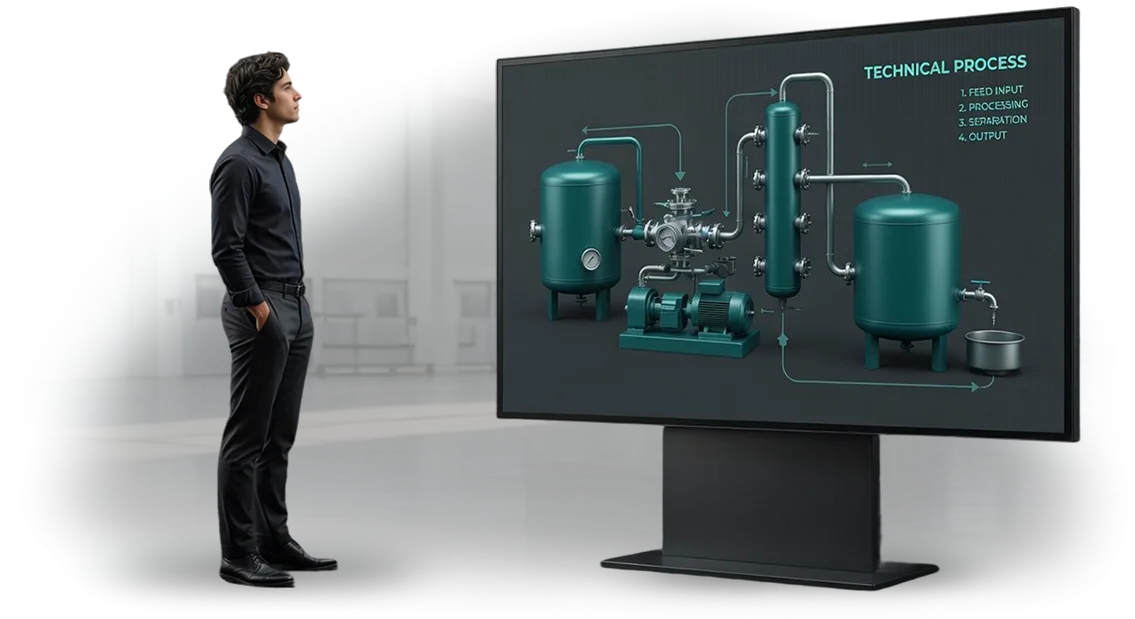
Training Video as a Technical Drawing: Why Texts Don't Work
Employees do not read long text instructions — a fact any manager will confirm. Even the most detailed corporate memo remains uncomprehended: eyes glide over the lines, and a day later the same mistakes recur.
The reason is simple: text describes an action linearly, while in reality a person sees the object as a whole — from all sides, in motion, and in the context of the work situation.
Training video works differently. It shows the process as precisely as a technical drawing shows the structure of a part: every operation is visible, every component is labeled, every step is clear without guesswork.
This is precisely the approach behind the corporate instructions we create. We take a real employee task and turn it into a clear visual video with no unnecessary words — only the sequence of actions and the correct result.
The precision of a technical drawing is not a metaphor but a principle of presenting material. A part that rotates, breaks down into its components, shows its internal structure, and then reassembles in the correct order.
Such a format eliminates ambiguity and guarantees that even new employees without experience grasp the material. They see not an abstract description but a ready-made standard for performing the work.
As a result, the company gets a single standard of actions: fewer errors, less waste, and less time spent on initial training. The manager stops repeating the same thing, and the employee confidently completes the task on the first try.
This is exactly what distinguishes a quality training video from a text instruction that everyone flips through but no one remembers.
3 Advantages of 3D Animation in the Style of a Technical Drawing
Reducing Errors and Losses
Each employee understands a text instruction in their own way: they skip steps, mix up the order, apply extra force. 3D animation in the style of a technical drawing shows the mechanism in cross-section, with correct proportions and an emphasis on critical points.
The company gets fewer defects and less rework — which means lower direct costs and less downtime. Experienced employees also use the video as a cheat sheet — no need to distract colleagues.
Fast Onboarding of New Employees
A newcomer finds it difficult to understand a mechanism from a paper diagram — they are afraid of making a mistake and ask dozens of questions. A short video shows how parts interact and where to apply force, so the employee masters the operations in a few days.
The company saves the mentor's time and gets a return on the new hire sooner. As a result, newcomers get up to speed faster and are less likely to break expensive equipment.
Long-Term Retention and Engagement
The brain retains visual information better than text, especially when it comes to complex equipment. 3D animation in the style of a technical drawing forms a precise image of the operation: the employee acts confidently and asks for clarification less often.
The modern presentation of the videos increases interest in training and reinforces knowledge for a long time. This reduces the load on mentors and improves the overall qualification of the team.
Training Video Formats for Different Tasks
The same process can be shown in different ways: from a short hint to an exhaustive procedure. The format determines how quickly an employee absorbs the material and can apply it in practice.
That is why we offer not one "universal" video but a range of formats that cover specific tasks — onboarding, review of a complex operation, reference material.
Each format is based on 3D animation in the style of a technical drawing: it clearly shows the structure and sequence of actions, eliminates discrepancies, and reduces preparation time. Below is a selection table — use your task and audience as a guide.
| Format | For whom | What it gives the client |
|---|---|---|
| Short loop (1–2 minutes) | New employees, mass personnel | Quick introduction to a stage: reduces errors "at the start", easy to integrate into the onboarding program |
| Medium video (5–7 minutes) | Line personnel, operators | Detailed review of a typical operation: consistent execution quality across the whole team |
| Full procedure (10–15 minutes) | Specialists, quality department | Exhaustive standard with a review of non-standard situations: a basis for certification and internal instructions |
| Video series (modular course) | Training center, HR | Systematic step-by-step training: flexible program assembly for different roles and pace of completion |
How to choose? If the process is short and repetitive — one 1–2 minute video is enough. If the operation is critical and has many steps — a full procedure is needed.
And for regular training of new employees, a series of modules is more convenient, where each video covers its own block.
We will help you choose a format for your specifics: we will analyze the process, audience, and training goal, and then propose the structure and duration. This prevents overpaying for extra "footage" and guarantees that the video will actually be watched to the end.
Instruction Development Stages: From Brief to Launch
We turn your brief into a ready-made video instruction through clear project stages. Each step is fixed in the schedule, you see the result, and you control the deadlines. This way, video instruction development goes without setbacks or unexpected edits at the final stage.
- Brief and task analysis — we define the goal, audience, and complex operations. We understand what the employee should remember after watching.
- Script and storyboard — we prepare a script in the style of a technical drawing and break the actions down into frames. The document is easy to coordinate with technologists.
- Concept approval — we show the style and presentation, and make edits before production begins. This saves time and budget.
- Creation of 3D models and animation — we model the components and play through each operation. The employee sees the steps as if on a diagram and remembers them faster.
- Voiceover and subtitles — we add a professional voice and text hints for complex terms. The video is clear even to a newcomer.
- Interim review and edits — we show a draft, collect comments, and make corrections. Approval does not derail the schedule.
- Launch and handover of source files — we deliver the finished videos in the required formats and upload them to your training system. We hand over the source files for future updates.
What You Get in the End: The Complete Delivery Package
Working on a project, we don't just hand over videos — we form a complete delivery package. It covers all stages of training and includes three key components: a video series, materials for the LMS, and accompanying documentation.
- Ready-made video series in the style of a technical drawing. Each video is rendered in 3D, which simplifies the perception of even complex processes. The employee sees the exact order of actions and can return to the instruction at any time.
- Integration with your LMS. Courses, tests, and scenarios are loaded into the distance learning system without the involvement of developers. Employees get access to the materials in their personal account and complete the training at a comfortable pace.
- Accompanying documentation. Includes a user guide, instructions for uploading to the LMS, and recommendations for adapting content to different staff groups. Everything needed for launch — in one place.
- Source projects and 3D models. You can make changes to the videos yourself or order revisions from us — without re-approving the scope of work or an additional brief.
- Technical specification and certificates of completed work. Transparent documentation for each stage: you always see what has been done and accept the result without risks.
- Support for a month after delivery. We answer employee questions, make sure the training starts without issues, and quickly fix any problems.
This approach eliminates fragmentation: every element is packaged and linked to the overall goal. You get a solution that can be launched as early as next week, not just files on a disk.
Case Study: Reducing Assembly-Line Errors with 3D Instructions
Working with personnel in manufacturing always boils down to the same thing: a newcomer needs a lot of time to master the assembly process, and an experienced employee can make a mistake due to carelessness or an ambiguous instruction.
Text procedures and static drawings are read differently — everyone sees something different in them. In the end, defects and rework become a familiar expense line, and training takes weeks.
We found a way to speed up this process.
For the machine-building client Technoprom, we developed a series of 3D training videos where every component is clearly broken down: parts "materialize" as if on a technical drawing, and the sequence of operations is shown from the first to the last step.
An employee watches such video instructions once or twice and immediately repeats the actions on the real assembly line.
How It Went
The enterprise had a task to reduce the onboarding time for assemblers and lower the number of errors when installing hydraulic systems. We took the five most complex operations that produced the most defects and turned them into short videos with a technical drawing effect.
Each video was no more than three minutes long — deliberately, so that it could be rewatched right before performing the task.
The fitters got access to the instructions through tablets at their workplace. After a month, we compared the indicators with the previous period.
Implementation Results
Defects in these operations dropped almost threefold, and the training time for new employees decreased from two weeks to three days.
In addition, the need to distract mentors every time disappeared — the video covers basic questions, and experienced staff handle only complex, non-standard cases.
Employees note that 3D instructions are clearer than any text document: you can see how the part rotates, where it fits, and how it is fixed.
It is the clarity of the technical drawing in motion that removes ambiguity — a person sees not an abstract diagram but an exact sequence of actions.
The effectiveness of this approach has been confirmed in practice: the client ordered an expansion of the video library to all key operations and introduced it into the training standard.
If your production has operations where errors are costly, a similar format can be easily adapted to your components and procedures.
How to Choose a Video Instruction Format for Your Production Specifics?
The choice of a video instruction format depends not on fashion but on the specifics of production. Identical operations require one kind of presentation, rare complex components require another.
Before shooting, we analyze the process charts, the level of employee training, and the cost of an error — and only then propose a format.
For unique operations — working with new equipment, setup, non-standard situations — detailed 3D videos in the style of a technical drawing are best suited.
This format shows the internal structure of the component, transparently breaks down the sequence of actions, and captures nuances that are not visible on the real object. The employee repeats every step without guessing, and the risk of error drops significantly.
For mass personnel and frequent operations, short 2–3 minute instructions with an emphasis on key control points are more effective. Their task is to quickly remind the correct procedure, not to explain the structure of the mechanism.
This format is easy to update, and it covers everyone at once — from newcomer to experienced worker.
In practice, the best result comes from a combination: basic short instructions for all employees and in-depth videos in the style of a technical drawing for complex tasks and newcomer training.
We help determine which format is needed for each position and build a system that is actually used in work.
The main thing is to start not from a "universal" solution but from a specific production area. Tell us about your operations — we will select a format that covers the task.
Common Client Doubts and How We Dispel Them
It is understandable that questions arise before launching training video instructions: how will this fit into current processes, will training have to be rebuilt, what about compatibility with your distance learning system. This is normal — we deal with such doubts every day and dispel them before the project even starts.
Will it be difficult to integrate video instructions into current training?
Integration happens in stages and does not require stopping work processes. We study your system in advance and propose a format that employees master without extra effort. All instruction remains in the familiar environment — your LMS.
Which distance learning systems are the videos compatible with?
We make universal formats that play in any popular LMS. If necessary, we adapt the packaging and settings to your platform — we specifically check uploading, launching, and result tracking.
How do you control deadlines and cost?
Before the start of work, we fix the scope and schedule, and the cost does not change during the process. You receive a clear plan with stages and approval points, so you know in advance when the result will be ready.
In the end, you get ready-to-use video instructions that employees easily perceive, and you get a measurable result without downtime or extra costs. If doubts remain — ask us directly, and we will work through your specific example.Order Development of Corporate Video Instructions
Guests remember emotions, and ordinary presentations don't surprise them. When employee training turns into long texts and abstract slides, information gets lost by the second minute.
A video instruction in the style of a technical drawing solves this problem: a complex process becomes visual, consistent, and clear to every newcomer.
As a result, the company gets not a "video for show" but a working tool that accelerates the employee's path to results and reduces the number of errors when working with equipment.
Instead of endless explanations and repeated briefings — one polished piece of material that can be reviewed at any time.
What You Get Immediately After Contacting Us
- Consultation: we analyze your task and advise which video instruction format will deliver the greatest effect for your employees.
- Preliminary calculation of timelines and development cost — without hidden surcharges or "surprises" during the process.
- A proposal for the video structure: we break your process into clear stages that are easy to absorb and remember.
- Examples of our work in the style of technical animation, so you can see the level of execution before the project starts.
- Individual approach: we don't offer a template; we design the video around the specifics of your equipment and the level of your team's training.
- A clear project plan: you know who is responsible for what and when each stage will be ready.
Why It's Convenient to Work with Us
We have been developing corporate video instructions for 10 years and understand the specifics of manufacturing and service companies. Behind us are dozens of projects where equipment similar to yours was presented as clearly as possible.
We work remotely, so you don't need to organize meetings or coordinate schedules — the entire process from brief to final video follows a clear procedure. You receive ready-made material that integrates into your training system and works to automate onboarding.
Leave a request for a consultation — tell us about your task. We will come back with concrete proposals and show how a technical drawing in animation can cover your need for fast, high-quality employee training.