

Complex parts and deadlines: the pain of aerospace manufacturing
In aerospace manufacturing, the cost of error is especially high: every part is the result of complex engineering decisions, and a defect on the production line means missed deadlines and additional costs.
New employees have to spend months understanding the intricacies of assembly, studying drawings and instructions that do not always reflect the real process.
Classic training in aerospace manufacturing is often built on static presentations and text-based regulations.
A specialist goes through a long path from theory to the first independent operation, but even after that, production errors remain — especially where it is necessary to understand the internal structure of an assembly or the sequence of operations.
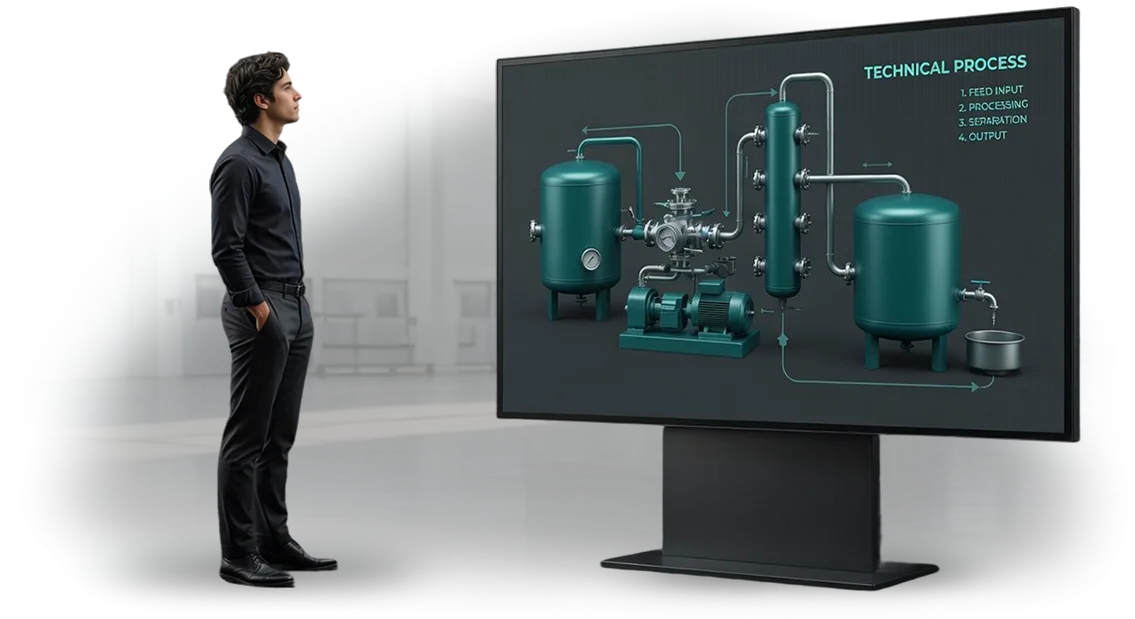
That is why we create video instructions with exploded view demonstrations for aerospace manufacturing: the employee sees how the part is designed, how it connects with others, and repeats the actions without guesswork. Employee training becomes visual, fast, and consistent across all workshops and shifts.
This approach reduces the time of introductory instruction and allows personnel to be cleared for work faster. The number of production errors decreases, which means less rework and downtime. For aerospace manufacturing, this means reliable adherence to deadlines and predictable quality.
We take on the analysis of drawings, script creation, and filming — you get ready-to-use videos that integrate into your training system. After that, the video instructions work as an internal standard: equally understandable for newcomers and experienced employees alike.
What a video instruction gives your production
The complexity of operations in aerospace manufacturing means the cost of each error is measured not only in time and materials, but also in safety.
Traditional "learn from the master" training is slow, and knowledge is passed on differently: one mentor reveals the nuances, another skips the details.
A video instruction removes this dependency — it shows the same standard of performing an operation to every employee, regardless of their experience or shift.
The main benefit is speed. A new employee no longer spends weeks observing from the sidelines and waiting for the mentor to become available.
They see the entire sequence of actions on screen, with the right emphasis on critical points, and start working independently within the first few days. Onboarding time is cut dramatically, so you fill the workshop's staffing needs faster.
The second benefit is fewer defects. When an operation is shown visually, with a breakdown of typical errors and the correct sequence, the operator acts on guesswork less often.
For complex assemblies that require understanding the internal structure of a unit, a video instruction with an exploded view lets the employee see how parts connect before picking up a tool. The result is less rework, fewer delays, and consistent product quality.
The third benefit is the standardization of knowledge. A video instruction is a corporate standard that does not change depending on the mentor's mood and is not forgotten after a month. The same process looks identical in Moscow, Kazan, or Novosibirsk.
You know exactly what your employees have been trained on and can use the video as a basis for certification and control. This makes production predictable and manageable.
In the end, you get not just a training video, but a tool that pays for itself by reducing training time, lowering the defect rate, and establishing a consistent level of competence.
These are the tasks we solve when developing corporate video instructions for aerospace manufacturing companies.
Training video formats: from 3D to live footage
For personnel training to deliver results, the video instruction format must match the specific task. Complex assemblies and units are best shown in 3D animation with an exploded view, while interaction with real equipment is best shown in live production footage. That is why we offer several formats and combine them to fit your process.
| Format | For whom | What it gives the client |
|---|---|---|
| 3D animation and exploded views | For training in assembly, disassembly, and repair of units, parts, and systems | Allows viewing the internal structure without risk to equipment and practicing the sequence of actions before going to the real object |
| Live process footage | For studying work operations, safety requirements, and regulations | Shows the real environment, nuances, and rules, reducing the number of errors during independent work |
| Combined format | For comprehensive programs where both the diagram and hands-on practice matter | Combines the clarity of 3D and the authenticity of video, accelerating onboarding and knowledge assessment |
In every project, we select the format based on the audience, the specifics of the equipment, and the skill level of the employees. Such a video instruction replaces hours of lectures and reduces the training's dependence on the mentor. The result is faster personnel training, higher safety, and fewer production errors.
Stages of creating video instructions with your involvement
We structure the creation of video instructions so that you control every stage of the work.
For aerospace manufacturing, training precision is critical, so the process is divided into transparent steps with approval checkpoints — you bring in technologists and instructors at the right moments and get a predictable result.
- Brief and process audit. We study the regulations and typical mistakes of newcomers. We determine which operations to show in 3D and which on real assemblies.
- Script and storyboard. We prepare a frame-by-frame plan and voice-over text. You review them with your technologists — we adjust the sequence and terminology.
- Creation of 3D models and exploded views. Based on your documentation and photos/videos, we build digital copies of the assemblies. We show disassembly and assembly in detail so the newcomer understands the structure.
- Video instruction production. Editing, voice-over, subtitles, and on-screen prompts. We prepare versions for the training classroom, tablet, and LMS.
- Approval and revisions. We show the draft to technologists and the quality department. We make changes within the planned iterations.
- Launch and integration. We hand over the final files and help you place them in your LMS or portal — training starts right away.
- Support and updates. When regulations change, we update the videos. You don't need to find a new contractor.
This process delivers a predictable timeline and quality: you see the result at every checkpoint, and your employees get clear study material. Launch training without schedule disruptions — the instructions will match real production operations.
What the video instruction delivery package includes
The full delivery package is not just ready-made videos, but a working system that can be integrated into training immediately after handover. We put the package together so your team does not have to buy additional tools, figure out someone else's work, or redo materials.
Here is what you get:
- Ready-made video instructions in several formats — for the LMS, for desktop computers, and for tablets in the workshop. Employees start learning without delay, and you don't spend time on re-encoding.
- Project source files — all scenes, 3D models, animations, and audio tracks. If regulations or the unit design change, your team can update the video without ordering the work from scratch.
- Technical documentation — a description of each instruction's structure, a list of symbols used, and recommendations for integrating the videos into your LMS. No "here's the file, figure it out yourselves."
- Update guide — a step-by-step procedure for making edits and keeping the videos up to date. It specifies which elements to change, how quickly to do it, and who is responsible for version control.
- Training for your specialists — a hands-on session on working with the source files and making changes. Your internal staff handles content maintenance on their own.
- Acceptance checklist — a list of criteria for checking each video: compliance with regulations, voice-over quality, correctness of exploded views, subtitles. You accept the work transparently, with no ambiguities.
The entire package is handed over under an acceptance certificate within the agreed timeframe, and the rights to the materials remain with you. After handover, we stay in touch: we answer questions about implementation and help with the first training launch.
Results of implementing video instructions at an aerospace plant
Getting familiar with new equipment in aviation production always involves risk: while the employee studies the documentation and gets the hang of things, the machines sit idle or operate with errors. For the enterprise, this means direct losses — from defects to contract delays. Video instructions remove this risk by turning multi-day training into a fast and visual process.
We don't just shoot videos — we systematically address the plant's need for quickly bringing personnel up to speed.
We break every operation down into steps and demonstrate the internal structure of assemblies with exploded views — so the employee understands the logic of the mechanism, not just memorizes a sequence of actions.
Implementation results at a specialized enterprise
A telling example is our collaboration with a machine-building plant during the launch of a new engine model. We developed a series of video instructions for assembling and maintaining a key assembly. The effect was measurable within the first months.
- Training time reduced — from 5 working days to 1.5 days per employee.
- Number of assembly errors reduced — by 60% compared to the previous quarter.
- Material savings — thanks to reduced defects, the plant recouped the cost of creating the instructions within one production cycle.
The head of the plant's training center noted in feedback: "Employees are no longer afraid of new operations. The video format is understandable even for newcomers, and assembly quality has reached a new level. We plan to convert all key technological processes to this format."
This case confirms: our team focuses on measurable business results, not "pretty pictures." We adapt the level of detail to the real operation, which is why the instruction doesn't just inform — it reduces production costs.
Investments in video instructions pay off quickly — through training speed, fewer defects, and consistent quality at every work area.
How to choose the right format for your task?
Choosing a format is always a matter of balancing goals and budget. If the task is to show an employee the internal structure of a complex assembly and explain a sequence of operations with invisible parts, then 3D animation with exploded views is indispensable.
It allows you to "take apart" the mechanism into its components and put it back together with perfect clarity, without waiting for physical access to the equipment.
If, on the other hand, the priority is to convey the real atmosphere of the process, the live environment of the workshop, or specific hands-on actions, then professional filming is the best solution.
It is cheaper to produce and faster to approve, but it is limited to what is visible through the camera lens.
When the budget is tight and the goal is simply to document the existing way of working, filming with minimal post-processing is sufficient.
This format covers the basic training task but is less effective for complex assemblies where, without animation, the employee simply cannot see the internal relationships.
We help clients avoid overpaying for unnecessary graphics and avoid skimping on critically important visual clarity.
At the brief stage, we analyze which operations need to be explained, who the audience is, and how often the instruction will be used — and based on that, we propose the optimal format for your budget.
Frequently asked questions and client concerns
We hear these questions at almost every aerospace brief, so we have collected answers to the most common client concerns. Below — about timelines, budget, implementation, and confidentiality. If you don't see your question here, just write to us.
How long does development take?
A typical video with a 3D exploded view takes 3-4 weeks. The timeline is fixed in the contract, and we show intermediate versions at every stage.
Is it expensive?
We prepare the cost estimate before we start and do not change it along the way. The project pays for itself after the first launch: new employees come up to speed faster.
Is it difficult to integrate video instructions into training?
No, all you need is a computer or tablet for viewing. We embed the videos into your LMS or provide links for independent access.
How is confidentiality ensured?
We sign a non-disclosure agreement, and intermediate versions are stored in secure access. Final videos are delivered in original quality, and the rights remain with you.
Do employees need training to work with the videos?
No, no special preparation is required: it is enough to press play and repeat the actions. If needed, we provide a short guide for mentors.
Let's discuss your video instruction project
Submit a request — and we will prepare a cost estimate and project plan for your tasks. This is not binding, but you will get a clear understanding of the timelines, formats, and development budget for employee video instructions.
Precision matters in aerospace manufacturing: every operation must be performed consistently and safely. A properly structured video instruction shows the entire process, eliminates discrepancies, and becomes the foundation for training new employees. We will take these specifics into account at the very first discussion.
In 30-40 minutes of conversation, we will clarify the target audience, the specifics of the operations, and the requirements for the training system. Based on that, we will send you a ready-made stage plan and a list of inputs needed from you. This way, you can make a decision based on numbers and timelines, not promises.
What you get after the first request:
- cost and timeline estimate tailored to your specifics;
- plan of development stages: script, voice-over, filming or 3D graphics, editing, approval;
- format recommendations for video instructions for different employee groups;
- structure of the first video instruction or a module prototype;
- list of materials needed from you at the start;
- calendar plan with checkpoints;
- answers to questions about integrating video instructions into your training system.
Thanks to this approach, you see the scope of work and the result we are heading toward in advance. We support the project from brief to final delivery, so we start the discussion with your tasks, not technical details.
If you need to present the project to management, we will prepare a presentation with the key decisions and expected impact.
Submit a request — let's discuss the details and start creating video instructions that reduce onboarding time and improve the quality of your employees' work.