

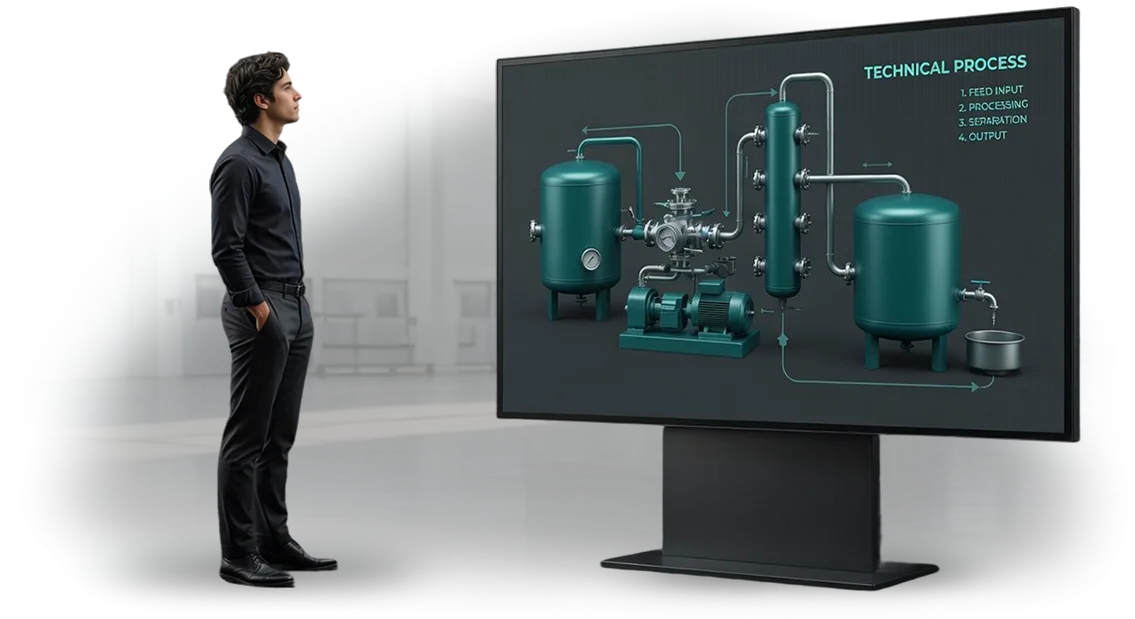
Why instructions do not work without scientific illustration techniques
Employees skip long text regulations — this is not a matter of discipline but a feature of perception. The brain seeks quick, clear reference points, while continuous text requires serious effort to concentrate.
Scientific illustration solves this task: it translates a complex process into a visual sequence where every step is obvious without reading.
Scientific illustration techniques are not just "beautiful pictures". They are a way to show structure and logic through precise visualization, as in anatomical atlases or technical diagrams.
When an employee sees an object in cross-section in a training video instruction, with emphasis on important details and stages, they do not need to decipher terms — they immediately understand the essence.
That is why training video instructions in this style work faster than text documents and are remembered for a long time.
For business, this means fewer mistakes in the workplace and reduced time to onboard a new employee. Instead of repeated explanations and incident reviews, you get a stable standard: every employee learns the algorithm in the same way.
The more visual the material, the higher the trust in it and the more often employees check the instruction rather than improvise.
Moreover, a video with elements of scientific illustration is easy to use at different stages of training: during initial introduction, during professional development, and during the implementation of new processes.
Material created once works as a permanent source of truth; it can be reviewed without involving a mentor. Thus, the perception of instructions stops being a bottleneck — training becomes systematic and predictable.
That is exactly why we build training video instructions based on methods of scientific illustration: so that employees do not "serve time" through mandatory training, but actually learn the algorithms and follow them.
This is an investment in process controllability that pays off through reduced costs of errors and faster personnel adaptation.
What a training video with 3D animation gives a company
Employees rarely read long texts and remember diagrams poorly. Training videos with 3D animation turn complex regulations into visual stories that people want to watch to the end.
Our team's practice shows: after switching to digital instructions, staff master processes faster and make fewer mistakes.
Engagement instead of boring instructions
Instead of monotonous text, the employee sees vivid 3D animation that shows the process step by step — from starting up the equipment to checking the result. Such training sparks genuine interest, which means the information is absorbed naturally, without rote memorization.
Moreover, the video can be rewatched at any moment, so a new person gets up to speed at work faster.
A single standard without discrepancies
Live training often depends on who explains things and how: one mentor will take the time, another will cut the details. A video instruction captures the one correct sequence of actions, and all employees work the same way — from the experienced specialist to the trainee. This reduces the number of errors and makes the result predictable for the whole team.
Saving the manager's time
Managers spend hours repeating the same explanations to every newcomer. With digital instructions, the task is solved once: the video is available at any moment, it can be embedded into the onboarding process, and you can simply give the employee a link. The freed-up time goes to real business tasks, not to conversations.
Formats of corporate video instructions in the style of scientific illustration
Employees absorb instructions differently: some need a short reminder, while others need a detailed breakdown of a process.
A text-based regulation spans pages, while a video in the style of scientific illustration fits the same process into a minute of visual explanation — with emphasis on key points.
That is why before development we clarify the audience and expected result: this directly determines the format of the video, and therefore the speed of learning and the number of errors at work.
We develop corporate video instructions in three main formats. They differ in detail, duration, and learning goal. The table will help you choose the right option for your task.
| Format | For whom | What it gives the client |
|---|---|---|
| Short video up to 60 seconds | For mass training and quick reminders at the workplace | Employees memorize frequent operations faster, get less distracted, and do not lose attention |
| Detailed breakdown up to 5 minutes | For new employees and complex multi-stage processes | Full understanding of the sequence of actions, fewer errors, and fewer follow-up questions to mentors |
| Module series of 5 or more videos | For systematic training of an entire department or regular briefings | A unified training program, easy knowledge assessment, and quick material updates when processes change |
Each format can be supplemented with interactive elements — for example, choosing the correct action at a key point in the process. This allows the employee to immediately practice the algorithm, and allows you to check how well the material has been learned.
We deliver the finished video in the required video format for your learning system, so it can be used without modifications.
If you are not sure which format will address your specific task, send a description of the scenario — we will select the optimal option and show an example based on your process.
How the creation of a training video for your company works
Creating a training video is a transparent process in which you participate at key points. We take care of everything: from task analysis to the final file and post-launch support. Below is the path your project goes through.
- Brief and immersion in the task. A short interview with you and with future viewers — employees. We find out which operation needs to be explained, where errors occur, and what result matters to the business.
- Script and storyboard. We prepare the video text and a frame-by-frame plan in the style of a scientific illustration. You see what will be on screen before rendering — we align on the logic and wording.
- Development of 3D graphics and animation. We create models and animation that clearly show the process: a cross-section of a mechanism or a sequence of actions. We show intermediate versions of key frames.
- Voiceover and sound. We record narration or subtitles. We select the voice and pace to match your corporate culture — calm, energetic, or formal.
- Approval and edits. We show the full draft. You leave comments by timecode — we make changes up to three rounds of edits.
- Handover and support. We provide the finished file in the required formats: for a learning management system, portal, or social media. After launch, we help with questions and adjust the video if regulations or equipment change.
What you get in the package: training and growth materials
We prepare the package so that you can launch training immediately after delivery — without rework or searching for contractors. Inside, you get not “bare” video files but a full-fledged tool for systematic employee development.
- Ready-to-use videos in all required formats — for LMS, video hosting platforms, offline screenings, and mobile devices. Each employee watches where it is convenient for them.
- Source project scenes — if the regulations change in a year, you won’t have to reshoot everything from scratch. The files can be opened and edited within your team.
- Methodological guidance — descriptions of scripts, video logic, and recommendations on how to embed the videos into the training program. A methodologist will understand the material immediately.
- Usage rights — a full package for corporate use. You can freely use the videos within the company, at events, and in distance learning systems.
- Post-launch technical support — if something doesn’t play or you need help with setup, we’re available and resolve the issue within one business day.
We separately secure usage rights — you get exclusivity for the materials in your industry. The videos will not appear with competitors, and the source files remain with you so that you can grow the library without our involvement.
Write to us to request the complete delivery checklist and discuss how to adapt the package to your training program. We’ll show examples of deliveries for similar projects.
Case study: how a training 3D video cut staff onboarding time
One of our clients — a manufacturing company, TekhnoProm — was facing the fact that new employees only reached full productivity after two months.
Experienced mentors were being pulled away from their own tasks, and errors at the initial stage were driving up losses in raw materials and time.
We proposed replacing part of the traditional training with a 3D video in the style of a scientific illustration.
Instead of flat diagrams and slides, a new employee sees the structure of the machine "from the inside": the movement of parts, the forces involved, the sequence of operations — everything that is hard to explain in words.
This format is understandable to people with different levels of experience and does not require a mentor to be present at every step.
What changed over three months
Onboarding was reduced by 40%: a new employee reaches target productivity by the end of the first month. Mentors spend 25% less time repeating the same things, and the number of errors when starting up equipment fell by almost half.
An additional effect is a single training standard. The video reproduces the ideal process without deviations, so all employees work correctly in the same way. This simplifies quality control and reduces the number of emergency situations.
The company now uses these same videos for retraining and for authorization to work on new equipment. Training content stays relevant for years, and the cost of creating it — calculated after audit — pays for itself after the very first group of newcomers.
How to choose a training video format for your team's task?
There is no single correct format "for everyone" — it is determined by the task and the audience. If you need to introduce hundreds of employees to a regulation, short videos focused on key actions will do the job.
For a complex technical process, detailed video instructions with 3D animation in the style of a scientific illustration work better — they show the structure and logic of the process from the inside.
For mass training, a series of short modules is convenient: each one covers a single topic and easily fits into the existing motivation and knowledge-check system. Employees go through them at a comfortable pace, while the manager sees progress and problem areas.
When it comes to technical processes, a different approach is needed. Here, the choice of video instruction format is built on step-by-step delivery: one video — one stage, with visualization and checkpoints.
Thanks to scientific illustration, hidden mechanisms become clear, and the employee moves on to independent work faster.
For structured training, we design a connected program rather than individual videos. Each module builds on the previous one, and the material goes from simple to complex. This format shortens time to productivity in the role and reduces the number of errors on the job.
We help you choose the format for your task — from a single video to a series of modules. At the start, we analyze the audience, the process and the learning goals, and then propose a solution that employees actually watch to the end and apply in practice.
Answering questions about corporate video instruction development
We understand that ordering corporate video instructions brings up the usual worries: deadlines will drag, the script will be hard to approve, and when regulations change, the videos will become outdated. We answer the key questions honestly — the way we actually work.
How long does it take to develop video instructions?
The timeline depends on the complexity of the script, the number of scenes, and the level of detail. We produce simple videos in 2–3 weeks, and larger ones in up to a month and a half.
To avoid delays, we lock in the approval plan right at the start: you see the dates of every stage — from the brief to the final render. Thanks to this, we deliver the finished video exactly on the agreed day, with no "we need another couple of weeks."
What if regulations or equipment change? Updating videos is a routine situation, not a problem. We keep the source project files, so when a regulation changes, a targeted revision is enough: replace one scene, update a text overlay, or re-record a voice-over comment.
There's no need to order a video from scratch — we make edits quickly, and you check the result against the new regulation. This is convenient when a process changes regularly.
How accurate will the 3D visualization in the style of a scientific illustration be? Accuracy is our baseline rule. We rely on drawings, photographs, technical descriptions, and comments from your experts.
For complex assemblies, we create intermediate versions; you check them against the real device and provide corrections. Only after your "yes" do we move to the final rendering.
As a result, an employee sees every detail exactly as it looks in operation — without simplifications or distortions.
If you still have questions, ask them directly: we'll give you the timeline for your task and show you how approval works.
Order turnkey corporate video instruction development
Onboarding new employees is always a race: you need to quickly integrate a person into processes without pulling experienced colleagues away from work.
A video instruction solves the task once and for all: the video explains standards just like the best mentor, but at any time and for any number of newcomers.
Ordering turnkey corporate video instruction development means getting a ready-made training tool, not just “shooting a video.” We take on the entire journey: from analyzing the task to the final video, which is embedded into your distance learning system or portal. You get a predictable result on time and an estimate without surprises.
What you get right after the project starts:
- Brief — a detailed questionnaire that captures learning goals and target audience.
- Script plan — a step-by-step structure of the video taking into account the logic of perception.
- Estimate — a transparent breakdown by stages without hidden extra charges.
- Work schedule — with checkpoints and a delivery date.
- An assigned project manager — always in touch.
- A demo version of a fragment so you can see the style before full rendering.
Next, you get a corporate video that is equally understandable to newcomers and experienced employees. We use scientific illustration to make complex processes look simple and clear.
Leave a request — and tomorrow you will have a plan, estimate, and work schedule for the task. We will start with a short conversation about your task and select a format that fits the budget.