

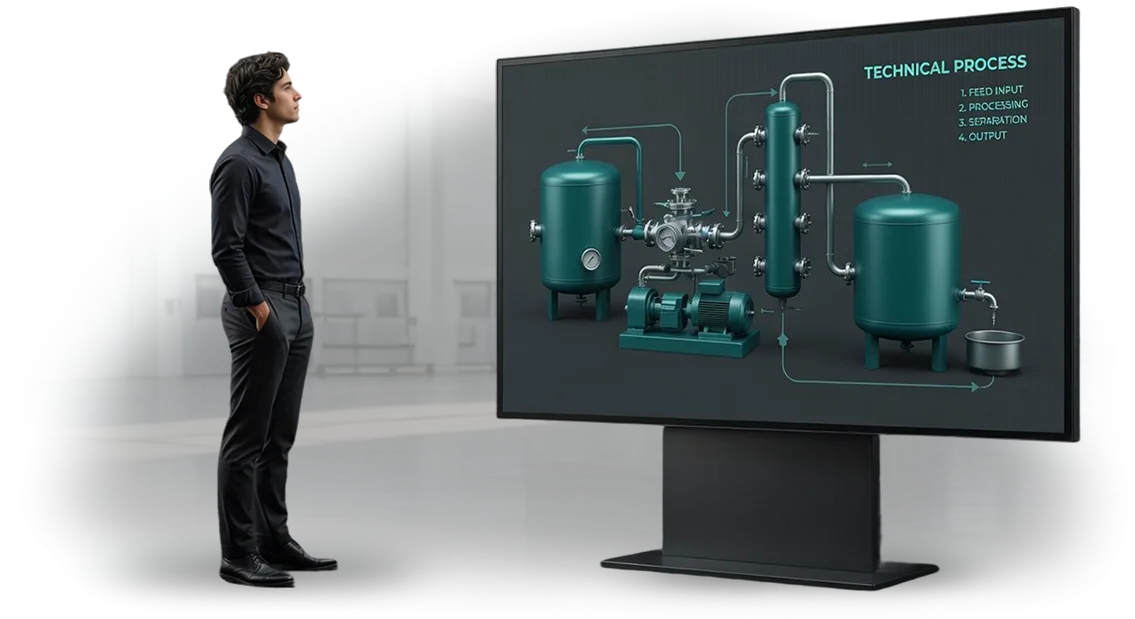
Employees Don’t Absorb Instructions: Time for an Animated Style
Employees rarely finish long text instructions, and even when they do, they forget half of them within a week. The result is errors on the job, more support tickets, and new hires taking longer to reach the required performance level.
This is a familiar pain point for any manager: you invest time in procedures, and they simply don’t work.
The problem isn’t employee responsibility — it’s the format. Text requires effort, concentration, and imagination, while the adult brain is easily distracted.
Regular video instructions help, but they often feel like a boring lecture: people play them in the background and still don’t remember the details.
That’s where the animated style comes in. Vivid characters, clear storylines, and dynamic visuals hold attention from the very first second.
A complex sequence of actions turns into a short story that an employee remembers effortlessly — just like they remember a favorite cartoon from childhood.
That’s why instructional videos in animation format show significantly higher engagement than text-based procedures or ordinary presentations.
Corporate video in an animated style solves several problems at once: faster onboarding for new employees, consistent work standards, fewer mistakes, and less time spent on explanations.
Employees watch these videos with interest and return to them when needed, while managers save hours of repeated explanations.
We create exactly this kind of instructional video: with 3D animation, well-thought-out scripts, and precise alignment with your business processes. You get a ready-to-use tool that any employee can understand — from frontline staff to top management.
Training cartoons stop being a “childish” format and become an effective way to pass on knowledge and standards across your company.
Benefits of Instructional Videos for Business
Employees don’t read long text procedures — they need clear and visual explanations. Instructional videos solve this problem: they hold attention, show the process step by step, and leave no room for misinterpretation.
The animated style multiplies the effect. Bright 3D images and dynamic scenes are easier to process and remember than dry diagrams or screen recordings. Such videos evoke emotion, which means they engage employees from the first minute, even when it comes to routine operations.
Training effectiveness grows thanks to visual clarity: the employee sees the correct order of actions and can repeat it without leaving work. Videos can be rewatched at any moment — this reduces the number of mistakes and speeds up the acquisition of new skills.
Instead of long lectures and repeated briefings — a short video that answers the question in two or three minutes.
Standardization of knowledge is another important advantage. Every video captures a single, reference scenario, so all employees act the same way, regardless of experience or tenure.
This is especially valuable for companies with a branch network or high staff turnover: a new person reaches the required performance level faster, and mentors save time on explanations.
In the end, the business gets a predictable result: fewer mistakes, faster adaptation for new employees, and confidence that every employee knows the company’s standards.
Animated instructional videos become more than just training material — they become a tool that improves the quality of work across the whole team.
Training Video Formats: From 3D Animation to Animated Style
The format of a training video directly affects how quickly employees absorb the material and how correct their actions are. Dry documents and long lectures lose attention, while a well-chosen video works toward results: it reduces training time and the number of mistakes.
We offer several production options — from realistic 3D animation to the animated style that people love for its ease of understanding.
So you don’t have to guess, we’ll select the format for your specific task. Below is a table of typical scenarios: when you need 3D animation, when a screencast is enough, and when animated graphics or full animation work better.
| Format | Who It’s For | What It Gives the Client |
|---|---|---|
| 3D animation | Complex mechanisms, devices, and processes that cannot be filmed with a camera | Shows the device and every stage of operation, reduces the risk of mistakes |
| Animated style | New employees, mass training, occupational safety materials | Friendly perception, holds attention, better remembered than dry instructions |
| Screencast | Working in software, CRM, and internal systems | Quickly and cost-effectively explains the interface, employees master the software without long introductions |
| Animated graphics | Procedures, company policies, processes without high detail | Concisely communicates key rules, easily embedded into a course or presentation |
How an Instructional Video Is Created: From Brief to Launch
So you don’t have to guess what happens at each stage, we’ve built a transparent work process. You always know when to approve the script, when to review intermediate versions, and when you’ll receive the finished instructional video. The result is an animated video that employees watch to the end and easily remember.
- Brief and immersion — we discuss the task, the target audience, and the operations that need to be explained. We identify where employees most often make mistakes and agree on deadlines, format, and key messages.
- Script and storyboard — we create a text where every step of the instruction is described in plain language. At the same time, we prepare the storyboard: how the scenes will look in an animated style. You receive the material for approval before animation begins.
- Script approval — we make edits, clarify wording, and approve the final version. All key decisions are recorded so that no disagreements or unnecessary rework arise later.
- Character and style development — we design the characters, color palette, and overall atmosphere of the video. You see the visual language in advance and approve it before production, so there are no surprises later.
- Animation production — the team brings the scenes to life according to the approved script. At key milestones, you receive intermediate versions and control the result without waiting for the final render.
- Launch and support — we deliver the finished files in the required formats and adapt them to your learning system. After launch, we stay in touch: we answer questions and make adjustments if needed.
What’s Included in the Delivery: A Complete Set of Instructional Videos and Animations
After development is complete, you receive a full delivery package that allows you to launch training without extra approvals. It includes final files, source files, and methodology documents — everything your HR department needs to start using the materials right away.
Here’s what’s included:
- Final instructional videos in formats for learning management systems and corporate portals — employees can complete training from a work computer or phone.
- Source project files: scenes, animations, resources. If a business process changes, you can make edits with your own team or any contractor — without reshooting.
- Methodological materials for mentors: scripts, timings, and comprehension check questions. This turns a video into a complete course.
- Subtitles and audio tracks — for videos used in noisy workshops or in silent mode.
- A set of covers and previews for modules — so employees can easily find the right video in the catalog.
- A content update policy: how and when changes can be made when instructions are updated.
This package immediately covers the needs of both the training department and the IT team: you have ready-made materials for employees and resources for developing the course. You’re not dependent on us after project delivery — all assets remain yours.
Case Study: How We Doubled Training Speed
One of our clients — a home appliance distributor with a thousand employees — faced a problem: onboarding took two weeks, but after a month most of the information was forgotten. New managers made the same mistakes, and experienced employees spent time on repeat explanations. The task was simple: make training fast and memorable.
Weproposed replacing boring presentations and text procedures with a series of short training videos in an animated style with 3D animation.
The corporate instructional video explained processes through relatable characters and scenarios — from goods receiving to handling customer objections. Employees watched the videos at their own pace, and the system tracked views and test results.
We measured the results two months later. The average time for a new hire to reach full productivity dropped from two weeks to one — training speed doubled exactly.
The number of errors in order processing fell by a third, and support requests about internal processes almost disappeared.
Metrics That Speak for Themselves
The training manager got not just “nice videos” but a working tool: briefing time was cut in half, and the share of employees who passed the final test rose to 95%.
The client was so impressed that they ordered another series of videos for frontline staff onboarding and an update of the instructional videos to match new procedures.
Why It Worked
The animated style holds attention and removes the fear of difficult material. Instead of a dry instruction, the employee sees a story where a character performs the same actions — so the information is absorbed naturally. And short series allow learning right between work tasks, without disrupting the schedule.
How to Choose the Right Instructional Video Format for Employee Training?
The short answer: the right format is the one your employees actually watch to the end and remember. To get there, it’s important to base your decision not on trends but on the specific task: what you want to teach and who will be watching.
Instructional videos come in live-action, animated, and combined formats. Live action works well when you need to show work with real equipment, but it requires a studio, lighting, and actors, and any change to the procedure means a new shoot.
Animation in an animated style, on the other hand, easily translates complex processes into a clear sequence of actions: anything hidden inside a mechanism can be shown in cross-section and with diagrams.
If your employees work at different paces and learn differently, animation levels out the experience. Short series with characters and a storyline hold attention, and the narrator calmly guides the viewer from the first step to the final result.
It doesn’t matter whether it’s assembling a component, working in a software program, or safety rules — the material stays equally clear.
When choosing a format, ask yourself three questions: how complex is the process, how often does it change, and who exactly will be watching. If both new hires and experienced employees can understand the instruction without interrupting their work, you’ve made the right choice.
Animation removes the limitations of reality: you don’t need to stop production for filming, and updating a video takes days, not months.
We help you choose the format for your task: we show the script, the character style, and a demo timing before launch. In the end, you get an instructional video that reduces training time and lowers the number of mistakes.
The main thing is that the chosen format matches your goal and audience — we’ll take care of the rest.
Frequently Asked Questions About Creating Corporate Instructional Videos
Every client asks the same questions before a project starts: will deadlines slip, will it cost more than budget, and will employees actually watch these videos. We answer honestly — like we would at a meeting.
How long does it take to create an instructional video?
A standard 2–3 minute video takes 3–4 weeks. That includes script, storyboard, voiceover, 3D animation, and editing. If you need it faster, we accelerate specific stages — for example, we finalize the script from the first version.
How much does development cost?
The cost depends on video length, the number of scenes, and character detail. Before we start, we fix the estimate with no hidden fees. Payment is staged, and we work under a contract.
Will employees take animation seriously?
Yes. The animated style simplifies complex procedures: it’s easier to show a process with a character than to describe it in text. Such videos get watched to the end, remembered faster, and rewatched when needed.
What quality guarantees do you provide?
You approve the script and storyboard before animation begins, so the result won’t be a surprise. We show intermediate versions, make edits, and the terms for revisions are written into the contract.
How will the video fit into training?
We deliver files in convenient formats: for LMS, video hosting, chats, and presentations. On request, we also cut the video into separate steps — perfect for use on the portal as a quick reference.
Order a Training Video for Your Employees Today
Training videos in an animated style help employees absorb procedures and standards faster. Instead of dry instructions — clear scenarios that are remembered and applied on the job.
But the main thing is the result: fewer mistakes, faster onboarding for new employees, and a uniform quality standard across all departments.
Leave a request right now, and we’ll prepare a proposal for your task. It takes just a couple of minutes, and you’ll feel the benefit after the first discussion. You’ll get:
- A specialist consultation: we’ll advise which video format suits your employees best.
- A cost and timeline estimate — transparent, with no hidden fees.
- Examples of work in an animated style so you can assess the level of presentation.
- A well-written script that turns a boring procedure into a clear story.
- Professional 3D animation that makes learning easy and engaging.
- Support at every stage: from defining the task to the finished video.
- The ability to make edits after the demo — we refine the result until it’s right.
Contact us any way you like. Tell us about your task, and we’ll offer a solution that saves your team time and improves training quality. Start with a request — we’ll handle the rest.