

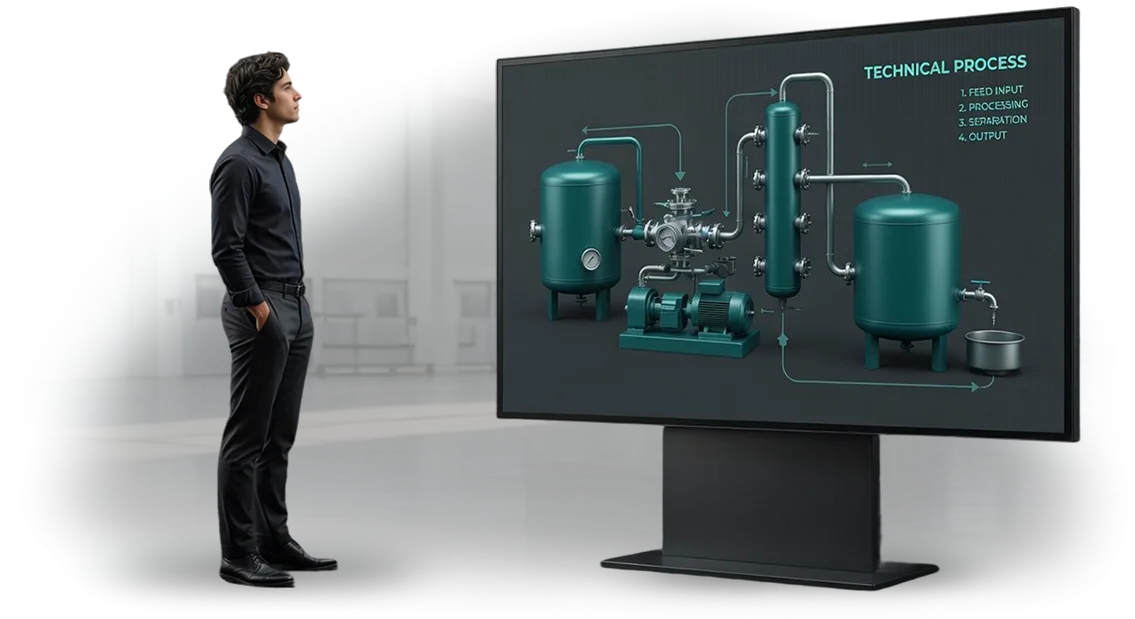
How Anatomical Illustration Makes Employee Training Visual
Employees make mistakes not because of inattention, but because they misunderstand instructions. Text-based regulations and flat images force them to reconstruct the process in their heads — and where there is guesswork, there are mistakes.
Employee training becomes an expensive cycle of trial and error, and every misstep costs the company time and money.
We solve this problem with visual video instructions. Anatomical illustration removes guesswork: the process is shown “in cross-section,” like in a medical atlas, layers open sequentially, and the employee sees the internal structure and exact mechanics of each step. The sequence is remembered from the first viewing, not through trial and error.
Such visual clarity shortens onboarding time and reduces the number of errors when working with machinery, equipment, and in processes where precision matters.
A video instruction works equally for everyone: experienced employees refresh their knowledge, and newcomers master complex operations without unnecessary questions.
Visual instructions in an anatomical illustration style are a tool that directly affects the speed and quality of work.
We create such video instructions using 3D animation: professional modeling shows the process the way a specialist should see it — without unnecessary details and with an emphasis on key actions.
The finished video can be embedded in a training system, shown on a tablet at the machine, or used during employee certification. The result is visible immediately: fewer errors, faster onboarding, and calmer work with new technology.
Business Benefits: Training Speed and Risk Reduction
Regular lectures and presentations take a lot of time, and knowledge fades within a couple of weeks. Employee mistakes are costly: defective products, damaged equipment, and conflicts with clients.
We create training video instructions in an anatomical illustration style — with a clear breakdown of internal processes so that training is faster and without losses. We work on professional equipment, so the videos are detailed and consistent.
Training Speed
Instead of dozens of pages of text, an employee gets a short video breakdown in 3–5 minutes. 3D animation shows how a component or process is built — the material is absorbed several times faster, and new employees settle into a working rhythm sooner.
Risk Reduction
Hazardous and rare situations can be “played out” on screen without real consequences. The employee sees the correct algorithm and remembers it on a habitual level. The result is fewer defects, breakdowns, and complaints — and therefore fewer unplanned expenses.
Employee Engagement
Bright animation and dynamics hold attention better than standard instructions. Employees willingly complete training and revisit videos when questions arise. This increases interest in work and reduces turnover.
Competency Growth
Video instructions create a single standard for all employees, from beginners to experienced staff. Even if the team changes, knowledge stays inside the company. Competencies grow and do not depend on which individual has left.
Formats of Video Instructions in Anatomical Illustration Style
Employees absorb information differently: some read regulations, others need a visual example, and some learn only through practice.
The format of a video instruction determines whether training becomes a routine “for show” or a working tool that reduces errors and accelerates the adaptation of newcomers.
How to Choose a Format
A universal video does not exist. A full course, a short module, an interactive scenario, or a 3D simulation solve different tasks: from initial training to skill assessment. We select the format based on the specific audience and business process, not “for pretty video.”
| Format | For Whom | What It Gives the Client |
|---|---|---|
| Full course | New employees | Systematic mastery of processes and reduced adaptation time |
| Modular lessons | Current staff | Targeted skill development without time off from work |
| Interactive video | All learner categories | Engagement and instant comprehension check |
| 3D simulations | Complex and hazardous operations | Safe skill practice without risk to people or equipment |
When the format matches the task, training produces measurable results: fewer errors, faster attainment of key metrics, and lower costs for repeated instruction sessions.
For example, 3D simulations in an anatomical illustration style allow you to examine the structure of a component or mechanism in a way ordinary video cannot — the employee sees internal processes and understands the underlying principle, rather than simply memorizing a sequence of actions.
Interactive videos additionally collect statistics: the manager can see who has completed the training and at which stages employees encounter difficulties.
This turns a video instruction from a one-off file into an element of training quality control that stays with you for years.
How We Create Video Instructions: 7 Project Stages
We have structured the process so that you see the result at every step and can influence it, instead of receiving a “black box” a month later. All stages are coordinated with you, so the final video solves business tasks rather than merely pleasing with visuals.
-
Brief and task immersion. First, we examine which audience the instruction is intended for, which usage scenarios need to be shown, and what result you want to achieve. This serves as the foundation for all subsequent work.
-
Script development. Together with you, we turn technical information into a clear visual flow: we define the sequence of actions, key emphasis points, and voice-over texts. You receive a complete script before production begins — this saves time and budget.
-
Concept approval. We show how the anatomical illustration style will look with your objects: color solutions, level of detail, and presentation. After your “okay,” we move on to production.
-
3D modeling. We create accurate models of equipment, parts, or processes. This is not abstract graphics but a visualization of your specific reality, so employees recognize objects without doubt and master the material faster.
-
Animation and visualization. We bring the script to life: showing movement, cross-sections, and the sequence of operations. Each frame makes the instruction visual — the complex becomes obvious.
-
Editing and voice-over. We assemble the video into a single script, adding narration, emphasis, and pauses. You receive a final file in the necessary formats for training, a portal, or offline classes.
-
Support after delivery. If a regulation changes or new details appear, we refine the video to keep it relevant. You are never left alone with an outdated instruction.
At each stage, you receive milestones for feedback, and the final product is a video instruction that reduces employee onboarding time and lowers the number of errors.
What Is Included in Delivery: A Complete Set of Video Instructions
We deliver not just files, but a ready-made training system. You receive a complete package that covers all launch stages: from publishing the videos to testing employee knowledge.
You will not have to separately order scripts, editing, or figure out how to upload videos to the corporate portal — everything is already thought through.
The delivery includes:
- Ready-to-use video instructions in formats for learning management systems, the internal portal, and offline presentations — they can be used immediately after delivery.
- Original project files: animated scenes and layered materials, so your team can make edits without involving the contractor.
- Methodological materials: text scripts, topic breakdowns, and recommendations on how to embed the videos into onboarding and professional development programs.
- Administrator guide: how to grant access, track views, and collect statistics for each employee.
- Updates and support package: within the agreed period, we adapt the videos to new regulations and equipment.
- Launch checklist: a step-by-step plan so training starts on the very first day after the materials are handed over.
- Support after delivery: consultations on any issue — from setup to integration with your system.
This saves your team from unnecessary requests and guesswork. You get a turnkey “plug and play” solution — the videos are already organized by topic, accompanied by guidelines, and ready to be deployed. All that remains is to add them to the training program and assign them to employees.
Case Study: How We Reduced New Employee Training Time by 40%
For the diagnostic center chain “Anatomy of Health”, we developed a corporate course in the format of 3D animation in anatomical illustration style.
The task was challenging: more than a hundred new employees joined every year, onboarding was long, and errors occurred when working with equipment.
Previously, training was based on text regulations and flat diagrams — each person understood them in their own way, and mentors spent hours repeating the same things.
We turned key work scenarios into visual training video instructions. Instead of abstract descriptions — realistic 3D models and step-by-step algorithms that are understandable even to those who see the equipment for the first time.
The results of this corporate training case exceeded the client’s expectations: average onboarding time fell by 40%, and the number of errors among new employees almost halved.
What Contributed to the Result
Visual clarity played a key role: anatomical illustration shows internal processes without excessive detail, so the employee memorizes the sequence of actions faster.
Video instructions are available at every workstation — you can review a difficult section at any moment without distracting a mentor or stopping the work process.
The effect was also visible in turnover: after switching to the 3D format, the share of employees who successfully completed their probation period grew noticeably.
Managers save time on training, mentors are less distracted by basic questions, and the consistency of service standards directly affects patient trust.
Numbers That Speak for Themselves
For the client, this is not just a pretty picture but measurable value: training became about 1.5 times faster, errors are repeated less often, and new employees begin working independently sooner.
Achieving such results with classic instructions is difficult — they lack the level of engagement and clarity that a visual video sequence provides.
If you want to see a similar effect in your own process, start with a pilot area. We will prepare a demo video based on your actual materials and show where reducing training time will deliver the greatest economic impact.
How to Choose the Right Video Instruction Format for Your Needs?
Choosing a video instruction format starts not with the visual, but with the task: what exactly the employee must learn to do and how critical it is for the business. If it is a simple sequence of actions, regular footage or a screencast is enough.
But when you need to explain the structure of a complex unit, internal processes, safety rules, or hidden mechanisms, text and flat video are not enough. This is where 3D animation is needed — it literally takes the object apart and shows its operation from the inside.
It is for such tasks that we use the anatomical illustration style: the object looks realistic but is clearly “dissected” — layers, cross-sections, and key elements are highlighted and labeled.
This approach suits different audiences: a new employee sees the logic of the process, an experienced specialist sees subtle nuances, and a manager gets a unified training standard.
The video works both as an instruction and as a reference that people return to in ambiguous situations.
Be guided by the complexity of the material and the cost of error. If a mistake is expensive — equipment breakdown, injury, or loss of a client — animation pays for itself many times over.
If the material is abstract, such as sales techniques or working in a CRM, animated diagrams and metaphors can also be used, but here a combination often works better: live footage for context and a 3D illustration for the key mechanism.
In any case, the right format is determined at the brief stage. We ask questions not about “minutes and pixels,” but about your situation: who will watch it, what result you expect from training, and what mistakes are happening now.
Based on this, we select the optimal presentation — even if it means half of the video will be filmed and half will be animation.
In the end, you get not just a “nice video,” but a working tool that shortens onboarding time, reduces the number of errors, and makes training predictable. Tell us about your task — together we will choose the format that solves exactly that task.
Frequently Asked Questions About Video Instruction Development: Answers and Guarantees
Cost, timelines, and guarantees are the three main questions we hear before every project begins.
It is clear that without a clear budget and deadline it is difficult to approve a video within a company, so we answer directly: we fix the estimate and schedule after the brief, not during the process.
Technical simplicity is also important: the finished video should open on any employee device, require no software installation, and easily integrate into your training. Below are answers to common objections.
Why isn’t the price of a video instruction set immediately and what affects the cost?
The cost depends on the volume of the script, the number of 3D scenes, the level of detail in the anatomical illustration, and the format — a short 2-minute video for one process costs differently than a 15-minute series of instructions with voice-over and subtitles.
After the brief, we provide an exact estimate with a breakdown by stage, and it does not change during the process without your consent.
For regular clients and packages of multiple videos, a discount applies, but even without it, you receive a fixed price and a clear scope of work.
How long does it take to develop a video instruction?
The typical timeline is two to six weeks depending on complexity. In two weeks, we produce a video based on a ready script with 1–2 scenes; in six weeks, we produce a full series covering several processes, with voice-over narration and adaptation for mobile devices.
We fix the schedule in the contract. If a shift is needed on your initiative, we inform you in advance, but we usually stick to the deadline.
What quality guarantees do you provide?
We guarantee that the video matches the approved script and technical specification. At every stage, you receive intermediate versions for review, so situations like “that’s not what we pictured in the final” are excluded.
After the video is delivered, we make revisions free of charge within two weeks based on your comments, provided they do not change the concept.
All source files and rights to the video are transferred to you — you are not tied to us for future updates.
Will there be technical difficulties when showing the videos to employees?
We deliver videos in standard formats that work on any computer, tablet, or phone without installing additional software.
If necessary, we adapt the resolution to your learning management system or corporate portal — this is part of the service and does not require the involvement of your IT department.
Order Video Instruction Development for Your Team
Employee training yields results only when the instruction is understood, accepted, and applied.
Instead of dull text regulations, we create video instructions in anatomical illustration style: a complex process is broken down into visually clear layers, like in training diagrams. This way, the material is memorized faster, and employees less often turn to mentors for guidance.
Ordering video instruction development means getting a ready-made training tool that works for you 24/7. Start with an online request or a short call: we will listen to your tasks, suggest the format, and answer questions about timelines.
How we structure our work:
- You leave a request on the website — it will take a couple of minutes, and our manager will contact you.
- We conduct an interview with you: we review your scenarios, employee pain points, and expected outcomes.
- We prepare the script and video style, and show key frames for approval.
- We create animation taking into account your brand and internal quality standards.
- We deliver the finished videos and support you after launch — making edits based on feedback.
What you get when you work with us:
- Clear employee training that requires no “deciphering” and works without an instructor present.
- A unified standard: all employees see one algorithm, not different interpretations.
- Format flexibility: the videos are suitable for LMS platforms, messengers, and in-person training.
- Savings of time on repeated explanations and a reduction in the number of errors at work.
- Transparent stages and fixed timelines — you always know what you will receive and when.
- Support after project delivery: we do not leave you halfway.
Leave an online request right now — we will call you back within one business day, discuss your goals, and offer a solution tailored to your task.