

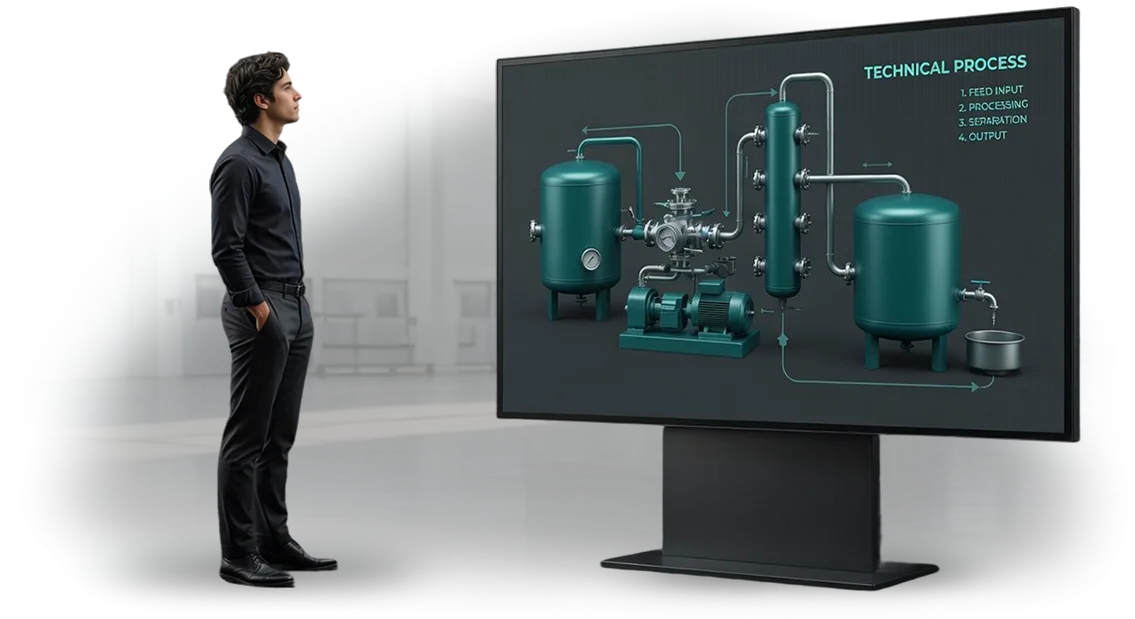
Assembly Errors: How Exploded View Animation Solves the Problem
New employees receive drawings and instructions where each component is shown in projection, and the assembly sequence is described in text.
Even an experienced specialist spends time mentally assembling the product, while a beginner simply cannot see how parts relate to each other — resulting in mixed-up fasteners, incorrect operation order, and defects.
Each such error means rework, line downtime, and a missed shipping deadline. When the problem surfaces at the quality control stage, the product has to be disassembled and the process started over. On a workshop scale, this is not an isolated case but a systemic loss caused by the human factor.
Exploded view animation solves the problem at its root: instead of a drawing, the employee sees a 3D animation where the product breaks down into components and assembles in the correct order.
Parts are highlighted, and the exact installation position and direction of movement are shown. Training becomes watching a short video rather than deciphering symbols and notations.
The team gets an equally clear video instruction for everyone — from a beginner to a shift supervisor. An employee remembers the sequence in one or two views and applies it without errors.
For the business, this means faster onboarding, fewer reworks, and consistent quality of the finished product. 3D animation does not replace a process engineer, but it removes the main pain point of training — the lack of understanding of the process.
What You Get from Exploded View Animation in Training
Exploded view animation created in Fusion 360 turns a complex assembly into a clear sequence of steps. The employee sees how the unit is built from the inside, how parts connect, and how to properly perform installation or repair.
Instead of dozens of pages of instructions — a visual video that can be reviewed at any time. This is especially valuable for new people: the onboarding process is accelerated many times over because there is no need to repeat the same thing to each newcomer personally.
The main benefit is reducing errors when working with equipment. When a mechanic or operator understands the internal structure of a mechanism, they act less on guesswork and do not skip critically important steps.
As a result, there are fewer defects, breakdowns, and emergency downtime — and therefore lower repair and rework costs. Based on our estimates, companies that implement such instructions reduce the number of errors by 30–40% within the first few months.
Training becomes engaging rather than formal. Animated video holds attention better than text or static diagrams, so employees watch the entire video and remember the sequence of actions.
They apply their knowledge more confidently in practice and are not afraid of complex tasks — and this directly affects job satisfaction and employee turnover.
Another advantage is the speed of knowledge dissemination. A video created once can be used to train all new employees without constant mentor involvement.
It is convenient to review on a tablet right at the machine or in the workshop, update when the design changes, and be confident that everyone works with the current version.
We create animations for your actual products using professional equipment so that every frame matches the drawings and the manufacturing process.
In the end, exploded view animation pays off by accelerating training, reducing errors, and increasing staff qualification. You get a ready-made tool that works every day: faster onboarding, less downtime, consistent quality.
If you want to evaluate the effect for your production — send us a description of your task, and we will propose a solution tailored to your budget and timeline.
Exploded View Animation Formats for Training: Which One to Choose
The choice of exploded view animation format directly affects the speed and quality of training.
A full 3D breakdown gives a complete picture of the product's structure, an interactive diagram allows for a detailed examination of each component, and short videos practice specific operations.
We select the format based on your training objective, so the content works rather than just looking good.
In our practice, three options are most commonly used. The comparison will help you understand which format will cover your need.
| Format | Target Audience | What It Gives the Client |
|---|---|---|
| Full 3D breakdown | New employees, technical specialists | A view of the entire product "in section" without a physical sample — faster integration into work |
| Interactive diagram | Setup technicians, service engineers | The ability to pause, rotate a part, and return to a complex step — fewer errors |
| Short videos | Line staff, mass training | Quick grasp of the action sequence and easy knowledge assessment |
A full 3D breakdown in Fusion 360 is convenient for introductory training: in a couple of minutes, an employee sees all components and the connections between them. An interactive diagram is indispensable for studying complex units where a missed step breaks the entire process.
Short videos are easy to integrate into regulations, tests, and e-learning courses — they can be replayed at any moment.
The main thing is not format for format's sake, but a measurable result: reduced onboarding time, fewer errors in assembly and repair, and less load on mentors.
Show us what problem your training solves — we will propose a format that the content will not need to be adjusted to fit.
Stages of Creating an Animation in Fusion 360: From Brief to Launch
For an animation to actually teach employees rather than just look impressive, the creation process must be transparent. We have broken it down into stages — at each one, you see an intermediate result and can adjust details before extra resources are invested.
-
Brief and task analysis. We discuss who the instruction is for, which skill needs to be reinforced, and where employees make mistakes most often. This is the foundation on which all further work is built.
-
Script and storyboard. We show the texts of future titles and the sequence of frames. You approve the script before animation begins — this eliminates rework at later stages.
-
3D model preparation. We create an accurate digital copy of the unit in Fusion 360. The animation replicates the real geometry, so employees see exactly the parts they work with on the production floor.
-
Exploded view creation. We break the object into components, showing the assembly order, rotation, and cross-sections. Even a complex process becomes visual and understandable from the first viewing.
-
Voiceover and accents. We add a narrator's voice or your expert's, subtitles, and highlighting of important elements. The video can be studied without headphones and in a noisy workshop — the information will still be absorbed.
-
Editing and upload to the training system. We assemble the final version, test it on different devices, and place it in your learning management system. Employees get access immediately after publication.
-
Support and updates. If the design or regulations change, we make edits to the animation. Materials stay current without ordering new work from scratch.
What Is Included in the Deliverable: A Complete Package for the Training Department
When you order the development of a video instruction for product disassembly and assembly, you get not just an exploded view animation but a complete package for the training department.
All materials are packaged to integrate immediately into your learning management system and corporate portal.
The deliverable includes:
- Ready-made videos in multiple formats — for the learning management system, portal, in-person sessions, and mobile devices. The videos are optimized for different screens and connection speeds, so employees watch them without delays.
- Source projects — animations, scenes, graphic materials, and textures used. This allows your specialists to make changes independently if equipment or regulations are updated.
- Adaptation to company standards — corporate style, logo, colors, fonts, corporate voiceover, and subtitles. The video instruction looks as if it was created by your internal department.
- Full usage rights — a perpetual license for all materials. You can publish the videos in training, at events, and in internal communications without additional approvals.
- Methodological materials — a guide for implementing the video instruction into the training program, checklists for knowledge assessment, and recommendations for evaluating effectiveness.
- Support and warranty — one month of free revisions after delivery, as well as consultations for your training department on any usage questions.
Case Study: How Exploded View Animation Cut Training Time by 40%
A manufacturing company with 200 employees faced a problem: training new operators on complex equipment took two weeks. Newcomers confused the assembly sequence, made mistakes, and mentors were distracted from their own tasks. Every error resulted in rework and shipping delays.
We proposed replacing paper instructions and static diagrams with exploded view animation in Fusion 360. The employee sees how the device disassembles and assembles in motion: which unit follows which, how parts connect.
The video is clear even to those who have never worked with drawings, and smartphone accessibility allows reviewing the material right at the machine.
What Changed
Training time was reduced from two weeks to four days. The number of assembly errors decreased by 25% — this immediately impacted product quality and reduced the load on the quality control department.
Mentors no longer spend hours repeating the same thing: newcomers figure it out on their own by reviewing the video at their own pace.
A month later, the company conducted a follow-up measurement: errors continued to decline, and assembly speed increased. For the business, this means faster full productivity for new employees and fewer defects.
Savings on mentor time and rework amount to tens of thousands of dollars per year, and the investment in the animation paid off with the first trained group. The approach scales to any process: from machine assembly to electronics maintenance.
Frequently Asked Questions About Implementing Animation in Training
Implementing animation in training usually raises the same questions: timelines, budget, and compatibility with the current training system. We answer the main concerns right away so you understand the process before it starts.
How long does it take to create one exploded view animation?
A typical 2–3 minute video is ready in 2–4 weeks. The timeline depends on the number of parts and assembly complexity. We set checkpoints — you always see what stage the project is at and when the result will be delivered.
What budget is needed?
The price depends on the level of detail and video length. Cost calculated after audit based on your drawing or 3D model. We provide an accurate range after reviewing your brief.
What if we have very complex equipment?
Detail level is not a problem. Our engineers understand drawings and kinematics, so a complex unit becomes a clear step-by-step diagram. A beginner will understand the video without a mentor.
How do we integrate the video with our LMS or training portal?
We deliver the video in standard formats compatible with any LMS: Moodle, internal portals. You only need to upload the file or paste a link — no custom development required.
This is how we eliminate risks before the start. After the brief, you receive a cost estimate, a schedule, and work samples. We create animations in a professional environment, including Fusion 360 — this speeds up video production and maintains accuracy.Order Exploded View Animation Development for Training
You are ordering not just an exploded view animation — but a ready-made training tool for your employees. We handle the entire process: from the brief to the final video that your staff will understand from the first viewing and be able to use on the job.
Transparent pricing and clear timelines — we state them before the start and record them in the contract. No hidden surcharges and endless approvals: only what your training scenario actually needs.
What you get when ordering video instruction development from us:
- Initial consultation — we analyze your task, help you choose the format, depth of detail, and script. We send examples of similar solutions.
- Clear cost estimate and timeline before work begins — you know the price and delivery date in advance, not "sometime in a month."
- Exploded view animation — the product is broken down into units and parts with clear labels so the employee can see the sequence and correct assembly.
- Adaptation to your training process — we add voiceover, text hints, and emphasis on critically important operations.
- Revisions until the result is right — we agree on the number of iterations and refine the video until it satisfies you and your specialists.
- Ready-to-use files for LMS, portal, or video hosting — without unnecessary rework, in the formats you need.
- Post-delivery support — we answer usage questions, help implement the video into the training program, and make quick refinements when needed.
To order video development and find out the exact cost, submit a request on the website — we will contact you within one business day. To get started, simply send a technical specification, a drawing, or just describe your task. We will consult and offer the optimal solution for your budget.
How to Choose the Animation Format for Your Training Task?
Choosing the animation format for a training instruction is always a trade-off between depth of detail and speed of comprehension.
If an employee is disassembling a complex unit for the first time, they need a step-by-step 3D exploded view animation: it shows which parts are removed, in what order, and where to place them.
The skill is reinforced faster because the person sees the entire process rather than reading a text instruction.
The key criteria are product complexity and the audience's skill level. For simple operations performed daily, a short video focusing on one unit is sufficient.
For complex equipment where a mistake is costly, a detailed animation with pauses and replays of key movements is better. It is important to consider who will watch the video: a beginner needs explanations, an experienced employee needs a quick breakdown without fluff.
Another criterion is the viewing environment and accessibility. On the production floor, a format that runs on a tablet or smartphone and requires no special preparation is convenient.
We select the duration, number of angles, and level of detail for your task rather than just making a pretty picture. We use engineering tools in our work, including Fusion 360 — this guarantees geometric accuracy and compliance with the actual design.
The main guideline is the result: so that after watching, the employee performs the operation correctly on the first try. We help you choose a format, test it with a real audience, and refine it until training becomes simple and visual.
This way, you get not just a video but a ready-made tool for reducing errors and accelerating onboarding.