

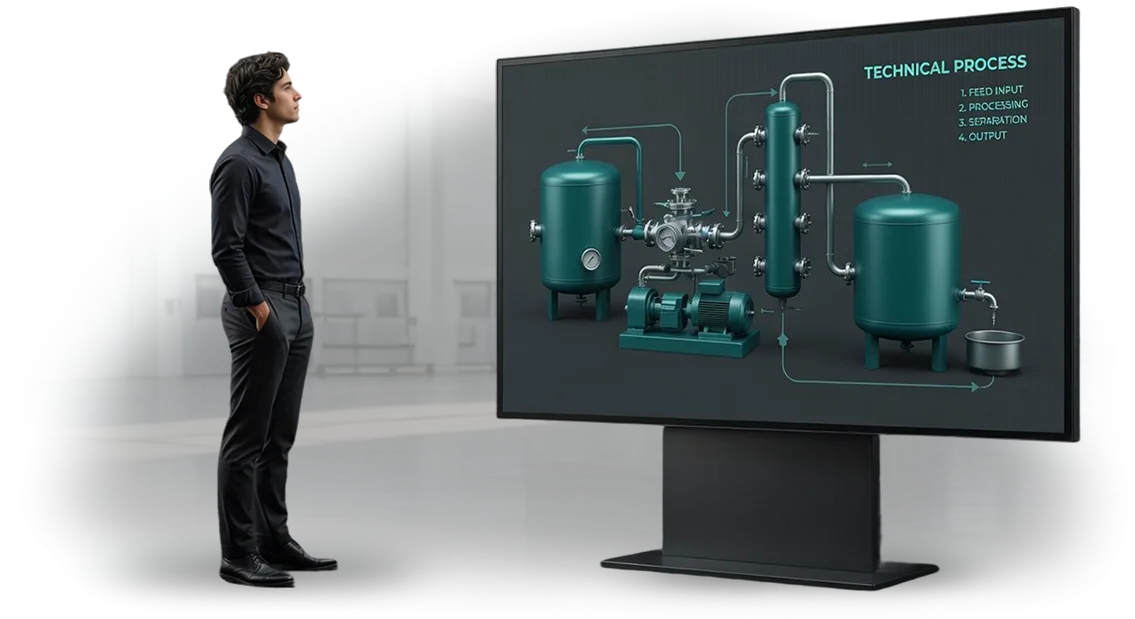
How Exploded Diagram Animation Reduces Costly Staff Errors
Every manager knows how costly staff errors can be during equipment assembly, maintenance, or repair. Expensive defects, downtime, repeated service visits, and even safety risks — all of these stem from misunderstanding instructions.
Text-based instructions and static diagrams don't give an employee the full picture, especially when dealing with complex assemblies made up of dozens of parts. An error here is not just a damaged part, but also lost time, missed deadlines, and dissatisfied customers.
Exploded-diagram animation solves this problem: it shows the product structure in motion, breaking it down into components and reassembling them in the correct order. The employee sees how each element connects to others, where it is installed, and which tool is needed.
Such staff training works faster and more effectively than memorizing articles and drawings because it engages visual memory and logic. An exploded diagram eliminates the questions that usually arise when reading blueprints and makes the process clear from the first viewing.
Implementing video instructions with exploded diagrams reduces the number of errors several times over. Practice confirms this: after switching from paper regulations to animated guides, companies report fewer defects, faster onboarding for new hires, and lower rework costs.
Less time spent on training, less need for expensive simulators and training grounds — employees master operations right at the workplace. In fact, the cost of creating one such instruction pays for itself by preventing even a couple of serious failures.
Reducing errors directly impacts profit: fewer defects means more quality products and satisfied customers.
We create exploded-diagram animation for corporate video instructions, taking into account the specifics of your equipment and the skill level of your employees.
As a result, your team gets an easy-to-understand tool that turns complex technical information into a clear visual film. This reduces costly staff errors and makes processes predictable.
As a result, you can confidently assign responsible operations even to newcomers, without constant supervision from experienced mentors.
Benefits of Training Video Instructions: Speed, Quality, Savings
Employees learn faster when they see the process rather than read multi-page instructions. Training video instructions turn a long introductory course into a few hours of self-paced work: a new person absorbs the material at a comfortable pace and gets to real tasks sooner. Time-to-competency increases, and managers stop spending time repeating the same things.
Personnel quality becomes predictable. The video captures uniform work standards — every employee receives the same algorithms, without distortions from word-of-mouth transmission. This reduces the number of errors, lowers defects, and decreases the flow of support requests. For areas where safety and precision matter, such a unified standard is critical.
Savings come from several components at once. Video instructions replace cycles of mentor-led sessions and return experienced specialists to their core work.
A video created once works for years and scales to any number of employees: new offices and branches receive equally high-quality training without additional investment.
Videos are especially effective when complex mechanisms are shown through assembly and disassembly animation — exploded diagram animation.
This format is understandable even to a beginner: you can see what the product consists of, in what order the parts connect, and where errors usually occur. Maximum clarity shortens the training period and speeds up the transition to practice.
Ultimately, you get not just a collection of videos, but a working corporate training system: fast onboarding, consistent personnel performance quality, and tangible budget savings on mentors and correcting the consequences of errors.
Video Instruction Formats for Your Production Tasks
The same instruction works differently for a newcomer, a repair crew, and an experienced operator.
That's why, before launch, we work together to select a format for a specific task: sometimes a detailed disassembly of a unit is needed, sometimes a quick answer to a common error, and sometimes a clear breakdown of the entire process from start to finish.
Below are the main formats we use in production instructions. This is not a rigid list but a guideline: in practice, we often combine them in a single project.
| Video Instruction Format | Who It's For | What It Gives the Client |
|---|---|---|
| Full exploded diagram with unit disassembly | Mechanics, repair services, service engineers | The employee sees all parts and the assembly order; the number of errors during repair and maintenance is reduced |
| Step-by-step assembly animation | New employees, production trainees | Fast onboarding without pulling experienced staff away from work |
| Interactive instruction with action choices | Operators of complex equipment | The employee finds the answer at the right moment themselves; less downtime from waiting for help |
| Before/after comparison and common errors | All personnel, especially when implementing new processes | Quick retraining and fewer typical failures caused by human error |
| Combined video for group training | Training centers, training departments | One piece of material covers both theory and practice — it can be used in face-to-face sessions and for self-study |
This approach lets you avoid overpaying for unnecessary detail and get exactly the format that closes the task most quickly. And if requirements change, we'll refine the video without reworking the entire line of instructions.
How We Develop Video Instructions: The Process for the Client
We structure the process so that you always know what stage the project is at and what you'll get in the end. You participate at key points: you approve the script, see intermediate versions, and control deadlines. No "black boxes" — only clear steps and a predictable result.
- Brief and audit. We discuss your goals, study regulations and current instructions. We understand who exactly will watch the video and what should change after training.
- Script and structure. We write a shot-by-shot script: logic, texts, accents. You approve it before animation begins — this eliminates unnecessary iterations.
- Layout approval. We show a storyboard and the first frames. You see how the video will look and make edits before full animation is launched.
- Animation production. We create exploded diagrams, arrows, highlighting of important parts — everything that helps an employee quickly master the operation.
- Review and revisions. We present a draft, gather feedback, and refine it to perfection. The final version won't be a surprise — you've already seen almost all of it.
- Launch and support. We deliver files in formats compatible with your training system, help with publication, and answer questions after launch.
After launch, we stay in touch: if processes change, we'll update the materials without a long lead-up. This approach yields instructions that employees actually watch and use — without drawn-out approvals or deadline surprises.
What’s Included in the Delivery: A Kit for Your Training Department
You get not just a video file, but a working kit that immediately integrates into your training system. With it, a new employee reaches the required level faster, and the training department stops spending hours on repetitive explanations to the same people.
Here's what's included in the delivery:
- Final videos — ready to upload to your training portal, messenger, or internal server. We choose the format based on your system so the video opens without any fuss.
- Text scripts — every instruction is duplicated in text. If your rules change or a new regulation appears, you can adjust the script in 10 minutes instead of reshooting everything from scratch.
- Step-by-step text instructions — a cheat sheet for the employee: "turn on, press, save." This is a foundation for on-the-job training and reduces the number of repetitive questions in the support chat.
- Mentor's guide — a short document on how to use the video and instruction in onboarding, so you don't repeat the same things verbally but instead assign the material for self-study.
- Project source files — saved in an open format. If a year from now you want to update just one button in the interface or change the logo, you don't need to order new development — simply edit the source file.
For your training department, this removes the biggest pain point: you stop depending on a "live" expert who leaves with that knowledge — the knowledge stays with you.
The entire body of knowledge is transformed into a format that can be replicated without the author's involvement.
All materials are delivered via a convenient cloud storage service; a download link arrives with the closing documents. If your colleagues have questions, our team's technical support responds within one business day.
How Animation Accelerated Onboarding at a New Production Plant
For industrial equipment manufacturer Vector, launching a new line turned into a problem: operator training took up to three months, and staff turnover at this stage reached a third.
Experienced employees were pulled away from work to train newcomers, but they still made errors during setup — each such error resulted in downtime and material overconsumption.
We replaced part of the in-person sessions with a series of short animated video instructions. Instead of abstract diagrams, the employee sees the exact sequence of actions: how to disassemble a unit, replace a consumable, set parameters.
The videos are available on a tablet near the machine — a needed step can be reviewed in 10 seconds without distracting a supervisor, then you return to work without losing pace.
We measured the effect within a month.
The time to onboard a new operator dropped from three months to three weeks, the number of errors during the first independent setup decreased by 40%, and the share of newcomers who successfully passed their probation period grew by 1.5 times.
The production plan began to be met without overtime, and supervisors returned to their direct tasks instead of constantly "putting out fires."
The production manager notes: "The key is not processing speed, but a person's confidence. Animation removes the fear of making a mistake: the newcomer sees the entire algorithm and acts calmly. Onboarding is no longer a fire drill, and you can see it in the mood on the shop floor."
This approach scales to any production task. When a company opens a new line or changes technology, we update the videos in a few days — without trainer trips or production shutdowns. The instructions stay relevant, and investments in quality video training pay off for years.
How to Tell Which Exploded-Diagram Format Fits Your Business?
You can't choose an exploded-diagram format "head-on" — it's not a matter of taste, but a matter of how employees will actually use the material.
If the product is complex and requires step-by-step breakdown, one approach works; if you need to quickly explain assembly or repair, another works.
So first we determine who will watch, how deeply they need to understand the structure, and under what conditions they'll turn to the video.
The industry often sets specific requirements. Manufacturing companies value maximum clarity and breakdown into units; construction companies need scenarios with assembly options; medical companies need precision and detail.
It also matters where the video will be used: on a computer in the workshop, on an engineer's tablet, or in a training system. This affects the length, the level of interactivity, and even the number of repetitions of key points.
We approach format selection as a separate stage of work. We discuss the task, audience, and constraints, then propose a solution: a short overview video, a detailed breakdown within an assembly, or animation with pauses and accents.
Our engineers create 2–3 prototypes so you can see how the material looks in each variant and confirm the one you need. This removes the risk of spending your budget on the wrong format.
Choosing a format is a practical question, not a technical one. An exploded diagram should speed up understanding and reduce the number of errors among employees.
The right format is obvious immediately: people find parts faster, ask for clarification less often, and work with the product more confidently. To decide, send us your task — we'll show which format suits your business and why.
We Answer Common Doubts Before Ordering Video Instructions
Before ordering corporate video instructions, managers tend to have the same doubts: will the materials become outdated, will deadlines drag on, and will the video fit into the existing system.
This is a normal concern — we address all three questions at the brief and contract stage. You know the terms of updates, compatibility, and deadlines in advance.
What happens when the regulations change after launch?
Video instructions last for years, but individual frames become outdated faster. That's why we prepare videos as a modular set: replaceable screens, text, and source files are stored with us. When standards change, edits take days, not months — you pay only for the actual replacement.
Compatibility with your internal portal and learning system
We'll provide the video in a standard format — it will open in any browser and on any device. If you have a corporate portal or learning platform, we'll test compatibility in advance and adapt the player. We'll include this in the technical specification to avoid surprises at launch.
Will you meet the deadlines?
A typical project takes two to four weeks, depending on the number of videos. We set dates in the contract and divide the work into stages with control points — you always see what stage the project is at. If revisions are needed, we use quick versions without moving the final deadline.
Once the main doubts are resolved, you get a predictable result: instructions that are easy to update, work in your system, and don't require redevelopment. We stay in touch after launch and help make edits when internal standards change. We're ready to discuss your script — write to us.Launch Training with Exploded-Diagram Animation — Submit a Request
Employees learn new processes faster when they see the entire structure rather than read abstract instructions. Exploded-diagram animation shows every detail in motion — clear even to a beginner.
That's why such video instructions reduce training time, lower the number of errors, and save mentors' time.
No need to pull people off work for long courses — the video can be watched at a convenient time, and the mentor answers only complex questions. This is practical employee training without unnecessary costs.
Submit a request for development, and we'll propose a solution for your task ourselves. On the very first day, you receive:
- an analysis of your topic and recommendations for the video instruction format;
- a cost and timeline estimate in two options — budget and optimal;
- a selection of our corporate training projects so you can see the quality level;
- a personal manager who supports the project from the first discussion through launch;
- a revision guarantee: we refine the video until the result satisfies your employees;
- turnkey video instructions: script, voiceover, animation, and editing — all in one place.
This way, you take the routine off your plate and get video instructions that are actually used. All that's left is to click the button and submit a request — from there, we'll take the project off your hands.