

Training Video Instructions for Airport Complexes
When it comes to airport complexes, the cost of staff error is measured not in downtime, but in passenger safety and reputation.
Turnover-driven briefings, paper regulations, and "senior to junior" knowledge transfer no longer work: employees remember only part of the instructions, and new hires take weeks to be brought up to speed.
Even experienced mentors are forced to step away from their own tasks to repeat the same things over and over.
A modern video instruction solves this problem. Instead of abstract texts — clear visual scenes: how equipment is serviced, how to act in an emergency, how to comply with regulations.
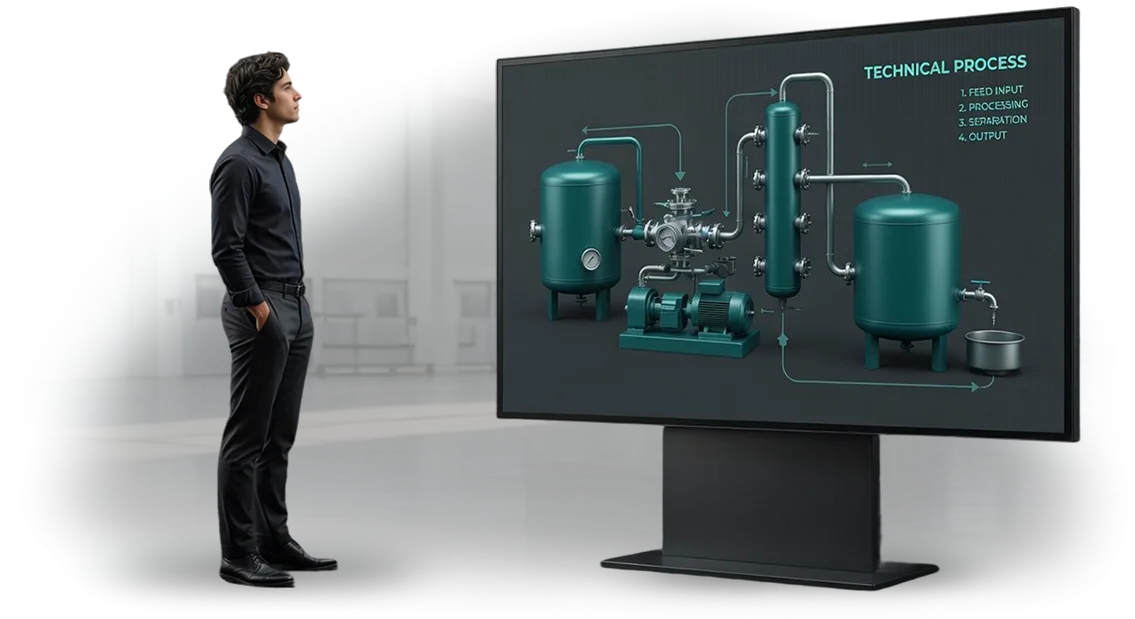
Such materials can be created from real drawings and 3D models — an employee sees assemblies and mechanisms exactly as they look in real life and forms the correct sequence of actions faster.
This is especially important for airport complexes: sophisticated machinery, strict standards, and high traffic intensity.
Video instructions make it possible to standardize staff training: every employee, from dispatcher to engineer, receives equally complete and accurate knowledge, regardless of shift or mentor.
Training can be completed at a convenient pace, and when needed — employees can return to the relevant segment.
In addition, video instructions save resources: the load on experienced specialists is reduced, new hires are onboarded faster, and the number of errors caused by the human factor decreases.
Managers can see that employees have truly mastered the material and can monitor training progress. This is a transparent system that works for the safety and efficiency of the entire airport operation.
We have already delivered such projects for enterprises with high staff training requirements, including airport complexes. We develop video instructions based on your regulations and equipment — with the required level of detail, tailored to specific tasks and training formats. You receive a ready-made tool that pays off quickly through improved employee training quality.
What Airport Staff Training Delivers
Airport staff training is not just a formal briefing, but an important element of safety and passenger service quality.
When employees act precisely and according to a single standard, this directly affects the speed of procedures, the reduction of errors, and the overall impression guests get from the airport.
We help airport complexes create clear video instructions that are easy to use in day-to-day work.
Here is what the client gains after implementing such materials:
-
Time savings. Video instructions with 3D equipment models allow new employees to get up to speed faster. Experienced mentors are less distracted by repeated explanations — it is enough to show the video and answer clarifying questions.
-
Fewer errors. Thanks to detailed 3D models created from CAD drawings, an employee sees the equipment structure from the inside: how components interact, where important elements are located. This reduces the number of incorrect actions during operation and maintenance.
-
Increased safety. Standardized instructions eliminate discrepancies: every employee performs a procedure the same way, without "personal" methods. This is especially important for airports, where lives and equipment integrity depend on precise actions.
-
Higher guest loyalty. Trained staff work quickly and confidently, delay passengers less, and respond to questions courteously. As a result, the airport's service ratings and repeat visits grow.
-
A unified knowledge system. All video materials follow one format and style. This is convenient for updates: when a procedure changes, only one video needs to be replaced rather than retraining the entire staff from scratch.
The key result — the airport gets predictable and safe operation of any shift, while training costs and typical errors are noticeably reduced.
Video Formats for Airport Complexes
In an airport complex, training video is not just a lecture recording — it is a safety regulation and a single standard of action for all services.
One employee needs a short introductory course, another needs interactive hands-on practice with a passenger boarding bridge, a third needs a knowledge refresh module after instruction changes. That is why it is important to choose a format for a specific task and staff category.
We have prepared a set of formats that cover the full training cycle — from the first working day to periodic skills assessment. The table shows which format solves your task.
| Format | For Whom | What It Delivers to the Client |
|---|---|---|
| Introductory video course | New employees of all services | Fast immersion in standards and regulations, fewer errors from the very first days |
| Modular instructions | Ground services, equipment operators | Step-by-step training without disrupting the schedule, clear visualization of every operation |
| Interactive simulators | Staff working with passenger boarding bridges, baggage systems | Safe hands-on practice, lasting skill without risk to passengers |
| Retraining videos | Experienced employees | Knowledge refresh after regulation changes, qualification confirmation |
Modular training allows you to reshoot only the part of the course that has changed, without spending budget on updating the entire complex. Interactivity is what truly engages: employees do not just watch video but memorize the action algorithm.
For an airport, this is critical, because every operation directly affects safety and flight punctuality.
Understanding the specifics of airport complexes, we adapt scenarios to real zones: from check-in counters to the baggage handling area. For filming, we use professional equipment and proven tools — so you get a consistent result that you can confidently show to any audience.
Our team has already worked on similar projects, so we know how to present a process so that it is clear to both a newcomer and an experienced engineer.
What Is Included in Video Instruction Delivery
The complete delivery package allows you to launch employee training immediately after the materials are handed over.
You receive not just a link to videos, but a ready-made system that easily integrates into your training program — especially when it comes to complex airport equipment, where an employee error is costly.
What Is Included in Delivery:
- Ready-made video instructions — in formats for learning management systems, corporate portals, and offline sessions. Each video is edited and voiced, with emphasis on key operations and safety rules.
- Scripts and text documentation — for each video. This simplifies approval with your internal experts and allows quick edits without reshooting.
- Source material archive — scripts, editing projects, 3D models, and textures created from your technical drawings. In the future, you will be able to update videos for new equipment modifications without contacting us.
- Integration recommendations — a guide on how to embed the videos into the training process: which videos to watch first, how to verify material comprehension, and how to track employee progress.
- Role-specific adaptation — for aviation personnel, engineers, security services, and frontline employees. The same process is shown with the required level of detail and emphasis.
- Subtitle and voice-over options — in Russian and English. This is important for international airports and mixed teams.
- Launch support — a short online session with your team to make sure the videos work from day one and deliver measurable results.
All of this saves your time on preparing training materials and reduces the risk of incidents caused by the human factor. You receive a clear tool that pays off quickly through faster employee onboarding and reduced downtime.
How It Works at an Airport: Implementation Example
An airport is an environment where an employee error is costly: from passenger safety to carrier reputation. The staff training department cannot afford long lectures or risky practice on real equipment, so it looks for clear and safe training formats.
We solved this task for an airport complex — let us call it Avia-Yug. Based on drawings and three-dimensional equipment models, we created a series of video instructions with a detailed breakdown of each component.
An employee sees the mechanism from the inside, the startup and shutdown steps, typical emergency situations — and can repeat this as many times as needed at a convenient pace.
Effectiveness was confirmed by figures over two months. Training time decreased by 40%, equipment-related incident rates dropped by 25%, and new hire onboarding accelerated from 8 to 5 weeks.
After the pilot project, the training department expanded the instruction library to all equipment types and ordered ongoing material updates.
Implementation Results
- Training time reduced by 40%
- Incident rate reduced by 25%
- New employee onboarding accelerated by 3 weeks
- Repeat order for the entire equipment line
This approach pays off within the first season: fewer downtimes, faster shift readiness, and confident staff actions in emergency situations. The Avia-Yug case shows how 3D instructions turn complex equipment into a clear and safe training process.
Answers to Frequently Asked Questions About Video Instructions
Clients often hesitate: will a video instruction become outdated, will strangers be allowed onto a secure facility, how can complex equipment be shown, and will staff actually want to learn from videos.
We answer the main questions briefly — so you understand how we work and what you will ultimately receive.
How often do video instructions need to be updated?
Airport equipment and regulations change, which is why we build updates into the support service. If a single component or procedure has changed — we reshoot only that segment, not the entire instruction.
This is faster and cheaper than a full content replacement, and employees always see the current version.
Will a film crew be allowed onto a secure facility?
We have experience working in airport complexes: we prepare documents in advance, pass security checks, and schedule filming so as not to disrupt operations.
If access to real equipment is restricted, we reproduce it in 3D from CAD drawings — accuracy is preserved and safety risks are eliminated.
How do you show equipment that cannot be filmed with a camera?
Large units, internal components, and hidden processes are visualized from drawings. An employee sees the device from the inside, the movement of parts, and the result of every action.
This is clearer than conventional single-angle filming and makes it possible to break down even the most complex operation.
Will employees actually watch and apply the instructions?
Short, visual videos are easier to absorb than text or diagrams. We build the scenario from startup to normal operation rather than delivering a lecture. As a result, staff memorize action sequences faster and make fewer mistakes, and newcomers reach their working rhythm sooner.
If you are unsure whether a video format suits your equipment — send us your drawings or regulations. We will show you what the instruction will look like and answer your questions based on the specifics of your airport complex.What You Get After Project Launch
After the project is launched, you receive not just video files, but a ready-made training tool that works immediately. Employees master complex airport equipment through clear 3D models created from your drawings — instead of dry text regulations.
Here is what is included in the final deliverable:
- Clear video instructions for each piece of equipment — from the control panel to hard-to-reach components, with a level of detail that text cannot convey.
- Training without interrupting work: videos are accessible from any device at any time; an employee goes through the material at a convenient pace and does not wait for an in-person training session.
- Fast deployment: a complete file package and training materials are delivered in a convenient format, and the training department can start within days.
- Reduced mentor workload: experienced specialists no longer repeat the same explanations — videos cover typical questions.
- Post-delivery support: we support the project, make edits when equipment or regulations change, and help adapt videos to new tasks.
- A unified training standard: all employees see the same accurate sequence of actions, which reduces the risk of errors and improves on-site safety.
This package pays off quickly: less time spent on onboarding, fewer mistakes, and stable work quality even with high staff turnover. Leave a request — our team will prepare a plan and give you exact timelines for your task. You will get videos that are truly used on the job.
How to Choose the Right Format for Employee Training?
There is no universal training video format: what works for one staff category is useless for another. Therefore, choosing a format starts not with visuals or duration, but with analyzing the tasks and target audiences within the airport complex.
First, the audience should be divided by skill level and area of responsibility. New employees need basic navigation and safety rules, while experienced specialists need emergency scenario breakdowns and equipment maintenance details with airport-specific context.
If you shoot one universal video for everyone, it will be too long for some and too superficial for others.
Airport specifics add special requirements: strict regulations, shift schedules, a high cost of error, and the need to onboard people quickly. The format must allow an employee to return to the right segment at any moment — for example, from a mobile device at the worksite.
This changes both the script structure and the material presentation: complex components and mechanisms are easier to show not in live footage but in a volumetric model created from equipment drawings.
We help you decide on the right format for a specific task: we propose a modular structure, a combination of video and 3D animation, and for the most critical operations — scenarios with comprehension checks.
When choosing, we take into account the target audience, viewing conditions, and the specifics of the equipment at your site. A properly chosen format shortens training time, reduces the number of errors, and makes the staff preparation process clear and manageable.