

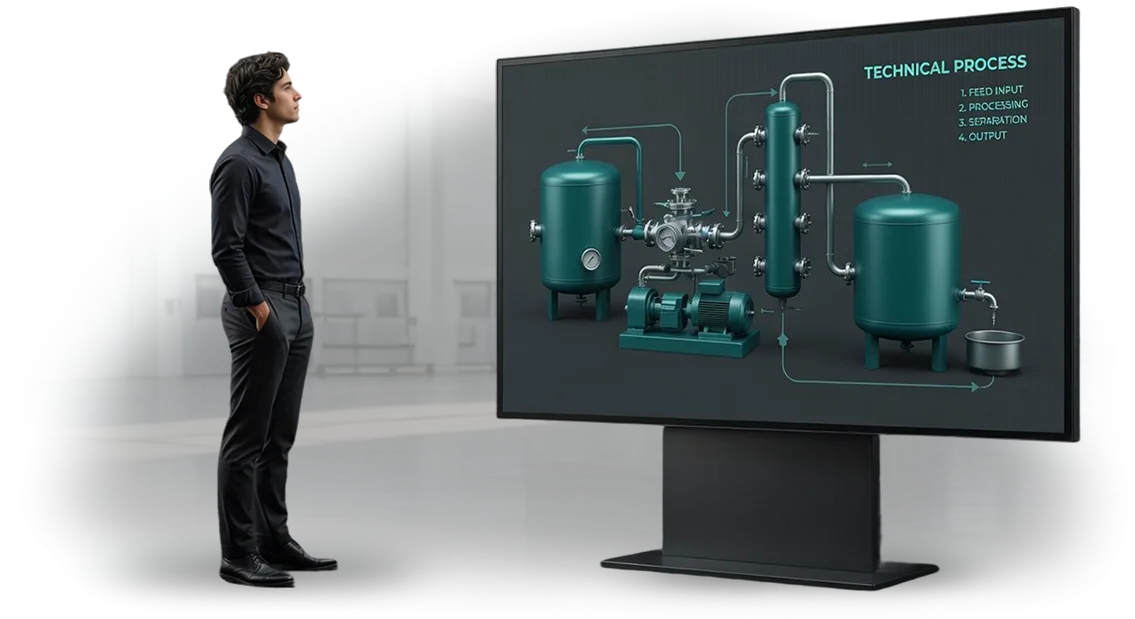
Why Does the Pulp and Paper Industry Need Video Instructions?
An employee at a pulp and paper mill operates complex equipment where the cost of a mistake is a costly line stoppage, an accident, or an injury.
Every production area — from pulp cooking to winding finished paper — requires a strict sequence of actions, and breaking that sequence is critical.
Most enterprises train staff using the “buddy system” or through written procedures. As a result, a new employee remembers only 10–15% of the instructions, while an experienced one performs operations in their own way, deviating from the process sheet.
Different approaches lead to defects, raw material losses, and emergency shutdowns, which are the most costly in the pulp and paper industry.
Staff turnover makes the situation worse: by the time a trainee reaches the level of a skilled operator, months have passed and hundreds of tons of product have been spoiled.
Video instructions are the only way to standardize the actions of all employees regardless of experience or shift. They provide a benchmark algorithm that is equally clear to a beginner and to a worker with twenty years of experience.
This is exactly the approach we use when creating training video instructions for the pulp and paper industry — you get predictable quality for every operation and fewer emergency situations.
A procedure that an employee sees with their own eyes is remembered many times better than a printed document. Onboarding time is reduced several times over — the employee works confidently and safely, and you do not lose revenue due to downtime and rework.
Benefits for the Company: Faster Onboarding and Fewer Errors
Every new production employee is an investment. If training takes months and mistakes lead to line downtime and defects, the company loses money before the newcomer starts working effectively.
Video instructions with detailed 3D visualization of equipment turn training into a clear, repeatable process — without the need to constantly distract mentors.
For Managers
A manager gets a tool that reduces onboarding time from weeks to days. The employee sees not a flat diagram but a realistic model of components and mechanisms, so they understand the operating principles faster and make fewer mistakes during start-up and maintenance.
Training becomes standardized: everyone receives the same knowledge rather than a retelling from different mentors. This reduces reliance on personal experience and increases the predictability of operations.
For HR Specialists
HR gets a single repository of training materials that is easy to replicate as the team grows. Video instructions are equally clear to experienced workers, newcomers, and temporary staff — there is no need to organize lectures every time.
Progress is easy to track: just check whether the employee has watched the material and practiced the skill. This accelerates the onboarding of new employees, reduces turnover during the probation period, and increases team loyalty.
To make such instructions work in real conditions, we create 3D models of equipment from your CAD drawings — down to every fastening unit. This lets us show details that are critical for safe operation in the pulp and paper industry.
We combine industrial experience and computer graphics to make training deliver measurable results.
Video Instruction Formats for the Pulp and Paper Industry
The choice of training format determines how quickly an employee will master an operation and be able to work without errors. On a pulp and paper production line, the cost of a mistake is high: equipment shutdown, defects, injuries. That is why the formats differ not in visuals but in the speed of achieving stable results.
| Format | For Whom | What It Gives the Client |
|---|---|---|
| 2D videos | Mass operations, fast onboarding | Low production cost, short delivery time, a single standard for the entire shift |
| 3D modeling from drawings | Complex units and internal mechanisms | Shows the equipment “in section” without stopping production |
| Video recording | Real operations on an operating line | Clarity without guesswork: the employee sees exactly what awaits them |
| Interactive modules | Knowledge testing, algorithm practice | Training with feedback, each worker's error zones are visible |
For Operational Roles
Operators and setup technicians need step-by-step guidance: what to press, in what order, what counts as a defect. 2D videos and interactive simulators work well here — they allow practicing the algorithm before going to the line.
The employee goes through the scenario in a safe mode and arrives at production already prepared, while the instructor sees who has absorbed the material and who needs extra practice.
For Engineering Staff
Mechanics, technologists, and maintenance services need to understand the design of equipment hidden behind covers and housings. 3D modeling from your drawings shows the components in section, the disassembly sequence, and control points.
This cuts the time spent studying documentation from weeks to a few hours, reduces the risk of maintenance errors, and minimizes line downtime.
Stages of Creating Training Videos for Your Enterprise
Creating training video instructions follows a proven workflow: you get a predictable result within an agreed timeline.
Each stage involves approval with your side — the final material precisely matches the enterprise's objectives and the specific features of working on your equipment.
Project Preparation
The work begins not with visuals but with immersion in the production processes. We gather information about the equipment, procedures, and employee skill levels so that the video speaks a clear language and addresses the real points of error.
Next are the seven stages the project goes through from the first request to the delivery of the finished material:
- Brief and task analysis. We define the training goals, audience, and list of operations. You get a work plan and an understanding of the scope of materials before production begins.
- Script approval. We prepare the structure of the future video: the sequence of actions, emphasis on safety procedures and complex components. You approve the text before we begin visualization.
- 3D visualization from CAD drawings. We model the equipment and its components with the required level of detail. The employee sees the process in section and from the right angle — this greatly simplifies understanding.
- Animation and editing. We assemble 3D scenes into a single video instruction. We place visual emphasis on critical actions and remove anything unnecessary.
- Voiceover and subtitles. We record a narrator's text or adapt yours, and add subtitles. You choose the format used in your training system.
- Review and revisions. We show a draft version and make adjustments until it fully matches your procedures. You approve the final video without missing deadlines.
- Delivery and support. We deliver the finished files in the required formats and remain in touch. If the equipment or procedures change, we will help update the video quickly.
This approach shortens employee onboarding, reduces the number of errors, and creates a unified training standard.
You get a clear process, transparent timelines, and material that can be easily integrated into a personnel training system for both the pulp and paper industry and any other type of production.
What Is Included in the Video Course Delivery Package
We prepare the delivery package so that the client does not have to worry about implementation. You receive not just videos, but a complete set for launching training: from the script to ready-made LMS files.
Everything is structured, labeled, and described — all that remains is to upload and assign it to employees.
- Script and methodology map — for each video, the goal, key shots, voiceover text, and quiz questions for assessing understanding are defined.
- Final video instructions in the required formats — for LMS, corporate portal, and offline viewing on tablets and screens in workshops.
- Video source files — project files, 3D models, and equipment textures recreated from your CAD drawings. If a part needs to be updated or the color changed, you will not have to order work from scratch.
- LMS files — standard course packages and separate mp4 files compatible with any distance learning system.
- LMS administrator guide — step-by-step instructions for uploading, configuring access, and tracking employee results.
- Implementation checklist — a list of actions to launch training across multiple shifts without disrupting the schedule.
Package Options
The basic package covers the main task — quickly and clearly training staff to operate the equipment.
For companies with branches and different shifts, we add package options: adapting videos to workplace types and skill levels, subtitles and translation of instructions, and regular material updates during production modernization.
The modular scheme lets you expand the package gradually — you pay only for what your employees actually use.
Case Study: How We Made 3D Instructions for a Mill
A pulp and paper mill approached us with a problem: onboarding new operators took several weeks, and some staff left after their first shifts.
Paper instructions and mentor-led training did not provide the needed speed — the equipment is complex, and mistakes were costly. Shop managers wanted a newcomer to safely understand the components before going out to the line.
We modeled the equipment from CAD drawings, textured the parts, and assembled interactive 3D instructions. The employee sees every component and the sequence of disassembly and maintenance from any angle, without the risk of stopping production. Training became visual, identical for all shifts, and independent of the mentor's availability.
Project Results
After launching training programs with 3D instructions, the mill reduced onboarding time by 30%: instead of three weeks, new employees were working independently after two.
The number of errors during scheduled maintenance fell by a quarter, and the number of repeated requests to mentors nearly halved.
They also noted safety: trainees practice operations on a digital model, so the risk of injury at the initial stage is almost eliminated. Shop managers use the same materials to test knowledge — the check takes 15–20 minutes instead of two-hour interviews. For the mill, this means less downtime and stable shop utilization.
We continue to support the mill: when equipment is upgraded, we update the 3D instructions as well, so training always matches the actual production line.
This personnel training case study in the pulp and paper industry shows that proper visualization from drawings pays off in the first months and delivers lasting results.
How to Choose the Training Video Format for Your Task?
There is no universal training video format — the choice depends on the task, the complexity of the operation, and the employees' skill level. For some, a short demonstration video is enough; for others, a detailed 3D model with a breakdown of every component is required.
In the pulp and paper industry, where equipment is expensive and complex, a mistake in format selection results in lost time and defects.
When an employee needs to master the repair or setup of a unique unit, the best choice is a video instruction based on 3D modeling from CAD drawings.
This format lets you show the internal structure and demonstrate the sequence of actions without the risk of damaging the equipment. The employee sees not a flat diagram but a three-dimensional mechanism — this speeds up understanding and memorization.
If the task is to teach a daily operation (replacing consumables, cleaning, standard adjustment), recording the real process with clear shots and emphasis on key points is sufficient. Such a video is easier to update, and the employee can find the needed fragment more quickly.
The key here is not detail, but speed: a person should get an answer in a minute and return to work.
How do you know which format you need? We analyze the task, the audience, and the usage scenario: what equipment, what employee experience, what error is critical.
After that, we suggest a selection of video instructions for your goal and create a short test fragment — you see the result before the full production and can adjust the approach.
Choosing the right format is not about looks, but about saving resources: less training time, fewer mistakes and accidents, and easier onboarding of new employees. That is why we start with diagnostics, not with a camera and editing. You get a format that actually solves your task.
Answers to Frequently Asked Questions About Video Instructions
Developing training video instructions for employees usually raises questions — even before the project starts, clients want to understand the budget, timeline, and result.
We have been working with pulp and paper industry enterprises for years and have collected the five most common concerns. We answer honestly and to the point.
How much does it cost to develop a video instruction?
The cost depends on the complexity of the equipment, the number of operations, and the level of detail in the 3D models. After the brief, we fix the price in the contract and work in stages.
At the approval stage, we calculate options for your budget: a full 3D breakdown or a lighter version with emphasis on key components.
What are the production timelines?
A typical project takes three to six weeks. First, we analyze the drawings and write the script, then create the model and textures, and then assemble and edit the video.
A clear schedule allows training to be launched by the planned equipment change or the arrival of a new group of employees.
Will employees actually watch the videos?
Yes, because a 3D instruction shows the equipment from the inside, not a flat picture from documentation. Voice guidance, emphasis on important components, and the sequence of operations keep attention.
According to our clients' experience, such videos reduce initial training time and lower the number of errors when working with complex units.
Can you handle complex equipment?
We have experience converting CAD drawings of pulp and paper equipment into accurate 3D models. You get an instruction in which every component matches the real machine, not a simplified diagram.
This is exactly the case where technical accuracy directly affects training quality and employee safety.
What if the equipment is upgraded?
We keep the original 3D models and project files. If a component or procedure changes, we can quickly rebuild the needed fragment and insert it into the existing video.
The update costs significantly less than creating a video from scratch, and employees always work with the current instruction.
Submit a Request for Video Instruction Development
Training employees to work with industrial equipment is a constant headache: expensive machines require careful handling, and staff errors lead to downtime and losses.
Video instructions solve this problem, but before starting, it is important to understand the scope of work, budget, and timeline. That is why we suggest starting with a request — it takes a couple of minutes, and in return you get the full picture of the project.
When you submit a development request, you get a consultation and a cost estimate tailored to your specifics. We will analyze your task in detail and propose a solution that truly fits your enterprise.
- Cost calculation for development tailored to your equipment fleet — no hidden surcharges or unexpected estimates.
- Producer consultation: which video instruction format is effective for different categories of employees.
- A selection of examples of our work for pulp and paper production and similar industries.
- A preliminary plan for video shoots and approval stages with your occupational safety service.
- Completion timelines and a schedule for launching the finished instructions into the training system.
- Recommendations on how to integrate video instructions into current processes and train the first employees.
- Personal support at all stages: from the brief to the delivery of the final result and post-launch support.
Submit a request for video instruction development today — we will contact you within one business day, clarify the details, and send you a cost estimate. You have nothing to lose, but you get concrete numbers and an action plan to quickly solve the problem.