

Why Dental Clinics Waste Time on Staff Training
In a dental clinic, every employee — from assistant to administrator — affects the patient's impression. Staff training in dental clinics often comes down to verbal instructions, scattered checklists, and the hope that a newcomer will quickly catch on by themselves.
As a result, mistakes repeat: the workstation is prepared incorrectly, the instrument processing sequence is broken, and the patient receives a different explanation than during the appointment.
Such staff turnover makes the problem worse. Every new employee takes up the time of senior specialists, and while they are learning the ropes, service quality already suffers.
The clinic loses not only time but reputation: patients sense instability, notice inaccuracies, and switch to competitors.
Employee mistakes cost more than they seem at first glance: fixing them takes hours of the doctor's and administrator's time, while the patient is left with a feeling of chaos.
Every inaccuracy in instrument processing or in pre-procedure instructions is a risk to safety and trust. When training depends on a mentor's memory rather than a proven standard, it is impossible to guarantee the same level of treatment and service in every branch.
That is why we create corporate training video instructions based on the clinic's real workflows. They turn scattered knowledge into a single visual standard that shortens the onboarding period, reduces the number of mistakes, and strengthens patients' trust in the clinic.
How Training Videos Solve Staff Turnover and Work Quality Problems
How do you deal with staff turnover and inconsistent work quality? In a dental clinic, every new employee is a risk: training takes months, and the result depends on personal experience.
Training video instructions remove this dependency — they turn the knowledge of the best specialists into a visual, reproducible standard.
Here is what this approach delivers in practice:
-
Fast onboarding of new employees. Instead of lengthy mentoring — short videos that can be reviewed at any time. A new employee learns procedures faster and starts contributing to the clinic several weeks earlier.
-
A single work standard. All employees perform operations in the same way: from instrument processing to complex equipment handling. This reduces the number of mistakes and makes the outcome more predictable for the patient.
-
Fewer errors when working with equipment. Based on precise equipment drawings, we create 3D models that show the design and operating principles without the risk of breaking a real device. Employees train before they start working with patients.
-
Quality control and certification. Managers can see who has completed the training and how well they absorbed the material. Video instructions become a basis for knowledge checks and also help quickly bring employees back up to speed after a break.
We develop such video instructions for a specific clinic's needs — from simple regulations to detailed simulators for working with complex dental equipment. This solves the staff turnover problem and makes work quality stable regardless of the team composition.
Formats of Training Video Instructions for Your Task
For dental clinics, it's important that employees quickly master equipment operation. But each scenario has its own goals: some need to show the sequence of actions for preparing a treatment room, others need to break down a complex unit of a device. The right format depends on the training goal, budget, and audience.
| Format | Target Audience | What It Gives the Client |
|---|---|---|
| Detailed video with instructor | New employees, staff without technical background | Fast onboarding, a single standard for equipment operation |
| Animation (diagrams, processes) | Experienced staff, refresher training | Visual explanation of operating principles, fewer errors during use |
| 3D visualization from CAD drawings | Specialists in complex devices, engineers, training for rare procedures | Full understanding of equipment design, skill practice before first contact with the real device |
A detailed video is the fastest way to show the sequence of actions from start to finish. This format is suitable for basic instructions on dental units and consumables: the new employee turns on the video and repeats after the instructor.
Animation adds diagrams and accents, helping to understand how the instrument moves inside the system — this reduces the risk of incorrect use.
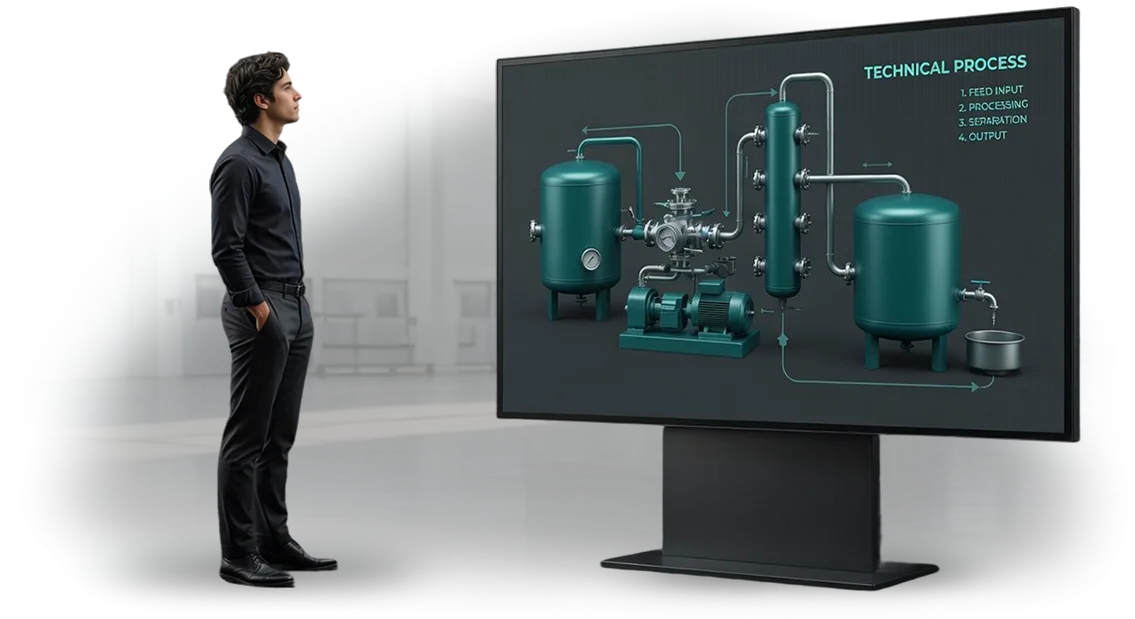
When you need to explain the design of complex equipment, we use 3D visualization from CAD drawings. It allows you to take the device apart, show internal components and the assembly sequence without stopping the clinic's operations. This format is especially useful when commissioning a new model of a dental unit.
Choose the format based on your training goal. For mass training of new employees, a detailed video is enough; for technical specialists — 3D visualization. We will help determine the best option for your task and budget.
How Work on Your Project Goes: From Brief to Launch
You receive a ready-made video instruction that is clear to any employee — from a newcomer to an experienced specialist. The process is structured so that you participate at every key stage and always know what is happening with the project. Below are the standard development stages we use to create training videos for dental clinics.
- Brief and audit. We gather requirements: what equipment, what operations need to be shown, and who will watch the instruction. We study CAD drawings and regulations to accurately convey all the parts and components.
- Training scenario. We break the process into clear steps, write the voiceover text, and define visual accents. We approve the scenario before production begins — this saves time and eliminates rework.
- 3D modeling and texturing. Based on your drawings, we create an accurate model of the equipment and show every part in action, including hidden mechanisms. Instead of filming a real object, we use 3D — this lets us demonstrate what cannot be seen with the naked eye.
- Voiceover and editing. We record a professional voiceover, add subtitles, diagrams, and pointers. We edit the video into a single instruction that is easy to understand and remember.
- Approval and revisions. You receive a draft version and provide feedback. We adjust the video until you are completely satisfied with the result.
- Launch and support. We deliver the final files in the required formats and help integrate the video into your training system. If equipment or regulations change, we update the instruction.
This approach turns video instruction creation into a managed process with clear timelines and results. You get not just a video, but a tool that reduces onboarding time and lowers the risk of errors when working with expensive equipment.
What Is Included in the Delivery: A Complete Set of Materials
You receive not just video files but a ready-made staff training system. All materials are collected in a single package: from finished videos to source models — so you can start training right after project handover, without lengthy adaptation or revisions.
What Is Included in the Delivery
- Finished video clips — step-by-step instructions for working with equipment, created on the basis of your internal regulations. The employee sees exactly the processes adopted in your clinic.
- Source files for all materials — editing projects, individual scenes, and graphic elements. If you later want to update the video — you won't have to order work from scratch; it is enough to make edits in the source files.
- Methodical recommendations for the mentor — a lesson scenario, a list of practical tasks, and questions for knowledge assessment. Helps quickly bring a new employee up to speed.
- Regulations and checklists — short reference notes for work: what to check before a procedure, how to prepare the equipment, which actions are mandatory. Convenient to keep at hand or hang at the workplace.
- Source 3D models of the equipment — created from your CAD drawings and remain your property. You can use them to create new materials, presentations, or training for other tasks.
This package covers the entire training chain: a video for initial viewing, an instruction for skill practice, and assessment materials for result control.
You don't pay for "hot air" — every element solves a specific task and works toward a single quality standard in the clinic.
Case Study: How We Cut Training Time by 3x
New employees of dental clinics face the same pain: complex equipment must be mastered quickly, and mentors are already busy seeing patients. Text instructions do not give a complete picture of the details, so mistakes at the initial stage are inevitable. Clinics lose time on onboarding, and patients feel the staff's uncertainty.
We decided to close this problem with visual video instructions. For a dental clinic chain, we developed a series of training videos for working with diagnostic and treatment equipment.
Instead of flat diagrams — an accurate three-dimensional model of the device, created from engineering drawings. The employee sees every component from all sides and can break down the sequence of actions down to the smallest detail: from connection to daily maintenance.
Result after a month
One month after the training launch, the adaptation time for new employees decreased by a factor of 3 — from 5 days to 1.5 days. The number of errors when working with equipment dropped by 40%, and mentors stopped being distracted by repeated explanations.
For each new employee, the clinic saves about 3 working days — those hours are redirected to seeing patients and developing the clinic.
Why the client came back
Video instructions quickly became the standard for onboarding training across all branches. HR managers note that newcomers ask the same questions less often, start working independently faster, and pass the probation period more confidently.
Six months later, the chain ordered an extended course for professional development of existing employees — that is the best sign that the result was valuable.
How to Choose the Right Format for Your Dental Clinic?
There is no universal video instruction that fits all dental clinics. The format must be chosen based on the clinic's size, types of procedures, training goals, and budget — otherwise, you will overpay for unnecessary features or get videos that employees don't finish watching.
A small private clinic with two or three chairs needs only short instructions for key procedures: instrument setup, sterilization, working with an assistant.
A chain with branches and a constant flow of new employees needs a modular system where each procedure is split into separate videos — they are easy to combine into a training program.
The complexity of the procedures also determines the format. For rare or technically intensive manipulations — for example, implantation or laser work — it is better to order detailed 3D instructions with equipment breakdown based on CAD drawings.
This allows the doctor to see the internal structure and understand the working principle before picking up the instrument. For everyday routine actions, simple step-by-step videos are enough.
Budget and training goals are directly connected. If the task is to quickly introduce staff to new equipment, choose short videos with minimal detail.
If the goal is to standardize service quality across all branches and reduce the number of errors, investing in detailed 3D visualization pays off through fewer reworks and more confident work by doctors.
We help you choose the format for your tasks: we analyze the clinic's specifics, number of employees, procedures, and budget, and then propose the optimal option — from a series of short videos to a full-fledged training system. You get exactly what you need and don't pay for anything extra.
Answers to Frequently Asked Questions About Training Video Instructions
Most often, clients ask not about the filming technology, but about predictability: whether the videos will stay relevant, how quickly you will make changes, and what to do when equipment is updated.
These are normal questions — they determine whether the investment in staff training will pay off. We answer directly, without fine print.
What guarantees do you provide for the result?
We fix in the contract the deadlines, the composition of the videos, and acceptance criteria. You see an intermediate version, provide feedback, and only after your approval do we deliver the final file. If the result does not match the technical specification, we refine it at our own expense.
What if we need revisions along the way?
Revisions are included in the cost and timeline of each project. You send your feedback as a list — we make the changes without unnecessary approvals. Minor adjustments take a couple of days; larger ones stay within the schedule we agree on in advance.
How long does it take to create a video instruction?
A standard video about working with equipment takes 2–4 weeks. The timeline depends on the complexity of the scenario, the number of 3D scenes, and the need for voiceover. If the deadline is tight, we can strengthen the team and deliver faster without losing quality.
Will the videos still be relevant in a year, and how do we update them?
Any training material becomes outdated when the equipment model or internal regulations change. That is why we give you the source files of the project — for targeted edits, there is no need to reshoot the video from scratch. Replacing a component name or changing the order of steps is 2–3 times cheaper and faster.
How closely does the video match the clinic's internal standards?
We approve the scenario and text with your senior staff or technologists. The video uses your clinic's terminology, and the 3D model of the equipment is built from your drawings.
If needed, we add branded intros, subtitles, and a voiceover — so the videos fit naturally into your training system.
Order Training Video Instruction Development Today
Submit a request, and within 1 business day we will prepare a cost estimate and a training development plan for your clinic. We will explain how we turn the CAD drawings of your dental equipment into clear 3D instructions for your staff, and show examples of similar projects.
Training development follows a transparent schedule: from the brief to the final videos, you always know what stage the project is at. We handle coordination, approvals, and revisions so you don't have to control every detail.
You will get:
- ready-made video instructions for employees — without taking them away from work;
- 3D models of the equipment that show the design and components more accurately than photos;
- a single training standard for all shifts and branches;
- short videos of 3–7 minutes, understandable for beginners and experienced specialists;
- the ability to make edits and expand the instruction library as the clinic grows.
To order video instructions, simply write to us or call us — the consultation is the first step. We will ask a few questions about your equipment and tasks, recommend the optimal video format, and send you a preliminary estimate.
After that, you can launch training development at a convenient time — without prepaying for the whole project.
You can find out the cost and timeline today. Submit a request, and we will get back to you with a calculation and concrete steps that will lead to ready-made material for your team.