

Undertrained Personnel — the Main Risk in the Oil and Gas Industry
Industrial accidents are the main risk in the oil and gas industry, and in most cases, the human factor is behind them.
Employee errors when working with equipment occur not because of negligence, but because of weak training: a person has not seen the assembly in a cutaway view, does not understand the sequence of operations, does not know emergency situations.
The cost of one such mistake is not only downtime and repair. It is the safety of people, environmental obligations, reputation, and fines.
When employees with different experience levels work on the site, the risk increases exponentially: a newcomer acts from memory, while an experienced specialist skips steps, considering them obvious. As a result, the standard instruction does not help — text regulations are read but not remembered.
Traditional employee training in the oil and gas industry often comes down to lectures and paper-based briefings. This doesn't work in conditions of staff turnover and high responsibility: knowledge fades, and it's impossible to test it on real equipment without risk.
As a result, the company pays twice — for the training itself and for the consequences of insufficient training.
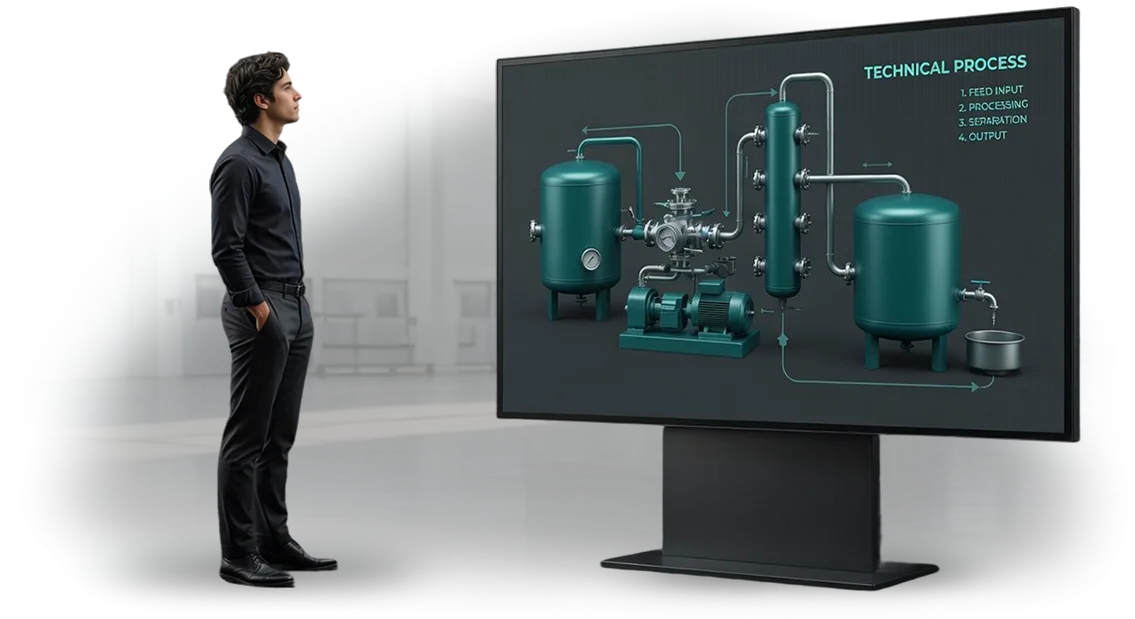
We solve this problem by shifting training to a visual format. Corporate training video instructions created from your CAD drawings show the equipment in precise detail — with assembly breakdowns, the correct sequence of operations, and typical errors.
The employee sees not an abstract diagram, but the real mechanism they work with. This reduces the likelihood of errors and makes training understandable for any skill level.
This approach pays off already at the first incident that was avoided. And the systematic use of video instructions reduces onboarding time, increases discipline, and gives the manager confidence that every employee knows what to do — in both standard and emergency situations.
What 3D Video Instructions Give Businesses and Employees
Training personnel in the oil and gas industry involves high requirements for safety and accuracy. Errors when working with expensive equipment cost the enterprise downtime, repairs, and risks to employees.
Traditional paper instructions or static presentations do not give a complete picture of the object, so new specialists take a long time to get up to speed, and experienced ones do not always remember all the regulations.
A 3D video instruction solves this problem. We create an exact digital copy of the equipment from your CAD drawings, showing it from any angle, in cutaway, in motion. The employee sees every component and sequence of operations as if they were holding the part in their hands.
The main benefit for the business is clarity. Complex technological processes stop being an abstraction. A newcomer grasps the regulations faster, and an experienced worker refreshes their knowledge without taking time away from production. The company gets reduced onboarding time and a lower load on mentors.
Fewer errors are a direct result of visual clarity. When a person understands the logic of how an assembly works, they less often act by guesswork. This reduces the number of emergency situations, defects, and breakdowns — and therefore reduces the enterprise's costs.
The time savings are obvious: a video instruction replaces hours of work with a mentor. The employee reviews the material at a convenient pace, and the training department doesn't spend resources on repeated orientations. A unified training standard levels out the skill levels across all branches.
In the end, the business gets predictable team qualifications, fewer errors, and confidence in the safety of production processes.
A 3D video instruction pays for itself through reduced downtime and accidents — and that is the main result for an industry where the price of a mistake is especially high.
Formats of Video Instructions for Oil and Gas Enterprises
The choice of video instruction format determines how quickly an employee moves from watching to confident action.
In the oil and gas industry, the cost of an error is high, so we select the presentation method for the specific operation: sometimes a short video is enough, while complex equipment requires an interactive 3D model to examine the device in detail without production risks.
All formats are created based on your regulations and CAD documentation, so the visuals match the real equipment. This reduces adaptation time and eliminates discrepancies when training different shifts.
| Format | For whom | What it gives the client |
|---|---|---|
| Classic video instruction | Line personnel, shift crews | Quick familiarization with equipment and regulations; the video can be reviewed from a phone at any time. |
| Interactive 3D scene | Technologists, operators, maintenance services | The employee chooses assemblies themself, sees the device from the inside, and clearly absorbs the assembly and disassembly order. |
| VR trainer | Operators of hazardous production facilities, occupational safety | Practicing actions in an emergency situation without stopping the process and without risk to people; skill is reinforced in 2-3 sessions. |
Most often, enterprises combine formats: classic videos for mass familiarization, interactive 3D scenes for 3D training on complex assemblies, and VR simulators for actions in emergency scenarios. This approach builds a complete training cycle: from initial briefing to a sustainable skill.
How We Create Video Instructions: a Step-by-Step Turnkey Process
We start with a brief where we record the training goal, audience, and enterprise regulations. At this stage, we determine what result the business needs: quick onboarding of a newcomer to a shift, standardization of actions, or reducing accident rates. Then we collect the source data — drawings, operating instructions, videos of real operations.
When the materials are ready, we design a 3D model of the equipment and coordinate it with your specialists. This is a key moment: you see how each component looks and confirm its accuracy before the videos are shot.
Only after the model is approved do we prepare the script — we break the operation into clear steps, write the voiceover, and highlight safety points.
Editing and adapting formats to your training systems is the final touch. You receive ready-made modules for the LMS, short versions for review, and materials for in-person briefings.
- Brief and task audit — we discuss employee profiles, regulations, and the desired result, and set timelines.
- Documentation collection — we study drawings, regulations, and typical employee errors.
- 3D modeling and approval — we create an accurate model of the equipment and approve it together with your technologists.
- Script and voiceover — we write the instruction text in plain language, record the narrator, and take industry terminology into account.
- Scene capture or rendering — we work through each component and action from the needed angle.
- Editing and graphic annotations — we add arrows, labels, and highlight key safety moments.
- Delivery and adaptation — we provide the video in the required formats and train your specialists to work with the materials.
Thanks to this process, you see intermediate results at every stage and understand exactly what you will get at the end. On average, a project takes three to four weeks — we give the exact timeline after the brief and documentation analysis.
What Is Included in a Completed Video Instruction Project
A complete set for a finished video instruction is not just a video, but a system that solves the training task: onboarding new employees, professional development, practicing actions in emergency situations.
We deliver everything in a single package so you immediately get a tool, not a set of semi-finished items. The package includes everything that goes into a video instruction, from script to final files.
- Script and storyboard plan. Text, presentation logic, timing — adapted to the specifics of the oil and gas industry and the skill level of your employees. You immediately see what is explained and at which moment.
- 3D equipment models based on your CAD drawings. Exact copies of units, assemblies, and parts with realistic textures. The employee can examine the equipment from any angle, zoom in, and study elements that are difficult to show in a photograph.
- Animated disassembly and assembly. Step-by-step diagrams of the operation sequence — from unscrewing a bolt to removing an assembly. Understandable even for those seeing the machinery for the first time.
- Professional voiceover and subtitles. A narrator with clear speech, without noise or "dead" pauses. Subtitles are useful in a noisy workshop or in an area where sound cannot be used.
- Final editing according to the script. Footage, animations, and text are combined into a single video that holds attention and guides the viewer from start to finish without questions.
- Files in the formats you need. We will prepare versions for the learning management system, for tablets and smartphones, and for offline on-screen displays. Let us know where you will use it, and we will adapt.
- Implementation guide. A short instruction on how to integrate the material into your training program and recommendations for monitoring knowledge retention.
This delivery set covers the entire cycle: from theory to practice. You receive ready-made instructions for employees and can launch training within a few days after project delivery. And if needed, we refine the materials to accommodate changes in regulations or new equipment.
Case Study: How We Helped a Plant Cut Training Time in Half
The case study of creating video instructions that we implemented for an oil and gas machinery plant starts with a typical pain: new employees came to production without practice, and mentors spent up to three months on each newcomer.
Paper regulations didn't help — complex assemblies had to be shown in person, and staff turnover hit the work schedule hard.
That's when we at our team proposed the implementation of 3D training based on the customer's CAD drawings. Instead of filming on real equipment, we created 3D models of all key assemblies: they can be taken apart, shown in cutaway, and paused at the most important moment.
This allowed on-the-job training to no longer depend on the availability of a mentor or the condition of the equipment.
Project
Over four weeks, we turned the engineering documentation into a series of short video instructions: assembly, disassembly, maintenance, quality control. Each video covered a specific operation — from replacing a seal to adjusting a pump unit.
The materials were uploaded into the plant's training system so employees could open them from a tablet right in the workshop.
Project Results
After two months, the time to train a new employee was cut in half — from eight weeks to four. The number of assembly errors decreased by a third, and mentors returned to their core work instead of constantly repeating the same things.
After the first stage, the customer ordered ten more videos for neighboring workshops — the best indicator that the project's results were measurable and valuable to the business.
How to Choose the Right Video Instruction Format for Your Task
Choosing a video instruction format starts with the question of what the employee should do after watching.
Simply repeat an operation, understand the structure of a complex assembly, or practice the sequence of actions in an emergency situation — both the presentation style and the depth of detail depend on this.
For standard regulations and simple operations, a regular video with voiceover and subtitles is sufficient. It is quick to produce, easy to update, and suitable for mass employee training.
A different matter is complex equipment, of which there is plenty in the oil and gas industry: pumps, compressors, shut-off valves.
Here, the choice of training type is better built on 3D visualization: it shows the internal structure and the physics of operation without needing to stop production.
Interactive videos add knowledge checks right in the viewing process. The employee answers questions, chooses the sequence of actions, and immediately sees the consequences of errors — so the training takes place in a safe environment.
We help you determine which format will cover your task: from short instructions to programs with 3D models and interactive scenarios.
During the consultation, we analyze the specifics of the equipment, the skill level of the employees, and the working conditions — and propose the optimal solution.
Frequently Asked Questions About Developing Video Instructions
Before launching, clients usually ask three questions: how long it will take, how accurately the equipment will be shown, and how to update the instructions afterwards. We answer honestly — without fine print or asterisks.
How long does it take to develop a video instruction?
The timeline depends on the complexity of the equipment and the number of scenes. We prepare a standard instruction for one piece of equipment in 2–4 weeks: from the brief and drawing analysis to the final video with voiceover and editing.
If the equipment is complex or the instruction is large, we discuss deadlines separately. But we always fix the deadline in the contract and work in parallel: while one assembly is being modeled, finished scenes are already being rendered. So delays are the exception, not the norm.
How accurate will the 3D model be?
The model is built strictly according to the customer's CAD drawings — that is the basic guarantee. All assemblies, fasteners, connectors, and the assembly order replicate the real structure, so after training the employee will not encounter surprises when arriving on site.
If ambiguous places are visible in the drawings, we clarify them using photographs or directly with your engineers. The result is always approved before the final render — you see the model and approve it before we start making the video.
What if the equipment is modernized?
This is why we make instructions modular. Each operation is a separate block, so when one assembly changes, there is no need to reshoot the entire video. It is enough to rebuild the changed 3D model and replace the fragment.
Updating takes significantly less time and budget than the original development. At the same time, you receive a complete set of source files and materials — even your internal specialist can update the instruction if they decide to do it themselves.
Order Video Instruction Development for Your Enterprise
Oil and gas production does not forgive mistakes: even an experienced employee can miss a nuance when working with complex equipment.
Text regulations are read diagonally, while a video instruction with an accurate 3D model shows every assembly clearly — as if the person were standing next to the installation. This reduces the risk of accidents and speeds up onboarding — especially with high staff turnover.
We develop training for your specific task: we recreate the equipment from drawings and animate operations. Employees get a single standard that works across all branches. What you get after ordering:
- An accurate 3D copy of the equipment based on your drawings — training without access to the real object.
- Step-by-step videos from the overall diagram to assemblies — for beginners and experienced workers.
- Fast preparation of new employees — saving mentor time and quick readiness for a shift.
- A unified training standard for all sites — not tied to the instructor's personal experience.
- Fewer errors and less downtime: personnel see the consequences of incorrect actions in advance.
- Video updates when equipment is modernized, based on new drawings.
How to start a project? Leave a request — we will contact you within a business day and clarify the task. If necessary, we visit the production site to record the actual conditions. Then we prepare a plan, timeline, and cost estimate, and after approval we get to work.
Ordering video instructions now means having a ready-made training tool by the next batch of new employees. Leave your contacts, and we will prepare a proposal for your task.