

Port terminals suffer losses due to weak employee training
Staff training at port terminals is often built on outdated methods: multi-page instructions, verbal transfer of experience from senior colleagues, and rare in-person trainings.
A newcomer masters complex equipment through trial and error — and every mistake with cranes, conveyors, or loading systems results in downtime, damaged cargo, or a safety risk.
The result of such failures is direct losses and lost customer trust. Shipowners and logistics companies are not willing to wait while your staff learns the hard way: they choose terminals where vessel handling runs exactly on schedule.
One disruption of stevedoring operations due to an untrained operator — and the contract goes to a competitor, while the reputation takes a hit that discounts cannot fix.
Regular video instructions do not save the situation either: filming real equipment often shows components from only one angle, while complex internal mechanisms remain a "black box." An employee memorizes the sequence of actions but does not understand how the machine is built and backs down in an emergency. That is why training does not deliver the required speed and confidence.
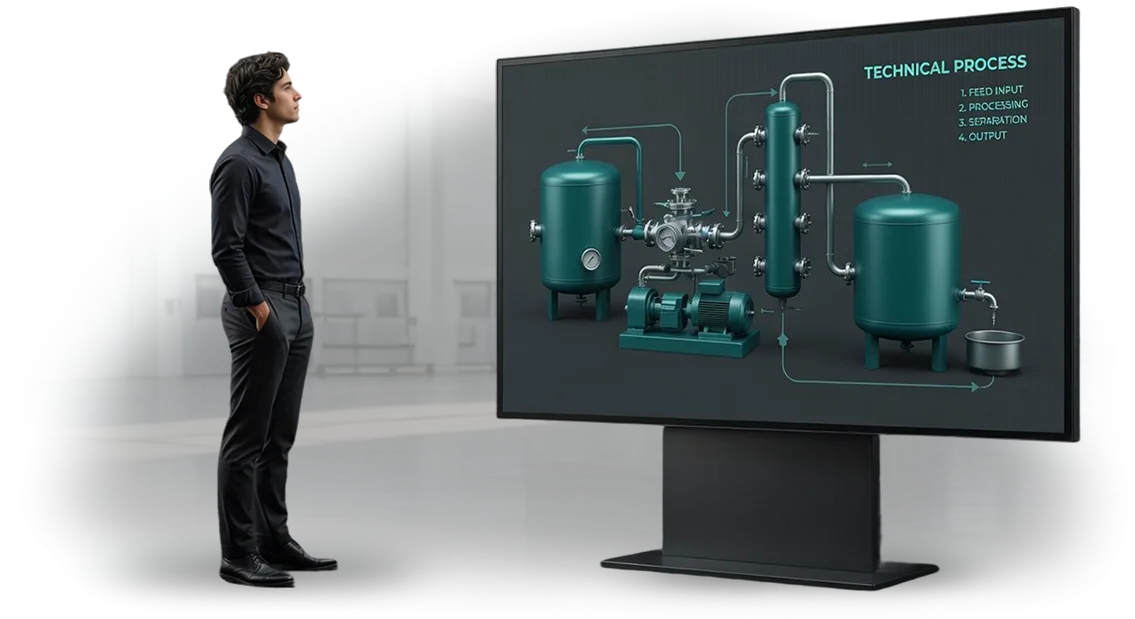
We solve this problem by creating corporate video instructions with 3D models of equipment based on your CAD drawings. The employee sees the terminal structure from the inside, examines each component, and practices procedures without risking cargo or machinery.
The result is quick ramping up of newcomers to working pace, fewer delays and disruptions, and therefore predictable terminal operation and client trust.
What a 3D video instruction delivers for employees and business
New employees at a port terminal learn for weeks, and the cost of a mistake on real equipment is high: downtime, breakdown, injury. Paper instructions and diagrams poorly convey the sequence of actions, and each mentor teaches in his own way.
A 3D video instruction closes these issues — it provides an accurate, visual, and unified picture of the work.
Benefit: faster onboarding for newcomers
The employee sees the equipment from all sides and in operation, not just flat drawings. He quickly understands the structure of the components and the order of operations, and the instruction can be reviewed at any time — no need to wait for a mentor.
Benefit: reduced risks and injuries
The video instruction shows hazardous zones and safe techniques before going out to the site. Fewer mistakes mean less downtime, safer equipment, and more peace of mind for people. Every prevented incident pays for the cost of the material.
Benefit: standardization of knowledge
All employees learn from a single standard rather than from different mentors' stories. This eliminates inconsistencies in actions and makes the result predictable. With high staff turnover, a new person quickly reaches the common level.
Benefit: clear KPIs for the manager
The video instruction is integrated into the certification system: you see who has completed the material and how well they have absorbed it. The manager gets a real readiness indicator instead of "word-of-mouth" assessments. On this basis, it is easier to plan shifts and improve work quality.
Our team creates instructions based on your equipment drawings — employees train on an accurate copy of the machinery even before their first shift.
Formats of 3D video instructions for a port terminal
A port terminal is dozens of units of complex equipment: cranes, loaders, conveyors. To work safely, an employee needs to understand the structure and the sequence of operations. Text instructions and photos are ineffective here — 3D videos show the mechanism in action.
We select the format for a specific training task: from a short video to a full-fledged simulator. Each option covers its own need — speeds up onboarding, reduces accident rates, or helps practice rare scenarios.
| Format | Target audience | What it gives the client |
|---|---|---|
| 3D videos | New employees, operators | Visual breakdown of components and operations — faster memorization of the sequence, fewer mistakes in the first week |
| Animated diagrams | Maintenance services, engineers | Show internal structure and working principle — simplify diagnostics and reduce downtime |
| Interactive modules | All staff, occupational safety department | Practice of actions with decision checking — the employee learns without risk to themselves or equipment |
| Video tours | Managers, contractors, new teams | Introduction to terminal areas and rules — quick adaptation without disrupting core tasks |
This variety allows you to cover all training scenarios in a single project. You get a unified training standard that can be easily scaled to new shifts and branches. Moreover, any format can be updated when regulations change or new equipment appears.
Stages of creating a video instruction: from brief to implementation
We work according to a transparent scheme: each stage is fixed in a plan, you see intermediate results and influence the outcome. This approach rules out the situation where the finished video does not match expectations.
-
Brief and audit. We collect requirements: which operations to show, who the viewer is, where mistakes most often occur. We study regulations and documentation so that the instruction fits into the existing training system.
-
Script. We write a frame-by-frame script and voice-over text, and align it with your technologists. The rules and terms comply with internal standards.
-
3D modeling based on CAD drawings. We create accurate models of your equipment — from cranes to conveyors. Employees see familiar machinery and transfer the skill to work without "relearning."
-
Interim approval. We show draft frames and animations. You make edits before the final render — this saves budget and time.
-
Final render and editing. We assemble the video with voice-over, subtitles, and packaging for your training portal. Formats are selected for the online platform and offline classes.
-
Test launch. A pilot group goes through the training. We fine-tune details: pauses, accents, pace of delivery.
-
Implementation and support. We hand over source files and final files, and help upload the video to the distance learning system. We stay in touch and will update the material when regulations change.
This process delivers a predictable result: the instruction reduces ramp-up time and lowers the number of staff errors.
What is included in the delivery of a corporate video instruction
The delivery package includes everything needed to launch training at a port terminal: all video versions of the instructions, text scripts, a mentor's guide, and access to a closed library.
We provide the materials in a form that can be used immediately — the manager appoints a responsible person, and employees start learning.
- The full version of the video instruction — a detailed breakdown of working with equipment, from startup to emergency situations.
- Short video modules on components — the required fragment can be shown again without rewinding the entire video.
- Mobile version — an employee opens the instruction on a tablet or smartphone right at the terminal.
- Text scripts for all videos — the basis for memos, exam tickets, and handouts.
- Mentor's guide: lesson plan, typical beginner mistakes, and control questions.
- Access to a closed library with role-based permissions — each shift and department has its own folder.
- Updates when regulations change — the materials are kept current, and training does not lag behind new procedures.
- Support during the implementation period — we answer employee questions while they get used to the new format.
With this package, the manager gets a transparent training system. There is no need to improvise: there are videos, accompanying documents, and access — all that remains is to control the result.
Case study: how 3D videos reduced operator training time
Training operators at port terminals is always a balance between speed and safety. Internship on a real crane takes weeks and requires a mentor to be present, and a single mistake by a newcomer can stop a shift and cause injury.
Therefore, the terminal looks for a way to give employees practical experience without risk to people or cargo.
With such a request, the port terminal operator came to us.
Based on CAD drawings, we created accurate 3D models of cranes, transshipment machines, and platforms, and then assembled them into video instructions with a first-person view and detailed action scenarios.
The employee sees every step — from grabbing a container to securing it on a trailer — and repeats it in a safe environment.
What results did the client get
Measurements after implementation showed that the time of introductory training was reduced threefold. Whereas previously an operator started working under a mentor's supervision after a month and a half, now it takes two weeks.
At the same time, the number of errors in container handling decreased by a third, and the number of dangerous situations at the terminal became noticeably lower.
Terminal management did not expect the video instructions to pay off so quickly. A month after launch, they ordered a new series for warehouse equipment and included 3D training in their staff training standard. Now three more company branches are using the materials.
How to choose the right video instruction format for your task?
You cannot choose the video instruction format "by eye" — it directly depends on two factors: the complexity of the equipment and the skill level of specific employees.
This is especially critical for port terminals: the same operation may require either a short reminder for an experienced machine operator or a step-by-step breakdown with three-dimensional detail for a newcomer.
If you choose the wrong format, you will end up with either a "skipped in a minute" video with unlearned nuances, or an overloaded lesson that demotivates staff.
For simple operations on universal equipment, a short overview video of up to three minutes is enough. It shows the sequence of actions in real time and quickly refreshes knowledge — this format suits an experienced team that only occasionally checks the regulations.
The opposite situation: a complex component, a rare emergency operation, or a new employee who sees a crane or transshipment machine for the first time.
This requires a detailed 3D instruction with the ability to pause, zoom in on components, and texturing based on CAD drawings, so that a person understands not only "what to press" but also what happens inside the mechanism.
The rule is simple: the higher the cost of a mistake and the lower the employee's experience, the more detailed the format should be. For mass regular training — modular videos cut into 2–3 minute segments.
For unique machines and dangerous operations — a full breakdown with filming and three-dimensional inserts that show hidden mechanisms and permissible tolerances.
We will help you choose a format after a short audit: it is enough to know the type of equipment, typical staff errors, and the current training level. On this basis, we will propose a structure and presentation style rather than a one-size-fits-all template.
This way, you do not overpay for excessive detail where a simple video is sufficient, and you do not risk an accident by saving on a detailed breakdown.
Frequently asked questions about ordering video instructions for staff
Ordering training videos is most often associated with questions even before the project starts: how long to wait, how much it will cost, and whether everything will need to be redone when equipment changes.
We have collected answers to the most common concerns — about timelines, budget, complexity, updates, and staff engagement.
How long does it take to create one video instruction?
On average, a 5–7 minute video takes from two to four weeks: the timeline depends on the number of equipment components and the number of scenes that need to be modeled and animated.
Before starting, we fix the schedule in the contract and show intermediate versions so that you understand at what stage the work is.
If training needs to be launched urgently, you can start with a short module on the most critical operation — it is faster, and the other parts are added at the next stage.
Why does developing video instructions cost this much?
The price is made up of the volume of 3D models, the number of scenes, voice-over, and editing. You are not paying for a "video" but for a finished training product that works for years: it replaces dozens of hours of live lectures and reduces the risk of staff errors.
Unlike filming at a real facility, a 3D model based on CAD drawings makes it possible to show internal mechanisms and hidden processes that cannot be seen on live equipment.
Is it difficult to integrate the video into the current training system?
No, we are ready to adapt to your process: we provide videos in common formats for LMS, tablets, desktop computers, and even for viewing at the production site.
The files are split into short modules by operation so that an employee can quickly find the required step without rewatching a long instruction.
What happens when equipment changes?
We store the project source files, so there is no need to reshoot the entire video for an update. We only change the affected scenes and voice-over — this is faster and cheaper than ordering a new version from scratch.
Clients often take the support option to update instructions as their equipment fleet is modernized.
Will employees actually watch the video?
Yes, if the video answers their questions and does not look like a lecture. We build the scenario around typical mistakes and safe work practices, rather than simply showing buttons.
From our experience, staff are more willing to watch short dynamic videos with an emphasis on the consequences of wrong actions — engagement is significantly higher than when reading paper regulations.
Submit a request for a 3D video instruction for your enterprise
You have equipment that needs to be maintained and employees who need to be trained. The faster a newcomer understands the work operations, the lower the risk of downtime, breakdowns, and losses.
A 3D video instruction based on your drawings turns a complex technological process into a clear scenario: the employee sees every component and repeats actions without errors.
To understand whether this format is suitable, there is no need to launch a test project. Just submit a request — and we will prepare a cost estimate for your scope of work and show examples that are already used at port terminals. This is non-binding.
What you get after submitting a request:
- Cost and timeline estimate — tailored to the number of operations, machine types, and staff training level.
- Examples of our 3D video instructions for port terminals and related areas — you will see what the finished result looks like.
- Work plan and list of source data — just send drawings or a technical specification, and we will handle the rest.
- Format recommendations — video, interactive instruction, or a training program consisting of several modules.
- Expert consultation — we will tell you which operations are better shown in 3D and which should remain text.
- Guarantees — we fix timelines and scope of work in the contract and show intermediate versions at every stage.
Submit a request for a 3D video instruction for your enterprise — and within the next few days you will receive an estimate, examples, and a clear action plan. The rest is up to you: we are ready to launch the project as soon as you confirm the task.