

Video Instructions for the Food Industry: How to Reduce Staff Errors?
On a food production line, the cost of an employee mistake is especially high: a breach in the cleaning sequence, incorrect equipment settings, or failure to follow regulations can lead to a rejected batch, line stoppage, and complaints from regulatory authorities.
Text-based instructions and one-off lectures don't solve this — a new hire retains only 20-30% of the information, and when staff rotate, the training process restarts from scratch.
Video instructions address this challenge systematically: the employee sees each step on real equipment and repeats it at their own pace.
Such training reduces the number of staff errors several times over. Video improves information retention by 80% compared to text, meaning employees reach consistent results faster and less frequently cause emergency situations.
For food production, this is also a safety matter: strict compliance with sanitary standards, operating rules, and safety protocols becomes a habit rather than a formality.
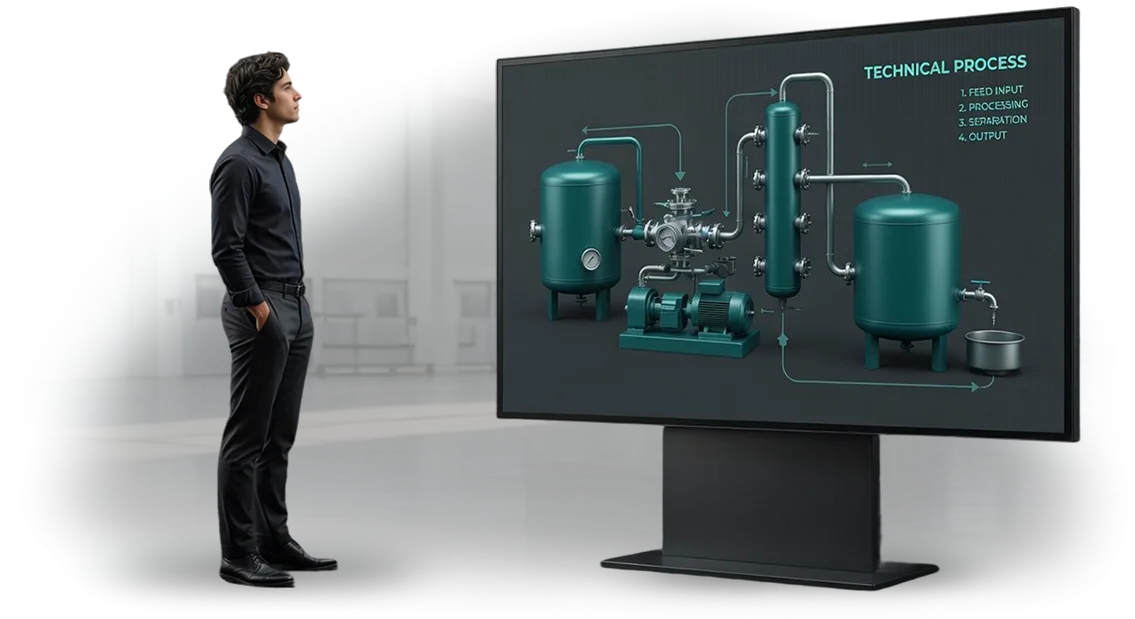
We create video instructions based on real equipment and CAD models, so every detail — from valve placement to the order of operations — is shown accurately and clearly.
The employee doesn't have to guess what the "right button" looks like: they see it on screen and find it on the line.
This is especially important when working with new lines, when equipment is already installed but there aren't enough experienced mentors for every workshop.
As a result, employee training takes several times less time, and work quality becomes predictable. The production manager gets a tool that works without their involvement: video instructions created once are used for all new employees and during recertification. This addresses both staff turnover and inconsistent line quality.
What Does a High-Quality Video Instruction Give a Production Facility?
A high-quality video instruction is not just a video for show, but a practical tool that immediately reduces employee onboarding time.
Instead of thick manuals and verbal explanations, a new worker gets a clear example: how to properly start equipment, wash lines, and maintain documentation. The result — a newcomer moves to independent work faster and with fewer errors during their first shifts.
A unified video training standard aligns the actions of all employees — regardless of experience or shift. When everyone performs an operation according to the same clear scheme, the risk of raw material spoilage, equipment breakdown, and sanitary violations decreases.
Consistent product quality and less waste are direct savings for production, as well as peace of mind for the manager regarding compliance with work standards.
Such instructions significantly simplify mentoring. Instead of explaining the same thing ten times, an experienced employee records the correct sequence of actions once — and then the video works on its own.
The mentor gains time for supervision and assistance where it is truly needed, rather than repeating basic steps. This is especially valuable during staff turnover and seasonal workloads.
Finally, staff training becomes systematic: new videos are easy to update when technologies or requirements change, and access can be opened from any device — from a tablet in the workshop to a home laptop.
Production gains a sustainable process that does not depend on the departure of a key employee. All of this together delivers rapid onboarding, fewer errors, and confidence that every worker acts according to unified standards.
Video Instruction Formats for the Food Industry
In the food industry, the cost of an error in violating instructions is especially high: a rejected batch, line stoppage, complaints from regulatory authorities.
Classic training formats — lectures or text-based regulations — often fail: employees remember only part, and on the line they act on instinct. Video instruction solves this problem by showing the reference process without breaking away from reality.
We shoot and model training videos that fit into any scenario: from initial induction to professional development. Below is a comparison of the main formats so you can choose a solution for your task.
| Format | Who It's For | What It Delivers to the Client |
|---|---|---|
| In-person training with video | New employees, complex regulations | Live contact with a mentor plus a clear visual. The employee reaches working mode faster, and experienced specialists spend less time on repetitive explanations |
| Remote courses | Distributed sites, shift schedules | Training at a convenient time without gathering people. You see each person's progress and control work authorization — no logistics or downtime |
| On-the-job instruction | Lines, packaging, equipment maintenance | 3D breakdown of components and operation sequences right at the machine. Fewer errors during changeovers, repairs, and planned work |
In practice, food industry companies combine formats: remote theory is reinforced with a short video briefing on site. We help select the optimal set for your production specifics — from a single video to a full library of instructions.
How We Create a Video Instruction: Stages of Work
Every project starts with the question "what should change in employee behavior after watching?" That's why we built the development process so you can see the result at every stage and influence it before the final edit — no surprises and no missed deadlines.
We work remotely; all communication happens through channels convenient for you. Over 10 years of practice, we have refined a process that delivers video instructions on time — from short 2-minute videos to complex training programs with 3D equipment models.
- Brief and material audit. We gather requirements: who will watch, which operations to show, where employees most often make mistakes. We study your regulations, instructions, and if available, CAD drawings of the equipment.
- Script plan and storyboard. We turn the technological process into a clear sequence of shots. We align the logic with you: what we say, what we show, where we place emphasis.
- Filming and 3D modeling. We film real operations on site and simultaneously create 3D models of equipment components based on your drawings. This lets us show details that cannot be seen on video: internal mechanisms, cross-sections, product flow.
- Video assembly and voiceover. We edit the material, add narrator text, pop-up captions, and emphasis on critical actions. You receive a draft version for review.
- Review and revisions. We make adjustments based on your feedback and approve the final version. Usually one or two rounds are enough — thanks to the approved script at stage two.
- Delivery and support. We provide the finished files in the required formats, source files, and access to the video library. We consult the staff who will work with the instruction and remain available if the material needs updating.
The entire cycle takes 2 to 4 weeks depending on equipment complexity. The result is a clear video instruction that can be used both for training newcomers and for retraining experienced employees.
What You Get in the Final Package
The full delivery package is a ready-made training system that can be implemented immediately after the materials are handed over. We've put everything needed for rapid employee onboarding into one package: videos, 3D models, text regulations, and access to updates. You won't have to search for materials in different folders or write instructions yourself.
Here's what's included in the package:
- Video instructions for each operation: from short overview videos to detailed breakdowns of complex actions. The formats are universal — they can be viewed on a computer, tablet, or smartphone right at the equipment.
- 3D equipment models built from your CAD drawings. Instruction becomes visual: the employee sees components and mechanisms from any angle, understands the operating logic, without risking a production stop.
- Text instructions and checklists — a compact version of the video for quick review. Handy to keep nearby when you need to quickly verify the sequence of actions.
- Materials for your learning management system or internal portal. Upload the ready files and assign courses to employees without additional adaptation.
- Access to package updates. If regulations change, new operations are added, or equipment is modernized — you receive current versions of instructions and models.
- Methodological recommendations for mentors: how to conduct knowledge checks, what to pay attention to, how to reinforce the skill after viewing.
This package covers the full training cycle — from initial familiarization with equipment to knowledge control. A new employee starts contributing faster, and mentors get a ready-made tool instead of repeated verbal explanations. This reduces errors and downtime related to the human factor and makes training predictable.
Case Study: How a Video Instruction Reduced Training Time at a Plant
When a new shift of line operators came to Molochny Dar dairy plant, we saw a typical food industry pain point: onboarding took almost a month, mentors were constantly distracted by training, and errors during changeovers cost downtime.
Previously, newcomers were explained things verbally and shown on real equipment — but for practice, the line had to be stopped, which is a direct loss to production.
We digitized the real workshop: built accurate 3D models of each machine from engineering drawings and created a series of video instructions where the entire sequence of operations is visible at a glance.
Employees train on a tablet or computer at their own pace, review complex components as many times as needed, and only then go to the equipment. This removed the burden from mentors and eliminated the risk of errors due to "human factors" in knowledge transfer.
The plant's results after 3 months speak for themselves: the onboarding period was reduced by 30% — from four weeks to nineteen days. The number of errors during line startup dropped by half, and mentors' time spent repeating basic operations fell by 60%. The metrics were recorded by the HR department and confirmed at a production meeting.
The implementation required no purchase of new equipment — the instructions open on any tablets and computers in the workshop. Seeing the effect, the plant immediately ordered similar video instructions for the maintenance department and warehouse.
This case is an example of how 3D visualization technology turns factory training from a cost center into a productivity tool.
Answers to Frequent Questions About Developing Video Instructions
Clients from the food industry often ask similar questions: how quickly we can make video instructions, how much it costs, and whether the videos will work in their training system. We answer the main concerns so you understand the workflow in advance and can plan your budget.
Below are typical questions we hear from production managers, marketers, and HR. If your question isn't here, ask us directly — we'll discuss the details on a short call.
How long does it take to develop a video instruction?
It depends on equipment complexity and the number of operations. For one item with 5-8 steps — an average of 2-3 weeks from the moment drawings and references are provided.
If you need to show non-standard setup or rare operating modes, the timeline increases — but we always fix the delivery date in the contract.
How much does it cost?
The price depends on the scope: the number of equipment models, the level of detail of 3D scenes, and the number of video episodes. We calculate the estimate individually after the brief — you receive a clear list of works and the final cost with no hidden surcharges.
Will the videos work with our training system?
Yes. We deliver videos in standard formats that play in any LMS and internal portal — from a simple corporate database to a training center. The video can be embedded in a course, a test, or attached to a safety instruction.
Do employees need training to use the videos?
No. The videos are designed so employees can figure things out themselves: close-up shots of operations, voiceover, and text hints. Just start the video — even a new operator without experience will understand the sequence of actions.
We work from your CAD drawings — this guarantees the accuracy of every detail and the sequence of operations. This way the instruction precisely matches the real equipment at your production facility and eliminates errors in staff training.Order Video Instruction Development for Your Equipment
Leave a request — and we'll take your project into work from day one: provide a quote, propose a plan, and agree on details before filming begins.
You'll get not just a video file, but a ready-made staff training solution that addresses food industry objectives: fast onboarding of newcomers, unified equipment handling standards, and fewer errors.
Here's what you get immediately after contacting us and upon project completion:
- Fast cost and timeline estimate — we provide the price and work schedule for your scope within one business day, with no hidden surcharges.
- Individual approach — video instructions are built on your regulations, equipment, and real work scenarios, not template shoots.
- Clear project plan — we document stages, deadlines, and responsible parties so you always know what's happening with your order.
- Employee-friendly format — short videos with emphasis on key actions: from startup to emergency stop.
- Training to fit your schedule — we deliver materials in a convenient format for your learning management system, internal portal, or in-person instruction.
- Guarantee of results — if the instruction doesn't meet your requirements, we refine it until it fully matches your expectations.
To order a video instruction, text us or submit a request — specify the equipment type and training objectives. We'll call back, clarify the details, and propose a solution that fits your budget and timeline.
This closes the employee preparation issue and removes risks associated with unsafe or ineffective work on the production floor.
How to Choose the Right Video Instruction Format for Your Production?
There is no single "one right" video instruction format — and that's normal. What works perfectly for one bottling line may be excessive for a packaging machine.
The format choice should be driven by three things: equipment complexity, staff turnover, and how employee training is currently organized at your facility.
Start with the tasks. If you need to quickly bring a newcomer up to speed on a simple machine — a short 3-5 minute video with emphasis on safety and standard operations is enough.
If you're dealing with a multi-operation complex in food production, a modular series works better: divided by component or technological step, so the employee doesn't overload their attention and can return to the needed segment.
The second consideration is the audience. Experienced operators don't want to rewatch basic material, while new employees need clear visual guidance. A good way to cover both scenarios is to create a baseline video instruction and short reference cards to accompany it.
And if the equipment is complex and requires understanding of internal mechanics, we add a 3D model from CAD drawings — so the employee sees the mechanism in cross-section and remembers the operating logic faster.
We match the format to your training system: in-person induction, self-paced study, or a blended approach.
At the project start, we conduct a short audit of the equipment and typical scenarios, then propose an optimal video instruction structure — no unnecessary details, but with full coverage of work operations.
As a result, you get a format that is actually used: employees learn the equipment faster, make fewer mistakes, and managers spend less time on repeated instruction.
To make this choice, you don't need to understand the nuances of production — just describe the task, and we'll handle the rest.